Lidaltrin Diu 20 mg/12.5 mg film-coated tablets
Spain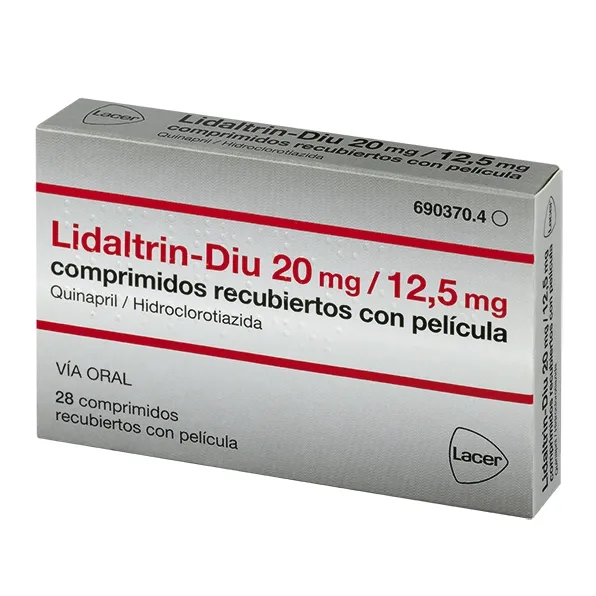
Table of Contents
Package leaflet: Information for the user
Introduction
Package leaflet: Information for the patient
Lidaltrin-Diu 20 mg/12.5 mg film-coated tablets
Quinapril / hydrochlorothiazide
Read the entire leaflet carefully before you start taking this medicine because it contains important information for you.
- Keep this leaflet as you may need to read it again.
- If you have any questions, ask your doctor or pharmacist.
- This medicine has been prescribed for you only, and you should not give it to others, even if they have the same symptoms as you, because it could harm them.
- If you experience any side effects, talk to your doctor or pharmacist, even if the side effects are not listed in this leaflet. See section 4.
Leaflet contents
-
What Lidaltrin-Diu is and what it is used for
-
What you need to know before taking Lidaltrin-Diu
-
How to take Lidaltrin-Diu
-
Possible side effects
-
How to store Lidaltrin-Diu
-
Contents of the pack and other information
1. What Lidaltrin-Diu is and what it is used for
Lidaltrin-Diu is a combination of quinapril, which belongs to a class of medicines known as angiotensin-converting enzyme (ACE) inhibitors, and hydrochlorothiazide, which belongs to a class of medicines called diuretics. Quinapril works by dilating blood vessels in the body, and hydrochlorothiazide works by eliminating water.
Lidaltrin-Diu is used to treat high blood pressure (hypertension).
2. What you need to know before taking Lidaltrin-Diu
Treatment with Lidaltrin-Diu requires periodic monitoring by your doctor.
Do not take Lidaltrin-Diu
? if you are more than 3 months pregnant (it is also advisable to avoid Lidaltrin-Diu during the first months of pregnancy – see Pregnancy section).
? if you are allergic (hypersensitive) to quinapril, hydrochlorothiazide, or any of the other components of this medicine (listed in section 6).
? if you have a history of angioedema of the head and neck (swelling of the face, eyes, lips, tongue, or difficulty breathing) or intestinal angioedema.
? if you have severe renal dysfunction (anuria, severe renal failure).
- if you have diabetes or renal impairment and are being treated with a blood pressure-lowering medicine containing aliskiren.
? if you have taken or are currently taking sacubitril/valsartan, a medicine used to treat chronic heart failure in adults, as the risk of angioedema (rapid swelling beneath the skin, e.g., in the throat) is increased.
? if you are taking any of the following medicines, the risk of developing angioedema may increase:
- Racecadotril, a medicine used to treat diarrhoea.
- Medicines used to prevent organ transplant rejection and for cancer (e.g., temsirolimus, sirolimus, everolimus).
- Vildagliptin, a medicine used to treat diabetes.
Warnings and precautions
Talk to your doctor or pharmacist before starting Lidaltrin-Diu.
? if you have liver disease.
? if you suffer from connective tissue disease (e.g., systemic lupus erythematosus), as worsening may occur.
? if you are diabetic.
? if you are scheduled for surgery, inform your doctor that you are taking Lidaltrin-Diu.
? if you are taking other medicines.
? if you are on a strict salt-free diet. Do not use salt substitutes containing potassium without consulting your doctor. Your doctor may perform periodic tests to monitor your blood electrolyte levels.
-
if you are taking any of the following medicines for high blood pressure (hypertension):
-
an angiotensin II receptor antagonist (ARA-II) (also known as “sartans” – e.g., valsartan, telmisartan, irbesartan), particularly if you have kidney problems related to diabetes
-
aliskiren
Your doctor may monitor your kidney function, blood pressure, and blood electrolyte levels (e.g., potassium) at regular intervals.
See also information under the heading “Do not take Lidaltrin-Diu”.
? if you have certain conditions (e.g., hepatic cirrhosis, electrolyte deficiency, increased diuresis, or edema) or are being treated with corticosteroids or ACTH, as disturbances in blood sodium and potassium levels may occur.
? inform your doctor if you are pregnant (or suspect you might be). Lidaltrin-Diu is not recommended during early pregnancy and must not be used after the third month of pregnancy, as it may cause serious harm to your baby when used from this stage onward (see Pregnancy section).
? if you have kidney disease, are undergoing dialysis, or have had a kidney transplant. Your doctor may perform periodic tests to check your kidney function.
? if you have a disease affecting blood vessels (vascular collagenosis) or kidney disease (renal impairment), your doctor may perform tests to assess your immune system.
- if you are taking other medicines to lower your blood pressure, as this may lead to excessive lowering of blood pressure (hypotension). Other conditions such as vomiting, diarrhoea, dehydration, or excessive sweating may also reduce blood pressure. Consult your doctor if you experience dizziness or vertigo. If dizziness occurs, lie down until the sensation passes. When getting up after lying down, do so slowly to avoid dizziness. If you faint or feel dizzy, inform your doctor.
- as with other ACE inhibitors, dry cough may occur while taking Lidaltrin-Diu. In such cases, consult your doctor. This cough usually resolves upon discontinuation of treatment.
- if you have had skin cancer or develop unexpected skin lesions during treatment. Treatment with hydrochlorothiazide, especially long-term use at high doses, may increase the risk of certain types of non-melanoma skin and lip cancer. Protect your skin from exposure to sunlight and UV radiation while taking Lidaltrin-Diu.
- if you experience vision changes or eye pain, which could be signs of fluid accumulation in the vascular layer of the eye (choroidal effusion) or increased intraocular pressure. These may occur within hours to a week after taking Lidaltrin-Diu.
- if you have previously experienced respiratory or pulmonary problems (such as lung inflammation or fluid in the lungs) after taking hydrochlorothiazide. If you develop shortness of breath or severe breathing difficulty after taking Lidaltrin-Diu, seek medical attention immediately.
Children and adolescents
The safety and efficacy of Lidaltrin-Diu in children and adolescents (under 18 years of age) have not been established.
Other medicines and Lidaltrin-Diu
Inform your doctor or pharmacist if you are taking, have recently taken, or might need to take any other medicines.
Your doctor may need to adjust your dose and/or take additional precautions:
If you are taking an angiotensin II receptor antagonist (ARA-II) or aliskiren (see also information under the headings “Do not take Lidaltrin-Diu” and “Warnings and precautions”).
If you are hospitalized or visiting another doctor, dentist, or pharmacist, inform them that you are taking Lidaltrin-Diu or any other medicine. Lidaltrin-Diu may interact with the following medicines. Do not take these medicines at the same time as Lidaltrin-Diu unless specifically prescribed by your doctor:
- lithium (a medicine used to treat depression)
- tetracyclines (antibiotics)
- diuretics (medicines that increase urine production)
- potassium supplements, or medicines or salt substitutes containing potassium
- corticosteroid-type medicines
- medicines for diabetes (insulin or oral hypoglycaemics)
- alcohol, barbiturates, and narcotics
- muscle relaxants
- non-steroidal anti-inflammatory drugs (NSAIDs)
- pressor amines-type medicines
- blood pressure-lowering medicines (antihypertensives)
- anion-exchange resins (medicines that lower cholesterol levels)
- Potassium supplements (including salt substitutes), potassium-sparing diuretics, and other medicines that may increase blood potassium levels (e.g., trimethoprim and cotrimoxazole for bacterial infections; cyclosporine, an immunosuppressant used to prevent organ transplant rejection; and heparin, a medicine used to prevent blood clots).
If you have any doubts about taking other medicines with Lidaltrin-Diu, consult your doctor.
Taking Lidaltrin-Diu with food, drinks, and alcohol
Lidaltrin-Diu can be taken with or without food.
Pregnancy, breastfeeding, and fertility
If you are pregnant, breastfeeding, think you might be pregnant, or plan to become pregnant, consult your doctor or pharmacist before using this medicine.
- Pregnancy
Your doctor will generally advise you to stop taking Lidaltrin-Diu before becoming pregnant or as soon as you know you are pregnant, and will recommend an alternative medicine. Lidaltrin-Diu is not recommended during early pregnancy and must not be used from the third month of pregnancy onward, as it may cause serious harm to your baby when used from this stage.
- Breastfeeding
Use of Lidaltrin-Diu is not recommended during this period. Your doctor may decide to prescribe a more suitable treatment if you intend to breastfeed, especially if the baby is a newborn or premature.
Use in athletes
Athletes should be aware that this medicine contains a substance that may lead to a positive analytical finding in doping controls.
Driving and using machines
Lidaltrin-Diu may cause a sudden drop in blood pressure, leading to dizziness and, in some cases, fainting. This may occur during the first days of treatment. Therefore, special caution is required when performing tasks such as driving or operating dangerous machinery.
Lidaltrin-Diu contains lactose
This medicine contains lactose. If your doctor has informed you that you have an intolerance to certain sugars, consult them before taking this medicine.
3. How to take Lidaltrin-Diu
Follow exactly the administration instructions for this medicine as given by your doctor or pharmacist. If in doubt, consult your doctor or pharmacist again.
Your doctor will determine the most appropriate dose of this medicine for you.
Do not take more tablets than specified by your doctor. Depending on individual response and patient conditions, your doctor may adjust the dose of Lidaltrin-Diu. Always follow your doctor's instructions regarding dose and method of use.
Lidaltrin-Diu is administered orally. Your doctor will indicate how many tablets you should take each day.
Swallow the tablets with a sufficient amount of liquid (for example, a glass of water).
Follow these instructions unless your doctor has given you different advice. Remember to take your medicine.
Your doctor will determine how long your treatment with Lidaltrin-Diu should last. Do not stop treatment prematurely, as this may be harmful to your health.
If you feel that the effect of this medicine is too strong or too weak, consult your doctor or pharmacist.
If you take more Lidaltrin-Diu than you should
Contact your doctor or pharmacist immediately.
An overdose of Lidaltrin-Diu may cause a drop in blood pressure. In this case, sit down with your head lowered.
In case of overdose or accidental ingestion, contact the Toxicology Information Service. Telephone 915 62 04 20, indicating the medicine and the amount taken.
If you forget to take Lidaltrin-Diu
Do not take a double dose to make up for missed doses.
If you stop taking Lidaltrin-Diu
If you have any further questions about the use of this medicine, ask your doctor or pharmacist.
4. Possible adverse effects
Like all medicines, Lidaltrin-Diu may produce adverse effects, although not everyone will experience them. Adverse reactions are usually transient and mild.
The following adverse effects have been observed:
-
Frequent (may affect up to 1 in 10 people):
- headache
- dizziness
- vertigo
- inflammation of the nasal mucosa (rhinitis)
- cough
- fatigue
- nausea and/or vomiting
- muscle pain (myalgia)
- viral infection
- upper respiratory tract infection
- diarrhea
- chest pain
- abdominal pain
- digestive disorder (dyspepsia)
- back pain
- inflammation of the pharynx (pharyngitis)
- inflammation of the bronchi (bronchitis)
- weakness (asthenia)
- dilation of blood vessels (vasodilation)
- difficulty falling asleep (insomnia)
- somnolence
- decreased sodium concentrations in blood
-
Uncommon (may affect up to 1 in 100 people):
- allergic reaction (anaphylactoid reaction)
- abnormal increased reactivity to sunlight (photosensitivity)
- palpitations
- low blood pressure (hypotension)
- increased heart rate (tachycardia)
- decrease in blood pressure upon standing (postural hypotension)
- syncope
- flatulence
- dry mouth or throat
- inflammation of the liver (hepatitis)
- inflammation of the pancreas (pancreatitis)
- decrease in platelet count (thrombocytopenia)
- inflammation of the sinuses (sinusitis)
- difficulty breathing (dyspnea)
- nervousness
- tingling (paresthesia)
- hair loss (alopecia)
- skin disorders (exfoliative dermatitis, erythema multiforme, Stevens-Johnson syndrome, pemphigus, pruritus, rash)
- urinary tract infections
- impotence
- excessive fluid accumulation in the body (edema)
- joint pain (arthralgia)
- reduced lifespan of red blood cells (hemolytic anemia)
-
Very rare (may affect up to 1 in 10,000 people):
- Acute breathing difficulty (symptoms include severe shortness of breath, fever, weakness, and confusion)
-
Frequency not known (cannot be estimated from available data):
- Skin and lip cancer (non-melanoma skin cancer)
- Decreased vision or eye pain due to elevated pressure [possible signs of fluid accumulation in the vascular layer of the eye (choroidal effusion) or acute angle-closure glaucoma]
- Dark urine, nausea, vomiting, muscle cramps, confusion, and seizures. These may be symptoms of a condition called SIADH (syndrome of inappropriate antidiuretic hormone secretion)
- Psoriasis or worsening of existing psoriasis (a skin disease characterized by red patches covered with silvery scales)
-
Laboratory findings:
- alterations in serum electrolytes
- blood abnormalities (agranulocytosis, leukopenia)
- abnormalities in various laboratory tests
These possible adverse effects may disappear during treatment. However, if they persist or become bothersome, inform your doctor, nurse, or pharmacist.
Other adverse effects may also occur in some patients. If you notice any adverse reaction not described above, consult your doctor or pharmacist.
Reporting of adverse effects
If you experience any type of adverse effect, consult your doctor or pharmacist, even if it is a possible adverse effect not listed in this leaflet. You may also report them directly via the Spanish Pharmacovigilance System for Human Medicines: https://www.notificaram.es
By reporting adverse effects, you can help provide more information on the safety of this medicine.
5. Storage of Lidaltrin-Diu
Keep this medicine out of the sight and reach of children.
Do not store above 30°C. Store protected from light and moisture.
Do not use Lidaltrin-Diu after the expiry date stated on the packaging after "EXP". The expiry date refers to the last day of the month indicated.
Medicines must not be disposed of via wastewater or household waste. Unused medicines and their containers should be returned to the SIGRE collection point at your pharmacy. If you are unsure, ask your pharmacist how to properly dispose of any unused medicines and their packaging. This will help protect the environment.
6. Contents of the pack and other information
Composition of Lidaltrin-Diu
The active substances are quinapril (hydrochloride) and hydrochlorothiazide. Each tablet contains 20 mg of quinapril (as hydrochloride) and 12.5 mg of hydrochlorothiazide.
The other components (excipients) are lactose monohydrate, crospovidone, heavy magnesium carbonate (E504), magnesium stearate (E572), povidone (E1201), hypromellose (E464), hydroxypropylcellulose (E463), macrogol 400, iron oxide red (E172), iron oxide yellow (E172), titanium dioxide (E171) and candelilla wax (E902).
Appearance of the product and contents of the pack
Lidaltrin-Diu film-coated tablets are pink, triangular, biconvex and scored. Each pack contains 28 tablets.
Marketing Authorization Holder and Manufacturer
LACER, S.A. - Boters, 5
08290 Cerdanyola del Vallès
Barcelona – Spain
Date of the most recent review of this leaflet: March 2022
Detailed and up-to-date information on this medicinal product is available on the website of the Spanish Agency for Medicines and Health Products (AEMPS) https://www.aemps.gob.es/