Lexxema 1 mg/g ointment
Spain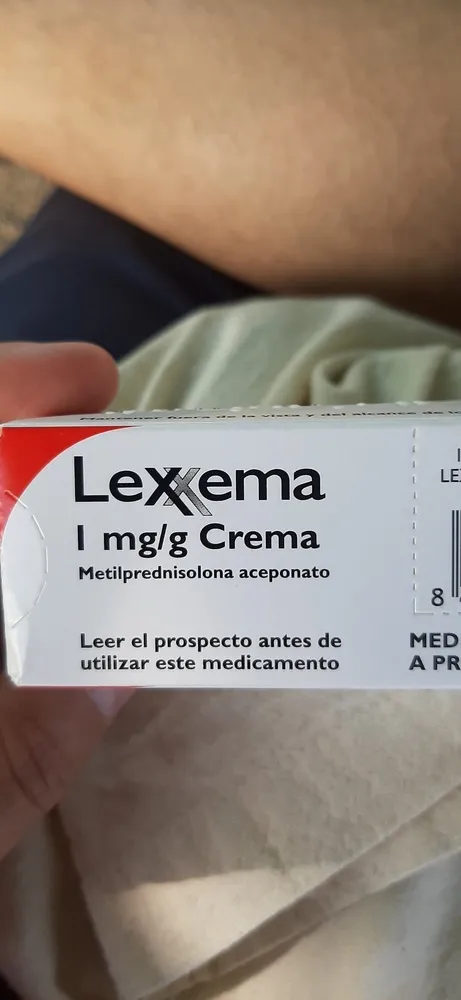
Table of Contents
- Package leaflet: Information for the user
- Introduction
- 1. What Lexxema ointment is and what it is used for
- 2. What you need to know before using Lexxema ointment
- 3. How to use Lexxema ointment
- 4. Possible adverse effects
- 5. Storage of Lexxema ointment
- 6. Contents of the container and additional information
- **-*The active substance is Methylprednisolone aceponate (MPA). Each g of ointment contains 1 mg of methylprednisolone aceponate (0.1%).***
- ***Appearance of the product and contents of the container***
Package leaflet: Information for the user
Introduction
Package leaflet: information for the user
Lexxema 1 mg/g ointment
Methylprednisolone aceponate
Read all of this leaflet carefully before you start using this medicine, because it contains important information for you.
- Keep this leaflet; you may need to read it again.
- If you have any questions, ask your doctor or pharmacist.
- This medicine has been prescribed for you only, and you should not give it to other people, even if they have the same symptoms as you, because it could harm them.
- If you experience any adverse reactions, consult your doctor or pharmacist, even if such reactions are not listed in this leaflet. See section 4.
Contents of this leaflet
-
What Lexxema ointment is and what it is used for
-
What you need to know before using Lexxema ointment
-
How to use Lexxema ointment
-
Possible side effects
-
How to store Lexxema ointment
-
Contents of the pack and other information
1. What Lexxema ointment is and what it is used for
It is an anti-inflammatory medicine (a corticosteroid) for use on the skin.
Lexxema ointment reduces inflammation and allergic reactions of the skin, as well as reactions associated with excessive multiplication of skin cells (hyperproliferation). Therefore, it reduces redness (erythema), fluid accumulation (edema), and exudate in inflamed skin. It also relieves itching, burning, or pain.
Lexxema ointment is used in the treatment of:
- Mild to moderate acute eczema related to an external cause, such as:
- Allergy to a substance that has come into contact with the skin (allergic contact dermatitis).
- Allergic reaction to commonly used substances such as, for example, soap (irritant contact dermatitis).
- Coin-shaped rash (nummular eczema).
- Itchy rash on hands and feet (dyshidrotic eczema).
- Unspecified eczema (vulgar eczema).
- Eczema related to patient factors (endogenous eczema), such as atopic dermatitis or neurodermatitis.
- Skin rash with inflammation and scaling (seborrheic eczema).
This ointment form is particularly indicated for very dry conditions.
2. What you need to know before using Lexxema ointment
Do not use Lexxema ointment
- If you are allergic to methylprednisolone aceponate (MPA) or to any of the other components of this medicine (listed in section 6).
- If you have tuberculosis, syphilis, or viral infections (for example, chickenpox or herpes).
- If you have rosacea (a condition causing red/pink skin inflammation), ulcers, acne, or skin diseases with thinning of the skin (atrophy).
- On areas of skin showing a vaccine reaction, such as redness or inflammation after vaccination.
- In specific skin inflammation around the upper lip and chin (perioral dermatitis).
- In case of bacterial or fungal infections; see section “Warnings and precautions”.
- Must not be used in the eyes or on deep open wounds.
- Children under four months of age, due to lack of experience.
Warnings and precautions
Consult your doctor or pharmacist before starting to use Lexxema ointment.
If your doctor also diagnoses a bacterial or fungal infection, you must use the additional prescribed treatment for the infection, because otherwise the infection may worsen.
Contact your doctor if you experience blurred vision or other visual disturbances.
Anti-inflammatory drugs (corticosteroids), such as the active substance (MPA) in Lexxema**, have significant effects on the body. Use of** Lexxema on large areas of skin or for prolonged periods is not recommended, as this significantly increases the risk of adverse effects.
To reduce the risk of adverse effects:
- Use the lowest possible dose, especially in children.
- Use only for the minimum time necessary to relieve the skin condition.
- Lexxema ointment must not come into contact with the eyes, mouth, open wounds, or mucous membranes (e.g., anal or genital areas).
- Must not be used in skin folds, groin, or armpits.
- Must not be used under airtight and waterproof materials, including dressings (unless directed by your doctor), bandages, clothing, or non-breathable diapers.
If Lexxema is used for conditions other than those for which it was prescribed, it may mask symptoms and make correct diagnosis and treatment more difficult.
If Lexxema ointment is applied to the anal or genital area, some of its ingredients may damage latex products such as condoms or diaphragms. Therefore, these products may no longer be effective as contraceptives or for protection against sexually transmitted infections, such as HIV infection. Contact your doctor or pharmacist if you need further information.
Children
It is important to note that diapers may be occlusive. If your doctor has previously assessed the benefits and risks, Lexxema ointment may be prescribed for use in children between 4 months and 3 years of age.
Other medicines and Lexxema ointment
Inform your doctor or pharmacist if you are taking, have recently taken, or might need to take any other medicines.
No interactions between Lexxema ointment and other medicines are currently known.
Pregnancy, breastfeeding, and fertility
If you are pregnant or breastfeeding, think you may be pregnant, or are planning to become pregnant, consult your doctor or pharmacist before using this medicine.
To avoid any risk to the child, you must not use Lexxema ointment during pregnancy or breastfeeding unless instructed by your doctor.
If your doctor recommends using Lexxema ointment during breastfeeding, do not apply the medicine to the breasts and avoid contact of the infant with treated areas.
Driving and using machines
Lexxema ointment does not affect your ability to drive or operate machinery.
3. How to use Lexxema ointment
Follow exactly the instructions for use of this medicine as given by your doctor. If in doubt, consult your doctor or pharmacist again.
Unless otherwise directed by your doctor, the recommended dose is:
Cutaneous use
- Apply Lexxema ointment in a thin layer, once daily, to the affected area, gently rubbing it in.
- In general, the duration of treatment should not exceed 12 weeks. Always keep the treatment as short as possible.
- Intermittent treatment is recommended when prolonged treatment is required.
- If you are using Lexxema for a skin rash with inflammation and scaling (seborrheic eczema) on the face, do not treat the affected areas for longer than one week.
Use in children
Lexxema ointment must not be used in children under four months of age due to lack of safety data.
The duration of treatment in children should be kept to a minimum and, in general, should not exceed 4 weeks.
If you use more Lexxema ointment than you should
Acute intoxication is not expected following a single cutaneous overdose (application over a large area, under conditions favorable for absorption) or after accidental ingestion.
In case of overdose or accidental ingestion, immediately consult your doctor or pharmacist, go to a medical center, or call the Toxicology Information Service at telephone (91) 562 04 20 (indicating the medicine and the amount ingested).
If you forget to use Lexxema ointment
Do not use a double dose to make up for forgotten doses. If you have missed a dose, continue with your usual schedule as instructed by your doctor or as described in this leaflet.
If you stop using Lexxema ointment
If you stop treatment prematurely, the original symptoms of your skin condition may reappear. Please contact your doctor before stopping treatment with Lexxema ointment.
If you have any further questions about the use of this medicine, ask your doctor or pharmacist.
4. Possible adverse effects
Like all medicines, this medicine can cause adverse effects, although not everyone will experience them.
The assessment of adverse effects is based on the following frequency categories:
Very common: may affect more than 1 in 10 people
Common: may affect up to 1 in 10 people
Uncommon: may affect up to 1 in 100 people
Rare: may affect up to 1 in 1,000 people
Very rare: may affect up to 1 in 10,000 people
Frequency not known (cannot be estimated from the available data)
-
Common:
Burning sensation at the application site and inflammation of hair follicles (folliculitis). -
Uncommon:
Dilated small blood vessels in the skin (telangiectasia), skin cracks, itching, pain, vesicles (blisters), pustules (acne-like pimples), and papules (small bumps) at the application site. -
Frequency not known:
Hypersensitivity to the active substance
Acne, thinning of the skin (atrophy), stretch marks on the skin, specific skin inflammation around the upper lip and chin (perioral dermatitis), skin discoloration, and skin allergic reactions.
Excessive hair growth (hypertrichosis)
Blurred vision.
Adverse effects may occur not only in the treated area but also in completely different areas of the body. This may happen if the active substance (a corticosteroid) passes into the body through the skin. For example, this could increase eye pressure (glaucoma).
Reporting of adverse effects
If you experience any type of adverse effect, consult your doctor or pharmacist, even if it is a possible adverse effect not listed in this leaflet. You may also report them directly via the Spanish Pharmacovigilance System for Human Medicines: www.notificaram.es.
By reporting adverse effects, you can help provide more information on the safety of this medicine.
5. Storage of Lexxema ointment
.
Keep this medicine out of the sight and reach of children.
Do not store above 30°C.
Do not use this medicine after the expiry date stated on the packaging after EXP. The expiry date refers to the last day of the month indicated.
Medicines must not be disposed of via wastewater or household waste. Dispose of unused medicines and their containers at the SIGRE collection point at your pharmacy. If in doubt, ask your pharmacist how to dispose of medicines and containers you no longer need. This will help protect the environment.
6. Contents of the container and additional information
Composition of Lexxema ointment
-The active substance is Methylprednisolone aceponate (MPA). Each g of ointment contains 1 mg of methylprednisolone aceponate (0.1%).
- The other components (excipients) are: white paraffin (semisolid), liquid paraffin, microcrystalline wax, hydrogenated castor oil.
Appearance of the product and contents of the container
Lexxema ointment is a translucent, whitish to slightly yellowish ointment, available in tubes of 30 and 60 g.
Not all pack sizes may be marketed.
Marketing Authorization Holder and Manufacturer
Marketing Authorization Holder:
ITALFARMACO S.A.
San Rafael 3, 28108-Alcobendas (Madrid)
Tel. 916572323
Manufacturer:
LEO Pharma Manufacturing Italy S.r.l.
Via E. Schering, 21
20054 Segrate (Milan) - Italy
Date of the most recent review of this leaflet: August 2021
Detailed information on this medicinal product is available on the website of the Spanish Agency for Medicines and Health Products (AEMPS) http://www.aemps.gob.es/