Levocetirizine Stada 5 mg film-coated tablets EFG
Spain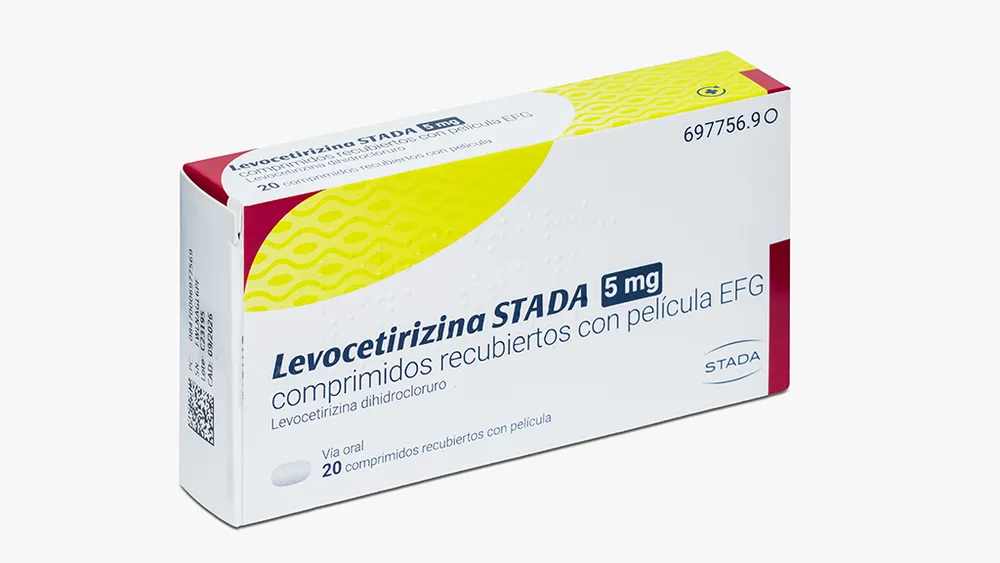
Table of Contents
- Package leaflet: Information for the user
- Introduction
- 1. What Levocetirizina Stada is and what it is used for
- 2. What you need to know before taking Levocetirizina Stada
- 3. How to take Levocetirizine Stada
- 4. Possible adverse effects
- 5. Storage of Levocetirizine Stada
- 6. Contents of the pack and other information
Package leaflet: Information for the user
Introduction
 Package leaflet: Information for the user
Levocetirizine STADA 5 mg film-coated tablets EFG
Levocetirizine dihydrochloride
Read this entire leaflet carefully before you start taking this medicine, because it contains important information for you.
- Keep this leaflet, as you may need to read it again.
- If you have any questions, ask your doctor or pharmacist.
- This medicine has been prescribed for you only, and you should not give it to others, even if they have the same symptoms as you. It could harm them.
- If you experience any adverse effects, consult your doctor or pharmacist, even if they are effects not listed in this leaflet. See section 4.
Contents of the leaflet
-
What Levocetirizine STADA is and what it is used for
-
What you need to know before taking Levocetirizine STADA
-
How to take Levocetirizine STADA
-
Possible side effects
-
How to store Levocetirizine STADA
-
Contents of the pack and other information
1. What Levocetirizina Stada is and what it is used for
The active substance of Levocetirizina Stada is levocetirizine dihydrochloride.
Levocetirizine dihydrochloride is an antiallergic medicinal product.
For the treatment of disease signs (symptoms) associated with:
- Allergic rhinitis (including persistent allergic rhinitis);
- Urticaria.
2. What you need to know before taking Levocetirizina Stada
DO NOT take Levocetirizina Stada:
- if you are allergic to levocetirizine dihydrochloride, cetirizine, hydroxyzine, or any of the other components of this medicine (listed in section 6).
- if you have severe impairment of kidney function (severe renal insufficiency with a creatinine clearance less than 10 ml/min.).
Warnings and precautions
Talk to your doctor or pharmacist before starting to take Levocetirizina Stada.
If you have any condition that impairs your ability to empty your urinary bladder (such as spinal cord damage or enlarged prostate), please inform your doctor.
If you have epilepsy or are at risk of seizures, please consult your doctor, as the use of levocetirizine dihydrochloride may worsen seizures.
If you are scheduled to undergo any allergy testing, ask your doctor whether you need to stop treatment with levocetirizine dihydrochloride several days in advance. This medicine may affect the results of allergy testing.
Children
The use of Levocetirizina Stada is not recommended in children under 6 years of age, as the film-coated tablets do not allow for dose adjustment.
 Other medicines and Levocetirizina Stada
Inform your doctor or pharmacist if you are taking, have recently taken, or might need to take any other medicines.
Taking Levocetirizina Stada with food, drinks, and alcohol
Caution is advised when taking this medicine together with alcohol or other agents acting on the central nervous system.
In sensitive patients, taking levocetirizine together with alcohol or other central nervous system agents may cause additional reduction in attention capacity and performance.
Pregnancy, breastfeeding, and fertility
If you are pregnant or breastfeeding, think you may be pregnant, or are planning to have a baby, consult your doctor or pharmacist before taking this medicine.
Driving and using machines
Some patients treated with levocetirizine dihydrochloride may experience drowsiness or fatigue, tiredness, and exhaustion. If you intend to drive, perform potentially hazardous activities, or operate machinery, you are advised to wait and observe your response to the medication. However, in special studies conducted in healthy individuals, no impairments in attention, reaction ability, or driving skills were detected after taking levocetirizine at the recommended dose.
Levocetirizina Stada contains lactose
This medicine contains lactose. If your doctor has informed you that you have an intolerance to certain sugars, consult with him before taking this medicine.
3. How to take Levocetirizine Stada
Follow exactly the administration instructions for this medicine as indicated by your doctor or pharmacist. If in doubt, consult your doctor or pharmacist again.
Dosage:
The usual dose for adults and children aged 6 years and older is one tablet daily.
Special dosage instructions for specific populations:
Patients with renal impairment should receive a reduced dose according to the severity of their kidney disease. In children, the dose will depend on body weight; your doctor will determine the appropriate dose.
Patients with severe renal impairment must not take this medicine.
Patients with hepatic impairment alone should take the standard prescribed dose.
Patients with both hepatic and renal impairment should take a reduced dose based on the severity of their kidney disease. In children, the dose will depend on body weight; your doctor will determine the appropriate dose.
Dose adjustment is not necessary in elderly patients, provided their renal function is normal.
Use in children
The use of Levocetirizine Stada is not recommended in children under 6 years of age.
 How and when should you take Levocetirizine Stada?
The tablets should be swallowed whole with water and may be taken either on an empty stomach or with food.
How long should your treatment with Levocetirizine Stada last?
The duration of treatment depends on the type, severity, and course of symptoms, and should be determined by your doctor.
If you take more Levocetirizine Stada than you should
If you take more levocetirizine dihydrochloride than prescribed, it may cause drowsiness in adults. In children, it may initially cause agitation and restlessness, followed by drowsiness.
In case of overdose or accidental ingestion, contact your doctor or pharmacist immediately or call the Toxicology Information Service at 915 620 420, indicating the medicine and the amount ingested.
If you forget to take Levocetirizine Stada
If you forget to take levocetirizine dihydrochloride, or if you take a lower dose than prescribed by your doctor, do not take a double dose to make up for the missed dose. Simply wait until the next scheduled dose and take the normal prescribed dose.
If you stop taking Levocetirizine Stada
Stopping treatment should not cause harmful effects. However, itching (intense pruritus) may rarely occur when stopping levocetirizine dihydrochloride, even if these symptoms were not present at the beginning of treatment. Symptoms may resolve spontaneously. In some cases, symptoms may be severe and require restarting treatment. Symptoms usually resolve when treatment is resumed.
If you have any further questions about the use of this medicine, ask your doctor or pharmacist.
4. Possible adverse effects
Like all medicines, this medicine can cause adverse effects, although not everyone will experience them.
Common: may affect up to 1 in 10 people
Dry mouth, headache, fatigue, drowsiness/sleepiness
Uncommon: may affect up to 1 in 100 people
Exhaustion and abdominal pain
Frequency not known: frequency cannot be estimated from the available data
Other adverse effects that have also been reported include palpitations, increased heart rate, seizures, tingling, dizziness, fainting, tremor, dysgeusia (altered sense of taste), sensation of movement, including spinning sensation, visual disturbances, blurred vision, pain or difficulty urinating, inability to urinate, edema, pruritus (itching), rash, urticaria (swelling, redness, and itching of the skin), skin rash, shortness of breath, weight gain, muscle pain, joint pain, aggressive or agitated behavior, hallucinations, depression, insomnia, recurrent worrying thoughts with suicidal ideation, nightmares, hepatitis, abnormal liver function, vomiting, increased appetite, nausea, diarrhea, and oculogyric crisis (uncontrollable circular eye movements). Pruritus (intense itching) upon discontinuation of treatment.
At the first signs of hypersensitivity reaction, stop taking levocetirizine dihydrochloride and see your doctor immediately. Symptoms of hypersensitivity reaction may include: swelling of the mouth, tongue, face and/or throat, difficulty breathing or swallowing (chest tightness or wheezing), urticaria (skin rash), sudden drop in blood pressure which may lead to collapse or shock, any of which may be fatal.
 Reporting of adverse effects
If you experience any type of adverse effect, consult your doctor or pharmacist, even if it is a possible adverse effect not listed in this leaflet. You may also report them through the Spanish Pharmacovigilance System for Human Medicinal Products: https:/www.notificaram.es. By reporting adverse effects, you can help provide more information on the safety of this medicine.
5. Storage of Levocetirizine Stada
Keep this medicine out of the sight and reach of children.
Do not use this medicine after the expiry date stated on the packaging after EXP. The first two digits indicate the month and the last four digits indicate the year. The expiry date refers to the last day of the indicated month.
Store in the original packaging to protect from moisture.
Medicines must not be disposed of via wastewater drains or household waste. Dispose of unused containers and medicines at the SIGRE collection point at your pharmacy. Ask your pharmacist how to dispose of containers and medicines you no longer need. This will help protect the environment.
6. Contents of the pack and other information
Composition of Levocetirizine Stada
- The active substance is levocetirizine. Levocetirizine is present in the form of levocetirizine dihydrochloride (5 mg), equivalent to 4.2 mg of levocetirizine.
- The other components are microcrystalline cellulose, lactose monohydrate, magnesium stearate (core), and hypromellose (E464), titanium dioxide (E171), and macrogol 400 (coating).
Appearance of the product and contents of the pack
The film-coated tablets are white or almost white, oval, biconvex, with the mark “L9CZ” engraved on one side and “5” on the other side.
They are packaged in blisters containing 7, 10, 14, 20, 21, 28, 30, 90 and 100 tablets per pack, and unit-dose blisters containing 30 x 1 tablet.
Only certain pack sizes may be marketed.
Marketing Authorization Holder and Manufacturer
Holder:
Laboratorio STADA, S.L.
Frederic Mompou, 5
08960 Sant Just Desvern (Barcelona)
Spain
 Manufacturer:
Synthon BV
Microweg 22,
6545 Nijmegen
The Netherlands
or
Synthon Hispania SL
Castelló 1, Polígono Las Salinas,
08830 Sant Boi de Llobregat
Spain
or
STADA Arzneimittel AG
Stadastrasse 2 - 18
61118 Bad Vilbel
Germany
or
LAMP SAN PROSPERO S.p.A.
Via della Pace, 25/A
41030 San Prospero (Modena)
Italy
or
STADA Arzneimittel GmbH
Muthgasse 36
A-1190 - Wien
Austria
This medicinal product is authorized in the Member States of the European Economic Area under the following names:
Austria | Levocetirizine STADA 5 mg film-coated tablets |
Denmark | Levocetirizine STADA 5 mg, film-coated tablets |
Finland | Levocetirizine STADA 5 mg, film-coated tablets |
Portugal | Levocetirizine Ciclum 5 mg, tablets |
Spain | Levocetirizine STADA 5 mg, film-coated tablets EFG |
Date of the most recent review of this leaflet: September 2018
Detailed and up-to-date information on this medicinal product is available on the website of the Spanish Agency for Medicines and Medical Devices (AEMPS) http://www.aemps.gob.es/