Levobupivacaine Kabi 2.5 mg/ml solution for injection and infusion EFG
Spain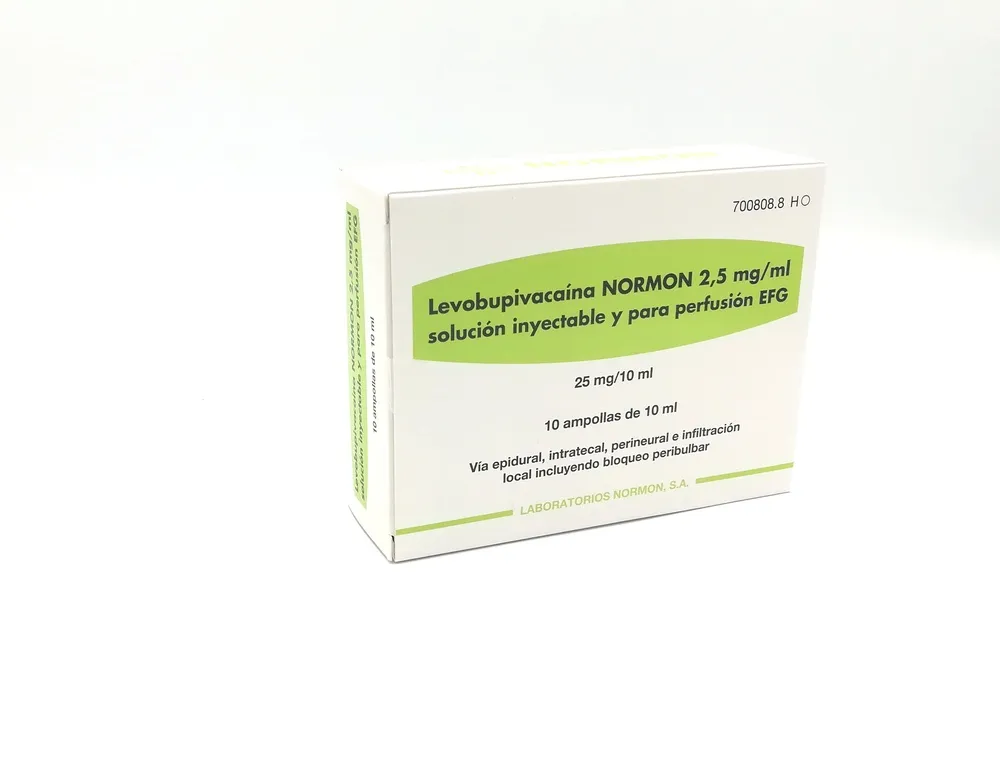
Table of Contents
- Package leaflet: Information for the user
- Introduction
- 1. What Levobupivacaine Kabi is and what it is used for
- 2. What you need to know before being given Levobupivacaine Kabi
- 3. How Levobupivacaine Kabi will be administered to you
- 4. Possible adverse effects
- 5. Storage of Levobupivacaine Kabi
- 6. Contents of the pack and other information
Package leaflet: Information for the user
Introduction
Package leaflet: Information for the user
Levobupivacaine Kabi 2.5 mg/ml solution for injection and infusion EFG
levobupivacaine hydrochloride
Read the entire leaflet carefully before you start using this medicine, because it contains important information for you.
- Keep this leaflet, as you may need to read it again.
- If you have any questions, consult your doctor or nurse.
- If you experience any adverse reactions, consult your doctor or nurse, even if they are adverse reactions not listed in this leaflet. See section 4.
Leaflet contents:
- What Levobupivacaine Kabi is and what it is used for
- What you need to know before you are given Levobupivacaine Kabi
- How Levobupivacaine Kabi will be administered to you
- Possible side effects
- How to store Levobupivacaine Kabi
- Contents of the pack and other information
1. What Levobupivacaine Kabi is and what it is used for
Levobupivacaine Kabi belongs to a group of medicines called local anaesthetics. This type of medicine is used to numb parts of the body or to relieve pain.
In adults and adolescents over 12 years of age:
Levobupivacaine Kabi is used as a local anaesthetic to numb parts of the body before major surgery (for example, as an epidural in caesarean sections) and minor surgery (such as in the eye or mouth).
It is also used for pain relief
- after major surgery
- during childbirth
In children (under 12 years of age):
Levobupivacaine Kabi may also be used in children under 12 years of age to numb parts of the body before surgery and for pain relief after minor surgery, such as inguinal hernia repair.
Levobupivacaine Kabi has not been studied in children under 6 months of age.
2. What you need to know before being given Levobupivacaine Kabi
Do not use Levobupivacaine Kabi:
- if you are allergic (hypersensitive) to levobupivacaine, to any other similar local anaesthetic, or to any of the other ingredients of this medicine (listed in section 6).
- if you have very low blood pressure.
- to anaesthetize a part of the body by injecting Levobupivacaine Kabi intravenously.
- to relieve pain by administration via injection around the cervix during early labour (paracervical block).
Warnings and precautions
Tell your doctor before you are given Levobupivacaine Kabi if you have any of the following conditions or diseases. You may require closer monitoring or a lower dose.
- if you have any heart disease
- if you suffer from a nervous system disorder
- if you are weak or ill
- if you are elderly
- if you have liver disease.
Use of Levobupivacaine Kabi with other medicines
Tell your doctor or nurse if you are taking, have recently taken, or might need to take any other medicines. In particular, inform them if you are taking medicines for:
- irregular heartbeat (such as mexiletine)
- fungal infections (such as ketoconazole), as they may affect the metabolism of Levobupivacaine Kabi.
- asthma (such as theophylline), as they may affect how long Levobupivacaine Kabi remains in your body.
Pregnancy and breastfeeding
If you are pregnant or breastfeeding, think you may be pregnant, or are planning to become pregnant, consult your doctor before using this medicine.
Levobupivacaine Kabi must not be administered to relieve pain by injection around the cervix during labour (known as paracervical block).
The effects of Levobupivacaine Kabi on the fetus during early pregnancy are unknown. Therefore, Levobupivacaine Kabi should not be used during the first three months of pregnancy unless your doctor considers it necessary.
It is not known whether levobupivacaine passes into breast milk. However, based on experience with similar drugs, it is expected that only small amounts of levobupivacaine pass into breast milk. Breastfeeding is therefore possible after the use of a local anaesthetic.
Driving and using machines
The use of Levobupivacaine Kabi may have a considerable effect on the ability to drive and use machines. You should not drive or operate machinery until all effects of Levobupivacaine Kabi and the effects of surgery have worn off. Before leaving the hospital, consult your doctor or nurse whether you are allowed to drive or use machines.
Levobupivacaine Kabi contains sodium
This medicine contains 3.6 mg of sodium (main component of table/cooking salt) per ml. This corresponds to 0.18% of the maximum daily recommended intake of sodium for an adult.
3. How Levobupivacaine Kabi will be administered to you
Your doctor will administer Levobupivacaine Kabi by injection through a needle or through a small tube inserted into your back (epidural). Levobupivacaine Kabi may also be injected into other parts of the body to anesthetize the area to be treated, such as the eye, arm, or leg.
Your doctor and nurse will carefully monitor you while Levobupivacaine Kabi is being administered.
Dosage
The amount of Levobupivacaine Kabi you will receive and how often it will be given depends on the intended use and your physical condition, age, and weight. You will be given the lowest dose that achieves anesthesia in the required area. The dose will be carefully calculated by your doctor.
When Levobupivacaine Kabi is used to relieve labor pain or for cesarean delivery (via epidural), the administered dose will be carefully controlled.
If you are given more Levobupivacaine Kabi than you should
If you are given more Levobupivacaine Kabi than you should, you may experience numbness of the tongue, dizziness, blurred vision, muscle twitching, severe difficulty breathing (including respiratory arrest), and even seizures. If you notice any of these symptoms, inform your doctor immediately. In some cases, administration of an excessive amount of Levobupivacaine Kabi may also cause hypotension, bradycardia or tachycardia, and changes in your heart rhythm. Your doctor may administer other medications to help manage these symptoms.
If you have any further questions about the use of this medicine, ask your doctor or nurse.
4. Possible adverse effects
Like all medicines, this medicine can cause adverse effects, although not everyone will experience them.
Immediately inform your doctor or nurse if you think you are experiencing any of the adverse effects listed below. Some of the adverse effects of Levobupivacaine Kabi may be serious.
Very common (may affect more than 1 in 10 people):
- feeling tired or weak, difficulty breathing, paleness (these are all signs of anaemia)
- low blood pressure
- nausea
Common (may affect up to 1 in 10 people):
- dizziness
- headache
- vomiting
- fetal distress
- back pain
- fever
- postoperative pain
Frequency not known (frequency cannot be estimated from the available data):
- severe allergic reactions (hypersensitivity) causing severe breathing difficulties, difficulty swallowing, hives, and very low blood pressure
- allergic reactions (hypersensitivity) characterized by red, irritated skin, sneezing, excessive sweating, increased heart rate, fainting, or swelling of the face, lips, mouth, tongue or throat
- loss of consciousness
- somnolence
- blurred vision
- respiratory arrest
- cardiac block or cardiac arrest
- localized tingling
- numb tongue
- muscle weakness or tremors
- loss of control over urine and faeces
- paralysis
- seizures
- tingling, numbness or other unusual sensations
- prolonged penile erection, which may be painful
- neurological disorders which may include drooping eyelids, small pupils (black centre of the eye), sunken eye socket, sweating and/or redness on one side of the face.
Bradycardia, tachycardia, and changes in heart rhythm that may have been observed on an ECG (electrocardiogram) have also been reported as adverse effects.
In very rare cases, some adverse effects may occur long-term or become permanent.
Reporting of adverse effects
If you experience any type of adverse effect, consult your doctor or nurse, even if it is a possible adverse effect not listed in this leaflet. You may also report them directly via the Spanish Pharmacovigilance System for Human Medicinal Products: https://www.notificaram.es. By reporting adverse effects, you can help provide more information on the safety of this medicine.
5. Storage of Levobupivacaine Kabi
Keep this medicine out of the sight and reach of children.
Do not use this medicine after the expiry date stated on the packaging after EXP. The expiry date is the last day of the month indicated.
Your doctor will store this medicine for you.
The solution should be used immediately after opening.
Do not use this medicine if you notice particles in the solution.
Medicines should not be disposed of via wastewater or household waste. Ask your pharmacist how to dispose of unused medicines and their containers. This will help protect the environment.
6. Contents of the pack and other information
Composition of Levobupivacaine Kabi
- The active substance is levobupivacaine (as hydrochloride)
Levobupivacaine Kabi 2.5 mg/ml solution for injection and for infusion: 1 ml of solution contains 2.5 mg of levobupivacaine (as levobupivacaine hydrochloride). Each 10 ml ampoule contains 25 mg of levobupivacaine as levobupivacaine hydrochloride.
- The other components are water for injections, sodium chloride, and small amounts of sodium hydroxide and hydrochloric acid.
This medicinal product contains an excipient with a known effect (sodium). See section 2 for further information.
pH: 4.0 – 6.0
Osmolality: 271 – 372 mOsmol/l
Appearance of the product and contents of the pack
This medicinal product is a clear, colourless solution in polypropylene ampoules contained in sterile blister packs. Each ampoule contains 10 ml of solution. It is supplied in packs of 5, 10 or 20 ampoules.
Some pack sizes may not be marketed.
Marketing Authorisation Holder and Manufacturer
Marketing Authorisation Holder:
Fresenius Kabi España S.A.U
C/ Marina 16-18,
08005-BARCELONA
Spain
Manufacturer:
HP Halden Pharma AS
Svinesundsveien 80
1788 Halden
Norway
This medicinal product is authorised in the European Economic Area member states under the following names:
Member State | Medicinal Product Name |
Belgium | Levobupivacaïne Fresenius Kabi 2.5 mg/ml solution for injection/infusion |
France | Levobupivacaïne Kabi 2.5 mg/ml, solution for injection/perfusion |
Ireland | Levobupivacaine 2.5 mg/ml solution for injection or infusion |
Italy | Levobupivacaina Kabi |
Netherlands | Levobupivacaïne Fresenius Kabi 2.5 mg/ml oplossing voor injectie/infusie |
Portugal | Levobupivacaína Kabi |
Slovenia | Levobupivakain Kabi 2.5 mg/ml raztopina za injiciranje/infundiranje |
Spain | Levobupivacaína Kabi 2.5 mg/ml solución inyectable y para perfusión |
United Kingdom | Levobupivacaine 2.5 mg/ml solution for injection/infusion |
Date of the most recent review of this summary: October 2018
Detailed and up-to-date information on this medicine is available on the website of the Spanish Agency of Medicines and Medical Devices (AEMPS) http://www.aemps.gob.es/
This information is intended solely for healthcare professionals:
Levobupivacaine Kabi 2.5 mg/ml solution for injection and infusion EFG
Instructions for use / handling
Levobupivacaine Kabi 2.5 mg/ml solution for injection and infusion is for single use only. Discard any unused solution. Use only if the container is intact.
The solution/dilution must be visually inspected before use. Only clear solutions without visible particles should be used.
A sterile blister pack should be selected when a sterile ampoule surface is required. The ampoule surface is not sterile if the sterile blister is damaged.
Dilutions of standard levobupivacaine solutions should be performed with 9 mg/ml (0.9%) sodium chloride injection solution using aseptic techniques.
It has been demonstrated that 8.4 µg/ml of clonidine, 50 µg/ml of morphine, 2–4 µg/ml of fentanyl, and 0.4 µg/ml of sufentanil are compatible with levobupivacaine in a 9 mg/ml (0.9%) sodium chloride injection solution.
Shelf-life after first opening: The product must be used immediately.
Shelf-life after dilution:
Chemical and physical in-use stability has been demonstrated for Levobupivacaine Kabi diluted with 9 mg/ml sodium chloride (0.9%) to final concentrations of 0.625 mg/ml and 1.25 mg/ml, respectively, for 30 days at 2–8°C or 20–25°C.
Chemical and physical in-use stability has been demonstrated for Levobupivacaine Kabi diluted with 9 mg/ml sodium chloride (0.9%) to final concentrations of 0.625 mg/ml and 1.25 mg/ml, respectively,
- with 8.4 µg/ml clonidine hydrochloride, 50 µg/ml morphine sulfate, and 2–4 µg/ml fentanyl citrate for 30 days at 2–8°C or 20–22°C.
- with sufentanil added at a concentration of 0.4 µg/ml for 30 days at 2–8°C or for 7 days at 20–22°C.
From a microbiological standpoint, the product should be used immediately. If not used immediately, storage times and conditions prior to use are the responsibility of the user and normally should not exceed 24 hours at 2–8°C, unless dilution and mixing were carried out under controlled and validated aseptic conditions.
Levobupivacaine Kabi must not be mixed with other medicinal products except those mentioned above. Mixing with alkaline solutions such as sodium bicarbonate may result in precipitation.
Experience regarding the safety of treatment with levobupivacaine for more than 24 hours is limited.
Method of administration
Administration of Levobupivacaine must be performed only by a physician with appropriate training and experience, or under their supervision.
For dosage information, refer to the Product Information leaflet.
Careful aspiration is recommended before and during injection to prevent intravascular injection.
Aspiration should be repeated before and during administration of a bolus dose, which should be injected slowly in incremental doses at a rate of 7.5–30 mg/min, while monitoring the patient's vital signs and maintaining verbal contact.
If toxic symptoms occur, discontinue the injection immediately.
Levobupivacaine Kabi®
(Levobupivacaine)
2.5 mg/ml
Read the instructions carefully. Shake to remove any contents from the neck.
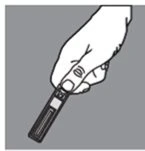
Hold the ampoule in the palm of your hand at waist level. Hold the arrow on the ampoule cap between thumb and index finger (with thumb pointing outward). Quickly and sharply twist toward you (counterclockwise).
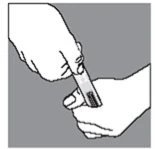
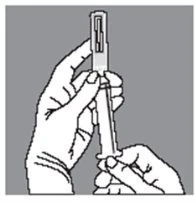
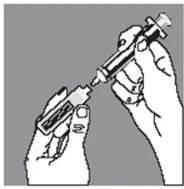
Firmly push the Luer cone of the syringe into the ampoule
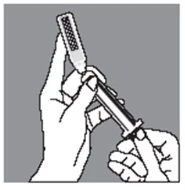
Gently push the ampoule toward you with your index finger and slowly withdraw the contents, taking special care at the beginning.