Levatik 5 mg film-coated tablets EFG
Spain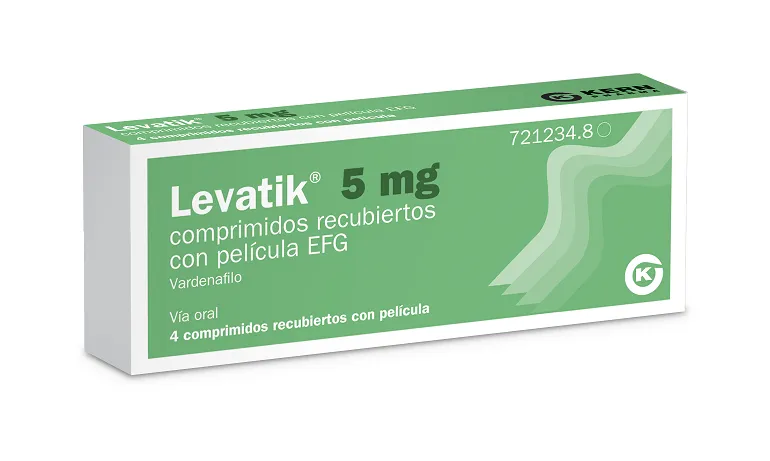
Table of Contents
Patient Information Leaflet
Introduction
Patient Information Leaflet
Levatik 5 mg film-coated tablets EFG
Vardenafil
Read the entire leaflet carefully before you start taking this medicine, as it contains important information for you.
- Keep this leaflet, as you may need to read it again.
- If you have any questions, ask your doctor or pharmacist.
- This medicine has been prescribed for you only; do not give it to other people, even if they have the same symptoms as you, because it could harm them.
- If you experience any adverse effects, consult your doctor or pharmacist, even if they are effects not listed in this leaflet. See section 4.
Leaflet contents:
- What Levatik is and what it is used for
- What you need to know before taking Levatik
- How to take Levatik
- Possible side effects
- How to store Levatik
- Contents of the pack and other information
1. What Levatik is and what it is used for
This medicine contains vardenafil, an active substance belonging to a group of medicines called phosphodiesterase 5 inhibitors, which are used to treat erectile dysfunction in adult men, a condition characterized by difficulty in achieving or maintaining an erection.
At least one in ten men will experience, at some point, problems achieving or maintaining an erection. This may be due to physical or psychological causes, or a combination of both. Regardless of the cause, disturbances in the muscles and blood vessels result in insufficient blood flow to the penis to achieve and maintain an erection.
Vardenafil will only work when you are sexually stimulated. This medicine reduces the action of a natural substance in the body that prevents erection. Vardenafil enables you to achieve an erection of sufficient duration to allow satisfactory sexual intercourse.
2. What you need to know before taking Levatik
Do not take vardenafil
- If you are allergic to vardenafil or to any of the other ingredients of this medicine (listed in section 6). Signs of an allergic reaction include rash, itching, swelling of the face or lips, and difficulty breathing.
- If you are taking medicines containing nitrates, such as glyceryl trinitrate for angina, or those that release nitric oxide, such as amyl nitrite. Taking these medicines together with vardenafil may severely affect your blood pressure.
- If you are taking ritonavir or indinavir, medicines used to treat human immunodeficiency virus (HIV) infections.
- If you are over 75 years old and are taking ketoconazole or itraconazole, antifungal medicines.
- If you have severe heart or liver problems.
- If you are undergoing renal dialysis.
- If you have recently had a stroke or heart attack.
- If you have low blood pressure now or in the past.
- If you have a family history of degenerative eye diseases (such as retinitis pigmentosa).
- If you have ever experienced vision loss due to damage to the optic nerve caused by insufficient blood supply, known as non-arteritic anterior ischemic optic neuropathy (NAION).
- If you are taking riociguat. This medicine is used to treat pulmonary arterial hypertension (i.e., high blood pressure in the lungs) and chronic thromboembolic pulmonary hypertension (i.e., high blood pressure in the lungs caused by blood clots). PDE5 inhibitors such as vardenafil have been shown to increase the hypotensive effect of this medicine. If you are taking riociguat or are unsure, consult your doctor.
- If you have ever developed a severe skin rash, skin peeling, blisters, and/or mouth sores after taking vardenafil.
Warnings and precautions
Talk to your doctor or pharmacist before taking this medicine.
Take special care with vardenafil
- If you have heart problems, as having sexual intercourse may pose a risk to you.
- If you have irregular heartbeats (cardiac arrhythmia) or an inherited heart condition that affects your electrocardiogram.
- If you have a physical condition affecting the shape of your penis, such as curvature, Peyronie's disease, or cavernosal fibrosis.
- If you have a medical condition that may cause prolonged erections (priapism), such as sickle cell anemia, multiple myeloma, or leukemia.
- If you have a stomach ulcer (also known as gastric or peptic ulcer).
- If you have bleeding disorders (such as hemophilia).
- If you are using any other treatment for erectile problems, including vardenafil film-coated tablets (see section: “Use of Vardenafil with other medicines”).
- Serious skin reactions have been reported with vardenafil treatment, including Stevens-Johnson syndrome and toxic epidermal necrolysis. Stop treatment with vardenafil and seek immediate medical attention if you experience any symptoms related to these serious skin reactions described in section 4.
- If you suddenly experience a decrease or partial loss of vision, or if your vision becomes distorted or darkened while taking vardenafil, stop taking vardenafil and consult your doctor immediately.
Children and adolescents
Vardenafil must not be used in children or adolescents under 18 years of age.
Other medicines and vardenafil
Inform your doctor or pharmacist if you are taking, have recently taken, or might need to take any other medicines, including those obtained without a prescription.
Some medicines may cause problems, especially the following:
- Nitrates, medicines for angina or those that release nitric oxide, such as amyl nitrate. Taking these medicines together with vardenafil may severely affect your blood pressure. Do not take vardenafil without first consulting your doctor.
- Medicines for cardiac arrhythmias, such as quinidine, procainamide, amiodarone, or sotalol.
- Ritonavir or indinavir, medicines for HIV. Do not take vardenafil without first consulting your doctor.
- Ketoconazole or itraconazol, antifungal medicines.
- Erythromycin or clarithromycin, macrolide antibiotics.
- Alpha-blockers, a group of medicines used to treat high blood pressure and enlarged prostate (such as benign prostatic hyperplasia).
- Riociguat.
Do not use vardenafil film-coated tablets in combination with another medicine for the treatment of erectile dysfunction, including vardenafil orally disintegrating tablets.
Taking vardenafil with food, drinks, and alcohol
-
You may take vardenafil with or without food, but it is preferable not to take it after a large meal or one high in fat, as this may delay its effect.
-
Do not drink grapefruit juice when taking vardenafil, as it may interfere with the normal effect of the medicine.
-
Drinking alcohol may worsen erectile problems.
Pregnancy and breastfeeding
Vardenafil must not be used in women.
Driving and using machines
In some people, vardenafil may cause dizziness or affect vision. Do not drive or operate tools or machinery if you feel dizzy or have vision problems after taking vardenafil.
3. How to take Levatik
Follow exactly the instructions for use of this medicine given by your doctor. If in doubt, consult your doctor or pharmacist again.
The recommended dose is 10 mg.
Take one vardenafil tablet 25 to 60 minutes approximately before sexual activity. With sexual stimulation, you may achieve an erection from 25 minutes up to four or five hours after taking vardenafil.
- Swallow the tablet with a glass of water.
Do not take vardenafil film-coated tablets together with any other formulation of vardenafil.
Do not take vardenafil more than once a day.
If you think the effect of vardenafil is too strong or too weak, inform your doctor. Your doctor may suggest switching to another vardenafil formulation with a different dose, depending on how it affects you.
If you take more vardenafil than you should
Taking too many vardenafil tablets may lead to an increased occurrence of adverse effects and cause severe back pain.
In case of overdose or accidental ingestion, contact your doctor or pharmacist immediately or call the Toxicology Information Service at telephone number 91 562 04 20, indicating the medication and the amount ingested.
If you have any further questions about the use of this medicine, ask your doctor or pharmacist.
4. Possible adverse effects
Like all medicines, vardenafil may cause adverse effects, although not everyone experiences them. Most of these adverse effects are mild or moderate.
Some patients have experienced sudden, temporary or permanent decrease or loss of vision, or distorted, dimmed or blurred central vision, in one or both eyes.
Sudden decrease or loss of hearing has also been reported.
Cases of sudden death, rapid or irregular heartbeat, heart attacks, chest pain, and cerebrovascular disorders (including temporary reduction in blood flow to parts of the brain and cerebral haemorrhage) have been reported in men taking vardenafil. Most of the men who experienced these side effects had pre-existing heart conditions before taking this medicine. It is not possible to determine whether these events were directly related to vardenafil.
The likelihood of experiencing an adverse effect is described using the following categories:
Very common adverse effects: may affect more than 1 in 10 people:
- Headache.
Common adverse effects: may affect up to 1 in 10 people:
- Dizziness.
- Facial flushing.
- Runny or congested nose.
- Indigestion.
Uncommon adverse effects: may affect up to 1 in 100 people:
- Swelling of the skin and mucous tissues, including facial, lip or throat swelling.
- Sleep disturbances.
- Numbness and altered sense of touch.
- Somnolence.
- Visual disturbances; eye discharge, colour vision changes, eye pain, and photosensitivity.
- Ringing in the ears (tinnitus); dizziness.
- Rapid pulse or palpitations.
- Difficulty breathing.
- Nasal congestion.
- Acid reflux, gastritis, abdominal pain, diarrhoea, vomiting, nausea, dry mouth.
- Increased liver enzymes in blood.
- Skin rashes, red skin.
- Back pain or muscle pain; increased blood levels of the muscle enzyme creatine phosphokinase; muscle stiffness.
- Prolonged erection.
- General malaise.
Rare adverse effects: may affect up to 1 in 1,000 people:
- Eye inflammation (conjunctivitis).
- Allergic reaction.
- Fainting.
- Amnesia (memory loss).
- Seizures.
- Glaucoma (increased intraocular pressure), watery eyes.
- Effects on the heart (e.g., heart attack, tachycardia, angina).
- High or low blood pressure.
- Nosebleeds.
- Abnormal liver function test results.
- Skin sensitivity to sunlight. Painful erection. Chest pain.
- Temporary reduction in blood flow to parts of the brain.
Very rare or frequency unknown adverse effects: may affect less than 1 in 10,000 people, or frequency cannot be estimated from available data:
- Blood in urine (haematuria).
- Bleeding in the penis (penile haemorrhage).
- Blood in semen (haemospermia).
- Sudden death; cerebral haemorrhage.
- Red, non-elevated, target-like or circular skin rashes on the trunk, often with central blisters, skin peeling, and ulcers in the mouth, throat, nose, genitals, and eyes. These serious skin reactions may be preceded by fever and flu-like symptoms (Stevens-Johnson syndrome, toxic epidermal necrolysis).
- Sudden decrease or loss of vision, or distorted, dimmed or blurred central vision.
Reporting of adverse effects
If you experience any adverse effect, consult your doctor, even if it is a possible adverse effect not listed in this leaflet. You may also report them directly via the Spanish Pharmacovigilance System for Human Medicines: https://www.notificaram.es. By reporting adverse effects, you can help provide more information on the safety of this medicine.
5. Storage of Levatik
Keep this medicine out of sight and reach of children.
Do not use this medicine after the expiry date which is stated on the packaging after "EXP". The expiry date refers to the last day of the month indicated.
Store this medicine at a temperature not exceeding 30°C.
Medicines should not be disposed of via wastewater or household waste. Unused medicines and their containers should be taken to the SIGRE point at your pharmacy. If you have any doubts, ask your pharmacist how to dispose of unused medicines and their containers. This helps protect the environment.
6. Contents of the pack and other information
Composition of Levatik
- The active substance is vardenafil. Each tablet contains 5 mg of vardenafil (as hydrochloride).
- The other components are:
In the tablet core: microcrystalline cellulose, crospovidone, anhydrous colloidal silica, and magnesium stearate.
In the film coating: polyvinyl alcohol, titanium dioxide (E171), talc, macrogol/PEG 3350, methacrylic acid copolymer type C, yellow iron oxide (E172), sodium bicarbonate, and red iron oxide (E172).
Appearance of the product and contents of the pack
Levatik 5 mg are film-coated tablets, light yellow in color, round, and marked with "A719" on one side.
Each pack contains 4 tablets.
Marketing Authorization Holder and Manufacturer
Marketing Authorization Holder
Kern Pharma, S.L.
Venus, 72 - Pol. Ind. Colón II
08228 Terrassa - Barcelona
Spain
Manufacturer
Actavis Ltd.
BLB016 Bulebel Industrial Estate
Zejtun ZTN 3000
Malta
Date of the most recent revision of this summary: January 2025
Detailed and up-to-date information on this medicine is available on the website of the
Spanish Agency for Medicines and Health Products (AEMPS)
http://www.aemps.gob.es/