Levact 2.5 mg/ml powder for concentrate for infusion solution
Spain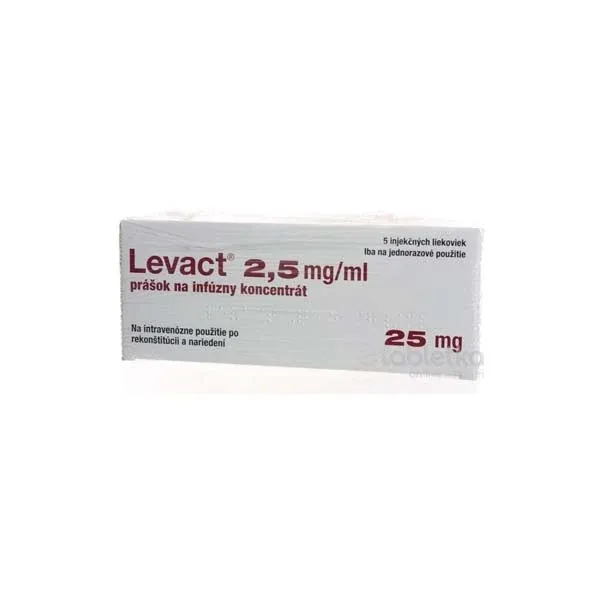
Table of Contents
Package leaflet: Information for the user
Introduction
Package leaflet: information for the user
Levact 2.5 mg/ml powder for concentrate for solution for infusion
Bendamustine hydrochloride
Read the entire leaflet carefully before you start using this medicine, because it contains important information for you.
- Keep this leaflet as you may need to read it again.
- If you have any questions, ask your doctor or pharmacist.
- This medicine has been prescribed for you only, and you should not give it to other people, even if they have the same symptoms as you, because it may harm them.
- If you experience any adverse reactions, consult your doctor or pharmacist, even if they are adverse reactions not listed in this leaflet. See section 4.
Leaflet contents
- What Levact is and what it is used for
- What you need to know before using Levact
- How to use Levact
- Possible side effects
- How to store Levact
- Contents of the pack and other information
1. What Levact is and what it is used for
Levact is a medicine used to treat certain types of cancer (it is a cytotoxic medicine).
Levact is used alone (monotherapy) or in combination with other medicines to treat the following types of cancer:
- Chronic lymphocytic leukemia, if combination chemotherapy with fludarabine is not suitable for you.
- Non-Hodgkin’s lymphomas that have not responded, or have responded only for a short period of time, following previous treatment with rituximab.
- Multiple myeloma, if high-dose chemotherapy with stem cell transplantation or treatments containing thalidomide or bortezomib are not suitable for you.
2. What you need to know before using Levact
Do not use Levact
- if you are allergic to bendamustine hydrochloride or to any of the other components of this medicine (listed in section 6);
- during breastfeeding; if you require treatment with Levact during breastfeeding, you must discontinue breastfeeding (see section Warnings and precautions regarding breastfeeding);
- if you have severe hepatic dysfunction (damage to the functional liver cells);
- if you have yellowing of the skin or whites of the eyes caused by liver or blood problems (jaundice);
- if you have severe bone marrow dysfunction (bone marrow suppression) and serious abnormalities in the number of white blood cells and platelets in the blood;
- if you have undergone major surgery within the 30 days prior to starting treatment;
- if you have had any infection, especially if accompanied by a reduction in white blood cell count (leucopenia);
- in combination with yellow fever vaccines.
Warnings and precautions
Consult your doctor or pharmacist before starting to use Levact
- if your bone marrow's ability to replace blood cells is reduced. The number of white blood cells and platelets in the blood must be measured before starting treatment with Levact, before each treatment cycle, and during the intervals between cycles.
- if you have infections. If you experience signs of infection, such as fever or pulmonary symptoms, you should contact your doctor.
- At any time during or after treatment, inform your doctor immediately if you or someone else notices: memory loss, cognitive difficulties, difficulty walking, or vision loss. These symptoms may be due to a very rare but serious brain infection that can be fatal (progressive multifocal leukoencephalopathy or PML).
- if you experience skin reactions during treatment with Levact. Skin reactions may increase in intensity.
- Contact your doctor if you notice any suspicious changes in the skin, as use of this medicine may increase the risk of certain types of skin cancer (non-melanoma skin cancer).
- if you develop painful red or purple widespread rashes and blisters and/or other lesions starting in the mucous membranes (e.g., mouth and lips), particularly if you have previously had light sensitivity, respiratory tract infections (e.g., bronchitis) and/or fever.
- if you have a heart condition (e.g., heart attack, chest pain, serious heart rhythm disorders).
- if you experience pain on one side or notice blood in your urine or reduced urine output. If your illness is very severe, your body may be unable to eliminate waste products from dying cancer cells. This is known as tumor lysis syndrome and may lead to kidney failure and heart problems within 48 hours after administration of the first dose of Levact. Your doctor will ensure you are adequately hydrated and will give you other medications to prevent this from occurring.
- in case of severe allergic or hypersensitivity reactions, you should be alert for infusion reactions after your first treatment cycle.
Use of Levact with other medicines
Inform your doctor or pharmacist if you are taking, have recently taken, or might need to take any other medicines.
If Levact is used in combination with medicines that suppress bone marrow blood cell formation, the effect on the bone marrow may be intensified.
If Levact is used in combination with medicines that affect your immune response, this effect may be intensified.
Cytostatic agents may reduce the effectiveness of live virus vaccines. In addition, cytostatic agents increase the risk of infection following vaccination with live virus vaccines (e.g., viral vaccination).
Pregnancy, breastfeeding, and fertility
If you are pregnant or breastfeeding, think you may be pregnant, or plan to become pregnant, consult your doctor or pharmacist before using this medicine.
Pregnancy
Levact may cause genetic damage and has caused malformations in animal studies. It must not be used during pregnancy unless clearly necessary as determined by your doctor. If you receive this treatment, you should ask your doctor to explain the risk of possible adverse effects of treatment on your unborn child. Genetic counseling is recommended.
If you are a woman of childbearing potential, you must use effective contraception before and during treatment with Levact. If you become pregnant during treatment with Levact, you must inform your doctor immediately and seek genetic counseling.
Breastfeeding
Levact must not be administered during breastfeeding. If you require treatment with Levact during breastfeeding, you must discontinue breastfeeding.
Consult your doctor or pharmacist before using any medicine.
Fertility
Men treated with Levact are advised not to father a child during treatment and for 6 months after treatment ends. Before starting treatment, you should seek advice on sperm preservation, as treatment may cause permanent sterility.
If you are a man, you must not father a child during treatment with Levact and for up to 6 months afterwards. There is a risk that treatment with Levact may cause sterility; you may wish to seek advice about sperm preservation before starting treatment.
Driving and using machines
Levact has a major influence on the ability to drive and use machines. Do not drive or operate machinery if you experience adverse effects such as dizziness or lack of coordination.
3. How to use Levact
Follow exactly the instructions for administering this medicine as given by your doctor or pharmacist. If in doubt, consult your doctor or pharmacist again.
Levact is administered into a vein over 30 to 60 minutes at various doses, either alone (monotherapy) or in combination with other medicines.
You must not start treatment if your white blood cell (leucocyte) count and/or platelet count is below certain predetermined levels.
Your doctor will measure these values periodically.
Chronic lymphocytic leukaemia
Levact 100 mg per square meter of body surface area (calculated using weight and height) | Days 1 and 2 |
This cycle will be repeated every 4 weeks for up to 6 cycles. |
Non-Hodgkin Lymphomas
Levact 120 mg per square meter of body surface area (calculated from weight and height) | Days 1 and 2 |
This cycle will be repeated every 3 weeks for at least 6 cycles. |
Multiple myeloma
Levact 120-150 mg per square meter of body surface area (calculated using weight and height) | Days 1 and 2 |
Prednisone 60 mg per square meter of body surface area (calculated using weight and height) by intravenous or oral administration | Days 1 to 4 |
This cycle will be repeated every 4 weeks, at least 3 times. |
Treatment will be discontinued if the white blood cell (leukocyte) count and/or platelet count falls below predetermined levels. Treatment may be resumed once the leukocyte and platelet counts have increased.
Renal or hepatic impairment
Dosage adjustment may be necessary depending on the degree of liver function impairment (initial 30% dose reduction in case of moderate liver impairment; if well tolerated, your doctor may consider returning to the normal dose).
Dosage adjustment is not required in case of renal function impairment. Your doctor will decide whether dosage adjustment is necessary.
How Levact is administered
Levact can only be administered by physicians experienced in the treatment of tumors.
Your doctor will administer the exact dose of Levact and take the necessary precautions.
Your doctor will administer the infusion solution after its proper preparation. The solution is given intravenously as a short infusion lasting 30 to 60 minutes.
Duration of treatment
A specific duration of treatment with Levact has not been established. The duration of treatment depends on the disease and the response to treatment.
If you have any concerns or questions about treatment with Levact, speak with your doctor or nurse.
If you forget to use Levact
If you miss a dose of Levact, your doctor will usually continue with the normal dosing schedule.
If you interrupt treatment with Levact
Your doctor will decide whether treatment should be interrupted or if another treatment should be used.
If you have any further questions about the use of this medicine, ask your doctor or pharmacist.
4. Possible adverse effects
Like all medicines, Levact may cause adverse effects, although not everyone experiences them. Some of the findings listed below may be detected following tests performed by your doctor.
The following definitions are used to assess adverse effects, based on their frequency:
Very common | may affect more than 1 in 10 people |
Common | may affect up to 1 in 10 people |
Uncommon | may affect up to 1 in 100 people |
Rare | may affect up to 1 in 1,000 people |
Very rare | may affect up to 1 in 10,000 people |
Frequency not known | cannot be calculated from the available data |
In very rare cases, tissue degradation (necrosis) has been observed following extravasation of Levact into the tissue surrounding blood vessels (extravascular). If the product extravasates outside a vessel, a burning sensation may occur at the needle insertion site. Consequences may include pain and impaired skin healing.
The dose-limiting adverse effect of Levact is impairment of bone marrow function, which is usually reversible. Suppression of bone marrow function may lead to reduced blood cell counts, resulting in an increased risk of infection, anemia, or an increased risk of bleeding.
Very common:
|
|
|
Frequent:
Uncommon:
Rare: |
|
|
|
|
|
Very rare:
Frequency not known:
|
|
|
There have been reports of tumors (myelodysplastic syndromes, acute myeloid leukemia, bronchial carcinoma) following treatment with Levact. A clear relationship with Levact could not be established.
Consult your doctor or seek immediate medical attention if you notice any of the following adverse reactions (frequency not known):
Severe skin rashes including Stevens-Johnson syndrome and toxic epidermal necrolysis. These may appear as reddish spots resembling targets, or circular lesions often with central blisters on the trunk, skin peeling, mouth ulcers, and ulcers in the throat, nose, genitals, and eyes, and may be preceded by fever and flu-like symptoms.
Widespread rash, high body temperature, swollen lymph nodes, and involvement of other body organs (drug reaction with eosinophilia and systemic symptoms, also known as DRESS or drug hypersensitivity syndrome).
If you consider any of the adverse effects you experience to be severe, or if you notice any adverse effect not listed in this leaflet, inform your doctor.
Reporting of adverse effects
If you experience any type of adverse effect, consult your doctor or pharmacist, even if it is a possible adverse effect not listed in this leaflet. You may also report them directly via the Spanish Pharmacovigilance System for Human Medicinal Products: www.notificaRAM.es. By reporting adverse effects, you can help provide more information on the safety of this medicine.
5. Storage of Levact
Keep this medicine out of the sight and reach of children.
Do not use this medicine after the expiry date stated on the label and on the packaging. The expiry date refers to the last day of the month indicated.
Store in the outer packaging to protect the contents from light.
Check the shelf life before opening or preparing the solution.
Solutions for infusion properly prepared according to the instructions listed at the end of this leaflet are stable in polyethylene bags at room temperature / 60% relative humidity for 3.5 hours and in the refrigerator for 2 days. Levact does not contain preservatives.
Therefore, the solution should not be used beyond these time limits.
The user is responsible for maintaining aseptic conditions.
Medicines must not be disposed of via wastewater or household waste. Unused medicines and waste containers should be returned to the SIGRE collection point at your pharmacy. If you have any doubts, ask your pharmacist how to dispose of unused medicines and containers. This will help protect the environment.
6. Package contents and other information
Composition of Levact
The active substance is bendamustine hydrochloride.
One vial contains 25 mg of bendamustine hydrochloride.
One vial contains 100 mg of bendamustine hydrochloride.
After reconstitution, 1 ml of concentrate contains 2.5 mg of bendamustine hydrochloride.
The other component is mannitol.
Appearance of the product and contents of the pack
Brown glass vials with a rubber stopper and an aluminium flip-off cap.
The powder is white and crystalline in appearance.
Levact is marketed in packs containing 5, 10 and 20 vials with 25 mg of bendamustine hydrochloride and 5 vials with 100 mg of bendamustine hydrochloride.
Only certain pack sizes may be commercially available.
Marketing Authorisation Holder and Manufacturer
Marketing Authorisation Holder
pharmaand GmbH
Taborstrasse 1
1020 Vienna, Austria
Manufacturer
Magnalabs EOOD
Bogdana Street, Stopanski Dvor,
vlg. Bistrica 1443
District Sofia (capital)
Stolichna Municipality
Bulgaria
For further information regarding this medicinal product, please contact the local representative of the Marketing Authorisation Holder:
Laboratorios Farmacéuticos ROVI, S.A.
Julián Camarillo, 35
28037 Madrid, Spain
This patient information leaflet was approved in July 2022
Detailed and up-to-date information on this medicinal product is available on the website of the Spanish Agency of Medicines and Health Products (AEMPS):
http://www.aemps.gob.es
This information is intended solely for healthcare professionals:
As with all similar cytotoxic agents, nursing staff and physicians must take extreme care due to the potential genotoxic and carcinogenic properties of this preparation. Avoid inhalation and contact with skin and mucous membranes when handling Levact (wear gloves, protective clothing, and, if possible, a mask!). If any part of the body becomes contaminated, wash carefully with water and soap, and rinse eyes with 0.9% saline solution (isotonic). If possible, it is recommended to work on a special safety workbench (laminar flow hood) using a liquid-impermeable disposable absorbent pad. Contaminated materials are cytotoxic waste. Please follow national regulations regarding the disposal of cytotoxic material! Pregnant female staff should not handle cytostatic agents.
The ready-to-use solution must be prepared by dissolving the contents of one vial of Levact exclusively in water for injection, as follows:
-
Preparation of the concentrate
- First, dissolve one vial of Levact containing 25 mg of bendamustine hydrochloride in 10 ml, with agitation.
- First, dissolve one vial of Levact containing 100 mg of bendamustine hydrochloride in 40 ml, with agitation.
-
Preparation of the infusion solution
Immediately after obtaining a clear solution (usually within 5 to 10 minutes), dissolve the recommended total dose of Levact in 0.9% saline solution (isotonic) to achieve a final volume of approximately 500 ml. Levact must not be dissolved in other infusion or injection solutions. Levact must not be mixed in the same infusion with other substances.
- Administration
The solution is administered by intravenous infusion over 30–60 minutes.
The vials are for single use only.
Unused products or waste material must be disposed of in accordance with local requirements.
If the product is accidentally injected into the tissue surrounding blood vessels (extravasation), the infusion must be stopped immediately. The needle will be withdrawn after brief aspiration. The affected tissue area should then be cooled and the arm elevated. It is unclear whether additional treatments (such as corticosteroids) are beneficial (see section 4).