Letybo 50 units powder for solution for injection
Spain
Table of Contents
Package leaflet: Information for the user
Introduction
Package leaflet: information for the user
Letybo 50 units powder for solution for injection
botulinum toxin type A
Read the entire leaflet carefully before you start using this medicine, because it contains important information for you.
- Keep this leaflet, as you may need to read it again.
- If you have any questions, consult your doctor or pharmacist.
- If you experience any adverse reactions, consult your doctor or pharmacist, even if they are possible adverse reactions not listed in this leaflet. See section 4.
Contents of the leaflet
- What Letybo is and what it is used for
- What you need to know before using Letybo
- How to use Letybo
- Possible side effects
- How to store Letybo
- Contents of the pack and other information
1. What Letybo is and what it is used for
Letybo contains the active substance botulinum toxin type A. It works by blocking nerve impulses to the muscles into which it is injected. This prevents the muscles from contracting, resulting in temporary paralysis.
Letybo is used in adults under 75 years of age to temporarily improve moderate to severe vertical lines between the eyebrows when their presence has an important psychological impact on these individuals.
2. What you need to know before using Letybo
Do not use Letybo:
- if you are allergic to botulinum toxin type A or to any of the other components of this medicine (listed in section 6)
- if you have a disorder affecting muscle activity, such as myasthenia gravis, Lambert-Eaton syndrome, or amyotrophic lateral sclerosis
- if you have an acute infection or inflammation in the proposed injection sites
Warnings and precautions
Talk to your doctor before starting to use Letybo if you have:
- any disorder affecting muscles and/or their direct control by the nervous system
- difficulty swallowing or breathing, or if you have had such difficulties in the past
- a bleeding disorder
If you have a history of these conditions, the use of Letybo is not recommended.
Fear of needles or needle-related pain may cause a sensation of fainting due to a sudden drop in blood pressure.
Very rarely, side effects related to the spread of the toxin away from the injection site, leading to botulism, have been reported with the use of botulinum toxin (e.g., double vision, blurred vision and/or drooping eyelids, difficulty breathing or speaking, excessive muscle weakness, difficulty swallowing, or unintended entry of food or liquid into the airways). Breathing and swallowing difficulties are serious and may lead to death.
If you experience problems with swallowing, speaking, or breathing, seek immediate medical help.
Children and adolescents
Letybo is not recommended for children and adolescents under 18 years of age.
Other medicines and Letybo
Inform your doctor or pharmacist if you are taking, have recently taken, or might need to take any other medicines.
The following medicines may interact with or be affected by Letybo:
- medicines that affect the transmission of nerve impulses to muscles
- certain antibiotics used to treat bacterial infections, such as spectinomycin or aminoglycoside antibiotics
- other medicines containing botulinum toxin.
Pregnancy and breastfeeding
If you are pregnant or breastfeeding, think you may be pregnant, or are planning to become pregnant, consult your doctor before using this medicine.
The use of Letybo is not recommended during pregnancy or breastfeeding, or in women of childbearing age who are not using contraception.
Driving and using machines
Botulinum toxin type A may cause muscle weakness, dizziness, and visual disturbances. Do not drive or operate machinery if your ability to react is impaired.
Letybo contains sodium
This medicine contains less than 1 mmol of sodium (23 mg) per dose; i.e., essentially "sodium-free".
3. How to use Letybo
This botulinum toxin unit is specific to Letybo. This means it is different from other botulinum toxin units and cannot be interchanged with those used in other botulinum toxin preparations.
Letybo has been prescribed exclusively for you by a qualified physician who has the appropriate equipment for this treatment. The detailed description of solution preparation and instructions for use are provided in the section “This information is intended for healthcare professionals only” at the end of the package leaflet.
The recommended dose is
20 units divided into five injections of 0.1 ml (4 units). Each injection is administered into the muscles located above or between the eyebrows.
Letybo is administered by intramuscular (IM) route.
Once the solution has been reconstituted, the vial should only be used for one treatment session per patient. Any unused solution must be discarded, as described after section 6 of the information for healthcare professionals.
It is recommended to wait at least 3 months between two Letybo treatments.
If you have been given more Letybo than you should have
Overdoses may cause paralysis of muscles and/or nerves. Signs of overdose may not appear immediately after injection.
In case of overdose, your doctor will monitor you for symptoms such as general weakness or muscle paralysis. You will be admitted to hospital if you develop symptoms of botulinum toxin type A intoxication, such as:
- generalized weakness
- drooping of the upper eyelid or double vision
- speech or swallowing disorders
- partial paralysis of the muscles controlling respiration.
If you have any further questions about the use of this medicine, ask your doctor or pharmacist.
4. Possible side effects
Like all medicines, this medicine can cause side effects, although not everyone gets them.
Most side effects are mild to moderate in intensity, occur during the first few days after injection, and are temporary.
Some side effects may be very serious. If you experience any of the following side effects, inform your doctor immediately or ask your family members to inform your doctor, and go to the nearest emergency department:
Uncommon – may affect up to 1 in 100 people
- Drooping of the upper eyelid, eyelid spasm
Rare – may affect up to 1 in 1,000 people
- Sensory disorder of the eyelid, drooping of the eyebrow
- Bleeding in the conjunctiva
- Eye pain, dry eye, visual field defect, blurred vision
- Reduced throat sensitivity
- Constipation
- Joint disorder
Very rare – may affect up to 1 in 10,000 people
- Muscle weakness
- Difficulty swallowing
- Respiratory tract or lung infection caused by aspiration of food or liquid
- Difficulty breathing
In addition to these possible side effects, a severe allergic reaction could cause the following symptoms:
- Difficulty swallowing, breathing, or speaking due to swelling of the face, lips, mouth, or throat; in addition to these symptoms, hives or urticarial rash may occur (see section 2)
Other known side effects may occur with the following frequencies. Inform your doctor or pharmacist if they are severe:
Common – may affect up to 1 in 10 people
- Headache
- Reactions at the injection site
Uncommon – may affect up to 1 in 100 people
- Head discomfort
- Local swelling, for example in the eyelid, face, or around the eyes
- Pain, bruising, swelling, itching, increased volume, or pressure at the injection site
- Bruising, for example around the eyes
- Infection, such as a viral upper respiratory tract infection, e.g., cold
- Mefisto effect (lateral elevation of the eyebrows)
Rare – may affect up to 1 in 1,000 people
- Migraine
- Inflammation of hair follicles
- Dizziness
- Abnormal sensations such as pricking, tingling, or itching
- Nausea
- Dry skin, rash, itching
- Facial pain
- Fever
- Oral herpes
- Elevated blood potassium
- Pseudoinfluenza syndrome
Reporting of side effects
If you experience any side effects, consult your doctor or pharmacist, even if they are possible side effects not listed in this leaflet. You can also report them directly via the Spanish Pharmacovigilance System for Human Medicines: https://www.notificaram.es. By reporting side effects, you can help provide more information on the safety of this medicine.
5. Storage of Letybo
Keep this medicine out of the sight and reach of children.
Do not use this medicine after the expiry date stated on the label and the carton following “CAD” or “EXP”. The expiry date refers to the last day of the month indicated.
Store and transport refrigerated (2 °C – 8 °C).
Reconstituted solution
Chemical and physical in-use stability has been demonstrated for 24 hours at 2 °C and 8 °C.
From a microbiological standpoint, unless the opening, reconstitution, and dilution methods exclude the risk of microbial contamination, the product should be used immediately. If not used immediately, the storage times during use and the conditions prior to use are the responsibility of the user.
Medicines should not be disposed of via wastewater or household waste. Ask your pharmacist how to properly dispose of unused medicines and their containers. This will help protect the environment.
6. Contents of the pack and other information
Composition of Letybo
- The active substance is botulinum toxin type A.
- One vial contains 50 units of botulinum toxin type A produced by Clostridium botulinum.
- After reconstitution, the solution contains 4 units per 0.1 ml.
- The other excipients are human albumin, sodium chloride.
Presentation of the product and contents of the container
Letybo is a white powder for injectable solution supplied in a clear glass vial with a rubber stopper and an aluminium safety seal.
The single pack contains 1 or 2 vials.
The multiple pack contains 2 boxes, each with one vial.
The multiple pack contains 6 boxes, each with one vial.
Only certain pack sizes may be marketed.
Marketing Authorization Holder
CROMA-PHARMA GmbH
Industriezeile 6
2100 Leobendorf
Austria
Manufacturer
Croma-Pharma GmbH
Cromazeile 2
2100 Leobendorf
Austria
Date of the most recent revision of this leaflet: December 2025
‐‐‐‐‐‐‐‐‐‐‐‐‐‐‐‐‐‐‐‐‐‐‐‐‐‐‐‐‐‐‐‐‐‐‐‐‐‐‐‐‐‐‐‐‐‐‐‐‐‐‐‐‐‐‐‐‐‐‐‐‐‐‐‐‐‐‐‐‐‐‐‐‐‐‐‐‐‐‐‐‐‐‐‐‐‐‐‐‐‐‐‐‐‐‐‐‐‐‐‐‐‐‐‐‐‐‐‐‐‐‐‐‐‐‐‐‐‐‐‐‐‐‐
This information is intended for healthcare professionals only:
Botulinum toxin units cannot be interchanged from one product to another. Recommended doses in units differ from those of other botulinum toxin preparations.
Instructions for use, handling, and disposal must be strictly followed.
Preparation of the solution
Reconstitution must be performed in accordance with good practice standards, particularly with regard to asepsis.
For reconstitution of Letybo, an injectable solution of sodium chloride 9 mg/ml (0.9%) should be used as diluent and added at a volume of 1.25 ml.
The recommended practice is to reconstitute the vial contents and prepare the syringe over plastic-backed absorbent paper to collect any spills. The injectable solution of sodium chloride 9 mg/ml (0.9%) is drawn into the syringe and gently injected into the vial to avoid foam or bubble formation or vigorous shaking, which could cause denaturation. The vial should be discarded if the vacuum does not draw the solvent into the vial. After reconstitution, Letybo is a clear, colorless solution free from particles. Before use, a visual inspection of the vial should be performed to ensure the product is free from foreign particles.
Letybo must not be used if the reconstituted solution appears cloudy or contains particles.
Reconstituted solution
Chemical and physical in-use stability has been demonstrated for 24 hours at 2 °C to 8 °C.
From a microbiological standpoint, unless the method of opening, reconstitution, and dilution excludes the risk of microbial contamination, the product should be used immediately. If not used immediately, the storage times and conditions prior to use are the responsibility of the user.
Any injectable solution stored for more than 24 hours must be discarded.
Disposal of unused medicine and of all materials that have been in contact with it must be carried out in accordance with local regulations.
Instructions for use
Intramuscular injections should be performed using a sterile 1 ml syringe, such as those used for insulin or tuberculin, graduated in 0.01 ml increments, and a needle with a gauge of 30 to 31 G.
A volume of 0.5 ml of properly reconstituted Letybo solution should be drawn into a sterile syringe, and air bubbles present in the syringe barrel should be expelled. The needle used for reconstitution must be removed and replaced with a new one for administration.
Care must be taken not to inject Letybo into a blood vessel.
To reduce complications such as ptosis, injections near the levator palpebrae superioris should be avoided, especially in patients with a large depressor supercilii complex. When injecting two sites in each corrugator supercilii muscle, the first injection should be made just above the mid-portion of the eyebrow margin. The second injection should be made approximately 1 cm above the supraorbital rim (palpable rigid bony boundaries above the upper eyelid), where the midlines of the eyebrows converge. The injection site for the procerus muscle is just above the midline of the nasal bridge, where horizontal wrinkles form between the medial ends of the eyebrows. When injecting the medial ends of the corrugator supercilii muscles and the midlines of the eyebrows, injection sites should be at least 1 cm away from the supraorbital rim (palpable rigid bony boundaries above the upper eyelid).
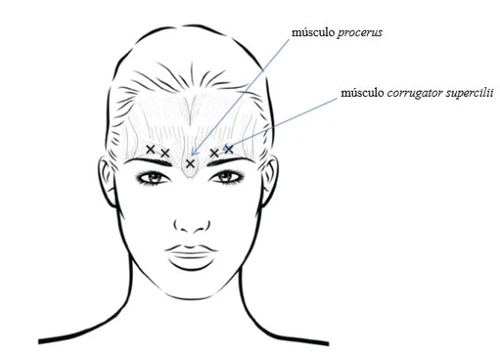
Injections should be administered carefully to avoid intravascular injection. Prior to injection, the thumb or index finger may be firmly placed under the supraorbital rim to prevent spread of the medication into that area. The needle should be oriented in an upward and medial direction.
In case of treatment failure one month after a previous session—i.e., absence of significant improvement from baseline—the following strategies may be considered:
- Analysis of causes of failure; e.g., injection into incorrect muscles, injection technique, formation of neutralizing antibodies to the toxin, insufficient dose
- Re-evaluation of the appropriateness of treatment with botulinum toxin type A
In the absence of unwanted adverse effects resulting from a previous treatment session, another treatment session may be initiated with a minimum interval of three months between treatment sessions.
Procedure for safe disposal of vials, syringes, and used materials
For safe disposal, unreconstituted Letybo should be reconstituted in the vial with a small amount of water and then sterilized by autoclaving. Empty vials, vials containing residual solution, syringes, or spills should be sterilized by autoclaving. Alternatively, residual Letybo can be inactivated with a diluted sodium hydroxide solution (0.1 N NaOH) or a diluted sodium hypochlorite solution (0.5% or 1% NaOCl).
After inactivation, vials, syringes, and used materials must not be emptied and should be discarded in appropriate containers and disposed of in accordance with local regulations.
Recommendations in case of an incident during handling of botulinum toxin
- Any product spill should be collected: using absorbent material impregnated with sodium hypochlorite solution in the case of powder, or dry absorbent material in the case of reconstituted product.
- Contaminated surfaces should be cleaned with absorbent material impregnated with sodium hypochlorite solution and then dried.
- If a vial breaks, follow the procedure described above, carefully collecting broken glass fragments and cleaning up the product. Avoid cuts to the skin.
- If the medicine comes into contact with the skin, wash the affected area with sodium hypochlorite solution and rinse thoroughly with abundant water.
- If the medicine comes into contact with the eyes, rinse thoroughly with abundant water or with an ophthalmic eye wash solution.
If the medicine comes into contact with a wound or broken or lacerated skin, wash thoroughly with abundant water and take appropriate medical measures according to the injected dose.