Lercanidipine Stada 20 mg film-coated tablets EFG
Spain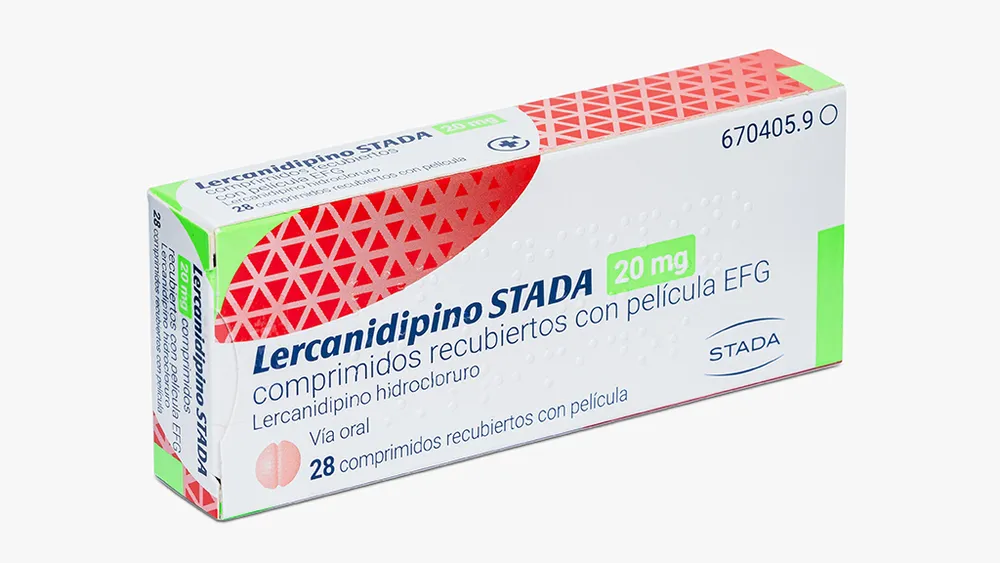
Table of Contents
- Package leaflet: Information for the user
- Introduction
- 1. What Lercanidipino Stada is and what it is used for
- 2. What you need to know before taking Lercanidipino Stada
- 3. How to take Lercanidipine Stada
- 4. Possible adverse effects
- 5. Storage of Lercanidipine Stada
- 6. Contents of the pack and other information
Package leaflet: Information for the user
Introduction
Package leaflet: information for the patient
Lercanidipino Stada 20 mg film-coated tablets EFG
lercanidipine hydrochloride
Read the entire leaflet carefully before you start taking this medicine because it contains important information for you.
- Keep this leaflet as you may need to read it again.
- If you have any questions, consult your doctor or pharmacist.
- This medicine has been prescribed for you only, and you should not give it to other people even if they have the same symptoms as you, because it may harm them.
- If you experience any adverse effects, consult your doctor or pharmacist, even if these effects are not listed in this leaflet. See section 4.
Leaflet contents
- What Lercanidipino Stada is and what it is used for
- What you need to know before taking Lercanidipino Stada
- How to take Lercanidipino Stada
- Possible side effects
- How to store Lercanidipino Stada
- Contents of the pack and other information
1. What Lercanidipino Stada is and what it is used for
Lercanidipine is a selective calcium channel blocker and belongs to a group of medicines called dihydropyridines. Selective calcium channel blockers reduce high blood pressure. They dilate (widen) the arteries, thereby lowering blood pressure.
Lercanidipine is used for:
- treatment of mild to moderate elevated blood pressure (essential hypertension).
2. What you need to know before taking Lercanidipino Stada
Do NOT take Lercanidipino Stada
-
if you are allergic to lercanidipine hydrochloride or any of the other ingredients of this medicine (listed in section 6)
-
if you have had allergic reactions to medicines closely related to lercanidipine (such as amlodipine, nicardipine, felodipino, isradipine, nifedipine or lacidipine)
-
if you are pregnant or breastfeeding, or might become pregnant (see section 2, Pregnancy and breastfeeding)
-
if you have certain heart conditions:
- uncontrolled heart failure
- obstruction of blood flow out of the heart
- unstable angina (angina at rest or progressively worsening)
- if you have had a heart attack within the last month
-
if you have severe liver or kidney problems
-
if you are taking medicines or foods that may affect the effectiveness or adverse reactions of lercanidipine, such as:
- antifungal medicines (such as ketoconazole or itraconazole)
- macrolide antibiotics (such as erythromycin or troleandomycin)
- antiviral medicines (such as ritonavir, a medicine used to treat AIDS)
- cyclosporine (a medicine used to prevent transplant rejection)
- grapefruit or grapefruit juice
Warnings and precautions
Talk to your doctor or pharmacist before taking lercanidipine, especially if you have or have had any of the following conditions or disorders:
- sick sinus syndrome (a heart condition that may cause the heart to beat too fast or too slow), unless you have had a pacemaker implanted
- left ventricular dysfunction (a heart condition in which one of the heart chambers cannot properly fill or pump blood)
- ischemic heart disease (a condition in which blood supply to the heart is insufficient)
- pre-existing angina pectoris (chest pain)
- moderate liver or kidney impairment
Other medicines and Lercanidipino Stada
Tell your doctor or pharmacist if you are taking, have recently taken, or might need to take any other medicines.
Do NOT take lercanidipine together with any medicine that inhibits its metabolism and therefore may influence the effect and/or adverse effects of lercanidipine. Your doctor knows which medicines these are. These include, for example:
- cyclosporine (a medicine used to prevent transplant rejection)
- ketoconazole and itraconazole (medicines used to treat fungal infections)
- ritonavir (a medicine used to treat AIDS)
- erythromycin or troleandomycin (antibiotics)
Some other medicines that are metabolized (activated or modified) by the enzyme CYP3A4 or that induce this enzyme may affect the blood concentration of lercanidipine. Therefore, consult your doctor if you are taking any other medicine.
The effect of lercanidipine is increased by:
-
midazolam (a sedative)
-
terfenadine or astemizole (antihistamines used to treat hay fever and other allergies)
-
amiodarone, quinidine (used to treat irregular heartbeats)
-
cimetidine (used to treat certain stomach ulcers), when administered at high doses (>800 mg per day)
The effect of lercanidipine is reduced by:
- phenytoin, carbamazepine (anticonvulsant medicines used to treat epilepsy)
- rifampicin (an antibiotic)
- beta-blockers (medicines used to treat high blood pressure and heart conditions; e.g. metoprolol)
Lercanidipine increases the effect of:
- digoxin (used to treat heart conditions)
- simvastatin (a medicine used to lower cholesterol)
Taking Lercanidipino Stada with food, drinks, and alcohol
Always take lercanidipine at least 15 minutes before a meal (breakfast).
Alcohol consumption may increase the effect and adverse reactions of lercanidipine. Therefore, you should not drink alcohol during treatment.
Grapefruit may increase the blood concentration of lercanidipine. You should not consume grapefruit or grapefruit juice while being treated with lercanidipine.
Pregnancy and breastfeeding
If you are pregnant or breastfeeding, think you may be pregnant, or plan to become pregnant, consult your doctor or pharmacist before using this medicine.
Pregnancy
Lercanidipine should not be taken during pregnancy. If you are planning a pregnancy or think you might be pregnant, consult your doctor. Your treatment will be changed.
Breastfeeding
You should not take lercanidipine while breastfeeding. Lercanidipine may pass into breast milk. If you continue treatment with lercanidipine, you must stop breastfeeding.
Driving and using machines
Lercanidipine may cause dizziness, weakness, fatigue, and drowsiness. If you are affected, do not drive or operate machinery.
Lercanidipino Stada contains lactose and sodium
This medicine contains lactose. If your doctor has informed you that you have an intolerance to certain sugars, consult with him before taking this medicine.
This medicine contains less than 23 mg of sodium (1 mmol) per tablet; therefore, it is essentially “sodium-free”.
3. How to take Lercanidipine Stada
Follow exactly the instructions given by your doctor for taking this medicine. If in doubt, consult your doctor or pharmacist again.
The whole or half tablet of lercanidipine should be swallowed whole with a glass of water, preferably in the morning, at least 15 minutes before breakfast.
The tablet may be divided into equal doses.
Store the half tablet protected from light, for example by returning the unswallowed half to the blister pack, with the foil covering the tablet, and keeping it inside the outer carton. Take this half-dose at your next scheduled dose.
Dosage
Adults:
The usual dose is 10 mg once daily. Your doctor will decide whether it is necessary to increase your dose to 20 mg daily.
Elderly patients:
In general, dose adjustment is not required in elderly patients.
Patients with liver or kidney impairment:
The usual initial dose in patients with mild or moderate liver or kidney impairment is 10 mg once daily. Your doctor will carefully increase the dose if needed. If you have severe liver or kidney impairment, you must not take lercanidipine.
Use in children and adolescents:
The use of lercanidipine is not recommended in children and adolescents under 18 years of age due to insufficient data on safety and efficacy.
If you take more Lercanidipine Stada than you should
If you take too many tablets, contact your doctor or the nearest hospital emergency department immediately. An overdose may cause excessive lowering of blood pressure and changes in heart rate (slower or faster). This may lead to loss of consciousness and other adverse effects. Other symptoms described in section 4, Possible side effects, may be intensified in case of overdose.
In case of overdose or accidental ingestion, contact your doctor, pharmacist, or the Poison Information Service immediately at telephone number 91 562 04 20 (indicating the medicine and the amount ingested).
If you forget to take Lercanidipine Stada
Do not take a double dose to make up for missed doses. Take the next dose at your usual time.
If you stop taking Lercanidipine Stada
Do not stop treatment with lercanidipine without consulting your doctor.
If you have any further questions about the use of this medicine, ask your doctor or pharmacist.
4. Possible adverse effects
Like all medicines, this medicine may cause adverse effects, although not everyone experiences them.
The following adverse effects have been associated with lercanidipine:
Uncommon (may affect up to 1 in 100 people):
- fast heartbeat (tachycardia)
- awareness of heartbeat (palpitations)
- peripheral edema (fluid accumulation in the limbs, especially in the legs)
- headache
- dizziness
- flushing (reddening of the skin, particularly of the face)
Rare (may affect up to 1 in 1,000 people):
- angina pectoris (chest pain)
- some medicines similar to lercanidipine may cause precordial pain (pain in the front part of the chest)
- somnolence
- nausea
- indigestion
- diarrhea
- abdominal pain
- vomiting
- polyuria (passing large amounts of urine)
- rash
- muscle pain
- weakness
- fatigue
Very rare (may affect up to 1 in 10,000 people):
- if you have angina pectoris, symptoms may occur more frequently, last longer, or be more severe
- isolated cases of heart attacks (myocardial infarction)
- fainting (syncope)
- increased liver enzyme levels (transaminases) in blood tests (usually reversible when treatment is stopped)
- swelling of the gums (gingival hyperplasia)
- increased frequency of urination
- hypotension (low blood pressure)
- chest pain
Reporting of adverse effects
If you experience any type of adverse effect, consult your doctor or pharmacist, even if it is a possible adverse effect not listed in this leaflet. You may also report them directly through the Spanish Pharmacovigilance System for Human Medicines: https://www.notificaram.es. By reporting adverse effects, you can help provide more information on the safety of this medicine.
5. Storage of Lercanidipine Stada
Keep this medicine out of the sight and reach of children.
Do not use this medicine after the expiry date stated on the packaging after EXP. The expiry date refers to the last day of the month indicated.
Store in the original packaging to protect from light.
Tablet halves must be protected from light.
Medicines must not be disposed of via wastewater or household waste. Return unused medicines and their containers to the SIGRE collection point at your pharmacy. Ask your pharmacist how to dispose of any unused medicines and their packaging. This will help protect the environment.
6. Contents of the pack and other information
Composition of Lercanidipine Stada
The active substance is lercanidipine.
One tablet contains 20 mg of lercanidipine hydrochloride as lercanidipine hydrochloride hemihydrate.
The other components are:
Tablet core: lactose monohydrate, pregelatinized corn starch, sodium croscarmellose, hypromellose, colloidal anhydrous silica, magnesium stearate.
Film coating: hypromellose, macrogol 8000, titanium dioxide (E-171), talc, and iron oxide red (E-172).
Appearance of the product and contents of the pack
Lercanidipine Stada 20 mg film-coated tablets are pink, round, biconvex, 8.1 mm in diameter, and scored.
The tablet can be divided into equal doses.
Lercanidipine Stada is available in packs containing 10, 14, 28, 30, 50, 56, 84, 98, 100, 126 or 154 tablets in opaque white aluminum/PVC/PVDC blisters.
Not all pack sizes may be marketed.
Marketing Authorization Holder and Manufacturer
Marketing Authorization Holder
Laboratorio STADA, S.L.
Frederic Mompou, 5
08960 Sant Just Desvern
(Barcelona) Spain
Manufacturer
STADA Arzneimittel AG
Stadastrasse, 2-18
D-61118 Bad Vilbel
Germany
or
STADA Arzneimittel GmbH
Muthgasse 36
1190 Wien
Austria
or
Eurogenerics N.V.
Heizel Esplanade B22
B-1020 Brussels
Belgium
or
Clonmel Healthcare Ltd.
Waterford Road
IRL-Clonmel
Co Tipperary
Ireland
or
LAMP SAN PROSPERO S.pA.
Via della Pace, 25/A
41030 San Prospero (Modena)
Co Tipperary
Italy
or
STADA M&D SRL
Str. Trascaului nr. 10,
Municipiul Turda,
Judet Cluj 401135,
Romania
This medicinal product is authorized in the Member States of the European Economic Area under the following names:
AT: | Lercanidipine STADA 20 mg film-coated tablets |
BE: | Lercanidipine EG 20 mg film-coated tablets |
BG: | ARETA 20 mg |
DK: | Lercastad |
ES: | Lercanidipine STADA 20 mg film-coated tablets EFG |
IE: | Lercanidipine Clonmel 20 mg Film-coated Tablets |
IT: | Lercanidipine EG – 20 mg film-coated tablets |
LU: | Lercanidipine EG 20 mg film-coated tablets |
NL: | Lercanidipine HCl 20 mg, film-coated tablets |
PT: | Lercanidipine Ciclum |
RO: | Lercanidipine STADA-HEMOFARM 20 mg film-coated tablets |
Date of the most recent review of this leaflet: June 2020
Detailed and up-to-date information on this medicine is available on the website of the Spanish Agency for Medicines and Health Products (AEMPS) http://www.aemps.gob.es/