Lapatinib Stada 250 mg film-coated tablets EFG
Spain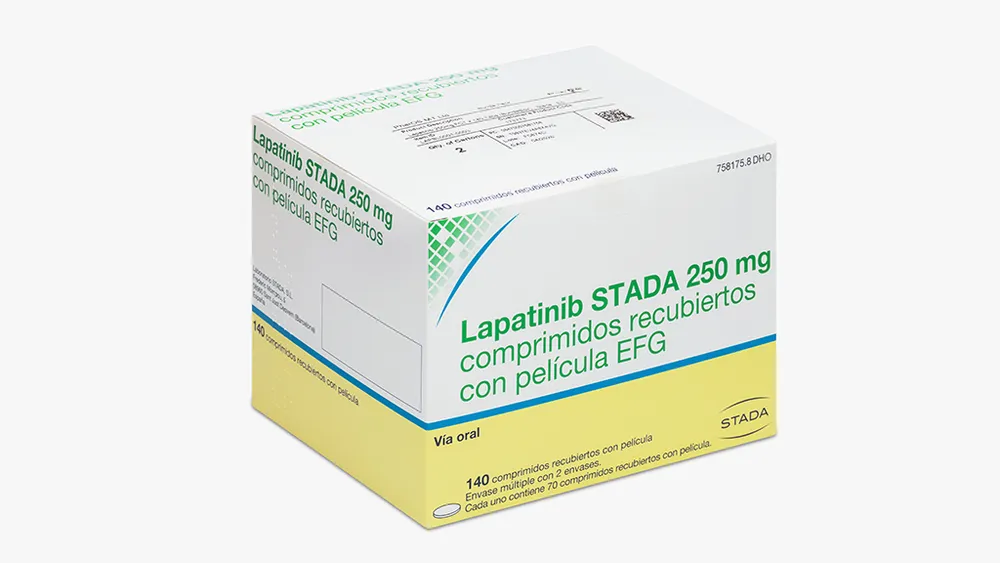
Table of Contents
- Patient Information Leaflet
- Introduction
- **Read the entire leaflet carefully before starting to take this medicine, as it contains important information for you.**
- **Package leaflet contents**
- 1. What Lapatinib Stada is and what it is used for
- 2. What you need to know before starting Lapatinib Stada
- **Exercise special caution with Lapatinib Stada**
- **Severe skin reactions**
- **Other medicines and lapatinib stada**
- **Driving and operating machinery**
- **Lapatinib Stada contains sodium**
- 3. How to take Lapatinib Stada
- **Taking the tablets**
- **While you are taking Lapatinib Stada**
- **If you take more Lapatinib Stada than you should**
- **If you forget to take Lapatinib Stada**
- 4. Possible adverse effects
- **Other very common side effects:**
- **Inform your doctor if you experience any of these symptoms.**
- **inform your doctor immediately if you experience any of these symptoms.**
- **Frequency not known (cannot be estimated from the available data):**
- **If you experience other adverse effects**
- **Reduction of the risk of diarrhea and skin rash**
- **Lapatinib may cause severe diarrhea.**
- **Lapatinib may cause skin rash**
- **Reporting of adverse reactions**
- 5. Storage of Lapatinib Stada
- 6. Contents of the pack and other information
- **Composition of Lapatinib Stada**
- **Appearance of the product and contents of the pack**
- **Marketing Authorization Holder and Manufacturing Responsible**
- **Marketing Authorization Holder**
- **Manufacturer Responsible**
- July 2022
Patient Information Leaflet
Introduction
Patient Information Leaflet
Lapatinib Stada 250 mg film-coated tablets EFG
Read the entire leaflet carefully before starting to take this medicine, as it contains important information for you.
- Keep this leaflet, as you may need to read it again.
- If you have any questions, consult your doctor or pharmacist.
- This medicine has been prescribed for you only, and you should not give it to others, even if they have the same symptoms as you, since it could harm them.
- If you experience any adverse effects, consult your doctor or pharmacist, even if they are adverse effects not listed in this leaflet. See section 4.
Package leaflet contents
- What Lapatinib Stada is and what it is used for
- What you need to know before taking Lapatinib Stada
- How to take Lapatinib Stada
- Possible side effects
- Storage of Lapatinib Stada
- Contents of the pack and other information
1. What Lapatinib Stada is and what it is used for
Lapatinib is used to treat certain types of breast cancer (those that overexpress HER2 receptors) that have spread beyond the original tumour or to other organs (advanced or metastatic breast cancer). This medicine may reduce or halt the growth of cancer cells, or may destroy them.
Lapatinib is prescribed to be taken in combination with other anticancer medicines.
Lapatinib is prescribed in combination with capecitabine in patients who have received prior treatment for advanced or metastatic breast cancer. Prior treatment for metastatic breast cancer must have included trastuzumab.
Lapatinib is prescribed in combination with trastuzumab in patients with metastatic breast cancer who are hormone receptor-negative and who have received prior treatment for metastatic breast cancer.
Lapatinib is prescribed in combination with an aromatase inhibitor in patients with hormone-sensitive metastatic breast cancer (breast cancer that is more likely to grow in the presence of hormones), for whom chemotherapy is not appropriate.
Information about these medicines is described in separate package leaflets. Ask your doctor to provide you with information about these medicines.
2. What you need to know before starting Lapatinib Stada
Do not take Lapatinib Stada
- if you are allergic to lapatinib or to any of the other ingredients of this medicine (listed in section 6).
Exercise special caution with Lapatinib Stada
Your doctor will perform tests to check that your heart is functioning properly before and during treatment with lapatinib.
Before taking lapatinib, inform your doctor if you have any heart problems.
Before starting lapatinib, your doctor also needs to know if:
- you have any lung disease
- you have inflammation in the lungs
- you have any liver problems
- you have any kidney problems
- you have diarrhea (see section 4)
Your doctor will perform tests to check that your liver is functioning properly before and during treatment with lapatinib.
Inform your doctor if you are in any of these situations.
Severe skin reactions
Severe skin reactions have been observed with the use of lapatinib. Symptoms may include skin rash, blistering, and skin peeling.
Inform your doctor as soon as possible if you experience any of these symptoms.
Other medicines and lapatinib stada
Inform your doctor or pharmacist if you are taking, have recently taken, or might need to take any other medicines. This also includes herbal remedies and other medicines obtained without a prescription.
It is especially important that you inform your doctor if you are using or have recently used any of the following medicines. Some medicines may affect how lapatinib works, or lapatinib may affect how other medicines work. These medicines include those from the following groups:
- St. John’s wort – a herbal extract used to treat depression
- erythromycin, ketoconazole, itraconazole, posaconazole, voriconazole, rifabutin, rifampicin, telithromycin – medicines used to treat infections
- ciclosporin – a medicine used to suppress the immune system, for example, after an organ transplant
- ritonavir, saquinavir – medicines used to treat HIV
- phenytoin, carbamazepine – medicines used to treat epileptic seizures
- cisapride – a medicine used to treat certain digestive system problems
- pimozide – a medicine used to treat certain mental health conditions
- quinidine, digoxin – medicines used to treat certain heart problems
- repaglinide – a medicine used to treat diabetes
- verapamil – a medicine used to treat high blood pressure or heart problems (angina pectoris)
- nefazodone – a medicine used to treat depression
- topotecan, paclitaxel, irinotecan, docetaxel – medicines used to treat certain types of cancer
- rosuvastatin – a medicine used to treat high cholesterol
- medicines that reduce stomach acid – used to treat stomach ulcers or indigestion
Inform your doctor if you are taking or have recently taken any of these medicines.
Your doctor will review all the medicines you are taking to ensure that none interact with lapatinib. Your doctor will advise you if there are suitable alternatives available.
Taking Lapatinib Stada with food and drinks
Do not drink grapefruit juice while being treated with lapatinib. It may affect how this medicine works.
Pregnancy and breastfeeding
The effect of lapatinib during pregnancy is unknown. You should not use lapatinib if you are pregnant unless specifically recommended by your doctor.
- Inform your doctor if you are pregnant or planning to become pregnant.
- Use an effective method of contraception to prevent pregnancy while taking lapatinib and for at least 5 days after the last dose.
- Inform your doctor if you become pregnant during treatment with lapatinib.
It is not known whether lapatinib passes into breast milk. Do not breastfeed while taking lapatinib and for at least 5 days after the last dose.
- Inform your doctor if you are breastfeeding or planning to breastfeed.
If you have any questions, ask your doctor or pharmacist before taking lapatinib.
Driving and operating machinery
You are responsible for deciding whether you are able to drive a vehicle or perform tasks requiring high concentration. Due to the possible adverse effects of lapatinib, your ability to drive or operate machinery may be affected. These effects are described in section 4, “Possible adverse effects”.
Lapatinib Stada contains sodium
This medicine contains less than 23 mg of sodium (1 mmol) per tablet; that is, essentially "sodium-free".
3. How to take Lapatinib Stada
Follow exactly the instructions given by your doctor for taking this medicine. If you are unsure, consult your doctor or pharmacist again.
Your doctor will determine the appropriate dose of lapatinib depending on the type of breast cancer being treated.
If you are prescribed lapatinib in combination with capecitabine, the usual dose is 5 lapatinib tablets daily, taken as a single dose.
If you are prescribed lapatinib in combination with trastuzumab, the usual dose is 4 lapatinib tablets daily, taken as a single dose.
If you are prescribed lapatinib in combination with an aromatase inhibitor, the usual dose is 6 lapatinib tablets daily, taken as a single dose.
Take the prescribed dose every day for as long as your doctor has instructed.
Your doctor will inform you about the dose of the other anticancer medicine and how you should take it.
Taking the tablets
- Swallow the tablets whole with water, one after the other, at the same time every day.
- Take lapatinib at least one hour before or one hour after a meal. Take lapatinib every day at the same time relative to meals; for example, you may take the tablets one hour before breakfast each day.
While you are taking Lapatinib Stada
- Depending on the adverse reactions you experience, your doctor may recommend reducing the dose or temporarily interrupting treatment.
- Your doctor will perform tests to monitor the function of your heart and liver before and during treatment with lapatinib.
If you take more Lapatinib Stada than you should
In case of overdose or accidental ingestion, consult your doctor or pharmacist immediately or call the Toxicology Information Service at telephone number: 91 562 04 20, stating the name of the medicine and the amount ingested. If possible, show the packaging.
If you forget to take Lapatinib Stada
Do not take a double dose to make up for missed doses. Take the next dose at the scheduled time.
4. Possible adverse effects
Like all medicines, this medicine can cause adverse effects, although not everyone will experience them.
A serious allergic reaction is a rare adverse effect that may affect up to 1 in every 1,000 people and may occur rapidly.
Symptoms may include:
- rash (including itching, presence of papules)
- unusual wheezing or difficulty breathing
- swollen eyelids, lips or tongue
- muscle or joint pain
- collapse or fainting
Contact your doctor immediately if you experience any of these symptoms. Do not take any more tablets.
Very common adverse effects (may affect more than 1 in 10 people)
- diarrhea (which may lead to dehydration and potentially more serious complications). Inform your doctor immediately at the first sign of diarrhea, as it is very important that diarrhea is treated promptly. Also, inform your doctor immediately if diarrhea worsens. You can find further advice on how to reduce the risk of diarrhea at the end of section 4.
- rash, dry skin, itching
Inform your doctor if you develop a skin rash. You can find further advice on how to reduce the risk of skin rash in section 4.
Other very common side effects:
- loss of appetite
- nausea
- vomiting
- tiredness, weakness
- indigestion
- constipation
- mouth inflammation / mouth ulcers
- stomach pain
- trouble sleeping
- back pain
- pain in hands and feet
- joint and back pain
- a skin reaction on the palms of the hands or soles of the feet (including tingling, numbness, pain, swelling, or redness)
- cough, difficulty breathing
- headache
- nosebleed
- hot flushes
- unusual hair loss or hair fragility
Tell your doctor if any of these side effects become severe or troublesome.
Common side effects (may affect up to 1 in 10 people):
- an effect on the way your heart works.
In most cases, this effect on your heart will not cause any symptoms. If you do experience symptoms related to this side effect, these may include irregular heartbeat and difficulty breathing.
- liver problems, which may cause itching, yellowing of the eyes or skin (jaundice), dark urine, or pain or discomfort in the upper right part of the stomach
- changes in the nails, such as a tendency to develop infection and inflammation of the cuticles
- skin fissures (deep cracks or cracked skin)
Inform your doctor if you experience any of these symptoms.
Uncommon adverse effects (may affect up to 1 in 100 people):
- treatment-induced lung inflammation, which may cause shortness of breath or cough.
inform your doctor immediately if you experience any of these symptoms.
Other uncommon adverse effects include:
- blood test results showing changes in liver function (usually mild and temporary)
Rare adverse effects (may affect up to 1 in 1,000 people):
- severe allergic reactions (see the beginning of section 4)
Frequency not known (cannot be estimated from the available data):
- irregular heartbeat (change in the heart's electrical activity)
- severe skin reaction that may include: rash, redness of the skin, blisters on the lips, eyes or mouth, skin dryness, fever, or some combination of these
- pulmonary arterial hypertension (increased blood pressure in the arteries (blood vessels) going to the lungs)
If you experience other adverse effects
Inform your doctor or pharmacist if you notice any adverse effects not listed in this leaflet.
Reduction of the risk of diarrhea and skin rash
Lapatinib may cause severe diarrhea.
If you have diarrhea while taking lapatinib:
- drink plenty of fluids (8 to 10 glasses per day), such as water, sports drinks, or other clear liquids
- eat low-fat, high-protein foods instead of fatty foods or spicy meals
- eat cooked vegetables instead of raw vegetables, and remove the skin from fruits before eating them
- avoid milk and dairy products (including ice cream)
- avoid herbal supplements (some may cause diarrhea).
Tell your doctor if your diarrhea continues.
Lapatinib may cause skin rash
Your doctor will perform skin examinations before and during treatment.
To care for sensitive skin:
- wash with a soap-free product
- use hypoallergenic, fragrance-free skincare products
- use sunscreen (sun protection factor (SPF) 30 or higher).
Tell your doctor if you develop a skin rash.
Reporting of adverse reactions
If you experience any type of adverse reaction, consult your doctor or pharmacist, even if it is a possible adverse reaction not listed in this leaflet. You may also report them directly through the Spanish Pharmacovigilance System for Human Medicinal Products: www.notificaRAM.es. By reporting adverse reactions, you can help provide more information on the safety of this medicine.
5. Storage of Lapatinib Stada
Keep this medicine out of the sight and reach of children.
Do not use this medicine after the expiry date stated on the packaging and blister after EXP. The expiry date refers to the last day of the month indicated.
This medicine does not require any special storage conditions.
Medicines must not be disposed of via wastewater or household waste. Ask your pharmacist how to dispose of medicines and packaging you no longer need. This will help protect the environment.
Medicines must not be disposed of via wastewater or household waste. Dispose of packaging and unused medicines at a SIGRE collection point at your pharmacy. Ask your pharmacist how to dispose of medicines and packaging you no longer need. This way, you will help protect the environment.
6. Contents of the pack and other information
Composition of Lapatinib Stada
- The active substance of Lapatinib Stada is lapatinib. Each film-coated tablet contains lapatinib ditosylate monohydrate, equivalent to 250 mg of lapatinib.
- The other components are: microcrystalline cellulose (type 101) (E460), povidone K30 (E1201), sodium carboxymethyl starch (from potato) (type A), magnesium stearate (E470b), hypromellose (3 mPa·s and 6 mPa·s) 2910 (E464), titanium dioxide (E171), macrogol 400 (E1521), polysorbate 80 (E433), yellow iron oxide (E172).
Appearance of the product and contents of the pack
Lapatinib Stada film-coated tablets are oval-shaped, biconvex, whitish tablets, marked with “250” on one side and flat on the other.
Lapatinib Stada is supplied in blister packs.
Each pack contains 70 or 84 tablets in aluminum foil blisters containing 10 or 6 tablets each.
Each pack contains 70 x 1 or 84 x 1 tablets in perforated aluminum foil blisters containing 10 or 6 tablets each.
Lapatinib Stada is also available in multiple packs containing 140 tablets comprising 2 packs, each with 70 tablets in aluminum foil blisters.
Lapatinib Stada is also available in multiple packs containing 140 x 1 tablets comprising 2 packs, each with 70 x 1 tablets in perforated aluminum foil blisters.
Only certain pack sizes may be marketed.
Marketing Authorization Holder and Manufacturing Responsible
Marketing Authorization Holder
Laboratorio STADA, S.L.
Frederic Mompou, 5
08960 Sant Just Desvern (Barcelona)
Spain
Manufacturer Responsible
Remedica Ltd
Aharnon Street, Limassol Industrial Estate
Building 10
3056, Limassol
Cyprus
or
STADA Arzneimittel AG
Stadastrasse 2-18
61118 Bad Vilbel
Germany
or
PharOS MT Ltd.
HF62X, Hal Far Industrial Estate,
Birzebbugia BBG3000,
Malta
This medicinal product is authorized in the Member States of the European Economic Area under the following names:
Netherlands: Lapatinib Stada 250 mg, filmomhulde tabletten
Germany: Lapatinib Stada 250 mg Filmtabletten
Spain: Lapatinib Stada 250 mg comprimidos recubiertos con película EFG
Malta: Lapatinib PharOS 250 mg film-coated tablets
Romania: Lapatinib Stada 250 mg comprimate filmate
Date of latest review of this leaflet:
July 2022
Detailed information on this medicinal product is available on the website of the Spanish Agency for Medicinal Products and Medical Devices (AEMPS) (http://www.aemps.gob.es/)