Lanvis 40 mg tablets
Spain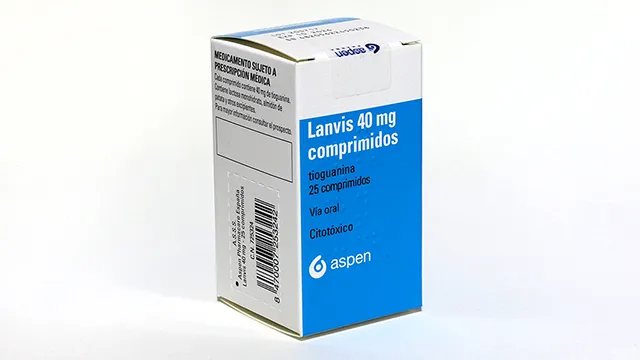
Table of Contents
Package leaflet: Information for the user
Introduction
Package leaflet: information for the user
Lanvis 40mg tablets
tioguanine
Read the entire leaflet carefully before you start taking this medicine, as it contains important information for you.
- Keep this leaflet, as you may need to read it again.
- If you have any questions, ask your doctor, pharmacist, or nurse.
- This medicine has been prescribed for you only, and you should not give it to others, even if they have the same symptoms as you, because it may harm them.
- If you experience any adverse effects, consult your doctor, pharmacist, or nurse, even if they are adverse effects not listed in this leaflet. See section 4.
Leaflet contents
- What Lanvis is and what it is used for
- What you need to know before taking Lanvis
- How to take Lanvis
- Possible adverse effects
- How to store Lanvis
- Contents of the pack and other information
1. What Lanvis is and what it is used for
Lanvis tablets contain a medicine called thioguanine. This belongs to a group of medicines known as cytotoxic agents (also called chemotherapy). Lanvis is used for certain blood disorders and blood cancers. It works by reducing the number of new blood cells that your body produces.
Lanvis is used for acute (fast-growing) leukaemias, especially:
- Acute myeloid leukaemia (also called acute myelogenous leukaemia or AML): a rapidly progressing disease that increases the number of white blood cells produced by the bone marrow. This can lead to infections and bleeding.
- Acute lymphoblastic leukaemia (also called acute lymphocytic leukaemia or ALL): a rapidly progressing disease that increases the number of white blood cells produced by the bone marrow. These immature white blood cells cannot develop and function properly, and therefore cannot fight infections and may cause bleeding.
Consult your doctor if you would like more information about these conditions.
2. What you need to know before taking Lanvis
Do not take Lanvis:
- if you are allergic to thioguanine or any of the other ingredients of this medicine (listed in section 6).
Warnings and precautions
Talk to your doctor, pharmacist or nurse before taking Lanvis:
- if you have a liver problem, so your doctor can monitor liver function through blood tests,
- if you have been taking this medicine for a long period of time. This may increase the risk of side effects, such as liver problems,
- if you have a condition in which your body produces very little of an enzyme called TPMT or "thiopurine-methyltransferase",
- if you have a mutation in the NUDT15 gene, you may be at higher risk of developing low levels of white blood cells in the blood compared to other patients. This may lead to infections. The mutation may also increase your risk of hair loss. Patients of Asian ancestry may be particularly at risk,
- if you have "Lesch-Nyhan syndrome". This is a rare inherited disorder occurring in families, caused by deficiency of a substance called HPRT or "hypoxanthine-guanine-phosphoribosyltransferase".
If you are unsure whether any of the above situations apply to you, speak with your doctor, pharmacist or nurse before taking Lanvis.
Infections in all populations
Tell your doctor immediately if you experience severe chills, fever, sore throat, cough, flu-like symptoms and headache, accompanied by nausea, rash and/or confusion, while taking thioguanine in combination with other cancer treatments, as these symptoms may indicate that you have a bacterial, viral or fungal infection. Your doctor may prescribe antiviral treatment and other supportive therapies.
Blood tests
Your doctor may ask you to have blood tests while taking Lanvis. These are to check your blood cell counts. Your doctor may also perform genetic tests (i.e., examine your TPMT and/or NUDT15 genes) before or during treatment to determine whether your response to this medicine may be affected by your genetics. Your doctor may adjust the dose of Lanvis after these tests.
Lanvis and the sun
While taking Lanvis, you may become sensitive to sunlight, which may cause skin discoloration or rash. Take precautions to avoid excessive sun exposure; cover up and use sunscreen.
Other medicines and Lanvis
Tell your doctor, pharmacist or nurse if you are taking, have recently taken or might need to take any other medicines.
In particular, inform your doctor or pharmacist if you are taking any of the following:
- olsalazine or mesalazine: used for a bowel condition called ulcerative colitis,
- sulfasalazine: used for rheumatoid arthritis or ulcerative colitis,
- mercaptopurine – a cytotoxic drug (patients with tumors resistant to mercaptopurine will not respond to Lanvis),
- medicines that may have harmful effects on the bone marrow, such as other chemotherapy or radiotherapy. This may lead to bone marrow damage, and the dose of Lanvis may need to be reduced.
Vaccination while taking Lanvis
If you are due to be vaccinated, talk to your doctor or nurse before receiving the vaccine. This is because certain vaccines (such as those for polio, measles, mumps and rubella) may cause you an infection if administered while you are taking Lanvis.
Pregnancy, breastfeeding and fertility
If you are pregnant or breastfeeding, think you may be pregnant or are planning to become pregnant, consult your doctor before using this medicine. This applies to both men and women. Lanvis may damage your sperm or eggs. Reliable contraceptive precautions should be taken to avoid pregnancy while you or your partner are taking this medicine.
Driving and use of machines
There are no data available on the effects of Lanvis on the ability to drive and operate machinery.
Lanvis contains lactose
If your doctor has informed you that you have an intolerance to certain sugars, consult him before taking this medicine.
3. How to take Lanvis
Lanvis should only be administered by a specialist doctor experienced in the treatment of blood disorders.
Follow exactly the instructions given by your doctor for taking this medicine. It is important to take the medicine at the correct time. The label on the pack will indicate how many tablets to take and how often to take them. If in doubt, consult your doctor, pharmacist, or nurse again.
-
Swallow the tablets whole with a glass of water.
-
If you need to split the tablet in half, do not inhale any of the tablet dust. Wash your hands afterwards.
-
While taking Lanvis, your doctor will carry out periodic blood tests. These are to monitor the number and types of your blood cells and to ensure your liver is functioning properly. Your doctor may adjust your dose from time to time, depending on the results of the blood tests.
The dose of Lanvis prescribed for you will be determined by your doctor based on the following:
- your body size (surface area),
- the results of blood tests,
- the condition being treated.
The usual dose ranges between 60 and 200 mg/m² body surface area per day. If you have kidney or liver problems, you may be given a lower dose of Lanvis.
If you take more Lanvis than you should
If you take more Lanvis than you should, inform your doctor immediately or go to a hospital straight away. Take the medicine pack with you.
If you forget to take Lanvis
Inform your doctor. Do not take a double dose to make up for forgotten doses.
If you stop taking Lanvis
Do not stop treatment with Lanvis without consulting your doctor.
If you have any further questions about the use of this medicine, ask your doctor, pharmacist, or nurse.
4. Possible adverse effects
Like all medicines, this medicine may cause adverse effects, although not everyone will experience them.
If you have any of the following symptoms, consult your specialist doctor or go to the hospital immediately, as you may need to stop taking Lanvis:
-
any signs of fever or infection (sore throat, mouth pain, or urinary problems)
-
treatment with Lanvis may cause a decrease in white blood cell count. White blood cells fight infection, and when there are too few white blood cells, infections may occur,
-
any unexpected bruising or bleeding, as this could mean that too few blood cells of a particular type are being produced,
-
if you feel unwell suddenly (even with normal temperature),
-
any yellowish discoloration of the whites of the eyes or skin (jaundice).
Consult your doctor if you experience any of the following adverse effects, which may also occur with this medicine:
Very common (may affect more than 1 in 10 people)
- decrease in the number of white blood cells (leucopenia),
- decrease in the number of platelets in the blood (cells that help blood to clot),
- jaundice (skin and whites of the eyes turn yellow) and severe liver damage (symptoms include tiredness and nausea followed by itching, dark urine, and may include rash or fever) – with long-term use or high doses of Lanvis – this may also show up in blood tests.
Common (may affect up to 1 in 10 people)
- liver damage that may cause jaundice (skin and whites of the eyes turn yellow) or liver enlargement (swelling under the rib cage); with short-term use of Lanvis, this may also appear in blood tests.
- Feeling dizzy or nauseous (nausea or vomiting), diarrhoea, and mouth ulcers,
- increased concentrations of uric acid in the blood (hyperuricaemia), which sometimes may lead to reduced kidney function.
Rare (may affect up to 1 in 10,000 people)
- a bowel problem called necrotising colitis, which may cause severe stomach pain, vomiting, diarrhoea, and fever,
- severe liver damage when used with other chemotherapy medicines, oral contraceptives, and alcohol.
The following effects have been reported infrequently: skin rash, light sensitivity, heart problems, ringing in the ears (tinnitus) and deafness, and unusual eye movements.
Reporting of adverse effects
If you experience any type of adverse effect, consult your doctor, pharmacist, or nurse, even if it is a possible adverse effect not listed in this leaflet. You may also report them directly via the Spanish Pharmacovigilance System for Human Medicinal Products: www.notificaRAM.es. By reporting adverse effects, you can help provide more information on the safety of this medicine.
5. Storage of Lanvis
- Keep this medicine out of the sight and reach of children.
- Do not use this medicine after the expiry date stated on the label of the bottle and the carton, following «EXP». The expiry date refers to the last day of the month indicated. Do not store Lanvis tablets above 25 °C. Store in the original container and packaging to protect from light. Keep the container tightly closed to protect from moisture.
- If your doctor advises you to stop taking the tablets, it is important to return any remaining tablets to your pharmacist, who will dispose of them according to the guidelines for the disposal of hazardous substances. Only keep the tablets if your doctor instructs you to do so.
6. Contents of the pack and other information
Composition of Lanvis
- The active substance is thioguanine. Each Lanvis tablet contains 40 mg of thioguanine.
- The other components are lactose monohydrate, starch (potato), acacia gum, stearic acid, and magnesium stearate.
Appearance of the product and contents of the pack
Lanvis tablets are white to off-white, round, biconvex, bevelled tablets, printed with "T40" on the upper side, without bevel or engraving on the lower side.
Lanvis tablets are supplied in bottles containing 25 tablets.
Marketing Authorization Holder and Manufacturer
Marketing Authorization Holder:
Aspen Pharma Trading Limited
3016 Lake Drive, Citywest Business Campus,
Dublin 24,
Ireland
Tel: +34 952 010 137
Manufacturer:
EXCELLA GmbH & Co. KG, Nürnberger Strasse 12,
90537 Feucht,
Germany
Local Representative:
Aspen Pharmacare España S.L.
Avenida Diagonal, 512
Planta Interior 1, Oficina 4
08006 Barcelona
Spain
Date of the most recent review of this leaflet: December 2022
Detailed information on this medicine is available on the website of the Spanish Agency of Medicines and Medical Devices (AEMPS): http://www.aemps.gob.es/