Lantanon 30 mg film-coated tablets
Spain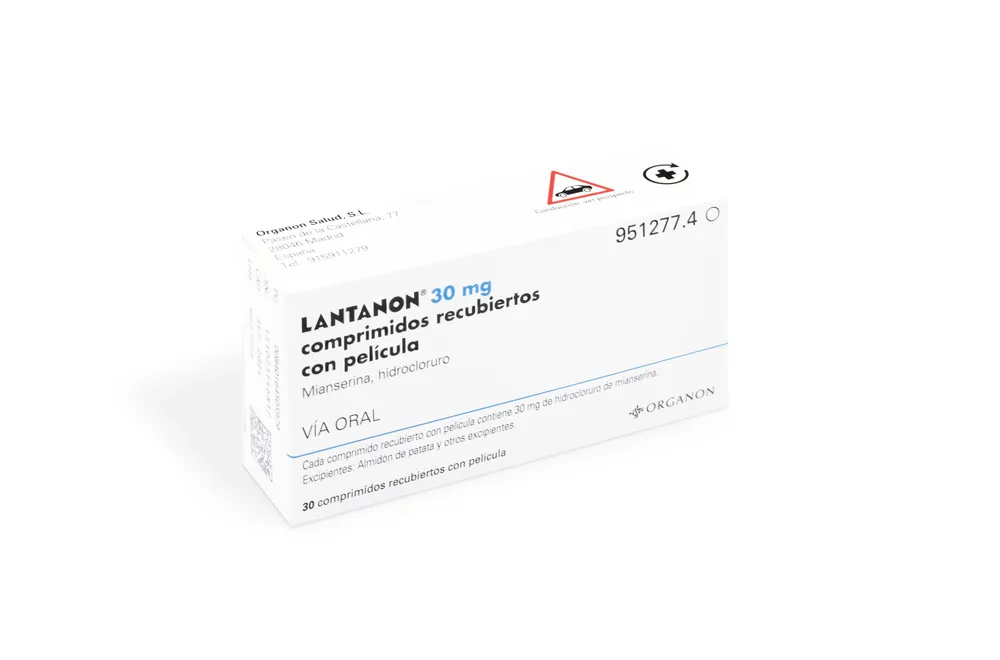
Table of Contents
Package leaflet: Information for the user
Introduction
Package leaflet: information for the user
Lantanon 30 mg film-coated tablets
Mianserin, hydrochloride
Read the entire leaflet carefully before you start taking this medicine, because it contains important information for you.
- Keep this leaflet, as you may need to read it again.
- If you have any questions, ask your doctor or pharmacist.
- This medicine has been prescribed for you only, and you should not give it to others, even if they have the same symptoms as you, because it could harm them.
- If you experience any adverse effects, consult your doctor or pharmacist, even if they are adverse effects not listed in this leaflet. See section 4.
Leaflet contents
- What Lantanon is and what it is used for
- What you need to know before taking Lantanon
- How to take Lantanon
- Possible adverse effects
- How to store Lantanon
- Contents of the pack and other information
1. What Lantanon is and what it is used for
Lantanon belongs to a group of medicines called antidepressants. Lantanon relieves the depressed mood caused by depression. Depression is an emotional disorder. During depression, changes occur in the brain: brain nerve cells communicate with each other through chemical substances, and in depression, the normal amount of these substances is reduced. Antidepressants can correct these deficiencies and restore normal brain function. In general, improvement is experienced within 2 to 4 weeks of treatment.
2. What you need to know before starting to take Lantanon
Do not take Lantanon
- if you are allergic to the active substance (mianserin) or to any of the other ingredients of this medicine (listed in section 6).
- if you have mania (a state of euphoria and hyperactivity).
- if you have liver disease.
- if you are taking or have recently taken (within the last two weeks) medicines called monoamine oxidase inhibitors (MAOIs).
Use in children and adolescents under 18 years
Lantanon is not normally used to treat children and adolescents under 18 years of age. You should also be aware that in patients under 18 years of age, there is an increased risk of adverse effects such as suicide attempts, suicidal thoughts, and hostility (mainly aggression, confrontation behaviour, and irritability) when taking this type of medicine. Nevertheless, your doctor may decide to prescribe Lantanon to patients under 18 years of age if they consider it to be the most appropriate treatment for the patient. If your doctor has prescribed Lantanon to a patient under 18 years of age and you wish to discuss this decision, please contact your doctor again. You must inform your doctor if any of the symptoms listed below worsen or complications arise while patients under 18 years of age are taking Lantanon. In addition, the long-term effects on safety, as well as on growth, maturation, and cognitive and behavioural development, with Lantanon in this age group have not yet been established.
Suicidal thoughts and worsening of depression
If you are depressed and/or have anxiety disorders, you may occasionally have thoughts of harming yourself or of suicide. This may worsen when you first start taking antidepressants, as these medicines usually take up to two weeks or sometimes longer to take effect.
You may be more likely to have such thoughts if:
- you have previously had suicidal thoughts or thoughts of self-harm,
- you are a young adult. Clinical trial data have shown an increased risk of suicidal behaviour in psychiatric patients under 25 years of age who are being treated with an antidepressant.
If you ever have thoughts of harming yourself or of suicide, contact your doctor or go to a hospital immediately.
It may be helpful to tell a close family member or friend that you are depressed or feel anxious, and ask them to read this leaflet. You may ask them to let you know if they think your depression or anxiety is getting worse, or if they are concerned about changes in your behaviour.
Warnings and precautions
Talk to your doctor or pharmacist before taking Lantanon:
-
if you have had or currently have:
-
epilepsy (seizures)
-
diabetes
-
liver disorders, such as jaundice
-
kidney disease
-
difficulty urinating due to an enlarged prostate
-
heart conditions, including certain types of heart disease that affect your heart rhythm, a recent heart attack, heart failure, or if you are taking certain medicines known to affect heart rhythm
-
blood pressure problems
-
glaucoma (increased intraocular pressure)
-
psychiatric disorders such as schizophrenia and bipolar depression (alternating periods of elevated mood/hyperactivity and depression)
Always consult your doctor, even if you have previously had any of these conditions or disorders.
Taking Lantanon with other medicines
The effect of Lantanon may be affected by other medicines, or Lantanon may affect other medicines. Inform your doctor or pharmacist if you are using, have recently used, or might need to use any other medicines.
Do not take Lantanon together with:
- monoamine oxidase inhibitors (MAOIs). Also, do not take Lantanon within two weeks after stopping MAOIs. If you stop taking Lantanon, do not take MAOIs for at least the next two weeks.
Examples of MAOIs include moclobemide, tranylcypromine (both are antidepressants), selegiline (for Parkinson’s disease), and linezolid (an antibiotic).
Be careful if you take Lantanon together with:
- medicines for epilepsy such as carbamazepine and phenytoin;
- medicines to prevent blood clotting such as warfarin.
Lantanon may increase the effects of warfarin on the blood. Inform your doctor if you are taking this medicine. If both are taken together, your doctor is advised to perform regular blood tests;
- medicines that may affect heart rhythm, such as certain antibiotics and some antipsychotics.
Taking Lantanon with food, drinks, and alcohol
Lantanon may increase the effect of alcohol. Therefore, drinking alcohol during treatment with Lantanon is not recommended.
Pregnancy and breastfeeding
Although animal studies and limited human data suggest that mianserin does not cause harm to the fetus or newborn and passes into breast milk only in very low amounts, the benefits of using Lantanon during pregnancy or breastfeeding must be weighed against the potential risks to the fetus or newborn.
If you are pregnant or breastfeeding, think you may be pregnant, or plan to become pregnant, consult your doctor or pharmacist before using this medicine.
Driving and using machines
- Lantanon may cause drowsiness.
- You should not drive, as Lantanon may impair your ability to drive safely.
- Do not operate tools or machinery.
3. How to take Lantanon
Follow exactly the instructions for use of this medicine as given by your doctor or pharmacist. If in doubt, consult your doctor or pharmacist again.
In general, treatment will start with a low dose (1 tablet per day, i.e. 30 mg of mianserin hydrochloride), which may gradually be increased if necessary, as directed by your doctor, up to the most effective daily dose. For successful treatment, it is very important that you take your tablet(s) every day. Strictly adhere to the recommended dosage.
Take the tablet(s) at the same time each day, preferably all at once, at night before going to bed. If your doctor advises, Lantanon may be taken in divided doses, equally spaced throughout the day (one in the morning and one at night before going to bed). The tablets should be swallowed whole, without chewing, with a little water or other liquid.
Do not stop taking Lantanon just because your symptoms appear to have disappeared. If you discontinue treatment too early or too abruptly, your condition may worsen. Inform your doctor about how your treatment is progressing. Your doctor will advise you on how to gradually reduce the dose if your treatment can be discontinued.
If you take more Lantanon than you should
In case of overdose or accidental ingestion, consult a doctor or pharmacist immediately.
You may also contact the Toxicology Information Service. Telephone 91 562 04 20.
Vomiting should be induced as soon as possible. Prolonged sedation or drowsiness may occur. Symptoms of a possible overdose may include changes in your heart rhythm (fast or irregular heartbeat) and/or fainting, which could be signs of a potentially life-threatening condition known as Torsades de pointes.
If you forget to take Lantanon
If you are supposed to take one dose per day at bedtime and you forget it, do not take the missed dose the following morning, as this may cause daytime drowsiness. Continue your treatment at night with your recommended dose.
If you are supposed to take the tablets twice daily (one in the morning after breakfast and one at night before going to bed) and you have forgotten to take one or both doses, do the following:
- if you forgot the morning dose, simply take it together with the evening dose,
- if you forgot the evening dose or both doses, do not try to make up for them; the next day, continue with your recommended doses both in the morning and at night.
If you interrupt treatment with Lantanon
Although Lantanon does not cause dependence, abruptly stopping treatment may cause dizziness, agitation, anxiety, headache, and nausea. Therefore, the dose should be gradually reduced.
If you have any further questions about the use of this medicine, ask your doctor or pharmacist.
4. Possible adverse effects
Like all medicines, this medicine may cause adverse effects, although not everyone experiences them. Lantanon may temporarily cause the following adverse effects:
- drowsiness,
- weight gain,
- thoughts of harming yourself or of suicide.
Contact your doctor or go to a hospital immediately.
In rare cases, Lantanon may cause a decrease in white blood cells, leading to reduced resistance of the body to infections. If you develop fever, sore throat, mouth ulcers, or other signs of infection while taking Lantanon, you must contact your doctor immediately and have a blood test. These symptoms mostly occur 4–6 weeks after starting treatment and are generally reversible upon discontinuation of Lantanon.
Other possible adverse effects include:
- low blood pressure, characterized by dizziness, lightheadedness, or fainting, especially when standing up quickly,
- epileptic seizures (convulsions),
- hypomania (abnormal mood similar to mania, but less severe),
- swelling of the ankles or feet due to fluid accumulation (edema),
- yellowing of the eyes or skin; this may indicate liver function abnormalities,
- hepatitis (inflammation of the liver),
- slow heart rate following the initial dose,
- neuroleptic malignant syndrome (the most important symptoms are body rigidity, involuntary movements, and high body temperature),
- joint pain,
- restless legs syndrome,
- rash,
- changes in your heart rhythm (fast or irregular heartbeat) and/or fainting, which may be symptoms of a potentially life-threatening condition known as Torsades de pointes.
Reporting of adverse effects
If you experience any adverse effect, consult your doctor or pharmacist, even if it is a possible adverse effect not listed in this leaflet. You may also report them directly through the Spanish Pharmacovigilance System for Human Medicines: https://www.notificaram.es. By reporting adverse effects, you can help provide more information on the safety of this medicine.
5. Storage of Lantanon
Keep this medicine out of the sight and reach of children.
Do not store above 30°C.
Store in the original packaging to protect from light and moisture.
Do not use this medicine after the expiry date stated on the container. The expiry date refers to the last day of the month indicated.
Medicines must not be disposed of via wastewater or household waste. Unused medicines and their containers should be returned to the SIGRE collection point at your pharmacy. If you are unsure, ask your pharmacist how to dispose of medicines and containers you no longer need. This will help protect the environment.
6. Contents of the pack and other information
Composition of Lantanon
- The active substance is mianserin hydrochloride. Each tablet contains 30 mg of mianserin hydrochloride.
- The other components are:
Core: potato starch, anhydrous colloidal silica, magnesium stearate, methylcellulose, calcium hydrogen phosphate dihydrate.
Coating: hypromellose (hydroxypropylmethylcellulose), polyethylene glycol 8000, titanium dioxide (E-171).
Appearance of the product and contents of the pack
Lantanon 30 mg tablets are oval-shaped, biconvex, and marked with the code “Organon” on one side and the code CT/7 on the other. They have a score line to allow division into equal halves. The tablets are presented in child-resistant blisters, in packs of 30 tablets.
Marketing Authorization Holder and Manufacturer
Marketing Authorization Holder
Organon Salud, S.L.
Paseo de la Castellana, 77
28046 Madrid
Spain
Tel.: 915911279
Manufacturer
Organon Heist bv
Industriepark 30
2220 Heist-op-den-Berg
Belgium
Date of the most recent revision of this leaflet: March 2015
Detailed and up-to-date information on this medicine is available on the website of the Spanish Agency for Medicines and Health Products (AEMPS) http://www.aemps.gob.es/