Lacerol Cor Retard 240 mg prolonged-release tablets
Spain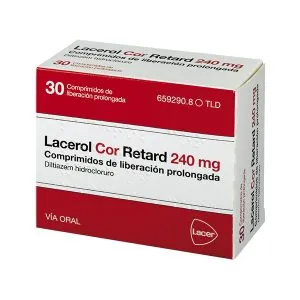
Table of Contents
- Package leaflet: Information for the user
- Introduction
- 1. What Lacerol Cor Retard is and what it is used for
- 2. What you need to know before taking Lacerol Cor Retard
- 3. How to take Lacerol Cor Retard
- 4. Possible adverse effects
- 5. Conservation of Lacerol Cor Retard
- Keep this medicine out of the sight and reach of children.
- 6. Contents of the pack and other information
Package leaflet: Information for the user
Introduction
Package leaflet: information for the user
Lacerol Cor Retard 240 mg prolonged-release tablets
Diltiazem hydrochloride
Read all of this leaflet carefully before you start taking this medicine, because it contains important information for you.
? Keep this leaflet, you may need to read it again.
? If you have any questions, ask your doctor or pharmacist.
? This medicine has been prescribed for you only and must not be given to other people, even if they have the same symptoms as you, because it could harm them.
? If you experience any adverse effects, consult your doctor or pharmacist, even if such effects are not listed in this leaflet. See section 4.
Contents of this leaflet:
-
What Lacerol Cor Retard is and what it is used for
-
What you need to know before taking Lacerol Cor Retard
-
How to take Lacerol Cor Retard
-
Possible side effects
-
How to store Lacerol Cor Retard
-
Contents of the pack and other information
1. What Lacerol Cor Retard is and what it is used for
Lacerol Cor Retard belongs to a group of medicines called calcium channel blockers, with predominantly cardiac action. They work by dilating blood vessels and simultaneously reducing the heart's oxygen requirements.
This medicine is used to treat ischemic heart disease and to prevent angina pectoris.
2. What you need to know before taking Lacerol Cor Retard
Do not take Lacerol Cor Retard
? If you are allergic to the active substance or to any of the other ingredients of this medicine (listed in section 6).
? If you have heart rhythm or conduction disorders, such as:
- sinus node dysfunction,
- second- or third-degree atrioventricular block if you do not have a pacemaker,
- significant bradycardia (heart rate equal to or less than 40 beats per minute).
? If you have decompensated heart failure or myocardial infarction with complications.
? If you are due to receive an intravenous infusion of dantrolene (a drug used in disorders of muscle contraction).
- if you are already taking a medicine containing ivabradine for the treatment of certain heart conditions
- if you are already taking a medicine containing lomitapide for the treatment of high cholesterol levels (see section: “Other medicines and Lacerol COR Retard”).
? If you have very low blood pressure (systolic blood pressure below 90 mmHg).
? If you have a type of arrhythmia known as atrial fibrillation in the presence of so-called Wolf-Parkinson-White syndrome.
? If you are pregnant or breastfeeding (see “Pregnancy and breastfeeding”).
Warnings and precautions
Talk to your doctor or pharmacist before starting to take Lacerol Cor Retard.
? If you are scheduled for surgery under general anesthesia while taking this medicine. You must inform your doctor or anesthesiologist in advance.
? If you have liver or kidney disease, or are over 65 years of age, blood levels of diltiazem may be higher. Your doctor may need to monitor you more closely and you may require periodic check-ups.
? If you have any heart condition or are prone to low blood pressure, inform your doctor before taking this medicine.
? If you develop any other illness or experience swelling in the lower limbs and/or ankles, inform your doctor or pharmacist promptly.
? If you develop skin rashes or other allergic reactions (such as itching or swelling of the face or lips), stop taking this medicine and contact your doctor. ? If you have a history of heart failure, new onset shortness of breath, slow heartbeats, or low blood pressure. Cases of kidney injury have been reported in patients with these conditions; your doctor may need to monitor your kidney function.
Children
The efficacy and safety of use in children have not been established. Therefore, the use of Lacerol Cor Retard is not recommended in children and adolescents (under 18 years of age).
Use in elderly patients
Experience in elderly patients (over 65 years of age) is limited. Since biological functions may be reduced in this patient group, your doctor will determine the appropriate dose and more intensive monitoring may be required (see “Warnings and precautions”).
Other medicines and Lacerol Cor Retard
Tell your doctor or pharmacist if you are taking, have recently taken, or might need to take any other medicines.
In particular, do not take this medicine and inform your doctor if you are taking:
- Ivabradine (see section “Do not take Lacerol”).
- Medicines containing lomitapide used to treat high cholesterol levels. Diltiazem may increase lomitapide concentrations, which could increase the likelihood and severity of liver-related side effects.
It is especially important that you inform your doctor if you are taking any of the following medicines:
? Beta-blockers (used to treat high blood pressure).
? Digoxin, organic nitrates (used in heart diseases).
? Amiodarone and other antiarrhythmic drugs.
? Cyclosporine, tacrolimus (used in organ transplantation).
? Carbamazepine, for the treatment of epilepsy.
? Cimetidine and ranitidine (used in the treatment of stomach ulcers).
? Lithium, for the treatment of bipolar disorder.
? Rifampicin, for the treatment of tuberculosis.
? Simvastatin, pravastatin (used to reduce cholesterol and other fatty substances in the blood).
? Theophylline, for the treatment of bronchial asthma.
? Midazolam, triazolam (used to induce relaxation or sleep and relieve anxiety).
Taking Lacerol Cor Retard with food, drinks and alcohol
Lacerol Cor Retard tablets are taken orally, swallowed whole without chewing, with a glass of water, and can be taken either on an empty stomach or with food. It is recommended to take the tablet at the same time each day. (See also “3. How to take Lacerol Cor Retard”)
During treatment with this medicine, you should not drink alcohol, as it may cause a drop in blood pressure with dizziness and/or fainting.
Pregnancy, breastfeeding and fertility
If you are pregnant or breastfeeding, think you may be pregnant, or are planning to become pregnant, consult your doctor or pharmacist before using this medicine.
Lacerol Cor Retard should not be taken during pregnancy or breastfeeding. Therefore, if you are pregnant, think you might be, or are breastfeeding, stop taking this medicine and inform your doctor as soon as possible.
Driving and using machines
At the beginning of treatment with this medicine, your ability to drive or operate machinery may be impaired due to reduced reflexes, which could be worsened by alcohol consumption. Therefore, do not drive or operate potentially dangerous machinery until you know how you tolerate the medicine.
Lacerol Cor Retard contains lactose and hydrogenated castor oil
This medicine contains lactose. If your doctor has informed you that you have an intolerance to certain sugars, consult with him before taking this medicine.
This medicine may cause stomach discomfort and diarrhea because it contains hydrogenated castor oil.
3. How to take Lacerol Cor Retard
Follow exactly the instructions for use of this medicine as given by your doctor or pharmacist. If in doubt, consult your doctor or pharmacist again.
The usual dose is 1 tablet once daily. It is recommended to take the medicine at the same time every day.
Instructions for correct administration of the preparation
Swallow the tablets whole, without chewing, with a sufficient amount of liquid (for example, a glass of water). Remember to take your medicine.
Your doctor will determine the duration of your treatment with Lacerol Cor Retard and may adjust your dose if necessary. Do not change the dose prescribed by your doctor and do not stop treatment without first consulting your doctor, as this could be harmful to your health.
If you feel that the effect of Lacerol Cor Retard is too strong or too weak, inform your doctor or pharmacist.
Substitution between sustained-release diltiazem-containing medicines is not recommended unless you have received explicit advice from your doctor to do so.
If you take more Lacerol Cor Retard than you should
If you take more tablets than you should, inform your doctor or go immediately to the hospital emergency department. Take the medicine packaging with you so that the doctor knows what you have taken. The following effects may occur: dizziness or weakness, blurred vision, chest pain, difficulty breathing, fainting, abnormally fast or slow heartbeat, difficulty speaking, confusion, reduced kidney function, coma, and sudden death.
If you have taken more tablets than prescribed by your doctor, contact your doctor immediately or go to the nearest hospital, taking the packaging and the patient information leaflet with you. You may also call the Toxicology Information Service at telephone number 915 62 04 20, indicating the medicine and the amount taken.
If you forget to take Lacerol Cor Retard
If you forget to take a dose, do not worry; wait until your next scheduled dose, take your next tablet then, and continue your normal dosing schedule. Do not take a double dose to make up for forgotten doses.
If you have any other questions about the use of this medicine, ask your doctor or pharmacist.
4. Possible adverse effects
Like all medicines, this medicine may cause adverse effects, although not everyone experiences them.
The following adverse effects have been reported for Lacerol Cor Retard. In such cases, you should inform your doctor as soon as possible:
Frequent adverse effects (between 1 and 10 in every 100 patients/people):
- facial flushing (sensation of warmth in the face)
- suffocation
- swelling of the lower limbs and/or ankles
- slowing of the pulse
- nausea
- headache
- dizziness
- general malaise
- fatigue.
Uncommon adverse effects (between 1 and 10 in every 1,000 patients/people):
- decrease in blood pressure upon standing
- tachycardia
- palpitations
- fainting
- difficult digestion
- abdominal pain
- constipation
- dry mouth
- somnolence
- skin redness
- itching and/or urticaria
- abnormal increased sensitivity to sunlight.
Rare adverse effects (between 1 and 10 in every 10,000 patients/people):
- sinoatrial and/or atrioventricular block
- inflammation of blood vessels
- congestive heart failure
- changes in the electrocardiogram
- inflammation of the gums
- erythema multiforme: An acute reaction affecting the skin and sometimes mucous membranes, which may rarely be accompanied by increased mucosal sensitivity (Stevens-Johnson syndrome)
- skin inflammation (exfoliative dermatitis, exanthematous pustular dermatitis)
- moderate elevations of liver enzymes (transaminases, alkaline phosphatase, LDH, bilirubin).
Very rare adverse effects (in fewer than 1 in every 10,000 patients/people):
- toxic epidermal necrolysis: A skin disorder characterized by blistering and skin peeling.
Frequency not known (cannot be estimated from available data):
- A condition in which the body's immune system attacks normal tissue, causing symptoms such as joint inflammation, fatigue, and skin rashes (called “lupus-like syndrome”).
Reporting of adverse effects
If you experience any type of adverse effect, consult your doctor or pharmacist, even if it is a possible adverse effect not listed in this leaflet. You may also report them directly via the Spanish Pharmacovigilance System for Human Medicines: https://www.notificaram.es. By reporting adverse effects, you can help provide more information on the safety of this medicine.
5. Conservation of Lacerol Cor Retard
Keep this medicine out of the sight and reach of children.
No special storage conditions are required.
Do not use this medicine after the expiry date stated on the carton and blister after "EXP.". The expiry date is the last day of the month indicated.
Medicines must not be disposed of via wastewater or household waste. Dispose of packaging and unused medicines at the SIGRE point in your pharmacy. Ask your pharmacist how to dispose of packaging and medicines you no longer need. This will help protect the environment.
6. Contents of the pack and other information
Composition of Lacerol Cor Retard:
The active substance is diltiazem. Each tablet contains 240 mg of diltiazem hydrochloride.
The other components (excipients) are: monohydrate lactose, hydroxypropyl cellulose, hydroxypropylmethyl cellulose, ethyl cellulose, methacrylic acid copolymer type A, shellac, triacetin, carbomer, talc, magnesium stearate and hydrogenated castor oil.
Appearance of the medicinal product and contents of the pack:
Lacerol Cor Retard are prolonged-release white tablets, oblong in shape and scored on one side. The score line is intended only to facilitate breaking the tablet for ease of swallowing, and not to divide it into equal doses. Packs containing 20 and 30 tablets are available.
Only certain pack sizes may be marketed.
Marketing Authorization Holder and Manufacturer:
LACER, S.A.
C/. Boters, 5
08290 Cerdanyola del Vallés
Barcelona - Spain
This leaflet was last approved in April 2023
"Detailed and up-to-date information on this medicinal product is available on the website of the Spanish Agency of Medicines and Medical Devices (AEMPS) http://www.aemps.gob.es/"