Lacerol 60 mg tablets
Spain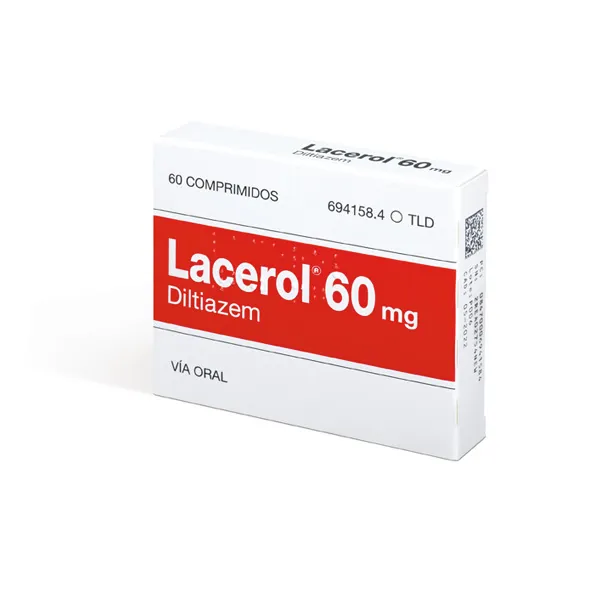
Table of Contents
Package leaflet: Information for the user
Introduction
Package leaflet: information for the patient
Lacerol 60 mg tablets
diltiazem hydrochloride
Read all of this leaflet carefully before you start taking this medicine because it contains important information for you.
- Keep this leaflet. You may need to read it again.
- If you have any questions, ask your doctor or pharmacist.
- This medicine has been prescribed for you only and must not be given to other people, even if they have the same symptoms as you, because it could harm them.
- If you experience any adverse effects, talk to your doctor or pharmacist, even if the effects are not listed in this leaflet. See section 4.
Contents of the leaflet
- What Lacerol is and what it is used for
- What you need to know before taking Lacerol
- How to take Lacerol
- Possible side effects
- How to store Lacerol
- Contents of the pack and other information
1. What Lacerol is and what it is used for
Lacerol belongs to a group of medicines called calcium channel blockers. It works by dilating blood vessels and at the same time reducing the heart's oxygen requirements.
This medicine is used for:
? The treatment and prevention of angina pectoris, including Prinzmetal's angina (vasospastic).
? The treatment of high blood pressure (hypertension).
2. - What you need to know before taking Lacerol
Do not take Lacerol
- if you are allergic to diltiazem or any of the other ingredients of this medicine (listed in section 6),
- if you are in shock,
- if you have a heart condition such as left ventricular failure with pulmonary congestion,
- if you have severe low blood pressure (severe hypotension),
- if you have acute myocardial infarction,
- if you have certain heart rhythm disorders, such as: bradycardia –less than 40 beats/minute–, second- or third-degree atrioventricular block in patients without a pacemaker, sinus node disease in patients without a pac游戏副本
3. How to take Lacerol
Follow exactly the instructions for using this medicine given by your doctor or pharmacist. If in doubt, consult your doctor or pharmacist again.
The recommended dose is:
Adults
Angina pectoris: The initial dose is 1 tablet every 12 hours. Your doctor will gradually increase the dose until the optimal response is achieved. The maximum dose is 4 tablets every 12 hours (480 mg/day).
Arterial hypertension:
The initial dose is 1 tablet every 12 or 8 hours. Your doctor will gradually increase the dose until the optimal response is achieved.
Elderly patients, patients with renal or hepatic impairment
Initial dose adjustment should be done with caution.
All dose modifications and monitoring must be carried out under medical supervision.
Swallow the tablets whole, without chewing, with a sufficient amount of liquid (for example, a glass of water). The tablets must not be divided or crushed.
Lacerol should preferably be taken before meals. Take Lacerol every day and approximately at the same time each day. Taking the tablets at the same time daily will provide a better effect on your blood pressure and will also help you remember when to take them.
Your doctor will determine the duration of your treatment with Lacerol and may adjust your dose if necessary. Do not change the dose prescribed by your doctor, and do not stop treatment without consulting your doctor first, as this could be harmful to your health.
If you think that the effect of Lacerol is too strong or too weak, inform your doctor or pharmacist.
If you take more Lacerol than you should
If you take more tablets than prescribed, inform your doctor or go immediately to the hospital emergency department. Take the medicine package with you so that the doctor knows what you have taken. The following effects may occur: dizziness or weakness, blurred vision, chest pain, difficulty breathing, fainting, abnormally fast or slow heartbeat, difficulty speaking, confusion, reduced kidney function, coma, and sudden death. In case of overdose or accidental ingestion, contact your doctor or pharmacist immediately or call the Toxicology Information Service at telephone number: 91 562 04 20, indicating the medicine and the amount ingested.
If you forget to take Lacerol
If you miss a dose, take the medicine as soon as possible and continue your treatment as prescribed. However, if it is almost time for your next dose, it is better not to take the missed dose and wait for the next scheduled dose.
Do not take a double dose to make up for a missed dose.
If you stop taking Lacerol
If you stop treatment with Lacerol, your condition may worsen, with symptoms such as chest pain or pressure, or a sudden increase in blood pressure.
Do not stop treatment with Lacerol without first consulting your doctor.
If you have any further questions about the use of this medicine, ask your doctor or pharmacist.
4. Possible adverse effects
Like all medicines, Lacerol can cause adverse effects, although not everyone experiences them.
The following adverse effects have been reported according to the frequencies detailed below:
Very common (may affect more than 1 in 10 patients):
? Swelling of hands, feet or ankles (peripheral edema).
Common (may affect between 1 and 10 in 100 patients):
- Swelling (edema).
- Fatigue (asthenia).
- General malaise.
- Flushing (rubefaction).
- Mild, moderate, or severe disruption of the heart's electrical signal (first-, second-, and third-degree A-V block, palpitations, bradycardia).
- Nausea, constipation, dyspepsia, gastric pain.
- Skin rashes, redness of the skin (erythema).
- Headache, dizziness.
- Joint swelling.
Uncommon (may affect between 1 and 10 in 1,000 patients):
- Thirst.
- Drop in blood pressure due to sudden changes in body position (orthostatic hypotension), low blood pressure (hypotension).
- Chest pain or tightness (angina pectoris), irregular heartbeats (arrhythmias), rapid heartbeat (tachycardia), abnormal heart contractions (ventricular extrasystoles), heart failure with generalized swelling (congestive heart failure), hypotonia of the heart muscle, sinoatrial block (delay in conduction of the stimulus to the heart's atria).
- Abnormal loss of appetite (anorexia), burning sensation, diarrhea, taste disturbances (dysgeusia), vomiting, dry mouth.
- Abnormal liver function tests, increased lactate dehydrogenase (LDH) enzyme, increased creatine phosphokinase (CPK) enzyme, increased bilirubin in blood tests, weight gain.
- Small red spots on the skin (petechiae), skin rash (exanthema), itching (pruritus), skin reaction to light (photosensitivity), urticaria, skin lesions usually circular with a red center, pale ring, and outer reddish ring (erythema multiforme).
- Difficulty initiating or maintaining sleep (insomnia), nervousness, abnormal sensation of tingling or numbness (paresthesia), tendency to fall asleep (somnolence), tremor, dizziness.
- Ringing in the ears (tinnitus).
- Depression, sleep disorders, hallucinations (seeing, hearing, or feeling things that do not exist while awake), personality changes.
- Increased blood glucose levels (hyperglycemia).
- Reduced vision (amblyopia), eye irritation.
- Joint pain.
- Need to urinate at night (nocturia) and increased frequency of urination (polyuria).
- Enlargement of lymph nodes (lymphadenopathy) and increase in a specific type of white blood cells (eosinophils).
- Difficulty breathing (dyspnea), nosebleeds (epistaxis), nasal congestion.
- Sexual dysfunction.
- Increased liver enzymes (transaminases).
Rare (may affect between 1 and 10 in 10,000 patients):
- Changes in the electrocardiogram.
- Prolonged bleeding time.
- Skin disorder with blistering and peeling of the skin (toxic epidermal necrolysis), acute skin reaction with increased sensitivity in mucous membranes (Stevens-Johnson syndrome), inflammation of the skin (acute generalized exanthematous pustulosis).
- Enlargement of breast glands in men (gynecomastia), painful menstruation (dysmenorrhea), inflammation of the vagina (vaginitis), prostate disease.
Frequency not known (cannot be estimated from available data):
- Fever, difficulty walking and movement disorders (extrapyramidal disorders), inflammation of blood vessels (vasculitis), pallor, heart rhythm disturbances such as: pause in the sinus rhythm (sinus arrest), cardiac arrest (asystole), atrial flutter, ventricular tachycardia, and ventricular fibrillation, gum inflammation (gingival hyperplasia), dental abnormalities, paralysis of intestinal muscles (paralytic ileus), swelling of the skin, mucous membranes, and submucosal tissues (angioneurotic edema), sweating, acute generalized exanthematous pustulosis (sudden rash accompanied by fever, with formation of pustules or skin lesions characterized as small, inflamed, pus-filled, and blister-like), skin inflammation with peeling with or without fever (exfoliative dermatitis), redness of the skin with peeling (desquamative erythema), purpura, cutaneous hypertrophy, memory loss (amnesia), temporary loss of consciousness (syncope), sudden involuntary muscle jerks (myoclonus), increased muscle tone (hypertonia), mood changes (including depression), confusional state, decreased appetite, gout, blurred vision, non-inflammatory retinal disease (retinopathy), muscle pain (myalgia), musculoskeletal pain, joint inflammation (bursitis), inflammation of the urinary bladder (cystitis), kidney stones (nephrolithiasis), abnormally low platelet count (thrombocytopenia), abnormally low number of red blood cells (hemolytic anemia), increased cough, inflammation of the nasal mucosa and paranasal sinuses (rhinitis, sinusitis), inflammation of the pharynx (pharyngitis), inflammation of the bronchial mucosa (bronchitis), liver inflammation (hepatitis), granulomatous liver disease (a specific type of inflammatory liver disorder), a condition in which the body's immune system attacks normal tissue causing symptoms such as inflamed joints, fatigue, and skin rashes (called "lupus-like syndrome").
After marketing and infrequently (without a proven causal relationship), the following adverse events have also been reported in patients treated with diltiazem: alopecia (hair loss) and leucopenia (decreased white blood cell count).
Reporting of adverse effects
If you experience any adverse effect, consult your doctor or pharmacist, even if it is a possible adverse effect not listed in this leaflet. You may also report them directly via the national reporting system: Spanish System of Pharmacovigilance for Human Medicinal Products: www.notificaram.es. By reporting adverse effects, you can help provide more information on the safety of this medicine.
5. Storage of Lacerol
Keep this medicine out of the sight and reach of children.
No special storage conditions are required.
Do not use this medicine after the expiry date stated on the packaging after "Exp". The expiry date is the last day of the month indicated.
Medicines must not be disposed of via wastewater drains or in household waste. Dispose of unused containers and medicines at the SIGRE collection point at your pharmacy. If in doubt, ask your pharmacist how to properly dispose of containers and medicines you no longer need. This will help protect the environment.
6. -Contents of the pack and other information
Composition of Lacerol
The active substance is diltiazem. Each tablet contains 60 mg of diltiazem hydrochloride.
The other components (excipients) are: hypromellose, glyceryl behenate, magnesium stearate and colloidal anhydrous silica.
Appearance of the medicinal product and contents of the pack
Lacerol are biconvex, white, smooth tablets. Packs containing 30, 60 and 500 tablets are available.
Marketing Authorization Holder and Manufacturer
LACER, S.A. - Boters, 5
08290 Cerdanyola del Vallès
Barcelona – Spain
Date of the most recent review of this leaflet: April 2023
Detailed and up-to-date information on this medicinal product is available on the website of the Spanish Agency for Medicines and Health Products (AEMPS) http://www.aemps.gob.es/