Kytril 1 mg/1 ml solution for injection
Spain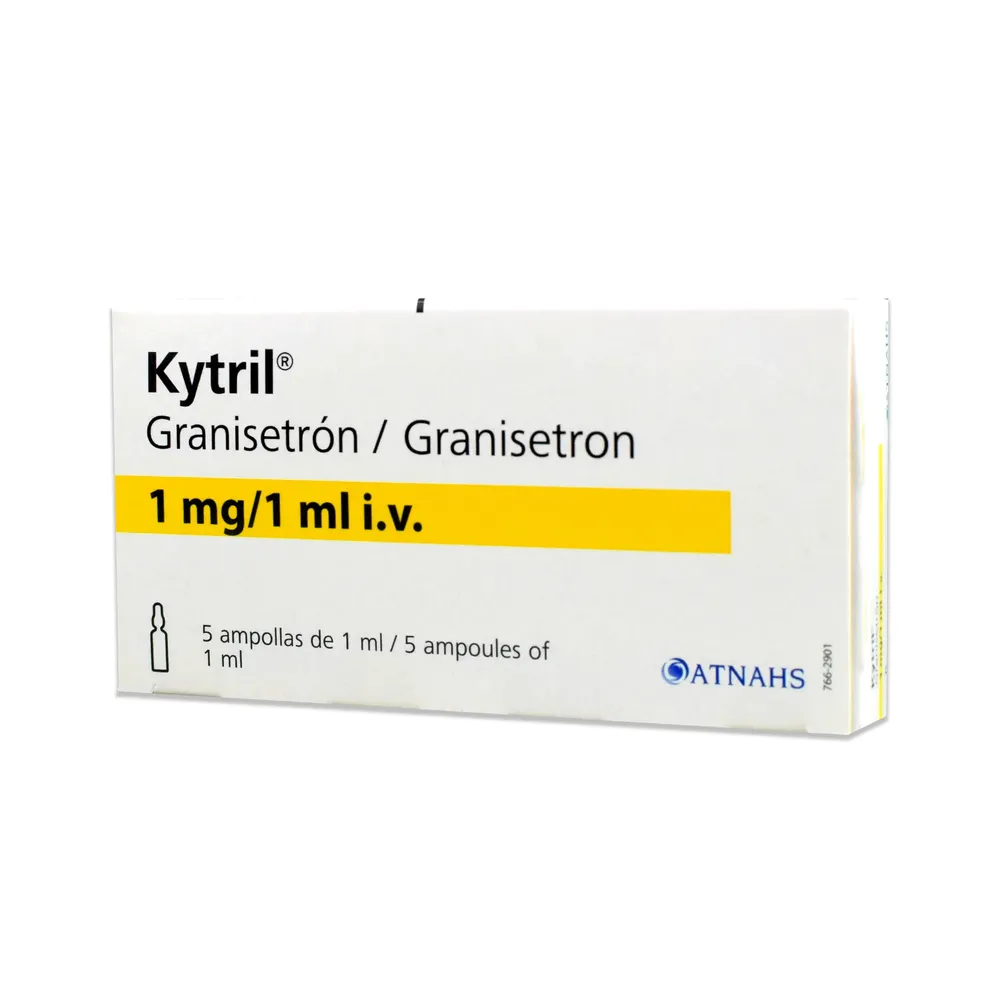
Instructions for Use
Package leaflet: Information for the user
Introduction
Package leaflet: information for the user
Kytril 1mg/1ml solution for injection
Granisetron
Read the entire leaflet carefully before you start taking this medicine, because it contains important information for you.
- Keep this leaflet as you may need to read it again.
- If you have any questions, ask your doctor or pharmacist.
- This medicine has been prescribed for you only and must not be given to other people, even if they have the same symptoms as you, because it could harm them.
- If you experience any adverse reactions, consult your doctor, nurse or pharmacist, even if they are adverse reactions not listed in this leaflet. See section 4.
Contents of the leaflet
- What Kytril is and what it is used for
- What you need to know before using Kytril
- How to use Kytril
- Possible side effects
- How to store Kytril
- Contents of the pack and other information
1. What Kytril is and what it is used for
Kytril contains the active substance granisetron. It belongs to a group of medicines known as serotonin 5-HT3 receptor antagonists, or antiemetics, which prevent or reduce nausea and vomiting.
Kytril is indicated for the prevention and treatment of nausea and vomiting (feeling of discomfort) caused by certain treatments, such as chemotherapy or radiotherapy in anticancer therapy, as well as for the treatment and prevention of postoperative nausea and vomiting.
The injectable solution is indicated in adults and children aged 2 years and older.
2. What you need to know before taking Kytril
Do not use Kytril
? if you are allergic (hypersensitive) to granisetron or to any of the other components of Kytril (listed in section 6: Further information).
If you are unsure, consult your doctor, nurse, or pharmacist before receiving the injection.
Warnings and precautions
Talk to your doctor, nurse, or pharmacist before starting Kytril, especially if you:
? have constipation due to intestinal obstruction
? have heart problems, are receiving anticancer medicines that may harm your heart, and/or have electrolyte imbalances such as low levels of potassium, sodium, or calcium (electrolyte disturbances).
? are taking another medicine from the group of “5-HT3 receptor antagonists.” This group includes dolasetron and ondansetron, which, like Kytril, are used to treat and prevent nausea and vomiting.
Serotonin syndrome is a rare but potentially life-threatening reaction that may occur with granisetron (see section 4). It may cause serious changes in how your brain, muscles, and digestive system function. The reaction may occur if you take granisetron alone, but it is more likely to occur if you take granisetron together with other medicines (particularly fluoxetine, paroxetine, sertraline, fluvoxamine, citalopram, escitalopram, venlafaxine, duloxetine). The risk of serotonin syndrome also increases if you are taking medicines containing buprenorphine or other opioids. Make sure to tell your doctor, nurse, or pharmacist about all medicines you are taking.
Other medicines and Kytril
Inform your doctor, nurse, or pharmacist if you are using or have recently used, or might take, any other medicines, including those obtained without a prescription. This is because Kytril may interact with certain medicines. Also, some medicines may interact with this injection.
Tell your doctor, nurse, or pharmacist if you are taking or may have taken other medicines:
? medicines used to treat irregular heartbeats, other “5-HT3 receptor antagonists” such as dolasetron or ondansetron (see “Warnings and precautions”).
? phenobarbital, a medicine used to treat epilepsy
? ketoconazole, a medicine used to treat fungal infections
? erythromycin, an antibiotic used to treat bacterial infections
? SSRIs (selective serotonin reuptake inhibitors) used to treat depression and/or anxiety. For example, fluoxetine, paroxetine, sertraline, fluvoxamine, citalopram, escitalopram
? SNRIs (serotonin and noradrenaline reuptake inhibitors) used to treat depression and/or anxiety. For example: venlafaxine, duloxetine.
- Medicines containing buprenorphine or other opioids.
Pregnancy and breastfeeding
Do not receive this injection if you are pregnant, trying to become pregnant, or breastfeeding, unless your doctor has advised you to do so.
If you are pregnant or breastfeeding, think you may be pregnant, or plan to become pregnant, consult your doctor, nurse, or pharmacist before using this medicine.
Driving and using machines
Kytril is not expected to affect your ability to drive or operate machinery.
Kytril content
Kytril contains less than 1 mmol of sodium (23 mg) per dose (1 mg/1 ml), i.e., essentially “sodium-free.”
3. How to use Kytril
The injection will be administered to you by your doctor or nurse. The recommended dose of Kytril varies from patient to patient. It depends on age, weight, and whether you are taking other medications to prevent or treat nausea and vomiting. Your doctor will decide how much you should be given.
Kytril may be given as an injection into the veins (intravenous route).
Prevention of nausea or vomiting following radiotherapy or chemotherapy
You will be given the injection before radiotherapy or chemotherapy begins. The intravenous injection will last between 30 seconds and 5 minutes, and the usual dose ranges between 1 and 3 mg. The medicine may be diluted before injection.
Treatment of nausea or vomiting following radiotherapy or chemotherapy
The injection lasts between 30 seconds and 5 minutes, and the usual dose is between 1 and 3 mg. The medicine may be diluted before intravenous injection. To control nausea, you may receive additional injections after the first dose. At least 10 minutes must pass between doses. The maximum daily dose of Kytril is 9 mg.
Combination with corticosteroids
The effect of the injection may be enhanced by using other medicines called corticosteroids. This may be 8–20 mg of dexamethasone, administered before the start of radiotherapy or chemotherapy, or 250 mg of methylprednisolone administered before the start of chemotherapy and again immediately after its completion.
Use in children for prevention or treatment of nausea or vomiting following radiotherapy or chemotherapy
Kytril is administered by intravenous injection as described above, with the dose adjusted according to the child's weight. The injections are diluted and administered before radiotherapy or chemotherapy and last 5 minutes. Children may receive up to 2 doses per day, with at least 10 minutes between doses.
Treatment of nausea or vomiting following surgery
The intravenous injection lasts between 30 seconds and 5 minutes, and the usual dose is 1 mg. The maximum daily dose of Kytril is 3 mg.
Use in children for prevention or treatment of nausea or vomiting following surgery
This injection must not be administered for the treatment of nausea or discomfort following surgery.
If you use more Kytril than you should
Because this injection is administered by a doctor or nurse, it is unlikely that you will receive more than the correct dose. However, if you are concerned, consult your doctor or nurse. Symptoms of overdose may include mild headache (cephalalgia). You will be treated according to your symptoms.
If you have any further questions about the use of this medicine, ask your doctor, nurse, or pharmacist.
4. Possible adverse effects
Like all medicines, this medicine can cause adverse effects, although not everyone will experience them. If you notice any of the following adverse effects, you should immediately contact your doctor:
? Allergic reactions (anaphylaxis). Signs may include swelling of the throat, or swelling of the face, lips and mouth, and difficulty breathing or swallowing.
- Serotonin syndrome. Signs may include diarrhoea, nausea, vomiting, high temperature and blood pressure, excessive sweating, rapid heartbeat, agitation, confusion, hallucinations, chills, muscle tremors, twitching or stiffness, loss of coordination, and restlessness. This reaction may occur when taking Kytril alone, but is more likely when taken with other medicines (see “Warnings and precautions”).
Other adverse effects that may occur while taking this medicine are:
Very common: affect more than 1 in 10 people
? headache
? constipation. Your doctor will monitor your condition.
Common: may affect up to 1 in 10 people
? difficulty sleeping (insomnia)
? blood tests show changes in liver function
? diarrhoea
Uncommon: may affect up to 1 in 100 people
? skin rashes or an allergic reaction or urticaria. Signs may include itchy red spots.
? changes in heart rhythm (beat) and changes in the ECG (electrocardiogram).
? abnormal involuntary movements, such as tremors, muscle stiffness, and muscle contractions.
Reporting of adverse effects
If you experience any type of adverse effect, consult your doctor or pharmacist, even if it is a possible adverse effect not listed in this leaflet. You can also report them directly via the Spanish Pharmacovigilance System for Human Medicinal Products, Appendix V. https://www.notificaRAM.es. By reporting adverse effects, you can help provide more information on the safety of this medicine.
5. Storage of Kytril
Keep this medicine out of the sight and reach of children.
Do not use this medicine after the expiry date stated on the packaging and/or ampoule after "EXP". The expiry date refers to the last day of the stated month.
Kytril should be stored below 30°C, protected from light.
After dilution, the diluted solution must be stored between 2°C and 8°C and used within 24 hours of dilution.
Medicines must not be disposed of via wastewater or household waste. Ask your pharmacist how to dispose of medicines and packaging that you no longer need. This will help protect the environment.
6. Contents of the pack and other information
Composition of Kytril
The active substance is granisetron.
Each ml of injectable solution contains 1 mg of granisetron (as hydrochloride).
The other components are sodium chloride, water for injections, citric acid monohydrate, hydrochloric acid, and sodium hydroxide to adjust the pH (acidity).
Appearance of Kytril and pack contents
Kytril solution is a clear, colourless liquid in clear glass vials with a nominal volume of 1 ml. Each pack contains 1 or 5 vials. Not all pack sizes may be marketed.
Each 1 ml of Kytril solution contains 1 mg of granisetron (as hydrochloride).
Each 1 ml vial contains 1 mg of granisetron (as hydrochloride).
Preparation of dilution
For single use only. Dilute before use. The medicine requires dilution prior to administration, whether by injection or infusion.
Other presentations:
Kytril 3 mg/3 ml injectable solution (hospital use)
Kytril 1 mg tablets (hospital diagnosis)
Marketing Authorisation Holder and Manufacturer
Marketing Authorisation Holder:
Atnahs Pharma Netherlands B.V.
Copenhagen Towers
Ørestads Boulevard 108, 5.tv
DK-2300 København S
Denmark
Manufacturer:
Cenexi
52, rue M. et J. Gaucher
94120 Fontenay-sous-Bois
France
This medicine is authorised in the European Economic Area (EEA) Member States and in the United Kingdom (Northern Ireland) under the following names:
Austria, Belgium, Czech Republic, Estonia, Finland, France, Ireland, Italy, Latvia, Netherlands, Slovak Republic, Slovenia, Spain, United Kingdom (Northern Ireland): Kytril
Germany: Kevatril
Date of the latest revision of this leaflet: March 2025
Other sources of information
Detailed information on this medicine is available on the website of the Spanish Agency for Medicines and Health Products (AEMPS) http://www.aemps.gob.es/
Similar Medications
-
Granisetron Normon 1 mg/1 ml solution for injection EFG
Form: solution for injection
Active substance Dosage GRANISETRON HYDROCHLORIDE 1,12 mg Manufacturer: Laboratorios Normon S.A.
-
Kytril 3 mg/3 ml solution for injection
Form: solution for injection
Active substance Dosage GRANISETRON HYDROCHLORIDE 3 mg Manufacturer: Atnahs Pharma Netherlands Bv.
This page has been machine-translated and may contain inaccuracies. The original data is available in the manufacturing country's language.
Last data check: May 18, 2026 · Data source: CIMA — AEMPS