Kyprolis 30 mg powder for solution for infusion
Spain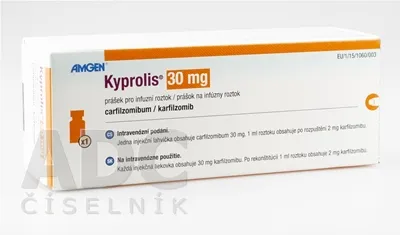
Table of Contents
Package leaflet: Information for the user
Introduction
Package leaflet: information for the patient
Kyprolis 10 mg powder for solution for infusion
Kyprolis 30 mg powder for solution for infusion
Kyprolis 60 mg powder for solution for infusion
carfilzomib
Read the entire leaflet carefully before you start using this medicine, because it contains important information for you.
- Keep this leaflet, as you may need to read it again.
- If you have any questions, ask your doctor or nurse.
- If you experience any adverse reactions, talk to your doctor or nurse, even if they are not listed in this leaflet. See section 4.
Leaflet contents
- What Kyprolis is and what it is used for
- What you need to know before using Kyprolis
- How to use Kyprolis
- Possible side effects
- How to store Kyprolis
- Contents of the pack and other information
1. What Kyprolis is and what it is used for
Kyprolis is a medicine that contains the active substance carfilzomib.
Carfilzomib works by blocking the proteasome. The proteasome is a system within cells that breaks down proteins when they are damaged or no longer needed. By preventing the breakdown of proteins in cancer cells—which are more likely to contain an increased amount of abnormal proteins—Kyprolis causes the death of cancer cells.
Kyprolis is used to treat adult patients with multiple myeloma who have received at least one prior therapy for this disease. Multiple myeloma is a cancer of plasma cells (a type of white blood cells).
You will be given Kyprolis in combination with daratumumab and dexamethasone, with lenalidomide and dexamethasone, or with dexamethasone alone. Daratumumab, lenalidomide, and dexamethasone are other medicines used to treat multiple myeloma.
2. What you need to know before using Kyprolis
Your doctor will examine you and review your complete medical history. You will be closely monitored during treatment.
Before starting treatment with Kyprolis, and during treatment, you will have blood tests. These will verify that you have sufficient blood cells and that your liver and kidneys are functioning properly. Your doctor or nurse will ensure that you receive an adequate amount of fluids.
You should read the package leaflet of all medications you are using in combination with Kyprolis so that you can understand the information related to these medicines.
Do not use Kyprolis if you are allergic to carfilzomib or to any of the other components of this medicine (listed in section 6).
Warnings and precautions
Talk to your doctor or nurse before starting to use Kyprolis if you have any of the conditions listed below. You may need to undergo additional tests to check that your heart, kidneys, and liver are functioning properly.
- Heart problems, including history of chest pain (angina), heart attack, irregular heartbeat, high blood pressure, or if you have ever taken a medicine for heart problems
- Lung problems, including history of shortness of breath at rest or during activity (dyspnea)
- Kidney problems, including kidney failure, or if you have ever received dialysis
- Liver problems, including history of hepatitis, fatty liver, or if you have ever been told that your liver is not working properly
- Unusual bleeding, including easy bruising, bleeding from an injury such as a cut that takes longer than expected to stop, or internal bleeding such as coughing up blood, vomiting blood, black stools, or stools with bright red blood; or brain bleeding causing sudden numbness or paralysis on one side of the face, legs or arms, sudden severe headache, vision problems, speech difficulties, or trouble swallowing. This may indicate a low platelet count (cells that help blood to clot)
- History of blood clots in your veins
- Pain in arms or legs or swelling (which could be symptoms of blood clots in the deep veins of the arms or legs), chest pain or difficulty breathing (which could be symptoms of blood clots in the lungs)
- Any other serious illness for which you have been hospitalized or received treatment.
Symptoms to watch for
You should be aware of certain symptoms while taking Kyprolis to reduce the risk of complications. Kyprolis can worsen some symptoms or cause serious, potentially fatal side effects, such as heart, lung, or kidney problems, tumor lysis syndrome (a potentially life-threatening condition that occurs when cancer cells break apart and release their contents into the blood), infusion reactions to Kyprolis, unusual bruising or bleeding (including internal bleeding), blood clots in your veins, liver problems, certain blood disorders, or a neurological syndrome known as PML. See the section "Signs and symptoms to watch for" in section 4.
Tell your doctor if you have ever had, or may currently have, hepatitis B virus infection. This medicine could cause the hepatitis B virus to become reactivated. Your doctor will check for signs of this infection before, during, and for some time after stopping treatment with this medicine. Inform your doctor immediately if you experience worsening fatigue or notice yellowing of the skin or whites of the eyes.
At any time during or after completing treatment, inform your doctor or nurse immediately if you experience blurred vision, loss of vision or double vision, difficulty speaking, weakness in one arm or leg, changes in the way you walk, balance problems, persistent numbness, reduced sensation, loss of sensation, memory loss, or confusion. These may be symptoms of a potentially fatal brain disease known as progressive multifocal leukoencephalopathy (PML). If you had these symptoms before treatment with carfilzomib, inform your doctor about any changes in these symptoms.
Other medicines and Kyprolis
Tell your doctor if you are taking, have recently taken, or might need to take any other medicines. This includes any medicines obtained without a prescription, such as vitamins or herbal remedies.
Tell your doctor or nurse if you are taking medicines used to prevent pregnancy, such as oral contraceptives or other hormonal contraceptives, as these may not be suitable for use with Kyprolis.
Pregnancy and breastfeeding
For women taking Kyprolis
Do not take Kyprolis if you are pregnant, think you may be pregnant, or plan to become pregnant. Treatment with Kyprolis has not been evaluated in pregnant women. While taking Kyprolis and for 30 days after stopping treatment, you must use an effective method of contraception to ensure you do not become pregnant. Discuss appropriate contraceptive methods with your doctor or nurse.
If you become pregnant while receiving Kyprolis, inform your doctor or nurse immediately.
Do not take Kyprolis if you are breastfeeding. It is not known whether Kyprolis is excreted in human milk.
Lenalidomide is expected to be harmful to the fetus. Kyprolis is administered in combination with lenalidomide; therefore, you must follow the Pregnancy Prevention Program (refer to the lenalidomide package leaflet for information on pregnancy prevention and speak with your doctor, pharmacist, or nurse).
For men taking Kyprolis
While taking Kyprolis and for 90 days after stopping treatment, you must use a condom, even if your partner is pregnant.
If your partner becomes pregnant while you are receiving Kyprolis or within 90 days after stopping treatment, inform your doctor or nurse immediately.
Driving and using machines
While receiving Kyprolis treatment, you may experience fatigue, dizziness, fainting, and/or low blood pressure. This may affect your ability to drive or operate machinery. Do not drive or operate machinery if you have these symptoms.
Kyprolis contains sodium
This medicine contains 37 mg of sodium per 10 mg vial. This corresponds to 1.9% of the maximum recommended daily intake of 2 g of sodium for an adult.
This medicine contains 109 mg of sodium per 30 mg vial. This corresponds to 5.5% of the maximum recommended daily intake of 2 g of sodium for an adult.
This medicine contains 216 mg of sodium per 60 mg vial. This corresponds to 11% of the maximum recommended daily intake of 2 g of sodium for an adult.
Kyprolis contains cyclodextrin
This medicine contains 500 mg of cyclodextrin (sulfobutyl ether beta-cyclodextrin sodium) in each 10 mg vial, equivalent to 88 mg/kg for a 70 kg adult.
This medicine contains 1,500 mg of cyclodextrin (sulfobutyl ether beta-cyclodextrin sodium) in each 30 mg vial, equivalent to 88 mg/kg for a 70 kg adult.
This medicine contains 3,000 mg of cyclodextrin (sulfobutyl ether beta-cyclodextrin sodium) in each 60 mg vial, equivalent to 88 mg/kg for a 70 kg adult.
3. How to use Kyprolis
Kyprolis will be administered to you by a doctor or nurse. The dose will be calculated based on your height and weight (body surface area). Your doctor or nurse will determine the dose of Kyprolis you receive.
You will receive Kyprolis as an intravenous infusion. The infusion may last up to 30 minutes. Kyprolis is given for 2 consecutive days each week, for 3 weeks, followed by 1 week without treatment.
Each 28-day period is a treatment cycle. This means you will receive Kyprolis on days 1, 2, 8, 9, 15, and 16 of each 28-day cycle. If you are receiving Kyprolis in combination with lenalidomide and dexamethasone, the doses on days 8 and 9 of each cycle will not be administered starting from cycle 13.
Most patients will continue treatment as long as their disease improves or remains stable. However, treatment with Kyprolis should also be discontinued if you develop adverse effects that cannot be controlled.
In addition to Kyprolis, you will also receive lenalidomide and dexamethasone, daratumumab and dexamethasone, or dexamethasone alone. You may also receive other medications.
If you use more Kyprolis than you should
This medicine will be administered by a doctor or nurse, so it is unlikely that you will receive more than the prescribed amount. However, if you do receive more Kyprolis than you should, your doctor will monitor you for adverse effects.
If you have any doubts about the use of this medicine, consult your doctor or nurse.
4. Possible adverse effects
Like all medicines, this medicine can cause adverse effects, although not everyone will experience them.
Signs and symptoms to watch for
Some adverse effects may be serious. Immediately tell your doctor if you experience any of the following symptoms:
- Chest pain, difficulty breathing, or swelling in the feet, which may be symptoms of heart problems
- Breathing difficulties, including shortness of breath at rest or during activity or cough (dyspnea), rapid breathing, feeling unable to breathe despite sufficient oxygen, wheezing (noises when breathing), or cough, which may be signs of pulmonary toxicity
- Very high blood pressure, severe chest pain, sudden severe headache, confusion, blurred vision, nausea and vomiting, or anxiety crisis, which may be signs of a disorder known as hypertensive crisis
- Difficulty breathing during daily activities or at rest, irregular heartbeat,
- rapid pulse, fatigue, dizziness, and fainting, which may be signs of a disorder known as pulmonary hypertension
- Swelling in the ankles, feet, or hands, loss of appetite, reduced urine output, or abnormal blood test results, which may be symptoms of kidney problems or kidney failure
- An adverse effect known as Tumour Lysis Syndrome, which may result from the rapid breakdown of tumour cells and may cause irregular heartbeats, kidney failure, or abnormal blood test results
- Fever, chills or shivering, joint pain, muscle pain, facial congestion or swelling of the face, lips, tongue, and/or throat that may cause difficulty breathing or swallowing (angioedema), weakness, difficulty breathing, low blood pressure, fainting, slow heart rate, chest tightness, or chest pain, which may occur as a reaction to infusion
- Unusual bruising or bleeding, such as a cut that takes longer than usual to stop bleeding; or internal bleeding such as coughing up blood, vomiting blood, black stools, or bright red blood in stools; or brain bleeding causing sudden numbness or paralysis on one side of the face, legs, or arms, sudden severe headache, vision problems, speech difficulties, or difficulty swallowing (dysphagia)
- Pain in arms or legs or swelling (which could be symptoms of blood clots in the deep veins of the arms or legs), chest pain or difficulty breathing (which could be symptoms of blood clots in the lungs)
- Yellowing of the skin and eyes (jaundice), abdominal pain or swelling, nausea or vomiting, which could be symptoms of liver problems, including liver failure. If you have ever had hepatitis B virus infection, treatment with this medicine may cause reactivation of hepatitis B virus infection.
- Bleeding, bruising, weakness, confusion, fever, nausea, vomiting, diarrhea, and acute kidney failure, which may be signs of a blood disorder known as thrombotic microangiopathy
- Headaches, confusion, seizures (fits), vision loss, and high blood pressure (hypertension), which may be symptoms of a neurological disorder called reversible posterior encephalopathy syndrome (RPES).
Other possible adverse effects
Very common adverse effects (may affect more than 1 in 10 people)
- Severe lung infection (pneumonia)
- Respiratory tract infection (respiratory infection)
- Low platelet counts, which may cause bruising or bleeding (thrombocytopenia)
- Low white blood cell count, which may reduce your ability to fight infections and may be associated with fever
- Low red blood cell count (anemia), which may cause tiredness and fatigue
- Changes in blood tests (decreased blood potassium levels, increased blood creatinine levels)
- Loss of appetite
- Difficulty sleeping (insomnia)
- Headache
- Numbness, tingling, or reduced sensation in the hands and/or feet
- Dizziness
- High blood pressure (hypertension)
- Difficulty breathing
- Cough
- Diarrhea
- Nausea
- Constipation
- Vomiting
- Stomach pain
- Back pain
- Joint pain
- Pain in limbs, hands, or feet
- Muscle spasms
- Fever
- Chills
- Swelling of the hands, feet, or ankles
- Weakness
- Tiredness (fatigue)
Common adverse effects (may affect up to 1 in 10 people)
- Infusion reactions
- Heart failure and heart problems including rapid, strong, or irregular heartbeats
- Heart attack
- Kidney problems, including kidney failure
- Blood clots in veins (deep vein thrombosis)
- Hot flushes
- Blood clots in the lungs
- Fluid in the lungs
- Wheezing (noises when breathing)
- Serious infection, including infection in the blood (sepsis)
- Lung infection
- Liver problems, including increased liver enzymes in the blood
- Flu-like symptoms (flu)
- Reactivation of the chickenpox virus, which may cause a skin rash and pain (herpes zoster)
- Urinary tract infection (infection of the structures that carry urine)
- Cough, which may include chest tightness or pain, nasal congestion (bronchitis)
- Sore throat
- Inflammation of the nose and throat
- Runny nose, nasal congestion, or sneezing
- Viral infection
- Stomach and intestinal infection (gastroenteritis)
- Bleeding in the stomach and intestines
- Changes in blood tests (decreased blood sodium, magnesium, protein, calcium, or phosphate levels; increased blood calcium, uric acid, potassium, bilirubin, or C-reactive protein levels, or increased blood sugar)
- Dehydration
- Anxiety
- Feeling confused
- Blurred vision
- Cataracts
- Low blood pressure (hypotension)
- Nosebleeds
- Voice changes or hoarseness
- Indigestion
- Toothache
- Skin rash
- Bone pain, muscle pain, and chest pain
- Muscle weakness
- Sore muscles
- Itching of the skin
- Redness of the skin
- Increased sweating
- Pain
- Pain, swelling, irritation, or discomfort at the site where the intravenous injection was given
- Ringing in the ears (tinnitus)
- Feeling unwell or general malaise
Uncommon adverse effects (may affect up to 1 in 100 people)
- Bleeding in the lungs
- Inflammation of the colon caused by Clostridium difficile bacteria
- Allergic reaction to Kyprolis
- Multi-organ failure
- Reduced blood flow to the heart
- Brain hemorrhage
- Stroke
- Difficulty breathing, rapid breathing, and/or bluish tint in the fingertips and lips (acute respiratory distress syndrome)
- Swelling of the lining of the heart (pericarditis); symptoms include pain behind the breastbone, sometimes spreading to the neck and shoulders, sometimes with fever
- Fluid accumulation around the heart lining (pericardial effusion); symptoms include chest pain or pressure and difficulty breathing
- Blockage of bile flow from the liver (cholestasis), which may cause itching of the skin, yellowing of the skin, very dark urine, and very pale stools
- Perforation of the digestive tract
- Cytomegalovirus infection
- Reactivated hepatitis B virus infection (viral inflammation of the liver)
- Pancreatitis
Reporting of adverse effects
If you experience any adverse effect, talk to your doctor, pharmacist, or nurse, even if it is a possible adverse effect not listed in this leaflet.
You may also report them directly through the national reporting system listed in Appendix V. By reporting adverse effects, you can help provide more information on the safety of this medicine.
5. Storage of Kyprolis
Kyprolis will be stored in the pharmacy.
Keep this medicine out of the sight and reach of children.
Do not use this medicine after the expiry date stated on the vial and the carton. The expiry date refers to the last day of the month indicated.
Store in a refrigerator (between 2°C and 8°C).
Do not freeze.
Keep the product in its original packaging to protect it from light.
The reconstituted product should be a clear solution, colourless to slightly yellowish. Do not administer if any change in colour or presence of particles is observed.
Kyprolis is intended for single use only. Any unused medicine and all materials that have come into contact with it must be disposed of in accordance with local regulations.
6. Contents of the pack and other information
Composition of Kyprolis
-
The active substance is carfilzomib. Each vial contains 10 mg, 30 mg or 60 mg of carfilzomib.
-
After reconstitution, 1 ml of solution contains 2 mg of carfilzomib.
-
The other components are sodium sulfobutyl ether beta-cyclodextrin, anhydrous citric acid (E330) and sodium hydroxide (see section 2, “Kyprolis contains sodium”).
Appearance of the product and contents of the container
Kyprolis is supplied in a glass vial as a white to off-white powder for solution for infusion, which is reconstituted (dissolved) before use. The reconstituted solution is a clear, colourless or slightly yellowish solution.
Each pack contains 1 vial.
Marketing Authorisation Holder and Manufacturer
Amgen Europe B.V.
Minervum 7061,
4817 ZK Breda,
The Netherlands
Marketing Authorisation Holder
Amgen Europe B.V.
Minervum 7061
4817 ZK Breda
The Netherlands
Manufacturer
Amgen Technology (Ireland) Unlimited Company
Pottery Road
Dun Laoghaire
Co Dublin
Ireland
Manufacturer
Amgen NV
Telecomlaan 5-7
1831 Diegem
Belgium
Further information on this medicinal product is available upon request to the local representative of the Marketing Authorisation Holder.
Belgium/Belgium/Belgium s.a. Amgen n.v. Tel/Tél: +32 (0)2 7752711 | Lithuania Amgen Switzerland AG Vilnius Branch Tel: +370 5 219 7474 |
| Luxembourg/Luxembourg s.a. Amgen Belgium/Belgium Tel/Tél: +32 (0)2 7752711 |
Czech Republic Amgen s.r.o. Tel: +420 221 773 500 | Hungary Amgen Kft. Tel.: +36 1 35 44 700 |
Denmark Amgen, branch of Amgen AB, Sweden Tlf: +45 39617500 | Malta Amgen B.V. The Netherlands Tel: +31 (0)76 5732500 |
Germany AMGEN GmbH Tel.: +49 89 1490960 | Netherlands Amgen B.V. Tel: +31 (0)76 5732500 |
Estonia Amgen Switzerland AG Vilnius Branch Tel: +372 586 09553 | Norway Amgen AB Tel: +47 23308000 |
Greece Amgen Hellas Pharmaceutical E.P.E. Tel.: +30 210 3447000 | Austria Amgen GmbH Tel: +43 (0)1 50 217 |
Spain Amgen S.A. Tel: +34 93 600 18 60 | Poland Amgen Biotechnologia Sp. z o.o. Tel.: +48 22 581 3000 |
France Amgen S.A.S. Tél: +33 (0)9 69 363 363 | Portugal Amgen Biofarmacêutica, Lda. Tel: +351 21 4220606 |
Croatia Amgen d.o.o. Tel: +385 (0)1 562 57 20 | Romania Amgen Romania SRL Tel: +4021 527 3000 |
Ireland Amgen Ireland Limited Tel: +353 1 8527400 | Slovenia AMGEN zdravila d.o.o. Tel: +386 (0)1 585 1767 |
Iceland Vistor hf. Sími: +354 535 7000 | Slovakia Amgen Slovakia s.r.o. Tel: +421 2 321 114 49 |
Italy Amgen S.r.l. Tel: +39 02 6241121 | Finland Amgen AB, branch in Finland/Amgen AB, filial i Finland Puh/Tel: +358 (0)9 54900500 |
Cyprus C.A. Papaellinas Ltd Tel.: +357 22741 741 | Sweden Amgen AB Tel: +46 (0)8 6951100 |
Latvia Amgen Switzerland AG Riga Branch Tel: +371 257 25888 | United Kingdom (Northern Ireland) Amgen Limited Tel: +44 (0)1223 420305 |

Date of the most recent review of this leaflet
Other sources of information
Detailed information on this medicinal product is available on the European Medicines Agency website: http://www.ema.europa.eu.
This leaflet can be found on the European Medicines Agency website in all languages of the European Union/European Economic Area.
This information is intended for healthcare professionals only:
Instructions for reconstitution and preparation of Kyprolis powder for solution for intravenous infusion
Carfilzomib is a cytotoxic agent. Therefore, Kyprolis must be handled and prepared with caution. The use of gloves and other protective equipment is recommended.
Kyprolis vials do not contain antimicrobial preservatives and are intended for single use only. Appropriate aseptic technique must be applied.
The reconstituted solution contains carfilzomib at a concentration of 2 mg/ml. Read the complete preparation instructions before reconstitution.
-
Calculate the dose (mg/m²) and the number of Kyprolis vials required based on the patient's body surface area (BSA). Patients with a BSA greater than 2.2 m² should receive a dose based on a BSA of 2.2 m². Dose adjustments are not required for weight changes ≤ 20%.
-
Remove the vial from the refrigerator immediately before use.
-
Use only a 21 G or larger gauge needle (needle outer diameter of 0.8 mm or less) to aseptically reconstitute each vial by slowly injecting 5 ml (for the 10 mg vial), 15 ml (for the 30 mg vial), or 29 ml (for the 60 mg vial) of sterile water for injections through the stopper, directing the stream toward the INNER WALL OF THE VIAL to minimize foaming.
-
Gently and slowly rotate and/or invert the vial for approximately 1 minute, or until complete dissolution is achieved. DO NOT SHAKE. If foam forms, allow the solution to stand in the vial until the foam subsides (approximately 5 minutes) and the solution becomes clear.
-
Visually inspect for particles and discoloration prior to administration. The reconstituted product should be a clear, colourless to slightly yellowish solution. Do not administer if discoloration or particulate matter is observed.
-
Discard any unused portion remaining in the vial.
-
Kyprolis may be administered directly as an intravenous infusion or, optionally, via an intravenous bag.
-
When administering via an intravenous bag, use only a 21 G or larger gauge needle (needle outer diameter of 0.8 mm or less) to withdraw the calculated dose from the vial and dilute it in a 50 or 100 ml intravenous bag containing 5% glucose injection solution.
From a microbiological standpoint, the product should be used immediately. If not used immediately, the user is responsible for the in-use storage times and conditions, which must not exceed 24 hours at 2°C to 8°C.
Disposal of unused medicinal product and all materials that have come into contact with it must be carried out in accordance with local regulations.