Kybernin P 1000 IU, powder and solvent for solution for injection or infusion
Spain
Table of Contents
- Package leaflet: Information for the user
- Introduction
- 1. What Kybernin P is and what it is used for
- 2. What you need to know before using Kybernin P
- **Pregnancy, lactation and fertility**
- **Driving and Use of Machines**
- 3. How to use Kybernin P
- 4. Possible adverse effects
- 5. Storage of Kybernin P
- 6. Package contents and other information
Package leaflet: Information for the user
Introduction
Package leaflet: information for the user
Kybernin P 1000 IU powder and solvent for solution for injection and for infusion.
Human antithrombin III
Read all of this leaflet carefully before you start using this medicine because it contains important information for you.
- Keep this leaflet. You may need to read it again.
- If you have any questions, ask your doctor or pharmacist.
- This medicine has been prescribed for you only. Do not pass it on to other people, even if they have the same symptoms as you, as it may harm them.
- If you experience any side effects, talk to your doctor or pharmacist, even if they are side effects not listed in this leaflet. See section 4.
Contents of this leaflet
- What Kybernin P is and what it is used for
- What you need to know before using Kybernin P
- How to use Kybernin P
- Possible side effects
- How to store Kybernin P
- Contents of the pack and other information
1. What Kybernin P is and what it is used for
Kybernin P is a powder and solvent for injectable solution and for infusion.
This medicine belongs to a group of medicines called antithrombotic agents.
Kybernin P is used if you have congenital antithrombin deficiency, to prevent the formation and development of blood clots in the blood vessels of your legs (deep vein thrombosis) or in other vessels of your body (thromboembolism) during surgery or in the peripartum period, and in combination with heparin if indicated.
Kybernin P is also used if you have acquired antithrombin deficiency.
2. What you need to know before using Kybernin P
Do not use Kybernin P:
If you are allergic to the active substance or to any of the other components of this medicine (listed in section 6).
Warnings and precautions
As with any protein-based product for intravenous administration, allergic-type hypersensitivity reactions may occur. Close monitoring and careful observation of patients are required to detect any symptoms during the infusion period. Patients should be informed about the early signs of hypersensitivity reactions, including skin rashes which may progress to generalized urticaria, chest tightness, difficulty breathing, hypotension, and anaphylaxis. If these symptoms occur after administration, contact your doctor.
In case of shock, current guidelines for its treatment should be followed.
Viral safety
When administering medicinal products derived from human blood or plasma, certain measures must be taken to prevent transmission of infections to patients. These measures include:
- Careful selection of donors to exclude those at risk of carrying infectious diseases,
- Testing of individual donations and plasma pools for specific markers of infection,
- Inclusion of steps in the manufacturing process to eliminate/inactivate viruses.
Despite these measures, when medicinal products derived from human blood or plasma are administered, the possibility of transmitting infectious agents cannot be completely ruled out. This also applies to emerging viruses or those of unknown origin, and to other types of infections.
The measures taken are considered effective against enveloped viruses such as human immunodeficiency virus (HIV), hepatitis B virus (HBV), hepatitis C virus (HCV), and against non-enveloped viruses such as hepatitis A (HAV) and parvovirus B19.
Your doctor may recommend that you consider vaccination against hepatitis A and B if you regularly receive antithrombin-containing products derived from human plasma.
It is highly recommended that each time Kybernin P is administered to a patient, the name of the medicine and the batch number used should be recorded, in order to maintain a traceable link between the patient and the product batch.
Clinical and biological monitoring when antithrombin and heparin are administered together:
- To adjust the heparin dose and avoid excessive anticoagulation, regular monitoring of anticoagulation extent (aPTT, and anti-FXa activity when appropriate) should be performed at short intervals, especially during the first minutes/hours after initiating antithrombin administration.
- Daily determination of antithrombin levels to adjust individual dosing, due to the risk of decreased antithrombin levels resulting from prolonged treatment with unfractionated heparin.
Use of Kybernin P with other medicines
Heparin: Replacement of antithrombin during administration of therapeutic doses of heparin increases the risk of bleeding. The effect of antithrombin is greatly enhanced by heparin. The half-life of antithrombin may be considerably reduced by concomitant treatment with heparin due to accelerated clearance of antithrombin. Therefore, simultaneous administration of heparin and antithrombin to patients at high risk of bleeding should be clinically and biologically monitored.
Inform your doctor or pharmacist if you are taking, have recently taken, or might need to take any other medicines.
Pregnancy, lactation and fertility
Experience regarding the safety of human antithrombin products for use during human pregnancy is limited.
The safety of using Kybernin P during human pregnancy has not been established in controlled clinical trials. Animal studies are insufficient to assess safety with regard to reproduction, embryo-fetal development, course of gestation, and peri- and postnatal development.
There are no negative experiences reported with regard to treatment during pregnancy and lactation.
Therefore, Kybernin P should be administered to pregnant or lactating women with antithrombin deficiency only if clearly indicated, taking into account that pregnancy increases the risk of thromboembolic episodes in these patients.
If you are pregnant, breastfeeding, think you may be pregnant, or are planning to become pregnant, consult your doctor or pharmacist before using this medicinal product. Your doctor will weigh the potential risk to the fetus and will advise you whether treatment with this medicine is appropriate. Your doctor will recommend this treatment only if clearly indicated.
Driving and Use of Machines
There is no indication that Kybernin P may affect the ability to drive vehicles or operate machinery.
Kybernin P contains sodium
Patients on sodium-restricted diets should be aware that Kybernin P 1000 IU contains up to 89.52 mg (3.894 mmol) of sodium per 1,000 IU.
3. How to use Kybernin P
Kybernin P is a hospital-use medicine, so it will be administered to you in a
hospital by the appropriate healthcare staff.
Kybernin P is administered by first preparing a solution, which is then slowly injected or infused intravenously (maximum 4 ml/min).
Follow exactly the administration instructions for this medicine as indicated by your doctor or pharmacist. If in doubt, consult your doctor or pharmacist again.
Your doctor will determine how often and at what intervals Kybernin P should be administered.
Your doctor will inform you of the duration of your treatment with Kybernin P.
If you use more Kybernin P than you should:
Symptoms of overdose with antithrombin have not been reported.
In case of overdose or accidental administration, contact the Toxicology Information Service. Telephone 91 562 04 20.
If you forget to use Kybernin P:
- Consult your doctor or pharmacist immediately.
- Do not administer a double dose to make up for missed doses.
4. Possible adverse effects
Like all medicines, this medicine may cause adverse effects, although not everybody gets them.
The following adverse reactions are based on post-marketing experience. When available, the following standard frequency categories have been used:
Very common >1/10
Common >1/100 to <1/10
Uncommon ≥ 1/1,000 to < 1/100
Rare ≥ 1/10,000 to < 1/1,000
Very rare < 1/10,000 (including individual cases reported)
System Organ Class | Preferred Term | Frequency |
Immune system disorders | Hypersensitivity/anaphylactic reactions, including severe anaphylaxis and shock. | Rare |
General disorders and administration site conditions | Pyrexia | Rare |
For information on viral safety, see “Warnings and precautions” in section 2 of this leaflet.
Reporting of adverse reactions
If you experience any type of adverse reaction, consult your doctor or pharmacist, even if it is an adverse reaction not listed in this leaflet. You may also report them directly via the Spanish Pharmacovigilance System for Human Medicinal Products: https://www.notificaram.es. By reporting adverse reactions, you can help provide more information on the safety of this medicine.
5. Storage of Kybernin P
Keep this medicine out of the sight and reach of children.
Do not store above 25 °C. Do not freeze.
Do not use this medicine after the expiry date stated on the container after EXP. The expiry date refers to the last day of the month indicated.
Do not use solutions that are cloudy or contain residues (deposits/particulate matter).
After reconstitution, physico-chemical stability has been demonstrated for up to 8 hours at room temperature (maximum 25 °C). From a microbiological standpoint, since Kybernin P does not contain preservatives, the reconstituted solution should be used immediately. If this is not possible, do not store for longer than 8 hours at room temperature (maximum 25 °C).
Any unused medicine or waste material must be disposed of in accordance with local regulations.
Medicines must not be disposed of via wastewater or household waste. Ask your pharmacist how to dispose of medicines and packaging that you no longer need. This will help protect the environment.
6. Package contents and other information
Composition of Kybernin P 1,000 IU
- The active substance is antithrombin III. Each lyophilized vial contains 1,000 IU of antithrombin III. The reconstituted solution contains approximately 50 IU of antithrombin III/mL of antithrombin derived from human plasma when reconstituted with 20 mL of water for injections.
The potency (IU) is determined using the Chromogenic Substrate Method according to the European Pharmacopoeia. The specific activity of Kybernin P is approximately 5.3 IU/mg of protein.
- The other components are: glycine, sodium chloride, sodium citrate, hydrochloric acid or sodium hydroxide (to adjust pH), and water for injections.
See section 2 for important information about some of the excipients.
Appearance of the product and contents of the pack
Powder and solvent for solution for injection and infusion.
The marketing pack contains one type II molded glass vial (according to Ph. Eur.), colourless, sealed with a rubber stopper, plastic disc and aluminium cap containing the lyophilized powder, one vial containing 20 mL of water for injections (solvent for preparation of the solution), and one transfer device.
Presentations:
Individual pack of Kybernin P 1,000 IU:
1 lyophilized vial
1 vial with 20 mL of water for injections
1 transfer device
Clinical pack of Kybernin P 1,000 IU:
10 lyophilized vials
10 vials with 20 mL of water for injections
10 transfer devices
Only certain pack sizes may be marketed.
Marketing Authorization Holder and Manufacturer
Marketing Authorization Holder:
CSL Behring, S.A.
C/ Tarragona 157, 18th floor
08014 Barcelona - Spain
Manufacturer:
CSL Behring GmbH
Emil-von-Behring-Str. 76
35041 Marburg - Germany
Date of the most recent revision of this leaflet: November 2020
Detailed and up-to-date information on this medicine is available on the website of the Spanish Agency of Medicines and Health Products (AEMPS) http://www.aemps.gob.es
This information is intended for healthcare professionals only:
Dosage
In congenital deficiency, the dose should be individualized for each patient, taking into account family history regarding thromboembolic episodes, the patient's clinical risk factors, and laboratory tests.
The dosage and duration of replacement therapy in acquired deficiency depend on the plasma antithrombin level, the presence of signs of increased consumption, the underlying disorder, and the severity of the patient's clinical condition. The dose and frequency of administration must always be based on clinical efficacy and laboratory tests in each individual case.
The number of antithrombin units administered is expressed in International Units (IU), in relation to the current World Health Organization (WHO) standard for antithrombin. Plasma antithrombin activity is expressed as a percentage (relative to normal human plasma) or in International Units (relative to an international standard for antithrombin in plasma).
One International Unit (IU) of antithrombin activity is equivalent to the amount of antithrombin present in 1 mL of normal human plasma. The calculation of the required antithrombin dose is based on the empirical finding that 1 International Unit (IU) of antithrombin per kg of body weight increases plasma antithrombin activity by approximately 1.5%.
The initial dose is determined by the following formula:
Units required = body weight [kg] × (100 – current antithrombin activity [%]) × 2/3
The antithrombin activity level to be initially achieved depends on the clinical status. When antithrombin replacement is indicated, the dose should be sufficient to achieve the desired antithrombin activity and to maintain an effective level. The dose must be determined and monitored according to laboratory tests of antithrombin activity, which should be performed at least twice daily until the patient is stabilized, and thereafter once daily, preferably immediately before the next infusion. Dose adjustments should take into account both signs of increased antithrombin consumption as indicated by laboratory tests and the patient's clinical evolution. Antithrombin activity should be maintained above 80% during treatment, unless the clinical condition indicates a different efficacy level.
The usual initial dose in congenital deficiency is 30–50 IU/kg.
Therefore, the dose and frequency of administration, as well as the duration of treatment, must be adjusted according to biological data and clinical status.
Paediatric population:
Kybernin P is not recommended for use in children under 6 years of age due to limited data.
Based on clinical experience, the use of antithrombin in the treatment of infant respiratory distress syndrome (IRDS) in premature infants cannot be recommended.
Instructions for correct administration of the preparation
General instructions
The lyophilized powder must be completely reconstituted under aseptic conditions with the accompanying solvent. A clear or slightly opalescent solution is obtained.
The appropriate diluent is a 5% human albumin solution. For dilutions up to 1:5, the following may also be used: Ringer lactate solution, physiological saline solution, 5% glucose solution, or polygeline.
The use of hydroxyethyl starches as solvent (for infusion) is not recommended, as loss of antithrombin activity has been observed.
This medicine must not be mixed with other medicines in the same syringe/infusion set. Dopamine, dobutamine, and furosemide must not be administered through the same intravenous access.
The product must be administered intravenously. Maximum infusion rate: 4 mL/min.
Reconstitution
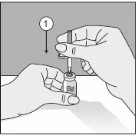
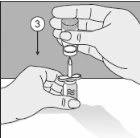
For correct handling of the double-ended Transofix® device, follow the steps below:
-
After removing one of the two protective caps, insert the exposed tip perpendicularly into the rubber stopper of the solvent vial.
-
Remove the protective cap from the second tip.
-
Pierce the product vial cap with this tip.
-
Rotate the entire unit 180°.
-
Position it so that the base of the product vial rests on the surface of the table. The solvent now flows into the product vial.
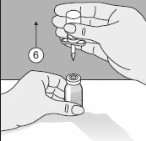
- The double-ended Transofix® device together with the solvent vial is removed from the product vial, and Kybernin P is then dissolved. Reconstituted Kybernin P can be drawn into a syringe and administered.