Kreon 35,000 U gastro-resistant hard capsules
Spain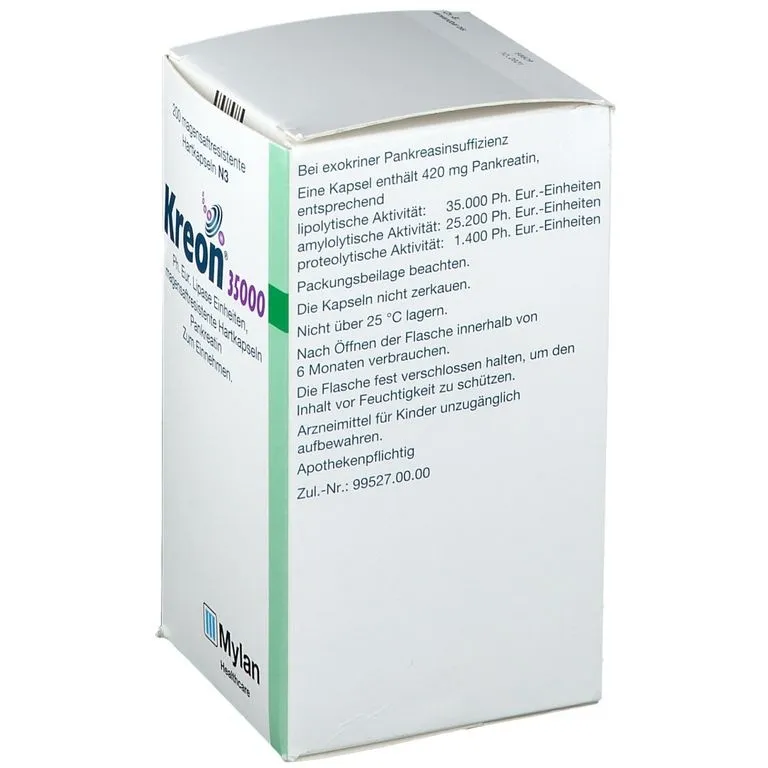
Table of Contents
Package leaflet: Information for the user
Introduction
Package leaflet: information for the patient
Kreon 35,000 U gastro-resistant hard capsules
Pancreatic powder
Read the entire leaflet carefully before you start taking this medicine, because it contains important information for you.
- Keep this leaflet, as you may need to read it again.
- If you have any questions, consult your doctor or pharmacist.
- This medicine has been prescribed for you only and must not be given to other people, even if they have the same symptoms as you, because it could harm them.
- If you experience any adverse reactions, consult your doctor or pharmacist, even if they are adverse reactions not listed in this leaflet. See section 4.
- What Kreon is and what it is used for
- What you need to know before taking Kreon
- How to take Kreon
- Possible side effects
- How to store Kreon
- Contents of the pack and other information
1. What Kreon is and what it is used for
What Kreon is
- Kreon contains a combination of enzymes called "pancreatic powder".
- Pancreatic powder is also known as pancreatin. It helps digest food. The enzymes are extracted from the pancreatic glands of pigs.
- Kreon capsules contain small granules that release the pancreatic powder slowly into your intestine (gastro-resistant granules, known as minimicrospheres).
What Kreon is used for
Kreon is used to treat "exocrine pancreatic insufficiency". This is a disorder in which the pancreas gland does not produce enough enzymes to digest food. It commonly occurs, for example, in people who:
- Have cystic fibrosis, a rare genetic disorder.
- Have chronic inflammation of the pancreas (chronic pancreatitis).
- Have had all or part of the pancreas removed (total or partial pancreatectomy).
- Have pancreatic cancer.
Kreon 35,000 can be used in children, adolescents, and adults. Dosage by age group is explained in section 3 of this leaflet, "How to take Kreon".
Treatment with Kreon improves the symptoms of exocrine pancreatic insufficiency, including stool consistency (e.g., fatty stools), abdominal pain, flatulence, and frequency of bowel movements (diarrhea or constipation), regardless of the underlying disease.
How Kreon works
The enzymes in Kreon work by digesting food as it passes through the intestine. You should take Kreon during or immediately after a meal or snack. This will allow the enzymes to mix well with the food.
2. What you need to know before taking Kreon
Do not take Kreon
- If you are allergic to pancreatic powder or to any of the other ingredients of Kreon (listed in section 6).
Warnings and precautions
Talk to your doctor or pharmacist before taking Kreon.
Patients with cystic fibrosis
A rare bowel condition called "fibrosing colonopathy," in which the bowel becomes narrowed, has been reported in patients with cystic fibrosis who are taking pancreatic powder products at high doses. If you have cystic fibrosis and are taking more than 10,000 lipase units per kilogram per day and experience unusual abdominal symptoms or changes in abdominal symptoms, inform your doctor.
The dosing of lipase units is explained in section 3 of this leaflet, "How to take Kreon."
Severe allergic reaction
If an allergic reaction occurs, stop treatment and consult your doctor. An allergic reaction may include itching, hives, or rashes. Rarely, a more serious allergic reaction may include feeling hot, dizziness, fainting, or breathing difficulties; these are symptoms of a serious and potentially life-threatening condition called "anaphylactic shock." If this occurs, seek immediate emergency medical attention.
Consult your doctor if you are allergic to pig proteins before taking Kreon.
Mouth irritation
Oral pain, irritation (stomatitis), bleeding, and ulcer formation in the mouth may occur if the capsules are chewed or held in the mouth for too long. Rinsing the mouth and drinking a glass of water may help if early signs of oral irritation occur.
Kreon can only be sprinkled onto certain foods (see section 3 of this leaflet, "How to take Kreon").
This medicine contains less than 1 mmol of sodium (23 mg) per dose unit and is therefore considered essentially sodium-free.
Taking Kreon with other medicines
Inform your doctor or pharmacist if you are taking, have recently taken, or might need to take any other medicines.
Pregnancy, breastfeeding, and fertility
If you are pregnant, breastfeeding, think you may be pregnant, or plan to become pregnant, consult your doctor or pharmacist before using this medicine.
Your doctor will decide whether you can take Kreon during pregnancy.
Kreon may be used during breastfeeding.
Driving and using machines
Kreon does not affect your ability to drive or operate tools or machinery.
3. How to take Kreon
Follow exactly the instructions for administering this medicine as given by your doctor or pharmacist. If in doubt, ask your doctor or pharmacist.
Your dose is measured in “lipase units.” Lipase is one of the enzymes in pancreatic powder. Different strengths of Kreon contain different amounts of lipase.
Always follow your doctor's advice regarding the dose of Kreon to take. Your doctor will adjust the dose according to your individual needs.
This will depend on:
- the severity of your condition
- your body weight
- your diet
- the amount of fat in your stools
If you have fatty stools or other gastrointestinal symptoms, consult your doctor, as your dose may need to be adjusted.
How much Kreon to take
For patients with cystic fibrosis
Children:
The strength of this medicine may not be suitable for initiating treatment in children, depending on their age and weight.
Your doctor must determine the required dose using dosage forms containing fewer lipase units (e.g., 10,000 or 5,000 lipase units).
Once the dose per meal has been established, this strength of the medicine may be used in children.
- The usual initial dose for children under 4 years of age is 1,000 lipase units per kilogram of body weight per meal.
- The usual initial dose for children aged 4 years and older is 500 lipase units per kilogram of body weight per meal.
Adolescents and adults:
Enzyme dosing based on body weight should start at 500 lipase units per kilogram of body weight per meal in adolescents and adults.
For all age groups:
The dose must not exceed 2,500 lipase units per kilogram of body weight per meal, nor 10,000 lipase units per kilogram of body weight per day, nor 4,000 lipase units per gram of fat ingested.
For patients with other pancreatic problems
Adolescents and adults:
The usual dose for a meal ranges between 25,000 and 80,000 lipase units.
The usual dose for a snack is half the dose used for a meal.
When to take Kreon
Always take Kreon during or immediately after a meal or snack. This ensures that the enzymes mix well with the food and are available for digestion as it passes through the intestine.
How to take Kreon
- Kreon must always be taken with a meal or snack.
- Capsules should be swallowed whole with a glass of water or juice.
- Do not break, crush, or chew the capsules or their contents, as this may cause irritation inside the mouth or alter how Kreon works in your body.
- If you have difficulty swallowing the capsules, carefully open them and mix the granules with a small amount of soft acidic food or acidic liquid. Soft acidic foods may include, for example, yoghurt or apple puree. Acidic liquids may include apple, orange, or pineapple juice. Do not mix the granules with water, milk (including flavored milk), breast milk, formula milk, or hot food. Swallow the mixture immediately, without crushing or chewing, and follow with water or juice.
- Mixing with non-acidic food or liquids, or crushing or chewing the granules, may cause irritation in the mouth or alter how Kreon works in your body.
- Do not retain Kreon capsules or their contents in the mouth. Ensure that the medicine and food mixture are completely swallowed and that no granules remain in the mouth.
- Do not store the mixture.
If you take more Kreon than you should
If you take more Kreon than prescribed, drink plenty of water and consult your doctor or pharmacist.
Very high doses of pancreatic powder have occasionally caused excessive uric acid in the urine (hyperuricosuria) and in the blood (hyperuricemia).
In case of overdose or accidental ingestion, contact your doctor or pharmacist immediately or call the Toxicology Information Service at telephone number 91.562.04.20, stating the medicine and the amount ingested.
If you forget to take Kreon
If you miss a dose, take the next dose at the usual time with your next meal. Do not take a double dose to make up for the missed dose.
If you stop taking Kreon
Do not stop taking Kreon without first discussing it with your doctor. Many patients will need to take Kreon for the rest of their lives.
If you have any further questions about the use of this medicine, ask your doctor or pharmacist.
4. Possible adverse effects
Like all medicines, Kreon may produce adverse effects, although not everyone experiences them.
The following side effects may occur with this medicine.
The most important side effects observed with pancreatic enzyme replacement medicines are "anaphylactic shock" and fibrosing colonopathy. These two side effects have occurred in a very small number of people, but their exact frequency is unknown.
Anaphylactic shock is a serious, potentially life-threatening allergic reaction that can develop rapidly.
If you experience any of the following symptoms, seek immediate medical attention:
- Itching, hives, or rashes.
- Swelling of the face, eyes, lips, hands, or feet.
- Weakness or fainting.
- Difficulty breathing or swallowing.
- Palpitations.
- Dizziness, collapse, or loss of consciousness.
Repeated high doses of pancreatic enzyme replacement medicines may also cause scarring or thickening of the intestinal wall, which can lead to intestinal blockage, a condition known as fibrosing colonopathy. If you have severe stomach pain, intestinal flow problems (constipation), nausea, or vomiting, consult your doctor immediately.
Very common adverse effects (may affect more than 1 in 10 people)
- Stomach (abdominal) pain.
Common adverse effects (may affect up to 1 in 10 people)
- Feeling unwell (nausea).
- Discomfort (vomiting).
- Constipation.
- Swelling (abdominal distension).
- Diarrhea.
These may be due to the condition for which you are taking Kreon.
Uncommon adverse effects (may affect up to 1 in 100 people)
- Rash.
Reporting of adverse effects
If you experience any type of adverse effect, consult your doctor or pharmacist, even if it is a possible adverse effect not listed in this leaflet. You can also report them directly through the Spanish Pharmacovigilance System for Human Medicines: https://www.notificaram.es. By reporting adverse effects, you can help provide more information on the safety of this medicine.
5. Storage of Kreon
Keep this medicine out of the reach and sight of children.
Do not use this medicine after the expiry date stated on the container or blister pack. The expiry date is the last day of the month indicated.
Do not store above 25 °C.
After opening, do not store above 25 °C and use within 6 months. Keep the container tightly closed to protect from moisture.
Medicines must not be disposed of via wastewater or household waste. Dispose of empty containers and unused medicines at the SIGRE collection point at your pharmacy. If you are in doubt, ask your pharmacist how to dispose of unused containers and medicines. This will help protect the environment.
6. Contents of the container and additional information
Composition of Kreon
The active ingredient in Kreon is pancreatic powder.
- Each Kreon 35,000 capsule contains 420 mg of pancreatic powder corresponding to (European Pharmacopoeia units):
| 35,000 |
| 25,200 |
| 1,400 |
- The other components are:
Capsule contents:
- Hypromellose phthalate
- Macrogol 4000
- Triethyl citrate
- Dimethicone 1000
- Cetyl alcohol
Capsule coating:
- Gelatin
- Red and yellow iron oxides (E 172)
- Sodium lauryl sulfate
Product appearance and packaging contents
Kreon 35,000 capsules are elongated size 00. They are orange and transparent. They contain brownish gastro-resistant granules (mini-microspheres).
Kreon 35,000 is available in HDPE bottles with screw caps containing 50 capsules, 60 capsules, 100 capsules, 120 capsules, and 200 capsules.
Only certain pack sizes may be marketed.
Marketing Authorization Holder and Manufacturer
Marketing Authorization Holder:
Viatris Healthcare Limited
Damastown Industrial Park
Mulhuddart, Dublin 15
Dublin
Ireland
Manufacturer:
Abbott Laboratories GmbH
Justus-von-Liebig-Str. 33
31535 Neustadt
Germany
or
Mylan Germany GmbH
Lütticher Straße 5
53842 Troisdorf
Germany
Further information about this medicinal product is available upon request by contacting the local representative of the Marketing Authorization Holder:
Viatris Pharmaceuticals, S.L.
C/ General Aranaz, 86
28027 Madrid
Spain
This medicinal product is authorized in the European Economic Area member states under the following names:
Austria | KREON 35,000 Units - Capsules |
Belgium | Creon 35,000, 300 mg, gastro-resistant capsules, hard |
Bulgaria | Kreon 35,000 gastro-resistant capsules, hard |
Croatia | KREON® 35,000 enteric-coated capsules, hard |
Cyprus | Creon 35,000 |
Czech Republic | KREON |
Denmark | Creon 35,000 |
Estonia | Kreon 35,000 U |
Finland | Creon 35,000 enteric-coated capsules, hard |
France | CREON 35,000 U, gastro-resistant capsule |
Greece | Creon-P 35,000 gastro-resistant capsule, hard |
Hungary | Kreon 35,000 Units acid-resistant hard capsules |
Iceland | Creon 35,000 enteric-coated capsules, hard |
Ireland | Creon 35,000 Gastro-resistant Capsules |
Italy | CreonIPE 35,000 |
Latvia | Kreon 35,000 V enteric-coated hard capsules |
Lithuania | Kreon 35,000 V acid-resistant hard capsules |
Luxembourg | Creon 35,000, 300 mg, gastro-resistant capsules |
Malta | Creon® 35,000 Capsules |
Netherlands | Creon 35,000, gastro-resistant capsules |
Norway | Creon 35,000 |
Poland | Kreon 35,000 |
Portugal | KREON 35,000, gastro-resistant capsule |
Romania | KREON 35,000 gastro-resistant capsules |
Slovakia | Kreon 35,000, hard gastro-resistant capsules |
Slovenia | Uprašeni pankreas Mylan 35,000 Ph.Eur.e. hard gastro-resistant capsules |
Spain | Kreon 35,000 U hard gastro-resistant capsules |
Sweden | Creon 35,000 enteric-coated capsules, hard |
United Kingdom | Creon® 35,000 Capsules |
Date of the most recent review of this leaflet: September 2018
Detailed and up-to-date information on this medicine is available on the website of the Spanish Agency for Medicines and Medical Devices (AEMPS) http://www.aemps.gob.es/.