Kreon 25,000 U gastro-resistant hard capsules
Spain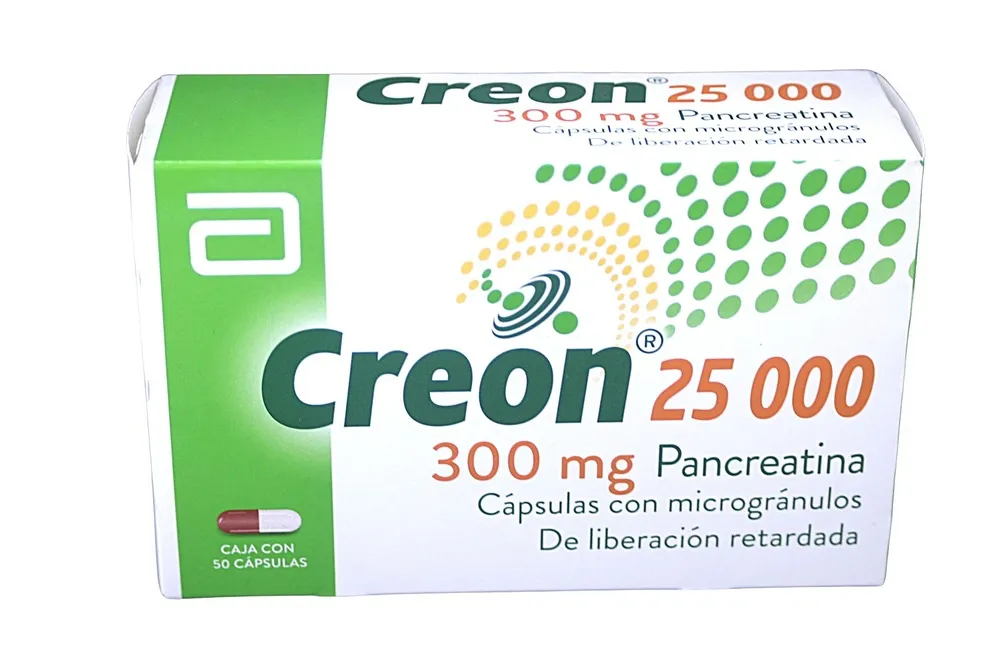
Table of Contents
- Package leaflet: Information for the user
- Introduction
- 1. What Kreon is and what it is used for
- 2. What you need to know before starting to take Kreon
- **Pregnancy, breastfeeding, and fertility**
- 3. How to take Kreon
- ***Dosing in pediatric and adult patients with cystic fibrosis***
- ***Dosage in other conditions associated with exocrine pancreatic insufficiency***
- 4. Possible adverse effects
- 5. Storage of Kreon
- 6. Contents of the pack and other information
Package leaflet: Information for the user
Introduction
Package leaflet: information for the user
Kreon 25,000 U gastro-resistant hard capsules
pancreatin (lipase, amylase, protease)
Read the entire patient information leaflet carefully before you start taking this medicine, as it contains important information for you.
|
Package leaflet contents:
- What Kreon is and what it is used for
- What you need to know before taking Kreon
- How to take Kreon
- Possible side effects
- How to store Kreon
- Contents of the pack and other information
1. What Kreon is and what it is used for
Kreon belongs to a group of medicines known as pancreatic enzymes.
Due to their activity on fats, carbohydrates, and proteins, pancreatic enzymes aid digestion and promote the absorption of food in individuals whose bodies are unable to produce sufficient amounts of these enzymes.
The pancreatin (lipase, amylase, protease) contained in this preparation is derived from the pancreas of pigs.
Kreon is used for the treatment of exocrine pancreatic insufficiency.
2. What you need to know before starting to take Kreon
Do not take Kreon:
- if you are allergic to pancreatin (lipase, amylase, protease) or to any of the other components of this medicine (listed in section 6).
Warnings and precautions:
Talk to your doctor, pharmacist, or nurse before starting to take Kreon.
Take special care with Kreon:
- if symptoms of allergy occur.
- if you experience a rare intestinal disorder called "fibrosing colonopathy," in which the intestine becomes narrowed. This has been reported in patients with cystic fibrosis taking high doses of pancreatic enzymes.
However, if you have cystic fibrosis and are taking more than 10,000 units of lipase per kilogram of body weight per day and develop unusual abdominal symptoms or changes in your usual abdominal symptoms, inform your doctor.
Traceability
In order to improve the traceability of biological medicines, the name and batch number of the administered medicine should be clearly recorded.
Other medicines and Kreon
Inform your doctor or pharmacist if you are taking, have recently taken, or might need to take any other medicines, including those obtained without a prescription.
Taking Kreon with food, drinks, and alcohol
This medicine should be taken during or immediately after meals. If necessary, the contents of the capsules may be mixed with liquid or soft foods. In this case, the mixture should be taken immediately to avoid damaging the enzymes.
The input is empty. Please provide the text you would like translated.
Pregnancy, breastfeeding, and fertility
If you are pregnant or breastfeeding, think you may be pregnant, or are planning to become pregnant, consult your doctor or pharmacist before using this medicine.
There are no data available in pregnant or breastfeeding women; however, animal studies have shown no absorption or systemic exposure to pancreatic enzymes. Caution should be exercised when prescribing this medication to pregnant women as well as to women who are breastfeeding.
If Kreon must be used during pregnancy or breastfeeding, it should be administered at doses sufficient to achieve adequate nutritional status.
Driving and using machines
Given the characteristics of this medicine, it is unlikely that its administration will affect the ability to drive or operate dangerous machinery.
Kreon contains sodium
This medicine contains less than 23 mg of sodium (1 mmol) per dose unit; hence, it is essentially "sodium-free".
3. How to take Kreon
Follow exactly the instructions for use of this medicine given by your doctor or pharmacist. If in doubt, consult your doctor or pharmacist again.
Dosing in pediatric and adult patients with cystic fibrosis
The initial dose is established according to weight and age. The initial dose should be 1,000 lipase units/kg/meal in children under 4 years of age and 500 lipase units/kg/meal in children aged 4 years and older.
The maintenance dose will be determined by the physician based on symptom control.
The administered dose should not exceed 10,000 lipase units/kg body weight per day or 4,000 lipase units per gram of ingested fat.
Dosage in other conditions associated with exocrine pancreatic insufficiency
The dose should be individually adjusted according to symptoms and dietary fat content. The required dose per meal ranges between approximately 25,000 and 80,000 Ph. Eur. units of lipase, and half of the individual dose should be used for light meals.
Capsules must be swallowed whole, without chewing or crushing, with sufficient liquid during or immediately after main and minor meals.
If swallowing the capsules is difficult, they may be opened and the contents mixed with a small amount of slightly acidic food or acidic liquids. Slightly acidic foods may include, for example, apple sauce or yoghurt. Acidic liquids may include apple, orange, or pineapple juice.
Mixing with foods or liquids that are not acidic, as well as crushing or chewing the capsules, may cause irritation in the mouth or alter the way Kreon works in the body.
Do not retain Kreon capsules or their contents in the mouth.
This mixture must be taken immediately to avoid damaging the coating of the granules.
Do not store the mixture.
Drink plenty of fluids (2–3 liters) while taking this medicine to maintain adequate hydration.
If you take more Kreon than you should
In case of overdose or accidental ingestion, it is advisable to discontinue treatment and drink plenty of water.
Contact your doctor or pharmacist immediately, or call the Toxicology Information Service at telephone number 91.562.04.20, indicating the medication and the amount ingested.
If you forget to take Kreon
If you forget to take this medicine, wait until your next meal and take your usual number of capsules. Do not take a double dose to make up for missed doses.
If you stop taking Kreon
Your doctor will advise you on the duration of your treatment with Kreon. Do not stop treatment without consulting your doctor first.
4. Possible adverse effects
Like all medicines, this medicine may cause adverse effects, although not everyone experiences them.
The following adverse effects were observed during studies in patients taking Kreon. These adverse effects may occur with this medicine:
Very common (may affect more than 1 in 10 people): abdominal pain.
Common (may affect up to 1 in 10 people): nausea, vomiting, constipation, bloated abdomen, diarrhoea.
These may be due to the condition for which you are taking Kreon. During the studies, the number of patients taking Kreon who experienced stomach pain or diarrhoea was similar to or lower than that in patients not taking Kreon.
Uncommon (may affect up to 1 in 100 people): skin rash.
Frequency not known (cannot be estimated from available data): pruritus (itching), urticaria.
Kreon may cause other serious allergic reactions (hypersensitivity), including breathing difficulties or swelling of the lips.
Ileocecal stenosis and large bowel stenosis (fibrosing colonopathy) have been reported in cystic fibrosis patients taking high doses of pancreatin-containing preparations.
If you experience any adverse effects, consult your doctor, pharmacist, or nurse, even if they are adverse effects not listed in this leaflet.
Reporting of adverse effects
If you experience any type of adverse effect, talk to your doctor, pharmacist, or nurse, even if they are possible adverse effects not listed in this leaflet. You can also report them directly via the Spanish Pharmacovigilance System for Human Medicines: https://www.notificaram.es.
By reporting adverse effects, you can help provide more information on the safety of this medicine.
5. Storage of Kreon
Keep this medicine out of the sight and reach of children.
Do not store above 25 ºC.
Once opened, it must not be stored above 25 ºC and should be used within 6 months. Keep the container tightly closed.
Do not use this medicine after the expiry date stated on the packaging after EXP or CAD. The expiry date refers to the last day of the month indicated.
Medicines must not be disposed of via wastewater or household waste. Return unused medicines and their containers to the SIGRE collection point at your pharmacy. Ask your pharmacist how to dispose of medicines and containers you no longer need. This will help protect the environment.
6. Contents of the pack and other information
Composition of Kreon
-
The active substance is pancreatin (lipase, amylase, protease). Each capsule contains 300 mg of pancreatin, equivalent to 25,000 U of lipase, 18,000 U of amylase and 1,000 U of protease.
-
The other components are macrogol 4000, hypromellose phthalate, cetyl alcohol, triethyl citrate and dimethicone. The components of the capsule shell are: gelatin, red and yellow iron oxide (E-172) and sodium lauryl sulfate.
Appearance of the medicine and contents of the pack
Kreon 25,000 is presented as hard gelatin capsules with an opaque orange cap and transparent body, packed in plastic containers. Each container contains 50 or 100 capsules.
Marketing Authorization Holder and Manufacturer
Marketing Authorization Holder
Viatris Healthcare Limited
Damastown Industrial Park
Mulhuddart, Dublin 15
Dublin
Ireland
Manufacturer
Abbott Laboratories GmbH
Justus von Liebig Strasse 33
31535 Neustadt (Germany)
For further information about this medicine, please contact the local representative of the Marketing Authorization Holder:
Viatris Pharmaceuticals, S.L.
C/ General Aranaz, 86
28027 Madrid
Spain
Date of the most recent revision of this leaflet: July 2021
Detailed information on this medicine is available on the website of the Spanish Agency for Medicines and Health Products (AEMPS) http://www.aemps.gob.es/”