Klisyri 10 mg/g ointment
Spain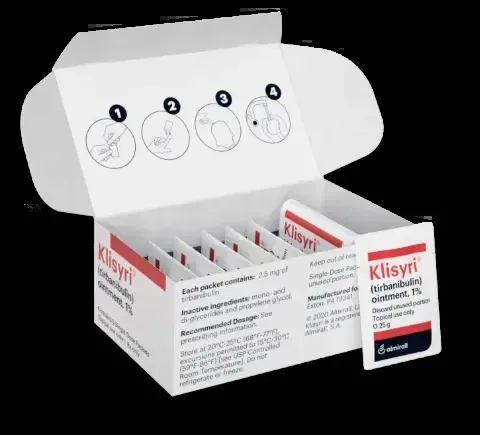
Table of Contents
Package leaflet: Information for the user
Introduction
Package leaflet: information for the patient
Klisyri 10 mg/g ointment
tirbanibulin
This medicinal product is subject to additional monitoring, which will allow for faster detection of new safety information. You can help by reporting any adverse reactions you may experience. Information on how to report adverse reactions is included at the end of section 4.
Read all of this leaflet carefully before you start using this medicine because it contains important information for you.
- Keep this leaflet as you may need to read it again.
- If you have any questions, ask your doctor or pharmacist.
- This medicine has been prescribed for you only, and you should not give it to others, even if they have the same symptoms as you, because it may harm them.
- If you experience any adverse reactions, consult your doctor or pharmacist, even if they are adverse reactions not listed in this leaflet. See section 4.
Contents of this leaflet
- What Klisyri is and what it is used for
- What you need to know before using Klisyri
- How to use Klisyri
- Possible adverse reactions
- How to store Klisyri
- Contents of the pack and other information
1. What Klisyri is and what it is used for
Klisyri contains the active substance tirbanibulin. It is used for the treatment of mild actinic keratosis in adults. Actinic keratosis consists of a rough skin area that develops in individuals who have had prolonged sun exposure over time. Klisyri should only be used for flat actinic keratosis on the face and scalp.
2. What you need to know before using Klisyri
Do not use Klisyri
- if you are allergic to tirbanibulin or to any of the other ingredients of this medicine (listed in section 6).
Warnings and precautions
Talk to your doctor or pharmacist before starting to use Klisyri
- Do not use Klisyri until the area to be treated has fully healed from any previous medication, procedure, or surgical treatment. Do not apply Klisyri to open wounds or broken skin.
- Wash your hands if you touch the area where the ointment has been applied.
- Do not allow Klisyri to come into contact with the eyes. In case of accidental contact with the eyes, rinse thoroughly with water, seek medical attention as soon as possible, and bring this leaflet with you.
- Do not apply the ointment to internal body areas, inside the nostrils, inside the ear, or on the lips. In case of accidental contact with any of these areas, rinse the area with water.
- Do not ingest this medicine. In case of accidental ingestion, drink plenty of water, seek medical attention, and bring this leaflet with you.
- Inform your doctor if you have problems with your immune system.
- Be alert for the appearance of new red, scaly patches, open sores, or warty or raised lesions around the treatment area. If you notice any of these, consult your doctor immediately.
- After using Klisyri, avoid activities that may cause excessive sweating and avoid exposure to sunlight as much as possible (including sunlamps and tanning beds). When outdoors, wear protective clothing and a hat.
- Do not cover the treated area with bandages after applying Klisyri.
- Do not use more ointment than your doctor has recommended.
- Do not apply the ointment more than once a day.
- Do not allow pets or other people to touch the treated area for approximately 8 hours after application. If the treated area is touched, the contact area on the other person or pet should be washed.
- Contact your doctor if you experience worsening skin reactions to this medicine at the treated site (see section 4).
Children and adolescents
Do not give this medicine to children and adolescents under 18 years of age, as they do not develop actinic keratosis.
Other medicines and Klisyri
Tell your doctor or pharmacist if you are taking, have recently taken, or might need to take any other medicines.
If you have previously used Klisyri or similar medicines, inform your doctor before starting treatment.
Pregnancy, breastfeeding, and fertility
If you are pregnant or breastfeeding, think you might be pregnant, or are planning to become pregnant, consult your doctor before using this medicine.
Klisyri must not be used during pregnancy.
Driving and using machines
This medicine is not expected to affect your ability to drive or operate machinery.
Klisyri contains propylene glycol
Propylene glycol may cause skin irritation.
3. How to use Klisyri
Follow exactly the instructions for administration of this medicine as given by your doctor. If in doubt, consult your doctor or pharmacist again.
This medicine is intended to treat a maximum area of 25 cm² in a single five-day treatment cycle. If the treated area has not completely cleared approximately 8 weeks after starting the treatment cycle, or if new lesions have appeared, your doctor should reconsider continuing this treatment and consider other therapeutic options.
Apply a thin layer of Klisyri to the affected area of the face or scalp once daily for 5 consecutive days. One sachet contains enough ointment to cover the treatment area. Do not store the opened sachet for later use, even if some ointment remains.
Instructions for application:
- Wash your hands with water and soap before applying the ointment.
- Wash the affected area with neutral soap and water and gently pat dry.
- Open a new sachet each time you are about to apply this medicine.
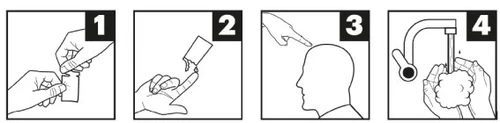
- Open the sachet along the perforated line (Figure 1).
- Squeeze a small amount of ointment onto the fingertip (Figure 2).
- Spread a thin, even layer of ointment uniformly over the entire affected area (Figure 3).
- Wash your hands immediately with water and soap after applying the ointment (Figure 4).
- Do not wash or touch the treated area for about 8 hours. After this period, you may wash the treated area with neutral soap and water.
- Do not cover the treated area with bandages after applying Klisyri.
- Repeat the above steps each day of treatment at approximately the same time.
If you use more Klisyri than you should
Wash the treated area with neutral soap and water. Consult your doctor or pharmacist if you experience severe skin reactions.
If you forget to use Klisyri
If you miss a dose, apply the ointment as soon as you remember, then continue with your usual treatment schedule. Do not apply the ointment more than once a day.
If you have any further questions about the use of this medicine, ask your doctor or pharmacist.
4. Possible adverse effects
Like all medicines, this medicine can cause adverse effects, although not everyone experiences them.
After using this medicine, you may experience adverse effects in the area of skin where the ointment is applied. These adverse effects may worsen up to 8 days after starting treatment and usually resolve within 2 to 3 weeks after treatment has ended. Consult your doctor if these adverse effects worsen.
Most frequent adverse effects at the treated site:
Very common (may affect more than 1 in 10 people)
- redness (erythema)
- skin peeling (exfoliation)
- crusting (scaling)
- swelling
- loss of the top layer of skin (erosion, ulcer)
Other possible adverse effects at the treated site:
Common (may affect up to 1 in 10 people)
- pain (tenderness, stinging, or burning sensation)
- itching (pruritus)
- blisters (vesicles, pustules)
Reporting of adverse effects
If you experience any type of adverse effect, consult your doctor or pharmacist, even if it is a possible adverse effect not listed in this leaflet. You may also report them directly via the Spanish System of Pharmacovigilance for Human Medicines: https://www.notificaram.es. By reporting adverse effects, you can help provide more information on the safety of this medicine.
5. Storage of Klisyri
Keep this medicine out of the sight and reach of children.
Do not refrigerate or freeze.
Do not use this medicine after the expiry date stated on the carton and label after EXP. The expiry date is the last day of the month indicated.
For single use only. Do not reuse sachets once opened.
Medicines should not be disposed of via wastewater or household waste. Ask your pharmacist how to properly dispose of any unused medicine and its container. This will help protect the environment.
6. Contents of the pack and other information
Composition of Klisyri
- The active substance is tirbanicline. Each sachet contains 2.5 mg of tirbanicline in 250 mg of ointment. Each gram of ointment contains 10 mg of tirbanicline.
- The other components are propylene glycol and glycerol monostearate 40-55.
Appearance of the product and contents of the pack
Each sachet of Klisyri contains 250 mg of white or almost white ointment. Each carton contains 5 sachets made of polyethylene/aluminum foil.
Marketing Authorization Holder
Almirall, S.A.
Ronda General Mitre, 151
08022 Barcelona
Spain
Manufacturer
Almirall Hermal GmbH Scholtzstrasse 3
21465 Reinbek
Germany
More information about this medicinal product can be requested by contacting the local representative of the Marketing Authorization Holder:
Almirall, S.A. Tel: +34 93 291 30 00 | |
Date of the most recent review of this leaflet: 07/2021
Detailed information on this medicinal product is available on the European Medicines Agency website: http://www.ema.europa.eu.