Kinpeygo 4 mg modified-release hard capsules
Spain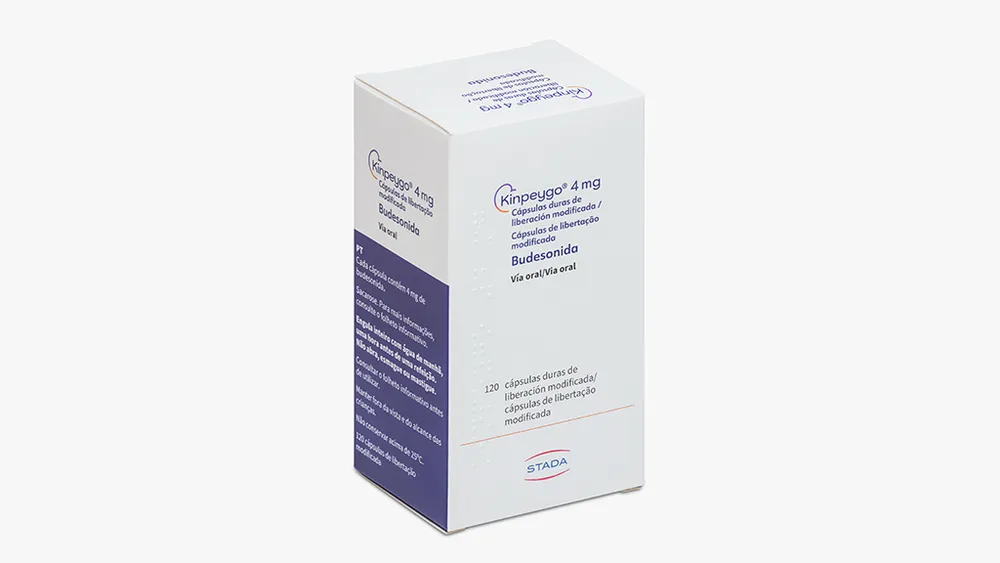
Table of Contents
Package leaflet: Information for the user
Introduction
Package leaflet: information for the patient
Kinpeygo 4 mg, modified-release hard capsules
budesonide
Read the entire leaflet carefully before you start taking this medicine, as it contains important information for you.
-
Keep this leaflet, as you may need to read it again.
-
If you have any questions, consult your doctor or pharmacist.
-
This medicine has been prescribed for you only, and you should not give it to other people, even if they have the same symptoms as you, because it may harm them.
-
If you experience any adverse reactions, consult your doctor or pharmacist, even if they are adverse reactions not listed in this leaflet. See section 4.
Leaflet contents
- What Kinpeygo is and what it is used for
- What you need to know before taking Kinpeygo
- How to take Kinpeygo
- Possible adverse effects
- How to store Kinpeygo
- Contents of the pack and other information
1. What Kinpeygo is and what it is used for
Kinpeygo contains the active substance budesonide, a corticosteroid that acts primarily locally in the intestine to reduce inflammation associated with primary immunoglobulin A (IgA) nephropathy.
Kinpeygo is used to treat primary IgA nephropathy in adults aged 18 years and older.
2. What you need to know before starting to take Kinpeygo
Do not take Kinpeygo:
- If you are allergic to budesonide or to any of the other components of this medicine (listed in section 6).
- If you have severe hepatic dysfunction, as determined by your doctor.
Warnings and precautions
Talk to your doctor or pharmacist before starting to take Kinpeygo:
- If you are about to undergo surgery.
- If you have liver problems.
- If you are taking or have recently taken corticosteroids.
- If you have recently had an infection.
- If you have active or latent tuberculosis, fungal, bacterial, systemic, viral, or parasitic infections that are untreated, or simple ocular herpes.
- If you have high blood pressure.
- If you have diabetes, or if someone in your family has diabetes.
- If you have fragile bones (osteoporosis).
- If you have stomach ulcers.
- If you have glaucoma (increased intraocular pressure) or cataracts, or if someone in your family has glaucoma (increased intraocular pressure).
If you are in any of the above situations, you may be at higher risk of experiencing adverse effects. Your doctor will decide what appropriate measures should be taken and whether it is still suitable for you to take this medicine.
Be alert for adverse effects
If you experience blurred vision or other visual problems, contact your doctor. See section 4 for more information.
Chickenpox or measles
Illnesses such as chickenpox and measles may be more severe while you are taking this medicine. If you have never had these diseases, avoid contact with people who have chickenpox or measles while taking this medicine. Inform your doctor if you think you have contracted chickenpox or measles while taking this medicine.
Adrenal function tests
Kinpeygo may affect the results of adrenal function tests (ACTH stimulation test) ordered by your doctor. Inform your doctor that you are taking Kinpeygo before undergoing any testing.
Children and adolescents
Kinpeygo must not be used in children and adolescents under 18 years of age. The use of this medicine has not been studied in children under 18 years of age.
Other medicines and Kinpeygo
Inform your doctor or pharmacist if you are taking, have recently taken, or might need to take any other medicines. This includes medicines available without a prescription and herbal products.
This is because Kinpeygo may affect how some medicines work, and some medicines may affect Kinpeygo.
In particular, inform your doctor or pharmacist if you are taking any of the following medicines:
Ketoconazole or itraconazole, used to treat fungal infections.
- Medicines for HIV called "protease inhibitors", such as ritonavir, indinavir, and saquinavir.
- Erythromycin, an antibiotic used to treat infections.
- Cyclosporine, used to suppress the immune system.
- Carbamazepine, used to treat epilepsy and neurological pain conditions.
- Cardiac glycosides, such as digoxin, used to treat heart conditions.
- Diuretics used to remove excess fluid from the body.
If you are in any of these situations (or are unsure), consult your doctor or pharmacist before taking Kinpeygo.
Use of Kinpeygo with food and drinks
Do not eat grapefruit or drink grapefruit juice while taking Kinpeygo, as it may affect how the medicine works.
Pregnancy and breastfeeding
If you are pregnant or breastfeeding, think you may be pregnant, or are planning to become pregnant, consult your doctor or pharmacist before using this medicine.
Do not take this medicine during pregnancy without first consulting your doctor.
Do not take this medicine while breastfeeding unless you have discussed it with your doctor. Budesonide passes into breast milk in small amounts. Your doctor will help you decide whether to continue treatment and stop breastfeeding, or discontinue treatment while breastfeeding.
Driving and use of machines
Kinpeygo is not expected to affect your ability to drive or operate machinery.
Kinpeygo contains sucrose
If your doctor has informed you of an intolerance to certain sugars, consult him before taking this medicine.
3. How to take Kinpeygo
Follow exactly the instructions given by your doctor for taking this medicine. If in doubt, consult your doctor or pharmacist again.
How to take it
The recommended dose of Kinpeygo is 16 mg (4 capsules of 4 mg Kinpeygo) once daily. It should be taken in the morning, at least 1 hour before eating.
- The capsules must be swallowed whole with a glass of water.
- Do not open, crush, or chew the capsules, as this could affect the release of the medicine. The capsules have a special coating to ensure that the drug is released in the correct part of the intestine.
When discontinuing treatment, your doctor will reduce the dose to 8 mg (2 capsules of 4 mg Kinpeygo) once daily during the final 2 weeks of treatment. If your doctor considers it necessary, the dose may be further reduced to 4 mg once daily (1 capsule of 4 mg Kinpeygo) for another 2 weeks.
If you take more Kinpeygo than you should
If you take more Kinpeygo than you should, contact your doctor or pharmacist immediately. Take the pack with you.
If you have taken more than the prescribed amount for a prolonged period, the possible adverse effects listed in section 4 may occur.
If you forget to take Kinpeygo
If you forget to take a dose of Kinpeygo, wait and take the medicine the next day as usual.
Do not take a double dose to make up for the missed dose.
If you stop taking Kinpeygo
Do not stop taking Kinpeygo without consulting your doctor first. If you stop taking the medicine abruptly, you may become unwell.
If you have any further questions about the use of this medicine, ask your doctor or pharmacist.
4. Possible adverse effects
Like all medicines, this medicine can cause adverse effects, although not everyone experiences them.
Inform your doctor if you notice any of the following adverse effects with this medicine:
Very common (may affect more than 1 in 10 people)
- Rash or itching of the skin
- Acne
- Decreased potassium levels in the blood (hypokalaemia)
Common (may affect up to 1 in 10 people)
- Increased blood pressure
- Swelling of arms or legs, such as in the ankles
- Facial swelling
- Cushingoid features, such as rounded face, increased body hair, weight gain, and acne
- Indigestion
- Muscle cramps
- Weight gain
- Diabetes mellitus
- Increase in the number of white blood cells (detected by blood test)
Rare (may affect up to 1 in 1,000 people)
- Blurred vision
Reporting of adverse effects
If you experience any type of adverse effect, consult your doctor or pharmacist, even if it is an effect not listed in this leaflet. You can also report them directly through the national reporting system included in Appendix V.* By reporting adverse effects, you can help provide more information on the safety of this medicine.
5. Storage of Kinpeygo
Keep this medicine out of the sight and reach of children.
Do not use this medicine after the expiry date stated on the carton and on the label of the bottle. The expiry date refers to the last day of the month indicated.
Do not store above 25 °C.
Medicines must not be disposed of via wastewater or household waste. Ask your pharmacist how to dispose of medicines and containers you no longer need. This helps protect the environment.
6. Contents of the pack and other information
Composition of Kinpeygo
-
The active substance is budesonide. Each modified-release hard capsule contains 4 mg of budesonide.
-
The other components are:
Contents of the capsule: sugar spheres (sucrose and maize starch), hypromellose, macrogol, citric acid monohydrate, ethylcellulose, medium-chain triglycerides, oleic acid (see also section 2, "Kinpeygo contains sucrose").
Capsule shell: hypromellose, macrogol, titanium dioxide (E171), methacrylic acid-methyl methacrylate copolymer, talc, dibutyl sebacate.
Printing ink: shellac, iron oxide black (E172).
Appearance of the product and contents of the pack
Kinpeygo 4 mg, modified-release hard capsules, are opaque 19 mm capsules with a white coating and printed with "CAL10 4MG" in black ink.
The capsules are supplied in a white high-density polyethylene (HDPE) bottle with a white child-resistant polypropylene (PP) closure and induction seal.
This medicine is available in bottles containing 28 or 120 modified-release hard capsules, and in multiple packs of 360 modified-release hard capsules containing 3 bottles with 120 modified-release hard capsules each.
Not all pack sizes may be marketed.
Marketing Authorization Holder
STADA Arzneimittel AG
Stadastrasse 2-18
61118 Bad Vilbel
Germany
Manufacturer
Tjoapack Netherlands B.V.
Nieuwe Donk 9
4879 AC Etten-Leur
Noord-Brabant
The Netherlands
STADA Arzneimittel AG
Stadastrasse 2 – 18
61118 Bad Vilbel
Germany
For more information about this medicine, please contact the local representative of the Marketing Authorization Holder:
Belgium/Belgium/Belgium EG (Eurogenerics) NV Tel/Tel: +32 24797878 | Lithuania UAB „STADA Baltics“ Tel: +370 52603926 |
STADA Bulgaria EOOD Tel.: +359 29624626 | Luxembourg/Luxembourg EG (Eurogenerics) NV Tel/Tel: +32 24797878 |
Czech Republic STADA PHARMA CZ s.r.o. Tel: +420 257888111 | Hungary STADA Hungary Kft Tel.: +36 18009747 |
Denmark STADA Nordic ApS Tlf: +45 44859999 | Malta Pharma.MT Ltd. Tel: + 356 21337008 |
Germany STADAPHARM GmbH Tel: +49 61016030 | Netherlands Centrafarm B.V. Tel.: +31 765081000 |
Estonia UAB „STADA Baltics“ Tel: +370 52603926 | Norway STADA Nordic ApS Tlf: +45 44859999 |
Greece FARAN S.A. Tel: +30 2106254175 | Austria STADA Arzneimittel GmbH Tel: +43 136785850 |
Spain Laboratorio STADA, S.L. Tel: +34 934738889 | Poland STADA Pharm Sp. z o.o. Tel: +48 227377920 |
France EG Labo - Laboratoires EuroGenerics Tél: +33 146948686 | Portugal Stada, Lda. Tel: +351 211209870 |
Croatia STADA d.o.o. Tel: +385 13764111 | Romania STADA M&D SRL Tel: +40 213160640 |
Ireland Clonmel Healthcare Ltd. Tel: +353 526177777 | Slovenia Stada d.o.o. Tel: +386 15896710 |
Iceland STADA Nordic ApS Tlf: +45 44859999 | Slovakia STADA PHARMA Slovakia, s.r.o. Tel: +421 252621933 |
Italy EG SpA Tel: +39 028310371 | Finland STADA Nordic ApS, Suomen sivuliike Puh/Tel: +358 207416888 |
Cyprus STADA Arzneimittel AG Tel: +30 2106664667 | Sweden STADA Nordic ApS Tel: +45 44859999 |
Latvia UAB „STADA Baltics“ Tel: +370 52603926 | United Kingdom (Northern Ireland) STADA Arzneimittel AG Tel: +49 61016030 |
Date of the most recent review of this leaflet: