Kimmtrak 100 micrograms/0.5 ml concentrate for solution for infusion
Spain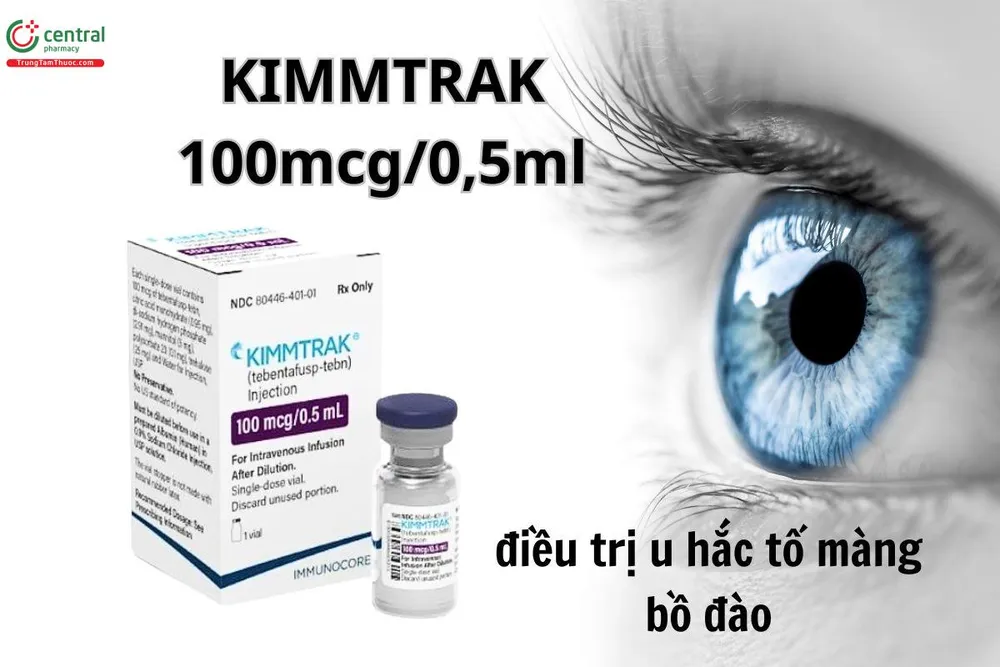
Table of Contents
Package leaflet: Information for the user
Introduction
Package leaflet: information for the patient
KIMMTRAK 100 micrograms/0.5 ml concentrate for solution for infusion
tebentafusp
This medicinal product is subject to additional monitoring, which will allow for faster identification of new safety information. You can help by reporting any adverse reactions you may experience. Section 4 includes information on how to report adverse reactions.
Read this entire leaflet carefully before starting to take this medicine, as it contains important information for you.
- Keep this leaflet, as you may need to refer to it again.
- If you have any questions, consult your doctor or nurse.
- If you experience any adverse reactions, consult your doctor or nurse, even if they are not listed in this leaflet. See section 4.
Leaflet contents
- What KIMMTRAK is and what it is used for
- What you need to know before receiving KIMMTRAK
- How KIMMTRAK is administered
- Possible side effects
- How to store KIMMTRAK
- Contents of the pack and other information
1. What KIMMTRAK is and what it is used for
KIMMTRAK contains the active substance tebentafusp. Tebentafusp is a cancer medicine made by fusing two different proteins. One of these proteins recognises an antigen (target protein) called "gp100" and binds to it. Uveal melanoma cancer cells have high concentrations of gp100. The other protein recognises a protein called CD3 and binds to it. CD3 protein is present on certain cells of the body's immune system. By binding to both gp100 and CD3, KIMMTRAK activates your immune system to recognise and destroy cancer cells.
KIMMTRAK is used to treat adults with a rare eye cancer called "uveal melanoma". The medicine is used when uveal melanoma has progressed despite local treatment or when it has spread to other parts of the body.
2. What you need to know before starting KIMMTRAK
Do not use KIMMTRAK if you are allergic to tebentafusp or to any of the other ingredients of this medicine (listed in section 6). If you are unsure whether you are allergic to any of the components, consult your doctor or nurse before receiving KIMMTRAK.
Warnings and precautions
Talk to your doctor or nurse before starting KIMMTRAK about all medical conditions you have, especially if you have the following:
- heart problems, including a change in the electrical activity of the heart (QT interval prolongation)
Your doctor may perform a blood test called HLA genotyping to determine whether KIMMTRAK is suitable for you.
Before you are given KIMMTRAK, inform your doctor if you are taking corticosteroids to treat adrenal insufficiency (also known as “Addison’s disease”). Your doctor may need to adjust your corticosteroid dose while you are being treated with KIMMTRAK.
Immediately inform your doctor or nurse or seek urgent medical attention if you experience any of the following adverse effects during or after treatment:
- fever, dizziness, or mild lightheadedness. These may be symptoms of a serious condition called cytokine release syndrome. Other symptoms of cytokine release syndrome include difficulty breathing, nausea, vomiting, fatigue, muscle pain, joint pain, swelling, low blood pressure, rapid heart rate, or headache.
- skin itching, rash, severe hives (itchy lumps under the skin), skin peeling, or swelling of the body and/or skin around the eyes, which may be symptoms of skin reactions.
- heart problems such as a fast or irregular heartbeat or a change in the electrical activity of the heart that may cause serious irregular heart rhythms, which may present as palpitations, difficulty breathing, mild lightheadedness or dizziness, or chest pain.
Your doctor or nurse will monitor you for signs and symptoms of these reactions during and after each dose. If you develop severe problems, your treatment may be temporarily interrupted and restarted once you have improved.
Children and adolescents
Do not administer this medicine to children under 18 years of age, as information on efficacy in this age group is limited.
Other medicines and KIMMTRAK
Inform your doctor if you are taking, have recently taken, or might need to take any other medicines.
Pregnancy, breastfeeding, and fertility
If you are pregnant or breastfeeding, think you might be pregnant, or plan to become pregnant, consult your doctor before using this medicine.
Pregnancy
KIMMTRAK should not be used during pregnancy unless you and your doctor agree that the benefit of taking the medicine outweighs the potential risks. If you are a woman of childbearing potential, your doctor or nurse will perform a pregnancy test before starting treatment with KIMMTRAK. If you become pregnant while receiving KIMMTRAK, inform your doctor or nurse immediately.
Contraception
If you are a woman of childbearing age, you must use an effective method of contraception to prevent pregnancy during treatment with KIMMTRAK and for at least 1 week after the last dose. Discuss the most appropriate contraceptive methods with your doctor.
Breastfeeding
You must not breastfeed during treatment with KIMMTRAK. It is unknown whether KIMMTRAK passes into breast milk.
Driving and use of machines
It is unlikely that KIMMTRAK will affect your ability to drive or operate machinery. However, if you do not feel well while receiving this medicine, you should not drive or operate machinery until you feel better.
KIMMTRAK contains sodium
This medicine contains less than 1 mmol of sodium (23 mg) per millilitre; therefore, it is essentially “sodium-free”.
3. How KIMMTRAK is administered
A doctor or nurse will administer this medicine to you in a hospital or outpatient setting.
You may be given an intravenous infusion of fluids (drip) before each KIMMTRAK infusion to help prevent low blood pressure due to cytokine release syndrome (see sections 2 and 4).
Your doctor or nurse will administer KIMMTRAK as an intravenous infusion (drip) into a vein over 15 to 20 minutes. You will receive KIMMTRAK once a week for as long as your doctor considers that the treatment is beneficial to you.
The recommended dose of KIMMTRAK is:
- Day 1: 20 micrograms
- Day 8: 30 micrograms
- Day 15: 68 micrograms
Once a week thereafter: 68 micrograms
The first three doses will be administered in a hospital. You will be monitored for any adverse reactions during treatment and for at least 16 hours after each dose.
If the first three doses do not cause you any severe or unmanageable adverse reactions, subsequent doses may be administered in an outpatient setting. You will be monitored for any adverse reactions during treatment and for at least 60 minutes after each dose. If you have received KIMMTRAK treatment in an outpatient setting for at least 3 months without a treatment interruption longer than 2 weeks, monitoring after each dose may be reduced to at least 30 minutes.
If you miss an appointment for your next dose of KIMMTRAK, contact your doctor or nurse as soon as possible to reschedule.
If you have any further questions about the use of this medicine, ask your doctor or nurse.
4. Possible adverse effects
Like all medicines, this medicine can cause adverse effects, although not everyone will experience them.
Contact your doctor or nurse immediately or seek urgent medical assistance if you experience any of the following very common adverse effects during or after treatment:
- Fever, dizziness, or mild lightheadedness. These may be symptoms of a serious condition called "cytokine release syndrome." Other symptoms of cytokine release syndrome include difficulty breathing, nausea, vomiting, fatigue, muscle pain, joint pain, swelling, low blood pressure, rapid heartbeat, or headache. These symptoms mostly occur after the first three infusions.
- Skin itching, rash, severe hives (itchy bumps under the skin), skin peeling, swelling of the body and/or of the skin around the eyes, which may be symptoms of skin reactions. These symptoms mostly occur after the first three infusions.
- Heart problems such as a fast or irregular heartbeat, or changes in the heart's electrical activity that may cause serious irregular heart rhythms, which may present as palpitations, difficulty breathing, mild lightheadedness or dizziness, and chest pain.
Other adverse effects:
Inform your doctor if you notice any of the following adverse effects:
Very common (may affect more than 1 in 10 people)
- Decreased appetite
- Tingling, itching, or numbness anywhere in the body
- Cough
- Diarrhea
- Constipation
- Indigestion
- Stomach pain
- Chills
- Sleep disorders (insomnia)
- Flu-like symptoms
- Inability to sleep
- Skin flushing
- High blood pressure
- Dry skin
- Changes in skin color
- Redness of the skin
- Decreased phosphate level in the blood
- Decreased magnesium level in the blood
- Decreased sodium level in the blood
- Decreased calcium level in the blood
- Decreased potassium level in the blood
- Decreased hemoglobin level in the blood
- Increased liver enzyme levels in the blood, which may indicate liver problems
- Increased bilirubin levels in the blood, which may indicate liver problems
- Increased blood level of the pancreatic enzyme lipase, which may indicate pancreatic problems
- Decreased white blood cell count in the blood
- Back pain or pain in the arms or legs
Common (may affect up to 1 in 10 people)
- Infection of the nose and throat
- Pain in the mouth and throat
- Hair loss
- Excessive night sweating
- Anxiety
- Changes in taste sensation
- Changes or irregularity in heartbeat
- Difficulty breathing
- Muscle spasms
- Increased blood level of the pancreatic enzyme amylase
- Increased creatinine level in the blood, which may indicate kidney problems
- Increased blood level of the liver enzyme gamma-glutamyltransferase
- Increased white blood cell count in the blood
- Increased liver enzyme levels in the blood
- Increased alkaline phosphatase level in the blood
- Increased blood glucose level
Uncommon (may affect up to 1 in 100 people)
- Increased levels of potassium, phosphate, and uric acid in the blood, which are signs of dying cancer cells
- Discomfort or chest pain, which may be a sign of heart problems
- Heart failure (difficulty breathing, chest discomfort, swelling of the legs and ankles)
- Changes in the heart's electrical activity that may lead to serious irregular heart rhythms
Reporting of adverse effects
If you experience any adverse effect, talk to your doctor or nurse, even if it is a possible adverse effect not listed in this leaflet. You can also report them directly through the national reporting system detailed in Appendix V. By reporting adverse effects, you can help provide more information on the safety of this medicine.
5. Conservation of KIMMTRAK
Keep this medicine out of the sight and reach of children.
Do not use this medicine after the expiry date stated on the vial label and carton after EXP. The expiry date refers to the last day of the month indicated.
Unopened vials should be stored between 2 °C and 8 °C.
Keep the vial in the outer packaging to protect it from light.
If not used immediately, the prepared infusion solution may be stored below 30 °C for up to 4 hours, or between 2 °C and 8 °C for up to 24 hours from the time of preparation/dilution until the end of administration.
Do not use this medicine if visible signs of deterioration are observed (i.e., particles, discoloration).
Do not store unused medicine for later use. Disposal of unused medicine and all materials that have come into contact with it should be carried out in accordance with local regulations. This will help protect the environment.
6. Contents of the container and additional information
Composition of KIMMTRAK
- The active substance is tebentafusp. One vial of 0.5 ml concentrate contains 100 micrograms of tebentafusp.
- The other components are: monohydrate citric acid (E330), disodium hydrogen phosphate (E339), mannitol (E421), trehalose, polysorbate 20 (E432), and water for injections (see section 2).
Appearance of the product and contents of the container
KIMMTRAK concentrate for solution for infusion (sterile concentrate) is a clear, colourless or slightly yellowish solution contained in a single-dose vial.
The pack size is 1 glass vial per carton.
Marketing Authorization Holder
Immunocore Ireland Limited
Unit 1, Sky Business Centre
Dublin 17, D17 FY82
Ireland
Manufacturer
Baxter Oncology GmbH
Kantstraße 2
33790 Halle/Westfalen
Germany
Date of the most recent revision of this summary:
Detailed information about this medicine is available on the website of the European Medicines Agency: http://www.ema.europa.eu.
This summary can be found on the website of the European Medicines Agency in all languages of the European Union/European Economic Area.
This information is intended for healthcare professionals only:
Important: Consult the Package Leaflet or Summary of Product Characteristics (SmPC) before using this medicine.
General precautions
The infusion solution must be prepared by a healthcare professional using appropriate aseptic techniques throughout the handling of this medicine.
Closed system drug-transfer devices (CSTDs) must not be used for the preparation of the KIMMTRAK infusion solution dose.
Whenever solution and container permit, parenteral medicines and infusion bags should be visually inspected before administration to check for the presence of particles or changes in colour.
Preparation
KIMMTRAK must be diluted before intravenous administration. Each KIMMTRAK vial is intended for single use only. DO NOT shake the KIMMTRAK vial.
Ensure the following materials are available before preparing KIMMTRAK for administration:
-
Sterile 1 ml syringes with 2 decimal graduations.
-
Sterile needles.
-
Human albumin; concentration according to local availability. Local concentrations include, among others, 4% (40 g/l), 5% (50 g/l), 20% (200 g/l), and 25% (250 g/l).
-
A 100 ml infusion bag containing sodium chloride 9 mg/ml (0.9%) solution for injection.
-
The infusion bag must be made of polyolefin (PO) (such as polyethylene [PE] and polypropylene [PP]) or polyvinyl chloride (PVC).
-
An infusion set with an in-line sterile, non-pyrogenic, low protein-binding 0.2 micron filter for administration of the final infusion bag.
Dilution and administration
A two-step process must be followed to prepare the final dose of KIMMTRAK:
Step 1: Preparation of the infusion bag
Using aseptic technique, prepare the infusion bag as follows:
- Using a 1 ml syringe and a sterile needle, withdraw the calculated volume of human albumin into the syringe (see Table 1 below) and add it to the 100 ml infusion bag containing sodium chloride 9 mg/ml (0.9%) solution for injection, to achieve a final human albumin concentration between 225 µg/ml and 275 µg/ml.
Table 1: Examples of human albumin concentrations and acceptable volumes to withdraw
Human albumin concentration | Acceptable volume range to add to a 100 ml perfusion bag to achieve a human albumin concentration between 225 µg/ml and 275 µg/ml |
4 % (40 g/l) | 0.63 ml (from 0.57 ml to 0.69 ml) |
5 % (50 g/l) | 0.50 ml (from 0.45 ml to 0.55 ml) |
20 % (200 g/l) | 0.13 ml (from 0.12 ml to 0.14 ml) |
25 % (250 g/l) | 0.10 ml (from 0.09 ml to 0.11 ml) |
- Perform the following steps to homogenize the diluted solution:
- Invert the infusion bag so that the inlet port is at the top of the bag, and gently tap the side of the port tube to ensure any residual solution drains into the main solution.
- Carefully mix by rotating the bag longitudinally 360 degrees from the inverted position at least five times. DO NOT shake the infusion bag.
- Repeat steps (i) and (ii) three more times.
Step 2: Preparation of KIMMTRAK infusion solution
- Using a 1 ml syringe and a sterile needle, withdraw the required volume of KIMMTRAK 100 micrograms/0.5 ml according to the required dose (shown in Table 2 below), and add it to the prepared 100 ml infusion bag containing 9 mg/ml (0.9%) sodium chloride injection solution and human albumin.
- DO NOT flush the needle or syringe after transfer. Discard the vial containing any unused portion of KIMMTRAK according to local regulations. Do not prepare more than one dose from a single vial.
Table 2: Volumes of KIMMTRAK required to be added to the infusion bag
Day of treatment | Dose (µg) of KIMMTRAK | Volume (mL) of KIMMTRAK |
Day 1 | 20 | 0.10 |
Day 8 | 30 | 0.15 |
Day 15 and weekly thereafter | 68 | 0.34 |
- Mix the infusion bag following the same process described in step 1b.
Administration
- Administer KIMMTRAK only as an intravenous infusion.
- Immediately administer the infusion over 15 to 20 minutes through a separate intravenous line. A sterile, non-pyrogenic, low protein-binding in-line filter set with a 0.2-micron filter must be used. Administer the entire contents of the KIMMTRAK infusion bag to the patient.
- After completion of the KIMMTRAK infusion, flush the infusion line with an appropriate volume of sterile 9 mg/ml (0.9%) sodium chloride injection solution to ensure that the entire contents of the infusion bag are delivered. KIMMTRAK must not be administered as an intravenous push or bolus injection. Do not mix KIMMTRAK with other medicinal products nor administer other medicinal products through the same intravenous line.
Storage of the prepared infusion bag
- KIMMTRAK does not contain preservatives. The prepared infusion bag must be administered within 4 hours after preparation, including the duration of the infusion. During this 4-hour period, the KIMMTRAK infusion bag must be stored below 30 °C.
- If not used immediately, the prepared KIMMTRAK infusion bag should be stored refrigerated at 2 °C to 8 °C for up to 24 hours from the time of preparation; this includes the time required to bring the infusion bag to room temperature and the duration of the infusion.
- Once removed from the refrigerator, the KIMMTRAK infusion bag must not be re-refrigerated. Discard unused KIMMTRAK solution if the recommended storage time is exceeded.