Kilor 80 mg granules for oral solution
Spain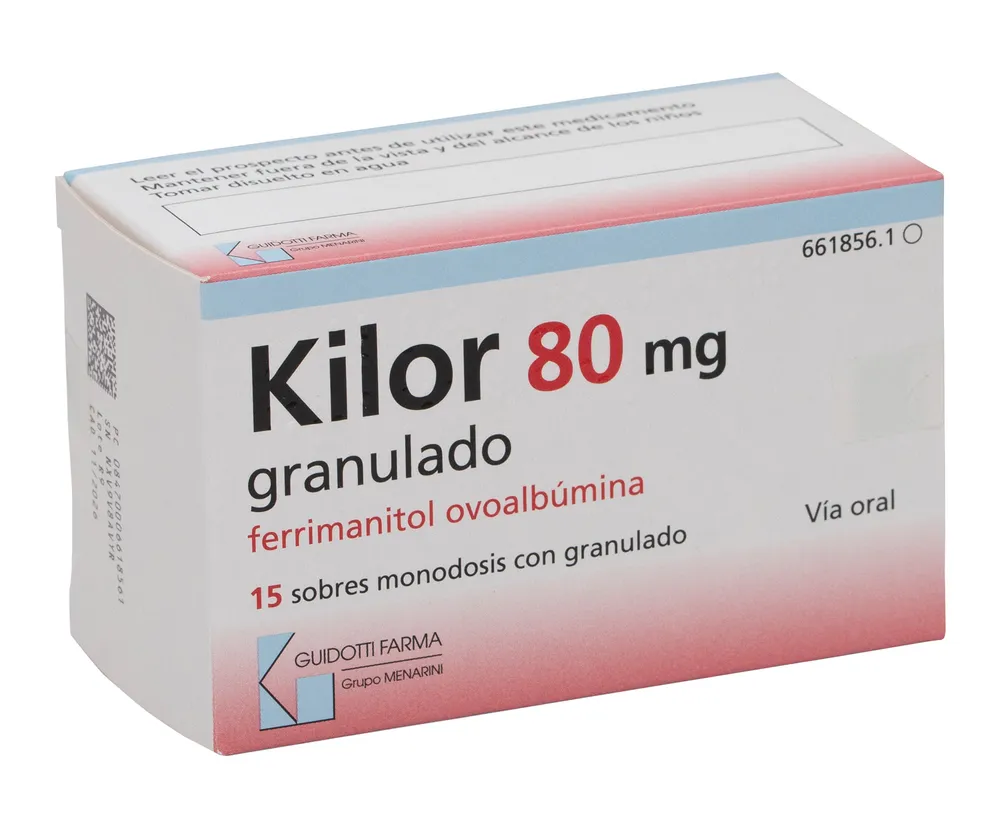
Table of Contents
- Package leaflet: Information for the user
- Introduction
- 1. What Kilor is and what it is used for
- 2. What you need to know before starting to take Kilor
- **Pregnancy, breastfeeding, and fertility**
- 3. How to take Kilor
- 4. Possible adverse effects
- 5. Storage of Kilor
- 6. Contents of the pack and other information
Package leaflet: Information for the user
Introduction
Package leaflet: information for the user
Kilor 80 mg granules for oral solution
ferrimanitol ovoalbumin
Read the entire leaflet carefully before you start taking this medicine because it contains important information for you.
- Keep this leaflet as you may need to read it again.
- If you have any questions, ask your doctor or pharmacist.
- This medicine has been prescribed for you only and must not be given to other people, even if they have the same symptoms as you. It could harm them.
- If you experience any adverse effects, consult your doctor or pharmacist, even if they are not listed in this leaflet. See section 4.
Contents of the leaflet
- What Kilor is and what it is used for
- What you need to know before taking Kilor
- How to take Kilor
- Possible side effects
- How to store Kilor
- Contents of the pack and other information
1. What Kilor is and what it is used for
Kilor belongs to a group of medicines called oral trivalent iron preparations.
Kilor normalizes altered hematological parameters in iron-deficient states.
Kilor is used in adult patients for the treatment of iron deficiency anemia and iron deficiency states.
2. What you need to know before starting to take Kilor
Do not take Kilor:
- if you are allergic to ferrimanitol ovoalbumin or to any of the other components of this medicine (listed in section 6).
- if you have hemosiderosis or hemochromatosis (iron storage diseases).
- if you have anemias not related to iron deficiency, such as aplastic, hemolytic, or sideroblastic anemia.
- if you have chronic pancreatitis and hepatic cirrhosis.
- if you have chronic inflammation of the pancreas and liver cirrhosis.
Warnings and precautions
Consult your doctor or pharmacist before starting to take Kilor.
If you have or have had gastric or duodenal ulcer, inflammatory bowel diseases, ulcerative colitis, or hepatic insufficiency.
If you are taking or are about to start taking any antacids, tetracyclines, quinolones, calcium salts, or levodopa.
Consult your doctor if any of the above-mentioned conditions have ever occurred in your case.
Other medicines and Kilor
Inform your doctor or pharmacist if you are taking, have recently taken, or might need to take any other medicine.
Kilor must not be administered concomitantly with:
- Tetracyclines or penicillamine, as they may mutually reduce oral absorption.
- Calcium salts, quinolones (such as ciprofloxacin), and levodopa, because iron preparations may reduce the absorption of these medicines.
- Antacids, as they may reduce the absorption of iron preparations.
When taking any of these medicines, administer them at least 2 hours apart from Kilor.
Taking Kilor with food and drinks
Kilor must not be administered together with milk or dairy products.
Pregnancy, breastfeeding, and fertility
If you are pregnant or breastfeeding, think you may be pregnant, or are planning to become pregnant, consult your doctor or pharmacist before using this medicine.
Studies conducted with ferrimanitol ovoalbumin in pregnant women have not shown any problems for the fetus. There are no data available regarding the excretion of ferrimanitol ovoalbumin in breast milk.
See section Kilor contains lactose, sucrose, benzyl alcohol, and sodium for information on the effects of benzyl alcohol on pregnancy and breastfeeding.
Driving and using machines
No symptoms affecting the ability to drive vehicles or operate machinery have been reported.
Kilor contains lactose, sucrose, benzyl alcohol, and sodium
This medicine contains lactose and sucrose. If your doctor has informed you that you have an intolerance to certain sugars, consult with him before taking this medicine.
It may cause dental caries.
This medicine contains 0.081 mg of benzyl alcohol per sachet.
Benzyl alcohol may cause allergic reactions. Consult your doctor or pharmacist if you are pregnant or breastfeeding, or if you have liver or kidney disease. This is because large amounts of benzyl alcohol may accumulate in your body and cause adverse effects (metabolic acidosis).
This medicine contains less than 23 mg of sodium (1 mmol) per sachet; thus, it is essentially "sodium-free".
3. How to take Kilor
Follow exactly the instructions for use of this medicine provided by your doctor. If in doubt, consult your doctor or pharmacist again.
Your doctor will indicate the duration of treatment with Kilor. Do not stop treatment early, as there is a risk of disease relapse.
The recommended dose in adults is 1 sachet daily after the main meal. Pour the contents of the sachet into 200 ml of water and shake until a uniform solution is obtained. The solution should be taken immediately.
In children, use Kilor 40 mg granules for oral solution.
If you think that the effect of Kilor is too strong or too weak, inform your doctor or pharmacist.
If you take more Kilor than you should
If you have taken more Kilor than recommended, consult your doctor or pharmacist immediately or call the Toxicology Information Service at telephone number 91 562 04 20.
If you forget to take Kilor
If you have forgotten a dose, take it as soon as possible and then continue with your regular dosing schedule. Do not take a double dose to make up for missed doses.
Gastrointestinal irritation symptoms such as nausea and vomiting may occur.
If you stop treatment with Kilor
Your doctor will indicate the duration of treatment with Kilor. Do not stop treatment early, even if you feel better.
If you have any further questions about the use of this medicine, ask your doctor or pharmacist.
4. Possible adverse effects
Like all medicines, this medicine may produce adverse effects, although not everyone will experience them.
Occasionally, gastrointestinal disturbances (stomach pain, nausea, constipation or diarrhoea) have been reported, which usually resolve upon reducing the administered dose or, if necessary, after discontinuing treatment. Black discolouration of stools.
Reporting of adverse effects
If you experience any type of adverse effect, consult your doctor or pharmacist, even if it is a possible adverse effect not listed in this leaflet. You may also report them directly through the Spanish Pharmacovigilance System for Human Medicinal Products: https://www.notificaram.es. By reporting adverse effects, you can help provide more information on the safety of this medicine.
5. Storage of Kilor
Keep this medicine out of the sight and reach of children.
This medicine does not require any special storage conditions.
Do not use this medicine after the expiry date stated on the packaging after EXP. The expiry date refers to the last day of the month indicated.
Medicines must not be disposed of via wastewater or household waste. Dispose of unused medicines and their containers at the SIGRE Point  at your pharmacy. If you are in doubt, ask your pharmacist how to properly dispose of unused medicines and their packaging. This way, you will help protect the environment.
6. Contents of the pack and other information
Composition of Kilor
-
The active substance is ferrimanitol ovoalbumin. Each sachet contains 600 mg (approx.) of ferrimanitol ovoalbumin (equivalent to 80 mg of Fe3+).
-
The other components are: banana flavouring (containing benzyl alcohol), ethyl vanillin, lactose monohydrate, sodium chloride and sucrose.
Appearance of the medicinal product and contents of the pack
Kilor is available as single-dose sachets containing a reddish-brown granule with a vanilla odour and banana flavour.
Each pack contains 15 or 30 sachets.
Only certain pack sizes may be marketed.
Marketing Authorization Holder and Manufacturer:
Marketing Authorization Holder:
GUIDOTTI FARMA, S.L.
Alfons XII, 587
08918 Badalona (Barcelona)
Spain
Manufacturer:
MEIJI PHARMA SPAIN, S.A.
Avda. de Madrid, 94
28802 Alcalá de Henares, Madrid
Spain
Date of the most recent revision of this leaflet: September 2021
Detailed information on this medicinal product is available on the website of the Spanish Agency of Medicines and Medical Devices (AEMPS) http://www.aemps.gob.es/