Kengrexal 50 mg powder for concentrate for solution for injection and for infusion
Spain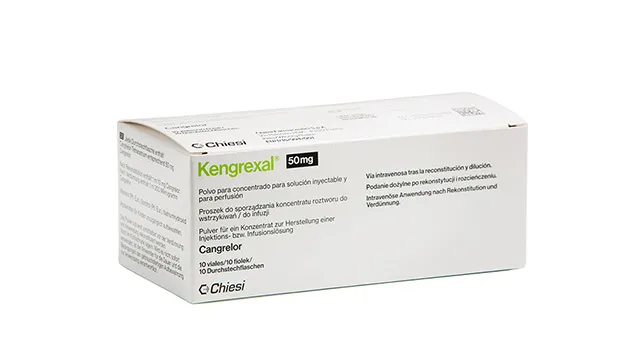
Table of Contents
Patient Information Leaflet
Introduction
Package Leaflet: Information for the Patient
Kengrexal 50 mg powder for concentrate for solution for injection and infusion
cangrelor
Read the entire leaflet carefully before you start using this medicine, because it contains important information for you.
- Keep this leaflet, as you may need to read it again.
- If you have any questions, ask your doctor.
- If you experience any adverse reactions, consult your doctor, even if they are not listed in this leaflet. See section 4.
Leaflet Contents
-
What Kengrexal is and what it is used for
-
What you need to know before using Kengrexal
-
How to use Kengrexal
-
Possible side effects
-
How to store Kengrexal
-
Contents of the pack and other information
1. What Kengrexal is and what it is used for
Kengrexal is an antiplatelet medicine that contains the active substance cangrelor.
Platelets are very small blood cells that can clump together and help with blood clotting. Sometimes clots can form inside a damaged blood vessel, for example in a heart artery, and this can be very dangerous as the clot may interrupt blood flow (a thrombotic event), leading to a heart attack (myocardial infarction).
Kengrexal reduces platelet clumping and thereby reduces the likelihood of clot formation.
You have been prescribed Kengrexal because you have blocked blood vessels in your heart (coronary artery disease) and require a procedure (called percutaneous coronary intervention, PCI) to remove the blockage. During this procedure, you may have a stent inserted into the blood vessel to help keep it open. The use of Kengrexal reduces the risk that this procedure may cause a clot that re-blocks the blood vessels.
Kengrexal should only be used in adults.
2. What you need to know before using Kengrexal
Do not use Kengrexal
- if you are allergic to cangrelor or to any of the other ingredients of this medicine (listed in section 6).
- if you have a condition currently causing bleeding, such as bleeding in the stomach or intestines, or have a disease that increases the likelihood of uncontrolled bleeding (impaired hemostasis or irreversible coagulation disorders).
- if you have recently undergone major surgery or have suffered any severe physical trauma, such as a bone fracture or traffic accident.
- if you have very high and uncontrolled blood pressure.
- if you have ever had a stroke or a mini-stroke (also known as transient ischemic attack, TIA) caused by a temporary interruption of blood flow to the brain.
Warnings and precautions
Talk to your doctor before using Kengrexal if:
- you have or think you may have an increased risk of bleeding. For example, if you have a condition affecting blood clotting or another condition that could increase the risk of bleeding, such as a recent serious injury, any recent surgical procedure, history of stroke or transient ischemic attack, or recent stomach or intestinal bleeding;
- you have renal impairment or require dialysis;
- you have ever had an allergic reaction to Kengrexal or any of its components;
- you have breathing problems, such as asthma;
- your doctor has told you that you have an intolerance to certain sugars.
Children and adolescents
Kengrexal is not recommended for use in children and adolescents under 18 years of age.
Other medicines and Kengrexal
You may receive acetylsalicylic acid (ASA) while being treated with Kengrexal or another type of antiplatelet medicine (e.g., clopidogrel) before and after treatment with Kengrexal.
Inform your doctor if you are taking any medicine that may increase the risk of adverse effects such as bleeding, including blood-thinning medicines (anticoagulants, e.g., warfarin).
Inform your doctor if you are taking, have recently taken, or might need to take any other medicine.
Pregnancy and breastfeeding
If you are pregnant, think you might be pregnant, or plan to become pregnant, consult your doctor before using this medicine. The use of Kengrexal during pregnancy is not recommended.
Driving and using machines
The effect of Kengrexal disappears rapidly and is unlikely to affect your ability to drive or operate machinery.
Kengrexal contains sodium and sorbitol
Sorbitol is a source of fructose. If you have hereditary fructose intolerance (HFI), a rare genetic disorder, you must not receive this medicine. Patients with HFI cannot break down fructose, which may lead to serious adverse effects.
Consult your doctor before receiving this medicine if you have HFI.
This medicine contains less than 1 mmol of sodium (23 mg) per vial; essentially "sodium-free".
3. How to use Kengrexal
Your treatment with Kengrexal will be supervised by a doctor experienced in managing patients with heart disease. Your doctor will decide how much Kengrexal you will receive and will prepare the medicine.
Kengrexal is administered by injection followed by an infusion (drip) into a vein. The dose administered depends on your body weight. The recommended dose is:
- 30 micrograms per kilogram of body weight as an injection, immediately followed by
- 4 micrograms per kilogram of body weight per minute as an infusion (drip), for at least 2 hours. Your doctor will decide whether you need treatment for a longer period.
If you are given more Kengrexal than you should
This medicine will be administered by a healthcare professional. Your doctor will decide how to manage your treatment, including stopping the medicine and monitoring for signs of adverse effects.
If in doubt, consult your doctor again.
4. Possible adverse effects
Like all medicines, this medicine may cause adverse effects, although not everyone experiences them.
If you experience any adverse effects, you may require medical attention.
Inform your doctor immediately if you notice any of the following:
- Bleeding anywhere in the body. Bleeding is a common adverse effect of treatment with Kengrexal (may affect up to 1 in 10 people). Bleeding may be severe and fatal outcomes have been reported.
- Allergic reaction (skin rash, itching, narrowing/swelling of the throat, swelling of the tongue or lips, difficulty breathing). An allergic reaction is a rare adverse effect of treatment with Kengrexal (may affect up to 1 in 1,000 people) but may be potentially serious.
Common adverse effects: may affect up to 1 in 10 people
- Minor bruising may occur anywhere on the body (including small red bruises on the skin or at the injection site under the skin causing swelling),
- dyspnea (shortness of breath),
- bleeding leading to reduced blood volume or red blood cell count,
- discharge from the injection site or catheter.
Uncommon adverse effects: may affect up to 1 in 100 people
- Bleeding causing fluid around the heart, blood in the chest cavity, or bleeding from the nose, gastrointestinal tract, abdomen, urine, or from the injection site or catheter,
- increased creatinine levels in the blood (detected in blood tests), indicating reduced kidney function,
- changes in blood pressure,
- skin rash, pruritus, urticaria,
- hematoma at the vessel puncture site.
Rare adverse effects: may affect up to 1 in 1,000 people
- Bleeding causing low platelet count or anemia,
- bleeding in the eyes, brain (including stroke), pelvis, and lungs,
- bleeding from wound sites,
- balloon-like swelling in an artery or heart wall, affecting only some layers of the vessel wall,
- severe allergic reactions,
- reduced blood clotting,
- bruising,
- facial swelling.
Very rare adverse effects: may affect up to 1 in 10,000 people
- Bleeding under the skin or around the eyes,
- infection at bleeding sites,
- heavy menstrual bleeding,
- bleeding from the penis, ear, or pre-existing skin tumours.
Reporting of adverse effects
If you experience any type of adverse effect, consult your doctor, even if they are possible adverse effects not listed in this leaflet.
You can also report them directly via the Spanish Pharmacovigilance System for Human Medicines: https://www.notificaram.es. By reporting adverse effects, you can help provide more information on the safety of this medicine.
5. Storage of Kengrexal
Keep this medicine out of the sight and reach of children.
Do not use this medicine after the expiry date stated on the label and the carton after EXP. The expiry date refers to the last day of the month indicated.
No special storage conditions are required.
Reconstituted solution: The powder must be reconstituted immediately before dilution and use. Do not refrigerate.
Diluted solution: From a microbiological standpoint, the medicine should be used immediately unless the reconstitution and dilution methods exclude the risk of microbiological contamination. If not used immediately, the times and conditions of storage during use are the responsibility of the user.
6. Contents of the pack and other information
Composition of Kengrexal
- The active substance is cangrelor. Each vial contains 50 mg of cangrelor. After reconstitution, 1 ml of concentrate contains 10 mg of cangrelor and after dilution, 1 ml of solution contains 200 micrograms of cangrelor.
- The other components are mannitol, sorbitol, and sodium hydroxide to adjust pH.
Appearance of the product and contents of the pack
Powder for concentrate for solution for injection and for infusion in a glass vial.
Kengrexal is a white to off-white lyophilized powder.
Kengrexal is available in packs of 10 vials.
Marketing Authorization Holder
Chiesi Farmaceutici S.p.A.
Via Palermo, 26/A
43122 Parma
Italy
Manufacturer
Diapharm GmbH & Co. KG
Am Mittelhafen 56
48155 Münster
Germany
For further information on this medicinal product, please contact the local representative of the Marketing Authorization Holder:
Spain Ferrer Farma, S.A. Tel: +34 93 600 3700 |
Date of the most recent review of this summary: January 2023
Other sources of information
Detailed information on this medicine is available on the European Medicines Agency website: http://www.ema.europa.eu.
This information is intended for healthcare professionals only:
Kengrexal must be administered by a physician experienced in acute coronary care or coronary interventional procedures and is intended for specialized use in a hospital setting for acute conditions.
Dosage
The recommended dose of Kengrexal for patients undergoing PCI is an intravenous bolus of 30 micrograms/kg followed immediately by a continuous intravenous infusion of 4 micrograms/kg/min. The bolus and infusion must be initiated prior to the procedure and continued for at least two hours or for the duration of the procedure, whichever is longer. At the physician's discretion, the infusion may be continued for a total duration of up to 4 hours; see section 5.1.
Patients should be transitioned to oral P2Y12 inhibitor therapy for chronic treatment. For transition, an oral loading dose of P2Y12 inhibitor therapy (clopidogrel, ticagrelor or prasugrel) should be administered immediately after discontinuation of cangrelor infusion. Alternatively, a loading dose of ticagrelor or prasugrel, but not clopidogrel, may be administered up to 30 minutes before stopping the infusion; see section 4.5.
Instructions for preparation
Aseptic techniques must be used when preparing Kengrexal.
The vial should be reconstituted immediately before dilution and use. Reconstitute each 50 mg vial by adding 5 ml of sterile water for injection. Gently swirl the vial until the entire contents are dissolved. Avoid vigorous mixing. Allow foam to dissipate. Ensure that the contents of the vial are completely dissolved and that the reconstituted product is a clear, colourless to pale yellow solution.
Do not use without dilution. Prior to administration, withdraw 5 ml of the reconstituted solution from each vial and further dilute with 250 ml of 9 mg/ml (0.9%) sodium chloride solution for injection or 5% glucose solution for injection. Mix thoroughly.
After reconstitution, the solution should be inspected visually for particulate matter.
Kengrexal is administered using a weight-based regimen consisting of an initial intravenous bolus followed by continuous intravenous infusion. Both the bolus and the infusion should be delivered from the infusion solution.
This dilution will yield a concentration of 200 micrograms/ml and should be sufficient for at least two hours of administration, as required. Patients weighing 100 kg or more will require a minimum of two bags.