Kapruvia 50 micrograms/ml solution for injection
Spain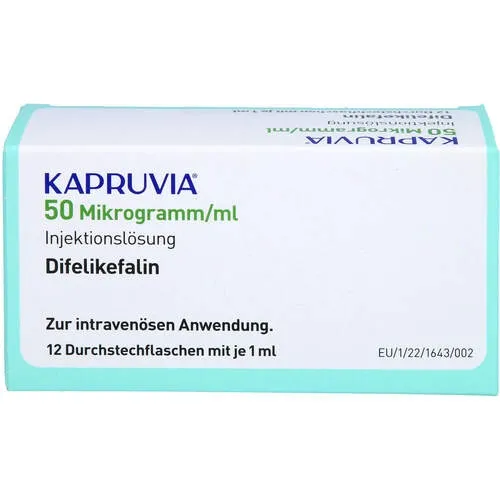
Table of Contents
Package leaflet: Information for the user
Introduction
Package leaflet: information for the patient
Kapruvia 50 micrograms/ml solution for injection
difelikefalin
This medicinal product is subject to additional monitoring, which will allow for rapid identification of new safety information. You can help by reporting any adverse reactions you may experience. Information on how to report adverse reactions is included at the end of section 4.
Read all of this leaflet carefully before you start using this medicine, because it contains important information for you.
- Keep this leaflet as you may need to read it again.
- If you have any questions, ask your doctor or nurse.
- This medicine has been prescribed for you only and must not be given to other people, even if they have the same symptoms as you, since it may harm them.
- If you experience any adverse reactions, consult your doctor or nurse, even if they are adverse reactions not listed in this leaflet. See section 4.
Contents of the leaflet
- What Kapruvia is and what it is used for
- What you need to know before using Kapruvia
- How to use Kapruvia
- Possible adverse reactions
- How to store Kapruvia
- Contents of the pack and other information
1. What Kapruvia is and what it is used for
Kapruvia contains the active substance difelikefalin. It is used to treat itching in adults with chronic kidney disease who require dialysis to clean their blood.
Kapruvia targets certain sites in the body known as kappa opioid receptors, which are involved in regulating the perception of itching. By stimulating these receptors in nerves and immune cells outside the brain, Kapruvia relieves the sensation of itching caused by chronic kidney disease. The active substance, difelikefalin, does not cross the blood-brain barrier (the natural protective barrier between blood vessels and the brain), which reduces the risk of adverse effects.
2. What you need to know before using Kapruvia
Do not use Kapruvia
- if you are allergic to difelikefalin or to any of the other ingredients of this medicine (listed in section 6).
Warnings and precautions
Talk to your doctor or nurse before you are given Kapruvia if:
- you have high levels of potassium in your blood;
- you have or have had heart weakness or heart rhythm disorders;
- you have reduced function of the blood-brain barrier (such as brain or central nervous system cancer, or a central nervous system disease such as multiple sclerosis or dementia), as this may increase the risk of adverse effects;
- you are 65 years of age or older, as you may be more likely to experience drowsiness due to the medicine;
- you are taking medicines that may increase the risk of drowsiness or dizziness, such as:
- medicines that slow down brain activity, such as those used to treat sleep disorders and anxiety;
- medicines used to treat allergies, colds, nausea and/or vomiting, known as sedating antihistamines;
- strong painkillers, known as opioid analgesics.
Talk to your doctor if you are taking any of these medicines.
Children and adolescents
The use of Kapruvia is not recommended in children and adolescents under 18 years of age, as it has not been studied in these patients.
Other medicines and Kapruvia
Inform your doctor if you are taking, have recently taken, or might need to take any other medicines.
Pregnancy and breastfeeding
If you are pregnant or breastfeeding, think you might be pregnant, or plan to become pregnant, consult your doctor before you are given Kapruvia.
Studies on the use of Kapruvia in pregnant women have not been conducted. It is unknown whether Kapruvia can harm the fetus. Your doctor will advise you whether you should use Kapruvia during pregnancy.
It is unknown whether difelikefalin passes into breast milk. If you are breastfeeding, your doctor will advise whether you should discontinue breastfeeding or discontinue use of Kapruvia, taking into account the benefits of breastfeeding for the infant and of Kapruvia for you, the mother.
Driving and using machines
Kapruvia may cause drowsiness and dizziness that may affect your ability to react. Do not drive or operate machinery if your ability to react is impaired or if you are unsure of how Kapruvia affects your ability to react.
Kapruvia contains sodium
This medicine contains less than 1 mmol of sodium (23 mg) per vial, i.e., essentially “sodium-free”.
3. How to use Kapruvia
Your doctor will calculate the appropriate dose of Kapruvia based on your body weight. A doctor or nurse will administer it intravenously as an injection at the end of your dialysis session, using the tube that connects you to the dialysis machine.
You will be given Kapruvia 3 times per week. This may increase to 4 times per week if a fourth dialysis session is performed. Administration of more than 4 doses per week is not recommended, even if the number of dialysis treatments in a week exceeds 4.
If you do not complete a dialysis session, your doctor will assess whether it is better to administer Kapruvia after the incomplete session or to wait until your next dialysis treatment. If a dialysis session is missed, you will receive your usual dose of Kapruvia during the next scheduled dialysis session.
A reduction in itching is expected within 2–3 weeks of starting treatment with Kapruvia.
Patients with reduced liver function
Dose adjustment is not required in patients with mild or moderate reduction in liver function.
The use of Kapruvia is not recommended in patients with severe reduction in liver function, as it has not been studied in these patients.
If you have been given more Kapruvia than you should
This may increase the occurrence of adverse effects, including those listed in section 4. Inform your doctor if you think this applies to you.
If you have any further questions about the use of this medicine, ask your doctor or nurse.
4. Possible adverse effects
Like all medicines, this medicine can cause adverse effects, although not everyone will experience them.
The following adverse effects have been reported in patients receiving this medicine:
Frequent, may affect up to 1 in 10 people:
- somnolence
- skin sensation disorders, such as tingling, prickling, burning, or numbness, reduced sense of touch or sensitivity
Uncommon, may affect up to 1 in 100 people:
- dizziness
- headache
- changes in mental state (level of alertness and clarity of thought), including confusion
- nausea, vomiting
- diarrhea
Reporting of adverse effects
If you experience any type of adverse effect, consult your doctor or nurse, even if it is a possible adverse effect not listed in this leaflet. You may also report them directly through the national reporting system detailed in Annex V.
By reporting adverse effects, you can help provide more information on the safety of this medicine.
5. Storage of Kapruvia
Keep this medicine out of the sight and reach of children.
Do not use this medicine after the expiry date stated on the label and the carton after "EXP". The expiry date is the last day of the month indicated.
This medicine does not require any special storage conditions.
Medicines must not be disposed of via wastewater or household waste. Ask your pharmacist how to dispose of medicines and packaging that you no longer need. This will help protect the environment.
6. Contents of the pack and other information
Composition of Kapruvia
- The active substance is difelicefalin.
Each vial contains 50 micrograms of difelicefalin (as acetate) in 1 ml of solution.
- The other components are acetic acid (to adjust pH), sodium acetate trihydrate (to adjust pH), sodium chloride, and water for injections. See section 2: “Kapruvia contains sodium”.
Appearance of Kapruvia and contents of the pack
Kapruvia is a clear, colourless solution free from particles (pH 4.5). It is supplied in a glass vial with a rubber stopper, an aluminium seal, and an easy-open blue plastic cap providing a hermetic closure.
Pack sizes of 3 and 12 vials.
Only some pack sizes may be marketed.
Marketing Authorisation Holder and Manufacturer
Marketing Authorisation Holder
Vifor Fresenius Medical Care Renal Pharma France
100–101 Terrasse Boieldieu
Tour Franklin La Défense 8
92042 Paris La Défense Cedex
France
Manufacturer
Vifor France
100–101 Terrasse Boieldieu
Tour Franklin La Défense 8
92042 Paris La Défense Cedex
France
For information about this medicine, contact the Marketing Authorisation Holder.
Date of the most recent review of this leaflet:
Detailed information about this medicine is available on the European Medicines Agency website: http://www.ema.europa.eu.