Kabipac glucose 5% solution for infusion
Spain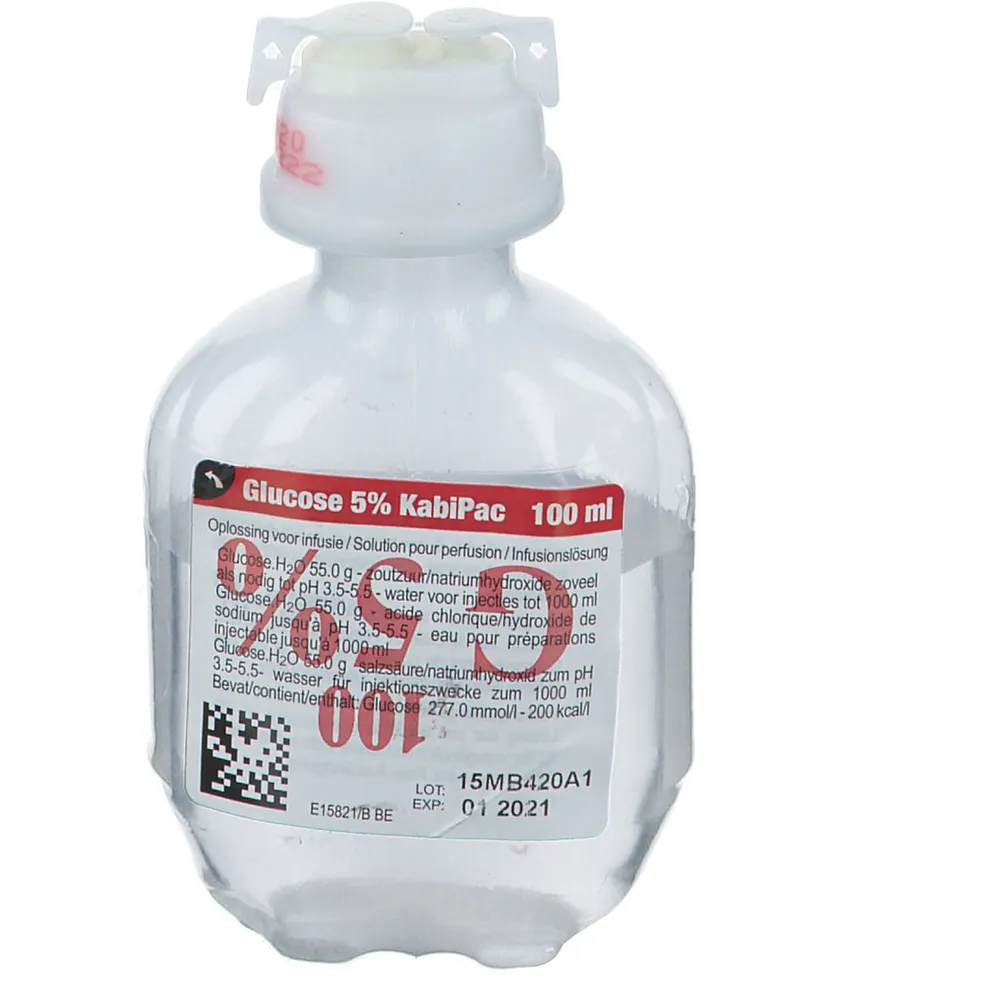
Table of Contents
- Package leaflet: Information for the user
- Introduction
- 1. What KabiPac Glucose 5% is and what it is used for
- 2. What you need to know before using KabiPac Glucose 5%
- 3. How to use KabiPac Glucose 5%
- 4. Possible adverse effects
- 5. Storage of KabiPac Glucose 5%
- 6. Contents of the pack and other information
Package leaflet: Information for the user
Introduction
Package leaflet: information for the user
KabiPac Glucose 5% solution for infusion
Read the entire leaflet carefully before you start using this medicine, because it contains important information for you.
- Keep this leaflet as you may need to read it again.
- If you have any questions, consult your doctor or nurse.
- If you experience any side effects, consult your doctor or nurse, even if they are side effects not listed in this leaflet. See section 4.
Leaflet contents:
- What KabiPac Glucose 5% is and what it is used for
- What you need to know before using KabiPac Glucose 5%
- How to use KabiPac Glucose 5%
- Possible side effects
- How to store KabiPac Glucose 5%
- Contents of the pack and other information
1. What KabiPac Glucose 5% is and what it is used for
KabiPac Glucose 5% is an intravenous infusion solution supplied in 100 ml bottles containing 50 ml or 100 ml of solution, 250 ml bottles containing 100 ml or 250 ml of solution, and 500 ml and 1000 ml bottles.
It belongs to the group of parenteral nutrition solutions intended for the provision of water and energy.
It is indicated for the treatment of hypertonic dehydration (vomiting, diarrhea, profuse sweating, gastrointestinal fistulas), as an energy source in parenteral nutrition when oral intake is limited, in carbohydrate metabolism disorders (hypoglycemia, insulin coma, hepatic coma, ketotic vomiting), and as a vehicle for the administration of compatible medications.
2. What you need to know before using KabiPac Glucose 5%
Do not use KabiPac Glucose 5%
- if you are allergic (hypersensitive) to the active substance or to any of the other components of KabiPac Glucose 5%
- if you have been diagnosed with hypotonic dehydration, salt loss, or reduced urine volume.
- during the first 24 hours after head trauma.
- in cases of hyperglycemia or elevated blood glucose levels.
- in conditions of hyperhydration (fluid overload)
- in cases of generalized edema (fluid accumulation in body tissues)
- if you have hyperlactacidemia (elevated lactic acid levels in blood)
- if you suffer from significant disturbances in glucose tolerance, including hyperosmolar coma.
Warnings and precautions
- Blood glucose concentration should be carefully monitored in cases of intracranial hypertension.
- If you have suffered acute ischemic events (reduced or absent blood flow in arteries), as hyperglycemia has been associated with increased cerebral ischemic damage and impaired recovery.
- In cases of shock and disturbances in acid-base balance, in patients with sodium deficiency,
administration of sodium-free solutions may cause peripheral circulatory collapse and oliguria (low urine output).
- Regular blood tests to monitor glucose, electrolytes, fluid balance, and acid-base balance are recommended, since frequent and large intravenous (parenteral) administration of glucose solutions may lead to fluid overload (hyperhydration) and significant ionic depletions. In such cases, electrolyte supplementation may be necessary.
- Along with glucose solution, potassium may be administered to prevent hypokalemia (low potassium levels in blood) caused by prolonged parenteral glucose feeding.
- If you suffer from malnutrition, you may have vitamin B1 deficiency. This vitamin is essential for glucose metabolism; therefore, this deficiency should be corrected first if needed.
- If you have diabetes. In this case, glucose solutions may be used only if appropriate treatment (insulin) has already been initiated. Blood glucose must be regularly monitored in diabetic patients, and insulin requirements adjusted accordingly.
- Blood must not be administered simultaneously using the same administration set as this medicine.
- If administered continuously at the same infusion site, thrombophlebitis (vein inflammation) may occur.
- Special care will be taken if you are elderly, as hepatic and/or renal functions may be impaired.
- Do not administer by intramuscular route.
- If you suffer from critical conditions, pain, postoperative stress, infections, burns, or central nervous system disorders.
- If you have any type of heart, liver, or kidney disease and are being treated with a medication that enhances the effect of vasopressin (a hormone regulating water retention in the body), because this may increase the risk of developing hospital-acquired low blood sodium levels (hyponatremia). (See section "Use of KabiPac Glucose 5% with other medicines").
All patients must be closely monitored. In cases where the normal regulation of blood water content is disrupted due to increased secretion of vasopressin, also known as Antidiuretic Hormone (ADH), infusion of fluids with low sodium chloride concentration (hypotonic fluids) may result in low blood sodium levels (hyponatremia). This may cause headache, nausea, seizures, lethargy, coma, brain swelling (cerebral edema), and death; therefore, these symptoms (acute symptomatic hyponatremic encephalopathy) are considered a medical emergency. (See section 4. Possible side effects)
Children, women of childbearing age, and patients with brain disorders such as meningitis, cerebral hemorrhage, cerebral contusion, and cerebral edema are at special risk of developing severe and potentially fatal brain swelling caused by acute hyponatremia.
Use of KabiPac Glucose 5% with other medicines
Inform your doctor or pharmacist if you are using or have recently used any other medicines, including those obtained without a prescription, as it may be necessary to interrupt treatment or adjust the dose of one or more of them.
It is important that you inform your doctor if you are taking any of the following medicines:
- Insulin or oral antidiabetics (biguanides, sulfonylureas): these medicines reduce the effect of glucose.
- Corticosteroids: due to the risk of increased blood glucose or because these medicines may retain sodium and water.
- Digitalis glycosides (digoxin): If intravenous glucose administration coincides with treatment with digitalis glycosides (digoxin), there is a risk of developing toxicity from these medicines.
- Medicines that lead to an increased vasopressin effect (see also section "Warnings and precautions" above), for example:
- Medicines that stimulate vasopressin release (e.g., antipsychotics, narcotics)
- Medicines that enhance vasopressin action (e.g., non-steroidal anti-inflammatory drugs)
- Medicines that act like vasopressin, known as vasopressin analogues
Other medicines that increase the risk of hyponatremia, including diuretics in general and antiepileptics.
In any case, the doctor must verify the compatibility of added medicines.
Pregnancy and breastfeeding
Consult your doctor or pharmacist before using any medicine.
This medicine should be administered with special caution in pregnant women during labor, especially if administered in combination with oxytocin (a hormone that may be given to induce labor and control bleeding), due to the risk of hyponatremia.
During pregnancy, your doctor will decide whether the use of 5% glucose solution is appropriate, as it should be used cautiously in this case. Intravenous glucose administration during pregnancy may increase glucose and insulin levels as well as acidic components in fetal blood.
There is no evidence suggesting that 5% Glucose may cause adverse effects in the neonate during breastfeeding. Nevertheless, caution is recommended during this period.
Driving and using machines
Not applicable, due to the characteristics of its use.
3. How to use KabiPac Glucose 5%
Follow exactly the administration instructions for KabiPac Glucose 5% provided by your doctor. Consult your doctor or pharmacist if you have any doubts.
Generally, intravenous drop-by-drop administration is recommended, according to your age, body weight, clinical condition, and metabolic status.
In adults, the maximum dose is 40 ml/kg body weight/day and the maximum infusion rate is 5 ml/kg body weight/hour = 0.25 g/kg body weight/hour.
In children, the infusion rate depends on the child's age and body weight, and generally should not exceed
10-18 mg of glucose (0.2-0.36 ml of solution)/kg/min.
0-10 kg: 100 ml/kg/24h
10-20 kg: 1000 ml + 50 ml/kg/24h for weight above 10 kg.
Over 20 kg: 1500 ml + 20 ml/kg/24h for weight above 20 kg.
If you use more KabiPac Glucose 5% than you should
In case of overdose, hyperglycemia, glycosuria (presence of glucose in urine), hyperhydration, or electrolyte disturbances may occur. Administration should be discontinued and symptomatic treatment initiated.
4. Possible adverse effects
Like all medicines, KabiPac Glucose 5% can cause adverse effects, although not everyone will experience them.
Hyperglycemia, glycosuria (glucose in urine), or disturbances in fluid or electrolyte balance may occur if the solution is administered too rapidly, if the fluid volume is excessive, or in cases of metabolic insufficiency.
Hyperglycemia resulting from rapid infusion or excessive volume should be monitored in severe cases of diabetes mellitus and can be avoided by reducing the dose and infusion rate or by administering insulin.
A local reaction at the injection site may occur.
Headache, nausea, seizures, lethargy. These may be caused by low sodium levels in the blood (hospital-acquired hyponatremia). When sodium levels in the blood drop significantly, water enters the brain cells, causing them to swell. This results in increased intracranial pressure and leads to hyponatremic encephalopathy.
Whenever any of these adverse reactions occur, inform your doctor, who will assess whether or not treatment should be discontinued.
If used as a vehicle for the administration of other medicines, the nature of the added medicines will determine the likelihood of other adverse reactions.
If you consider any of the adverse effects you experience to be severe, or if you notice any adverse effects not listed in this leaflet, inform your doctor or pharmacist.
Reporting of adverse effects
If you experience any type of adverse effect, consult your doctor or nurse, even if it is a possible adverse effect not listed in this leaflet. You may also report them directly through the Spanish Pharmacovigilance System for Human Medicines: https://www.notificaram.es. By reporting adverse effects, you can help provide more information on the safety of this medicine.
5. Storage of KabiPac Glucose 5%
No special storage conditions are required.
Keep out of the sight and reach of children.
Do not use KabiPac Glucose 5% after the expiry date stated on the container.
Do not use KabiPac Glucose 5% if the solution is not clear or contains precipitates.
Medicines should not be disposed of via wastewater or household waste. Ask your pharmacist how to properly dispose of medicines and packaging you no longer need. This will help protect the environment.
6. Contents of the pack and other information
Composition of KabiPac Glucose 5%
The active substance is glucose. Each 100 ml of solution contains 5 g of glucose (as monohydrate 5.5 g).
The other components are: water for injections, hydrochloric acid for pH adjustment.
Isotonic, pyrogen-free and sterile solution.
Theoretical osmolarity: 278 mosm/l
pH: 3.5–6.5
Theoretical caloric content: 200 kcal/l
Appearance of the medicinal product and contents of the pack
KabiPac Glucose 5% is a clear, colourless solution free from visible particles.
KabiPac Glucose 5% is available in polyethylene bottles (KabiPac) in the following sizes and pack formats:
1 bottle of 50/100ml 1 bottle of 1000ml 1 bottle of 250ml 1 bottle of 100ml 1 bottle of 100/250ml 1 bottle of 500ml | 50 bottles of 50/100ml 20 bottles of 250ml 20 bottles of 100/250ml 20 bottles of 100 ml 40 bottles of 100 ml 10 bottles of 500 ml 40 bottles of 50 ml |
Some pack sizes may not be marketed.
Marketing Authorization Holder and Manufacturer
Marketing Authorization Holder:
Fresenius Kabi España S.A.U.
C/ Marina 16-18
08005-Barcelona (Spain)
Manufacturers:
Fresenius Kabi Deutschland GmbH
Werk Friedberg
Freseniusstraße 1
D - 61169 Friedberg
Germany
Fresenius Kabi Polska Sp. z o.o.
ul. Sienkiewicza 25
PL - 99-300 Kutno
Poland
Labesfal – Laboratórios Almiro, S.A.
Zona Industrial do Lagedo,
Santiago de Besteiros
3465 – 157 Portugal
Fresenius Kabi Italia S.r.l.
Via Camagre, 41
I - 37063 Isola della Scala – Verona
Italy
Fresenius Kabi España S.A.U.
C/ Dr. Ferran, 12
08339 Vilassar de Dalt (Barcelona)
Spain
This patient information leaflet was last reviewed in April 2021.
Up-to-date detailed information on this medicine is available on the website of the Spanish Agency of Medicines and Health Products (AEMPS) http://www.aemps.gob.es/
?----------------------------------------------------------------------------------------------------------------------
This information is intended for healthcare professionals only:
This medicine must always be administered by trained healthcare personnel. It should be given by intravenous infusion via a central or peripheral vein.
The solution must be clear and free from precipitates. Do not administer if otherwise.
The content of each container is intended for single use only; any unused portion must be discarded. Use an aseptic technique when administering the solution and when preparing mixtures.
Before adding any medications to the solution or administering it simultaneously with other drugs, compatibility must be verified.
Dosage
General advice
It may be necessary to monitor fluid balance, serum glucose, serum sodium, and other electrolytes before and during administration, especially in patients with non-osmotic vasopressin release (syndrome of inappropriate antidiuretic hormone secretion, SIADH) and in patients receiving concomitant treatment with vasopressin agonists, due to the risk of hyponatremia.
Monitoring of serum sodium is particularly important with products having a lower sodium concentration compared to serum sodium levels. Following infusion of KabiPac Glucose 5%, there is rapid and active glucose transport into body cells. This condition promotes an effect equivalent to the administration of free water and may lead to severe hyponatremia.