JYSELECA 200 mg film-coated tablets
Spain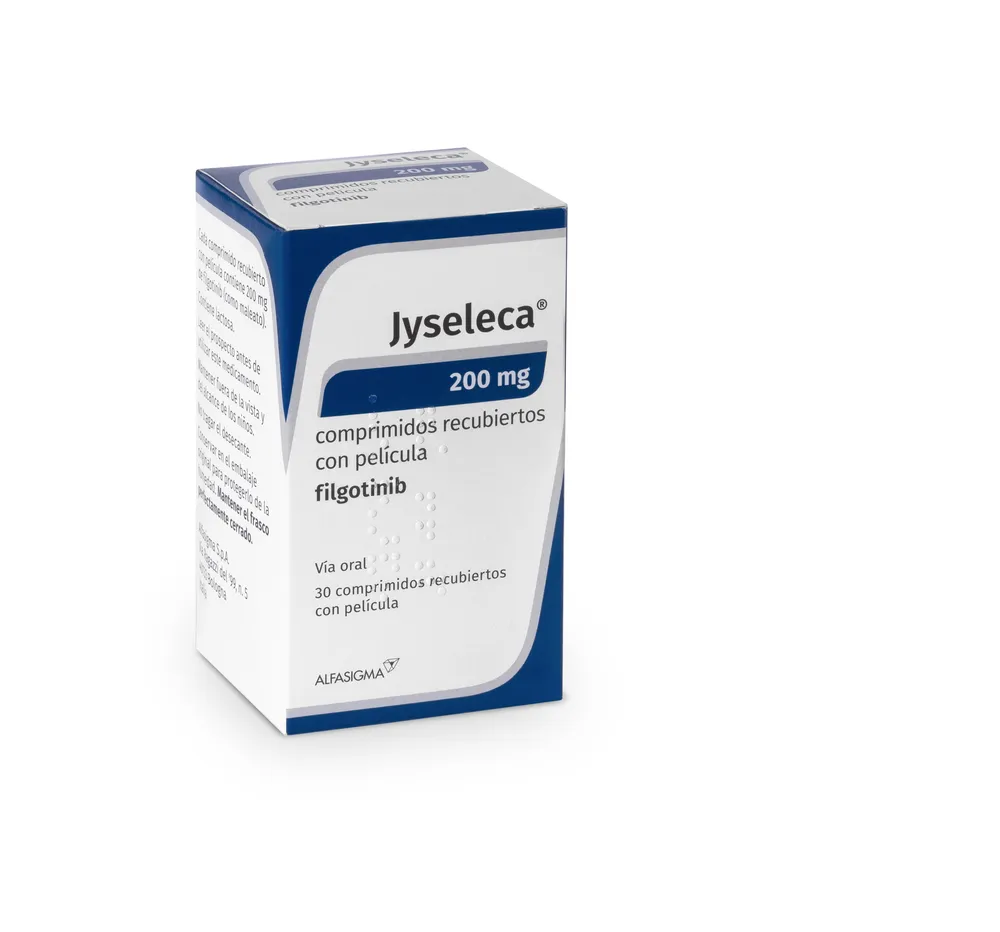
Table of Contents
Patient Information Leaflet
Introduction
Patient Information Leaflet
Jyseleca 100mg film-coated tablets
Jyseleca 200mg film-coated tablets
filgotinib
Read the entire leaflet carefully before you start taking this medicine, as it contains important information for you.
- Keep this leaflet, as you may need to read it again.
- If you have any questions, ask your doctor or pharmacist.
- This medicine has been prescribed for you only, and you should not give it to others, even if they have the same symptoms as you, because it may harm them.
- If you experience any adverse reactions, consult your doctor or pharmacist, even if they are adverse reactions not listed in this leaflet. See section 4.
Leaflet Contents
- What Jyseleca is and what it is used for
- What you need to know before taking Jyseleca
- How to take Jyseleca
- Possible side effects
- How to store Jyseleca
- Contents of the pack and other information
1. What Jyseleca is and what it is used for
Jyseleca contains the active substance filgotinib. It belongs to a group of medicines called Janus kinase inhibitors, which help reduce inflammation.
Rheumatoid arthritis
Jyseleca is used to treat adults with rheumatoid arthritis, an inflammatory disease affecting the joints. It can be used when previous treatment has not worked well enough or has not been tolerated. Jyseleca can be used alone or in combination with another arthritis medicine, methotrexate.
Jyseleca reduces inflammation in the body. It helps reduce pain, fatigue, stiffness, and joint swelling, and slows the progression of joint bone and cartilage damage. These effects may help you carry out your daily activities and improve your quality of life.
Ulcerative colitis
Jyseleca is used to treat adults with ulcerative colitis, an inflammatory bowel disease. It can be used when previous treatment has not worked well enough or has not been tolerated. It helps reduce the signs and symptoms of ulcerative colitis and reduces the need for steroids.
2. What you need to know before starting Jyseleca
Do not take Jyseleca
-
if you are allergic to filgotinib or to any of the other ingredients of this medicine (listed in section 6).
-
if you have active tuberculosis (TB).
-
if you have an active serious infection (see section "Warnings and precautions").
-
if you are pregnant or think you may be pregnant.
-
If any of these apply to you, do not take Jyseleca and inform your doctor immediately.
Warnings and precautions
- Consult your doctor or pharmacist before starting to take Jyseleca:
- if you have an infection or frequently get infections. Inform your doctor if you experience symptoms such as fever, sores, feel more tired than usual, or have dental problems, as these may be signs of infection. Jyseleca may reduce your body’s ability to fight infections and may worsen an existing infection or increase the likelihood of developing a new infection. If you have diabetes or are 65 years of age or older, you may have a higher risk of infections.
- if you have ever had tuberculosis (TB) or have been in contact with someone who has TB. You may need to be tested for tuberculosis before and during treatment with Jyseleca.
- if you have previously had herpes zoster (shingles), Jyseleca may cause a recurrence of the infection. Inform your doctor if you develop a painful rash with blisters during treatment with Jyseleca, as these may be signs of shingles.
- if you have ever had hepatitis B or C.
- if you have or have had cancer, smoke or have smoked in the past, because your doctor will assess whether Jyseleca is appropriate for you.
- Non-melanoma skin cancer has been observed in patients receiving Jyseleca. Your doctor may recommend regular skin examinations while you are taking Jyseleca. If new skin lesions appear during or after treatment, or if existing lesions change in appearance, inform your doctor.
- if you have recently received a vaccine or are scheduled to receive one. The use of certain types of vaccines (live vaccines) is not recommended during treatment with Jyseleca. Consult your doctor or pharmacist before starting Jyseleca. They may want to ensure your vaccinations are up to date.
- if you have or have had heart problems, because your doctor will assess whether Jyseleca is appropriate for you.
- if you have previously had blood clots in the veins of your legs (deep vein thrombosis) or in your lungs (pulmonary embolism), or if you have a higher risk of developing them (for example: if you recently had major surgery, use hormonal contraceptives or hormone replacement therapy, or if a clotting disorder has been identified in you or your close relatives). Your doctor will assess whether Jyseleca is suitable for you. Inform your doctor if you experience sudden shortness of breath or difficulty breathing, chest or upper back pain, swelling of an arm or leg, pain or tenderness in the leg, or redness or color change in an arm or leg, as these may be signs of blood clots in the veins.
Elderly patients
Patients aged 65 years and older may have an increased risk of infections, heart attacks, and certain types of cancer. Your doctor may decide that Jyseleca is not suitable for you.
Children and adolescents
Do not give this medicine to children and adolescents under 18 years of age, as it has not been studied in this age group.
Other medicines and Jyseleca
Inform your doctor or pharmacist if you are taking, have recently taken, or might need to take any other medicines, especially if you are using medicines that affect the immune system (such as cyclosporine or tacrolimus).
It is also very important that you consult your doctor or pharmacist if you are taking any of the following:
- medicines for the treatment of heart failure, coronary artery disease, or high blood pressure (such as diltiazem or carvedilol)
- the medicine fenofibrate (used to treat high cholesterol)
Pregnancy, contraception, and breastfeeding
Pregnancy
Jyseleca must not be used during pregnancy. If you are pregnant, think you may be pregnant, or plan to become pregnant, do not take this medicine. Consult your doctor for advice.
Contraception
You must take necessary precautions to avoid becoming pregnant during treatment with Jyseleca. You should use an effective method of contraception during treatment with Jyseleca and for at least 1 week after taking the last dose of Jyseleca. If you become pregnant while taking Jyseleca, stop taking the tablets and inform your doctor immediately.
Breastfeeding
Do not breastfeed your baby during treatment with Jyseleca. It is unknown whether the active substance passes into breast milk.
Driving and use of machines
Jyseleca may cause dizziness and vertigo. Do not drive or operate tools or machinery if you feel dizzy after taking Jyseleca.
Jyseleca contains lactose
Each 100 mg film-coated tablet of Jyseleca contains 76 mg of lactose, and each 200 mg film-coated tablet of Jyseleca contains 152 mg of lactose.
If your doctor has diagnosed you with an intolerance to certain sugars, consult with them before taking this medicine.
3. How to take Jyseleca
Follow exactly the instructions for administration of this medicine as given by your doctor. If in doubt, consult your doctor or pharmacist again.
The recommended dose is one 200 mg or 100 mg tablet once daily.
If you are 65 years of age or older and have rheumatoid arthritis, or if you have kidney problems, your doctor may recommend a dose of one 100 mg tablet once daily. Jyseleca is not recommended for you if you are over 75 years old and have ulcerative colitis. Inform your doctor if you have severe liver problems, as the use of Jyseleca is not recommended in your case.
Swallow the tablet with a glass of water. The tablet must not be split, crushed, or chewed before swallowing, as this could affect the amount of medicine absorbed by your body. You may take Jyseleca with or without food. Do not swallow the desiccant.
Take Jyseleca at the same time each day. This will help you remember when to take your tablets.
Your doctor may temporarily or permanently interrupt treatment if blood tests show a low count of white or red blood cells.
If you take more Jyseleca than you should
If you take more tablets than you should, inform your doctor immediately.
If you forget to take Jyseleca
- If you forget to take a dose, take it as soon as you remember.
- If a full day (24 hours) has passed without taking a dose, skip the missed dose and take a single dose at your usual time.
- Do not take a double dose to make up for forgotten doses.
If you stop taking Jyseleca
If you stop treatment with Jyseleca, inform your doctor immediately.
If you have any further questions about the use of this medicine, ask your doctor or pharmacist.
4. Possible adverse effects
Like all medicines, this medicine can cause adverse effects, although not everyone experiences them.
Serious adverse effects
Inform your doctor or seek immediate medical attention if you experience any signs of a serious infection such as:
- fever and symptoms of urinary tract infection (needing to urinate more often than usual, pain or discomfort when urinating, or back pain). Urinary tract infections are common (may affect up to 1 in 10 people) and some may be serious.
- lung infection (pneumonia): symptoms may include persistent cough, fever, difficulty breathing, and fatigue. This is uncommon (may affect up to 1 in 100 people).
- shingles (herpes zoster): symptoms may include a painful rash on the skin with blisters. This is uncommon (may affect up to 1 in 100 people).
- blood infection (sepsis): uncommon (may affect up to 1 in 100 people).
Other adverse effects
Inform your doctor if you notice any of the following adverse effects:
Frequent
(may affect up to 1 in 10 people)
- throat and nasal infections
- dizziness
- feeling sick (nausea)
Blood tests may show:
- low number of white blood cells (lymphocytes)
- reduced level of phosphate in the blood
Uncommon
(may affect up to 1 in 100 people)
- spinning sensation (vertigo)
Blood tests may show:
- low number of white blood cells (neutrophils)
- increase in a muscle enzyme called creatine kinase
- increased level of fat in the blood (cholesterol)
Reporting of adverse effects
If you experience any adverse effect, talk to your doctor or pharmacist, even if it is a possible adverse effect not listed in this leaflet.
You can also report them directly via the national reporting system included in Appendix V. By reporting adverse effects, you can help provide more information on the safety of this medicine.
5. Storage of Jyseleca
Keep this medicine out of the sight and reach of children.
Do not use this medicine after the expiry date stated on the carton and bottle after EXP. The expiry date is the last day of the month indicated.
Store in the original packaging to protect from moisture. Keep the bottle tightly closed. Do not use this medicine if the bottle's security seal is missing or broken.
Medicines must not be disposed of via wastewater or household waste. Ask your pharmacist how to dispose of any unused medicines and their containers. This will help protect the environment.
6. Contents of the container and additional information
Composition of Jyseleca
-
The active substance is filgotinib. Each film-coated tablet contains 100 or 200 mg of filgotinib (as filgotinib maleate).
-
The other components are:
Tablet core: microcrystalline cellulose, monohydrate lactose, pregelatinized starch, colloidal silicon dioxide, fumaric acid, magnesium stearate
Film coating: polyvinyl alcohol, titanium dioxide (E171), macrogol, talc, yellow iron oxide (E172), red iron oxide (E172)
Appearance of Jyseleca and contents of the pack
Jyseleca 100 mg film-coated tablets are beige-colored, capsule-shaped tablets measuring 12 x 7 mm, engraved on one side with «G» and «100» on the other side of the tablet.
Jyseleca 200 mg film-coated tablets are beige-colored, capsule-shaped tablets measuring 17 x 8 mm, engraved on one side with «G» and «200» on the other side of the tablet.
Jyseleca 100 mg and 200 mg are available in bottles of 30 tablets and in packs consisting of 3 bottles of 30 tablets each. Each bottle contains a silica gel desiccant which should be kept inside the bottle to help protect the tablets. The silica gel desiccant is contained in a separate sachet or container and must not be swallowed.
Only certain pack sizes may be marketed.
Marketing Authorization Holder
Alfasigma S.p.A.
Via Ragazzi del '99, n. 5
40133 Bologna
Italy
Manufacturer
Alfasigma S.p.A.
Via Enrico Fermi, 1
65020 Alanno (PE)
Italy
Date of the most recent review of this leaflet: June 2025
Detailed information on this medicine is available on the European Medicines Agency website: https://www.ema.europa.eu.https://www.ema.europa.eu.
QR code to be included
www.jyseleca.eu