Juluca 50 mg/25 mg film-coated tablets
Spain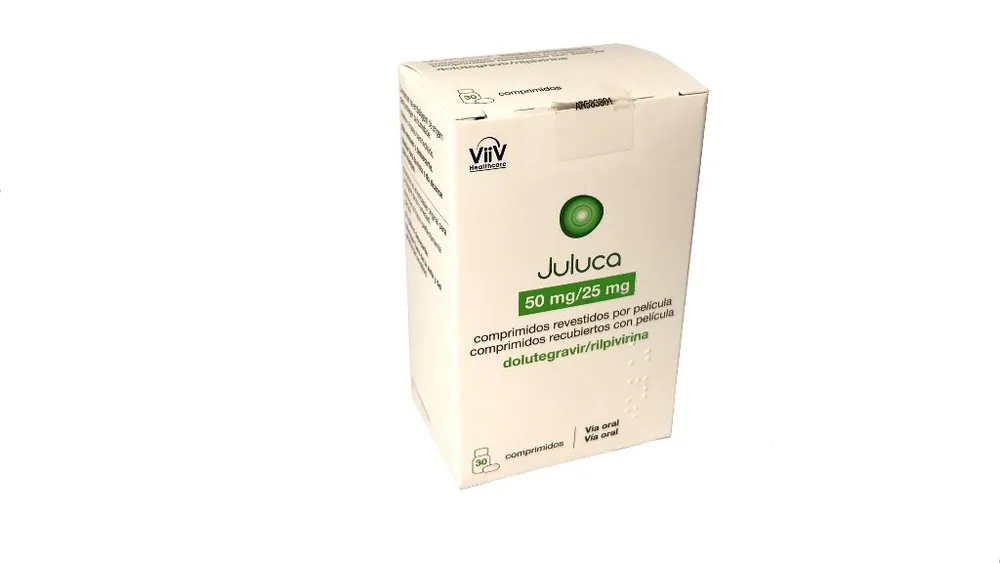
Instructions for Use
Patient Information Leaflet
Introduction
Patient Information Leaflet
Juluca 50 mg/25 mg film-coated tablets
dolutegravir/rilpivirine
Read the entire leaflet carefully before you start taking this medicine, as it contains important information for you.
-
Keep this leaflet, as you may need to read it again.
-
If you have any questions, ask your doctor or pharmacist.
-
This medicine has been prescribed for you only, and you should not give it to other people, even if they have the same symptoms as you, because it may harm them.
- If you experience any adverse effects, consult your doctor or pharmacist, even if they are adverse effects not listed in this leaflet. See section 4.
Leaflet Contents
- What Juluca is and what it is used for
- What you need to know before taking Juluca
- How to take Juluca
- Possible side effects
- How to store Juluca
- Contents of the pack and other information
1. What Juluca is and what it is used for
Juluca is a medicine that contains two active substances used to treat human immunodeficiency virus (HIV-1) infection: dolutegravir and rilpivirine. Dolutegravir belongs to a group of antiretroviral medicines called integrase inhibitors (INI), and rilpivirine belongs to a group of antiretroviral medicines called non-nucleoside reverse transcriptase inhibitors (NNRTI).
Juluca is used to treat HIV-1 infection in adults aged 18 years and older who are currently taking other antiretroviral medicines and whose HIV-1 infection has been controlled for at least 6 months. Juluca may replace your current antiretroviral medicines.
Juluca keeps the amount of HIV-1 virus in the body at a low level. This helps maintain the number of CD4 cells in the blood. CD4 cells are a type of white blood cell important in helping your body fight infections.
2. What you need to know before taking Juluca
Do not take Juluca:
- if you are allergic to dolutegravir or rilpivirine or to any of the other ingredients of this medicine (listed in section 6).
Do not take Juluca if you are taking any of the following medicines, as they may affect how Juluca works:
- fampridine (also known as dalfampridine; used to treat multiple sclerosis)
- carbamazepine, oxcarbazepine, phenobarbital, phenytoin (medicines used to treat epilepsy and prevent seizures)
- rifampicin, rifapentine (medicines used to treat certain bacterial infections such as tuberculosis)
- omeprazole, esomeprazole, lansoprazole, pantoprazole, rabeprazole (medicines used to prevent and treat stomach ulcers, heartburn or reflux)
- dexamethasone (a corticosteroid used for many conditions such as inflammation and allergic reactions) when taken orally or by injection, except for a single-dose treatment
- products containing St. John’s wort (Hypericum perforatum) (a herbal remedy used for depression).
If you are taking any of the above, consult your doctor about alternative treatments.
Warnings and precautions
Talk to your doctor or pharmacist before starting this medicine.
Allergic reactions
Juluca contains dolutegravir. Dolutegravir may cause a serious allergic reaction known as hypersensitivity reaction. You need to be aware of the important signs and symptoms to watch for while taking Juluca.
- Read the information on “Allergic reactions” in section 4 of this leaflet.
Liver problems including hepatitis B and/or C
Tell your doctor if you have or have had liver problems, including hepatitis B and/or C. Your doctor will assess the severity of your liver disease before deciding whether you can take this medicine.
Be alert to important symptoms
Some people taking medicines for HIV infection develop other disorders, which may be serious. These include:
- symptoms of infections and inflammation
- joint pain, stiffness and bone problems.
You need to know which important signs and symptoms to watch for while taking Juluca.
- Read the information on “Other possible side effects” in section 4 of this leaflet.
Children and adolescents
This medicine must not be used in children or adolescents under 18 years of age, as it has not been studied in these patients.
Other medicines and Juluca
Tell your doctor if you are taking, have recently taken, or might need to take any other medicine.
Julucano must not be taken with certain other medicines (see “Do not take Juluca” in section 2):
Some medicines may affect how Juluca works, or increase the likelihood of side effects. Juluca may also affect how some other medicines work.
Tell your doctor if you are taking any of the following medicines:
-
metformin, to treat diabetes
-
medicines that may cause potentially life-threatening irregular heartbeats (Torsade de Pointes). Since several medicines can cause this, you should ask your doctor or pharmacist if you are unsure
-
medicines called antacids, to treat indigestion and heartburn. Do not take an antacid within 6 hours before taking Juluca, or at least 4 hours after taking it (see also section 3 “How to take Juluca”)
-
calcium supplements, iron supplements, and multivitamin preparations should be taken at the same time as Juluca with a meal. If you cannot take them at the same time as Juluca, do not take a calcium supplement, iron supplement, or multivitamin preparation within 6 hours before taking Juluca or until at least 4 hours after taking it (see also section 3 “How to take Juluca”)
-
medicines called H2-receptor antagonists (e.g., cimetidine, famotidine, nizatidine, ranitidine) used to treat stomach or intestinal ulcers or to relieve heartburn due to reflux. Do not take these medicines within 12 hours before taking Juluca or for at least 4 hours after taking it (see also section 3 “How to take Juluca”)
-
any medicine used to treat HIV infection
-
rifabutin, used to treat tuberculosis (TB) and other bacterial infections. If you are taking rifabutin, your doctor may need to prescribe an additional dose of rilpivirine to treat HIV infection (see section 3 “How to take Juluca”)
-
artemether/lumefantrine, used to prevent malaria
-
clarithromycin and erythromycin, used to treat bacterial infections
-
methadone, used to treat opioid dependence
-
dabigatran etexilate, used to treat or prevent blood clots.
-
Tell your doctor or pharmacist if you are taking any of these medicines. Your doctor may decide that you need additional monitoring.
Pregnancy
If you are pregnant, think you may be pregnant, or are planning to become pregnant:
The use of Juluca is not recommended. Consult your doctor for advice.
Inform your doctor immediately if you become pregnant or plan to become pregnant. Your doctor will review your treatment. Do not stop treatment with Juluca without consulting your doctor, as this could harm both you and your fetus.
Breast-feeding
Breast-feeding is not recommended for women living with HIV because HIV infection can be transmitted to the baby through breast milk.
A small amount of the component dolutegravir in Juluca may pass into breast milk. It is unknown whether the other component, rilpivirine, passes into breast milk.
If you are breast-feeding or considering breast-feeding**, you should consult your doctor as soon as possible.**
Driving and using machines
Juluca may cause dizziness, tiredness or drowsiness and other side effects that may reduce your alertness.
- Do not drive or operate machinery unless you are certain that it does not affect you.
Juluca contains lactose
If your doctor has informed you that you have an intolerance to certain sugars, consult him before taking this medicine.
3. How to take Juluca
Follow exactly the instructions for using this medicine as given by your doctor. If in doubt, consult your doctor or pharmacist again.
- The recommended dose of Juluca is one tablet once daily. Juluca must be taken with a meal. It is important to take it with food to achieve adequate levels of the medicine in the body. A nutritional drink alone with high protein content does not replace a meal.
- Do not chew, crush, or split the tablet to ensure you receive the full dose.
Rifabutin
Rifabutin, a medicine used to treat certain bacterial infections, may reduce the amount of Juluca in the body and may make it less effective.
If you are taking rifabutin, your doctor may need to give you an additional dose of rilpivirine. Take the rilpivirine tablet at the same time as you take Juluca.
- Consult your doctor for advice on taking rifabutin with Juluca.
Antacids
Antacids, used to treat indigestion and heartburn, may interfere with the absorption of Juluca into the body and make it less effective.
Do not take an antacid within 6 hours before taking Juluca, or at least 4 hours after taking it.
- Consult your doctor for advice on taking antacids with Juluca.
Calcium supplements, iron supplements, or multivitamin preparations
Calcium supplements, iron supplements, or multivitamin preparations may interfere with the absorption of Juluca into the body and make it less effective.
Calcium or iron supplements or multivitamin preparations should be taken at the same time as Juluca. Juluca must be taken with a meal.
If you cannot take these supplements at the same time as Juluca, do not take calcium supplements, iron supplements, or multivitamin preparations within 6 hours before taking Juluca, or at least 4 hours after taking it.
- Consult your doctor for advice on how to take calcium supplements, iron supplements, or multivitamin preparations with Juluca.
H2-receptor antagonists (e.g., cimetidine, famotidine, nizatidina, ranitidine)
H2-receptor antagonist medicines may interfere with the absorption of Juluca into the body and make it less effective. Do not take these medicines within 12 hours before taking Juluca, or at least 4 hours after taking it.
- Consult your doctor for advice on taking these medicines with Juluca.
If you take more Juluca than you should
If you take more Juluca tablets than prescribed, contact your doctor or pharmacist immediately. If possible, show them the Juluca carton.
If you forget to take Juluca
If you realize you have missed a dose within 12 hours of your usual time for taking Juluca, take it as soon as possible. The Juluca tablet must be taken with a meal, and then take the next dose at your usual time. If more than 12 hours have passed since your usual time for taking Juluca, skip the missed dose and take the next dose at your usual time.
- Do not take a double dose to make up for missed doses.
If you vomit within 4 hours after taking Juluca, take another tablet with a meal. If you vomit more than 4 hours after taking Juluca, you do not need to take another tablet until your next dose.
Do not stop treatment with Juluca
Take this medicine for as long as your doctor tells you to. Do not stop taking it unless your doctor tells you to.
If you have any further questions about the use of this medicine, ask your doctor or pharmacist.
4. Possible adverse effects
Like all medicines, this medicine can cause adverse effects, although not everyone experiences them. Therefore, it is very important that you inform your doctor about any changes in your health.
Allergic reactions
Juluca contains dolutegravir. Dolutegravir can cause a serious allergic reaction known as hypersensitivity reaction. This is an uncommon reaction (may affect up to 1 in 100 people) in those taking dolutegravir. If you experience any of the following symptoms:
-
skin rash
-
high temperature (fever)
-
lack of energy (fatigue)
-
swelling, sometimes of the face or mouth (angioedema), causing difficulty breathing
-
muscle or joint pain
-
Seek medical attention immediately. Your doctor may consider it necessary to run tests to monitor your liver, kidneys, or blood and may instruct you to stop taking Juluca.
Very common adverse effects
These may affect more than 1 in 10 people:
- headache
- dizziness
- diarrhea
- nausea
- difficulty sleeping (insomnia).
Very common adverse effects that may appear in your blood tests include:
- increased levels of liver enzymes (transaminases)
- increased cholesterol
- increased pancreatic amylase (a digestive enzyme).
Common adverse effects
These may affect up to 1 in 10 people:
- decreased appetite
- rash
- itching (pruritus)
- discomfort (vomiting)
- stomach pain or discomfort (abdominal pain)
- weight gain
- gas (flatulence)
- drowsiness
- sleep disorders
- abnormal dreams
- lack of energy (fatigue)
- depression (feeling of deep sadness and low self-esteem)
- depressed mood
- anxiety
- dry mouth.
Common adverse effects that may appear in your blood tests include:
- increased levels of enzymes produced in muscles (creatine phosphokinase)
- decreased platelet count (involved in blood clotting)
- decreased white blood cell count
- decreased hemoglobin
- increased triglycerides (a type of fat)
- increased lipase (an enzyme involved in fat digestion)
- increased bilirubin (liver function test) in your blood.
Uncommon adverse effects
These may affect up to 1 in 100 people:
- allergic reaction (hypersensitivity) (see “Allergic reactions” above in this section)
- inflammation of the liver (hepatitis)
- suicidal thoughts and behaviors (especially in patients who previously had depression or mental health problems)
- panic attacks
- joint pain
- muscle pain.
Rare adverse effects
These may affect up to 1 in 1000 people:
-
liver failure (signs may include yellowing of the skin and whites of the eyes, or abnormally dark urine)
-
suicide (especially in patients who previously had depression or mental health problems).
-
Inform your doctor immediately if you experience any mental health problems (see also other mental health issues listed above).
Adverse effects of unknown frequency
Cannot be estimated from the available data:
- signs or symptoms of inflammation or infection, for example, fever, chills, sweats (immune reconstitution syndrome)
- a condition in which red blood cells do not form properly (sideroblastic anemia).
Other possible adverse effects
People receiving combination treatment for HIV may experience other adverse effects.
Symptoms of infection and inflammation
People with advanced HIV infection (AIDS) have a weakened immune system and are more likely to develop serious infections (opportunistic infections). Symptoms of infection caused by previously hidden or old infections may emerge as the body begins to fight them. Symptoms usually include fever, along with some of the following:
- headache
- stomach pain
- difficulty breathing.
In rare cases, as the immune system becomes stronger, it may also attack healthy tissues (autoimmune disorders). Symptoms of autoimmune disorders may appear many months after starting treatment for HIV infection. Symptoms may include:
- palpitations (fast or irregular heartbeat) or tremor
- hyperactivity (excessive restlessness and movement)
- weakness starting in the hands and feet and moving upward toward the body trunk.
If you have any symptoms of infection or notice any of the symptoms listed above:
- Consult your doctor immediately. Do not take other medicines for infection without first consulting your doctor.
Joint pain, stiffness, and bone problems
Some people receiving combination HIV treatment develop osteonecrosis. In this condition, parts of bone tissue die due to reduced blood supply to the bones. People may be more likely to develop this condition if they:
- have been on combination treatment for a long time
- are also taking anti-inflammatory medicines called corticosteroids
- drink alcohol
- have a severely weakened immune system
- are overweight.
Signs of osteonecrosis include:
- stiffness in the joints
- discomfort and pain in the joints (especially in the hip, knee, or shoulder)
- difficulty moving.
If you notice any of these symptoms:
- Inform your doctor.
Effects on weight, lipids, and blood glucose
During HIV treatment, there may be an increase in weight and in lipid and blood glucose levels. This is partly related to improved health, lifestyle, and sometimes to the HIV medicines themselves. Your doctor will assess these changes.
Reporting of adverse effects
If you experience any type of adverse effect, consult your doctor or pharmacist, even if it is a possible adverse effect not listed in this leaflet. You may also report them directly through the national reporting system included in Appendix V. By reporting adverse effects, you can help provide more information on the safety of this medicine.
5. Storage of Juluca
Keep this medicine out of the sight and reach of children.
Do not use this medicine after the expiry date stated on the pack and bottle after EXP. The expiry date refers to the last day of the month indicated.
Store in the original packaging to protect from moisture. Keep the bottle tightly closed. Do not remove the desiccant.
This medicine does not require any special storage temperature conditions.
Medicines should not be disposed of via wastewater or household waste. Ask your pharmacist how to dispose of medicines and packaging you no longer need. This will help protect the environment.
6. Contents of the pack and other information
Composition of Juluca
- The active substances are dolutegravir and rilpivirine. Each tablet contains dolutegravir sodium equivalent to 50 mg of dolutegravir and rilpivirine hydrochloride equivalent to 25 mg of rilpivirine.
- The other components are mannitol (E421), magnesium stearate, microcrystalline cellulose, povidone (K29/32), sodium carboxymethylstarch, stearoyl fumarate and sodium, lactose monohydrate, sodium croscarmellose, povidone (K30), polysorbate 20, silicified microcrystalline cellulose, partially hydrolyzed polyvinyl alcohol, titanium dioxide (E171), macrogol, talc, yellow iron oxide (E172), red iron oxide (E172). See "Do not take Juluca" and "Juluca contains lactose" in section 2.
- This medicine contains less than 1 mmol of sodium (23 mg) per tablet; essentially, it is "sodium-free".
Appearance of the product and contents of the pack
Juluca film-coated tablets are pink, oval-shaped, biconvex, and engraved with “SV J3T” on one side.
Film-coated tablets are supplied in child-resistant containers.
Each bottle contains 30 film-coated tablets and a desiccant to reduce moisture. Once the bottle has been opened, keep the desiccant inside—do not remove it.
Multiple packs containing 90 film-coated tablets (3 packs of 30 film-coated tablets) are also available.
Only certain pack sizes may be marketed.
Marketing Authorization Holder
ViiV Healthcare BV
Van Asch van Wijckstraat 55H
3811 LP Amersfoort
The Netherlands
Manufacturer
Glaxo Wellcome, S.A.
Avda. Extremadura, 30
9400 Aranda de Duero
Burgos
Spain
For further information about this medicinal product, please contact the local representative of the Marketing Authorization Holder:
Belgium/Belgium/Belgium ViiV Healthcare srl/bv Tel/Tel: + 32 (0) 10 85 65 00 | Lithuania ViiV Healthcare BV Tel: +370 80000334 |
| Luxembourg/Luxembourg ViiV Healthcare srl/bv Belgium/Belgium Tel/Tel: + 32 (0) 10 85 65 00 |
Czech Republic GlaxoSmithKline, s.r.o. Tel: + 420 222 001 111 | Hungary ViiV Healthcare BV Tel.: +36 80088309 |
Denmark GlaxoSmithKline Pharma A/S Tel.: + 45 36 35 91 00 | Malta ViiV Healthcare BV Tel: +356 80065004 |
Germany ViiV Healthcare GmbH Tel.: + 49 (0)89 203 0038-10 | Netherlands ViiV Healthcare BV Tel: + 31 (0) 33 2081199 |

Estonia ViiV Healthcare BV Tel: +372 8002640 | Norway GlaxoSmithKline AS Tlf: + 47 22 70 20 00 |
Greece GlaxoSmithKline Μονοπρόσωπη A.E.B.E. Tel: + 30 210 68 82 100 | Austria GlaxoSmithKline Pharma GmbH Tel: + 43 (0)1 97075 0 |
Spain Laboratorios ViiV Healthcare, S.L. Tel: + 34 900 923 501 | Poland GSK Services Sp. z o.o. Tel.: + 48 (0)22 576 9000 |
France ViiV Healthcare SAS Tel.: + 33 (0)1 39 17 69 69 | Portugal VIIVHIV HEALTHCARE, UNIPESSOAL, LDA Tel: + 351 21 094 08 01 |
Croatia ViiV Healthcare BV Tel: +385 800787089 | Romania ViiV Healthcare BV Tel: +40 800672524 |
Ireland GlaxoSmithKline (Ireland) Limited Tel: + 353 (0)1 4955000 | Slovenia ViiV Healthcare BV Tel: +386 80688869 |
Iceland Vistor ehf. Tel: +354 535 7000 | Slovakia ViiV Healthcare BV Tel: +421 800500589 |
Italy ViiV Healthcare S.r.l Tel: + 39 (0)45 7741600 | Finland GlaxoSmithKline Oy Tel: + 358 (0)10 30 30 30 |
Cyprus ViiV Healthcare BV Tel: +357 80070017 | Sweden GlaxoSmithKline AB Tel: + 46 (0)8 638 93 00 |
Latvia ViiV Healthcare BV Tel: +371 80205045 |
Date of the most recent review of this leaflet:
Other sources of information
Detailed information on this medicinal product is available on the website of the European Medicines Agency: https://www.ema.europa.eu.
This page has been machine-translated and may contain inaccuracies. The original data is available in the manufacturing country's language.
Last data check: May 18, 2026 · Data source: CIMA — AEMPS