Jubereq 120 mg solution for injection
Spain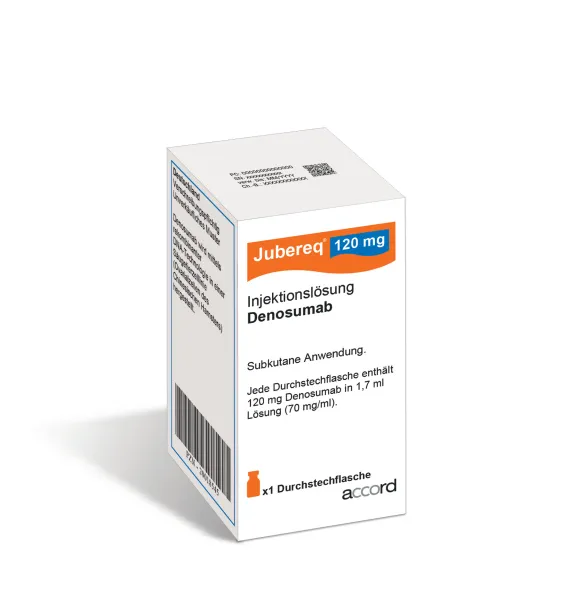
Table of Contents
Patient Information Leaflet
Introduction
Patient Information Leaflet
Jubereq 120 mg injection solution
denosumab
This medicinal product is subject to additional monitoring, which will allow for faster identification of new safety information. You can help by reporting any side effects you may experience. Section 4 at the end of this leaflet contains information on how to report side effects.
Read this entire leaflet carefully before you start using this medicine, as it contains important information for you.
- Keep this leaflet, as you may need to read it again.
- If you have any questions, ask your doctor, pharmacist, or nurse.
- This medicine has been prescribed for you only, and you should not give it to other people, even if they have the same symptoms as you, since it may harm them.
- If you experience any side effects, consult your doctor, pharmacist, or nurse, even if they are side effects not listed in this leaflet. See section 4.
- Your doctor will provide you with a patient reminder card containing important safety information you should know before and during your treatment with Jubereq.
Leaflet Contents
- What Jubereq is and what it is used for
- What you need to know before using Jubereq
- How to use Jubereq
- Possible side effects
- How to store Jubereq
- Contents of the pack and other information
1. What Jubereq is and what it is used for
Jubereq contains denosumab, a protein (monoclonal antibody) that slows down bone destruction occurring when cancer spreads to the bones (bone metastases) or in giant cell tumor of bone.
Jubereq is used in adults with advanced cancer to prevent serious complications caused by bone metastases (e.g., fractures, spinal cord compression, or the need for radiation therapy or surgery).
Jubereq is also used for the treatment of giant cell tumor of bone that cannot be treated with surgery, or when surgery is not the best option, in adults and adolescents whose bones have stopped growing.
2. What you need to know before using Jubereq
Do not use Jubereq
- if you are allergic to denosumab or to any of the other ingredients of this medicine (listed in section 6).
Your healthcare professional will not administer Jubereq to you if you have severely low levels of calcium in your blood that have not been treated.
Your healthcare professional will not administer Jubereq to you if you have unhealed wounds from dental or oral surgery.
Warnings and precautions
Talk to your doctor before starting to use Jubereq.
Calcium and vitamin D supplements
You must take calcium and vitamin D supplements during treatment with Jubereq unless your blood calcium levels are high. Your doctor will explain this to you. If your blood calcium level is low, your doctor may decide to prescribe calcium supplements before starting treatment with Jubereq.
Low blood calcium levels
Contact your doctor immediately if you experience muscle spasms, twitches or cramps and/or numbness or tingling in your fingers, toes or around your mouth and/or seizures, confusion or loss of consciousness during treatment with Jubereq. Your blood calcium level may be low.
Kidney problems
Inform your doctor if you have or have had severe kidney problems, kidney failure, or if you have required dialysis, as this may increase the risk of low blood calcium levels, especially if you are not taking calcium supplements.
Problems with mouth, teeth and jaw
Osteonecrosis of the jaw (damage to the jaw bone) has been frequently reported (may affect up to 1 in 10 people) in patients receiving injectable Jubereq for cancer-related conditions. Osteonecrosis of the jaw may also occur after stopping treatment.
It is important to try to prevent the development of osteonecrosis of the jaw, as it may be a painful condition that can be difficult to treat. To reduce the risk of developing osteonecrosis of the jaw, you should take the following precautions:
- Before receiving treatment, inform your doctor or nurse (healthcare professional) if you have any problems with your mouth or teeth. Your doctor should delay the start of your treatment if you have unhealed wounds in your mouth due to dental procedures or oral surgery. Your doctor will recommend a dental examination before starting treatment with Jubereq.
- While you are being treated, you should maintain good oral hygiene and have regular dental check-ups. If you wear dentures, make sure they fit properly.
- If you are undergoing dental treatment or are scheduled for dental surgery (e.g., tooth extractions), inform your doctor about your dental treatment and inform your dentist that you are being treated with Jubereq.
- Contact your doctor and dentist immediately if you experience any problems with your mouth or teeth, such as loose teeth, pain or swelling, or non-healing or oozing sores, as these could be signs of osteonecrosis of the jaw.
Patients undergoing chemotherapy and/or radiotherapy, taking steroids or anti-angiogenic medicines (used to treat cancer), who have had dental surgery, who do not have regular dental check-ups, who have gum disease or who smoke may have a higher risk of developing osteonecrosis of the jaw.
Unusual fractures of the thigh bone
Some people have developed unusual fractures of the thigh bone during treatment with Jubereq. Contact your doctor if you experience new or unusual pain in your hip, groin or thigh.
High calcium levels in blood after stopping Jubereq treatment
Some patients with giant cell tumour of bone have developed high levels of calcium in the blood weeks or months after stopping treatment. Your doctor will monitor for signs and symptoms of high calcium levels after stopping treatment with Jubereq.
Children and adolescents
Jubereq is not recommended for children and adolescents under 18 years of age except for adolescents with giant cell tumour of bone whose bones have stopped growing. The use of Jubereq has not been studied in children and adolescents with other types of cancer that have spread to the bones.
Other medicines and Jubereq
Tell your doctor or pharmacist if you are taking, have recently taken, or might need to take any other medicines. This includes medicines obtained without a prescription. It is very important that you inform your doctor if you are being treated with
- another medicine containing denosumab
- a bisphosphonate
You should not take Jubereq together with other medicines containing denosumab or bisphosphonates.
Pregnancy and breastfeeding
Jubereq has not been studied in pregnant women. It is important that you inform your doctor if you are pregnant, think you may be pregnant, or plan to become pregnant. Jubereq is not recommended during pregnancy. Women of childbearing potential must use effective contraception during treatment with Jubereq and for at least 5 months after stopping treatment with Jubereq.
If you become pregnant during treatment with Jubereq or within 5 months after stopping treatment with Jubereq, please inform your doctor.
It is unknown whether Jubereq is excreted in human breast milk. It is important that you inform your doctor if you are breastfeeding or plan to breastfeed. Your doctor will help you decide whether to discontinue breastfeeding or to discontinue Jubereq, taking into account the benefits of breastfeeding for the child and the benefits of Jubereq for the mother.
If you are breastfeeding during treatment with Jubereq, please inform your doctor.
Talk to your doctor or pharmacist before taking any other medicine.
Driving and using machines
The effect of Jubereq on the ability to drive and use machines is negligible or none.
Jubereq contains sorbitol
This medicine contains 78.2 mg of sorbitol per vial.
Jubereq contains polysorbate 20
This medicine contains 0.17 mg of polysorbate 20 in each 1.7 ml vial. Polysorbates may cause allergic reactions. Inform your doctor if you have known allergies.
Jubereq contains sodium
This medicine contains less than 1 mmol of sodium (23 mg) per 120 mg dose; this is essentially “sodium-free”.
3. How to use Jubereq
Jubereq must be administered under the supervision of a healthcare professional.
The recommended dose of Jubereq is 120 mg given once every 4 weeks as a single subcutaneous injection (under the skin). Jubereq will be injected into the thigh, abdomen, or upper arm. If you are being treated for giant cell tumor of bone, you will receive an additional dose 1 and 2 weeks after the first dose.
Do not shake.
You should also take calcium and vitamin D supplements during treatment with Jubereq unless you have high levels of calcium in your blood. Your doctor will advise you on this matter.
If you have any further questions about the use of this product, ask your doctor, pharmacist, or nurse.
4. Possible adverse effects
Like all medicines, this medicine can cause adverse effects, although not everyone will experience them.
Tell your doctor immediately if you experience any of the following symptoms during treatment with Jubereq (may affect more than 1 in 10 people):
- muscle spasms, tics, cramps, numbness or tingling in the fingers of the hands and feet or around the mouth, and/or seizures, confusion or loss of consciousness. These symptoms may be signs that your blood calcium levels are low. Low blood calcium may also cause a change in heart rhythm known as QT prolongation, which is detected by an electrocardiogram (ECG).
Tell your doctor and dentist immediately if you experience any of the following symptoms during treatment with Jubereq or after stopping treatment (may affect up to 1 in 10 people):
- persistent pain in the mouth and/or jaw, swelling and/or non-healing ulcers in the mouth or jaw, discharge, numbness or a feeling of heaviness in the jaw, or loosening of a tooth, which may be signs of bone damage in the jaw (osteonecrosis).
Very common adverse effects (may affect more than 1 in 10 people):
- bone, joint and/or muscle pain, sometimes severe,
- breathing difficulties,
- diarrhoea.
Common adverse effects (may affect up to 1 in 10 people):
- low blood phosphate levels (hypophosphatemia),
- dental extraction,
- excessive sweating,
- in patients with advanced cancer: development of another type of cancer.
Uncommon adverse effects (may affect up to 1 in 100 people):
- high blood calcium levels (hypercalcemia) after stopping treatment in patients with giant cell tumor of bone,
- new or unusual pain in the hip, groin or thigh (may be an early sign of a possible fracture in the thigh bone),
- skin rash or mouth ulcers (drug-induced lichenoid eruptions).
Rare adverse effects (may affect up to 1 in 1,000 people):
- allergic reactions (e.g.: wheezing or breathing difficulties; swelling of the face, lips, tongue, throat or other body parts; skin rash, itching or hives). In rare cases, allergic reactions could be severe.
Frequency not known (cannot be estimated from available data):
- consult your doctor if you have ear pain, ear discharge, and/or an ear infection. These could be symptoms of damage to the ear bones.
Reporting of adverse effects
If you experience any adverse effect, talk to your doctor, pharmacist or nurse, even if it is a possible adverse effect not listed in this leaflet. You can also report them directly through the national reporting system included in Appendix V. By reporting adverse effects, you can help provide more information on the safety of this medicine.
5. Storage of Jubereq
Keep this medicine out of the sight and reach of children.
Do not use this medicine after the expiry date stated on the carton and label after "CAD" or "EXP". The expiry date refers to the last day of the month indicated.
Store in a refrigerator (between 2 °C and 8 °C).
Do not freeze.
Keep the vial in the outer packaging to protect it from light.
Prior to injection, the vial may be removed from the refrigerator and allowed to reach room temperature (up to 25 °C) to make the injection less uncomfortable. Once the vial has reached room temperature (up to 25 °C), do not return it to the refrigerator; it must be used within 30 days.
Medicines must not be disposed of via wastewater or household waste. Ask your pharmacist how to properly dispose of unused medicines and their packaging. This will help protect the environment.
6. Contents of the container and other information
Composition of Jubereq
- The active substance is denosumab. Each vial contains 120 mg of denosumab in 1.7 ml of solution (equivalent to 70 mg/ml).
- The other components are glacial acetic acid, sodium hydroxide, sorbitol (E420), polysorbate 20, and water for injections (see section 2, Jubereq contains sorbitol, Jubereq contains sodium and Jubereq contains polysorbate 20).
Appearance of the product and contents of the container
Jubereq is an injectable solution (injectable).
Jubereq is a clear, colourless to pale yellow solution.
Each pack contains one, three, or four single-use vials.
Only certain pack sizes may be marketed.
Marketing Authorisation Holder
Accord Healthcare S.L.U.
World Trade Center, Moll de Barcelona, s/n
Edifici Est, 6a Planta
08039 Barcelona
Spain
Manufacturer
Accord Healthcare Polska Sp. z.o.o.
Ul. Lutomierska 50, 95-200,
Pabianice, Poland
For further information about this medicinal product, contact the local representative of the Marketing Authorisation Holder:
AT / BE / BG / CY / CZ / DE / DK / EE / ES / FI / FR / HR / HU / IE / IS / IT / LT / LV / LU / MT / NL / NO / PL / PT / RO / SE / SI / SK
Accord Healthcare S.L.U.
Tel: +34 93 301 00 64
EL
Win Medica Α.Ε.
Τel: +30 210 74 88 821
Date of the most recent revision of this leaflet:
Detailed information on this medicinal product is available on the European Medicines Agency website: https://www.ema.europa.eu.
This information is intended for healthcare professionals only:
- Jubereq solution should be inspected visually before administration. The solution may contain residual amounts of protein particles ranging from translucent to white. Do not inject if the solution is cloudy or has changed colour.
- Do not shake.
- To avoid discomfort at the injection site, allow the vial to reach room temperature (up to 25 °C) before administration, and administer the injection slowly.
- The entire contents of the vial must be injected.
- A 27 G gauge needle is recommended for administration of denosumab.
- Do not reinsert the needle into the vial.
Any unused medicinal product and materials that have been in contact with it should be disposed of in accordance with local regulations.