Jemperli 500 mg concentrate for solution for infusion
Spain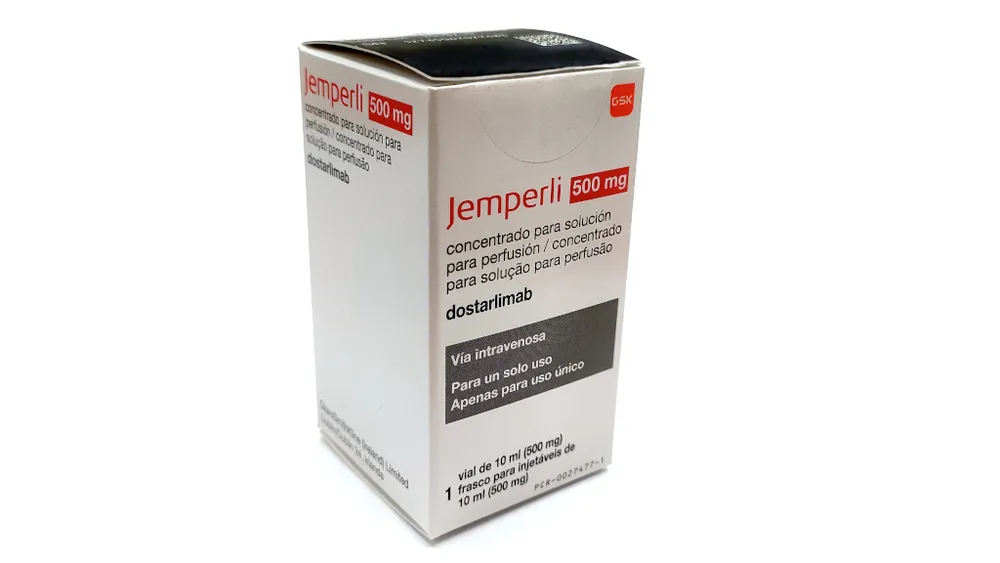
Table of Contents
Package leaflet: Information for the user
Introduction
Package leaflet: information for the patient
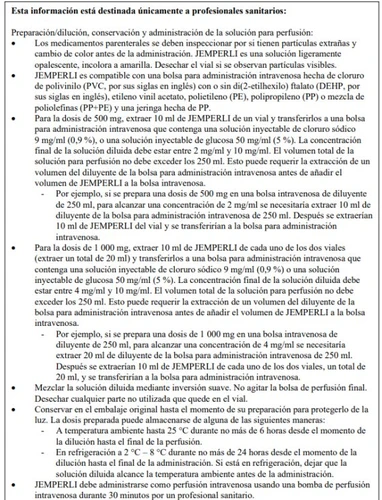
JEMPERLI 500mg concentrate for solution for infusion
dostarlimab
This medicinal product is subject to additional monitoring, which will allow for faster identification of new safety information. You can help by reporting any side effects you may experience. Section 4 at the end of this leaflet includes information on how to report side effects.
Read the entire leaflet carefully before you start using this medicine, as it contains important information for you.
- Keep this leaflet, as you may need to read it again.
- Your doctor will provide you with the Patient Information Card. Make sure to carry the Patient Information Card with you throughout your treatment with JEMPERLI.
- If you have any questions, consult your doctor or nurse.
- If you experience any side effects, consult your doctor or nurse, even if they are side effects not listed in this leaflet. See section 4.
Leaflet contents
- What JEMPERLI is and what it is used for
- What you need to know before being given JEMPERLI
- How JEMPERLI is administered
- Possible side effects
- How to store JEMPERLI
- Contents of the pack and other information
1. What JEMPERLI is and what it is used for
JEMPERLI contains the active substance dostarlimab, which is a monoclonal antibody, a type of protein designed to recognize and bind to a specific target substance in the body.
JEMPERLI works by helping your immune system to fight cancer.
JEMPERLI is used in adults to treat a type of cancer called endometrial cancer (cancer of the lining of the uterus). JEMPERLI is given when the tumor is diagnosed for the first time, has spread or cannot be removed by surgery, or the patient has progressed during or after prior treatment.
JEMPERLI may be given in combination with other anticancer medicines. It is important that you also read the package leaflets for any other anticancer medicines you may be receiving. If you have any questions about these medicines, consult your doctor.
2. What you need to know before JEMPERLI is administered to you
Do not use JEMPERLI:
- if you are allergic to dostarlimab or to any of the other ingredients of this medicine (listed in section 6).
Warnings and precautions
Talk to your doctor or nurse before receiving JEMPERLI if you have:
-
severe rash or skin peeling, blistering, and/or mouth ulcers;
-
immune system disorders;
-
breathing or lung problems;
-
liver or kidney problems;
-
other medical conditions.
-
Warnings and precautions – Special care with JEMPERLI:
-
This medicine may cause serious skin reactions. Stop using JEMPERLI and seek immediate medical attention if you notice any symptoms related to these serious skin reactions, described in section 4.
Symptoms to watch for
JEMPERLI may cause some serious adverse effects, which in some cases could be life-threatening and may lead to death. These adverse effects may occur at any time during treatment, or even after your treatment has ended. You may experience more than one adverse effect simultaneously.
You should be aware of the possible symptoms so that your doctor can provide treatment for adverse effects if necessary.
- Read the information under ‘Symptoms of serious adverse effects’ in section 4. Contact your doctor or nurse if you have any questions or concerns.
Children and adolescents
JEMPERLI must not be used in children and adolescents under 18 years of age.
Other medicines and JEMPERLI
Tell your doctor or nurse if you are taking, have recently taken, or might need to take any other medicines.
Some medicines may affect the action of JEMPERLI:
-
medicines that weaken your immune system – for example, corticosteroids such as prednisone.
-
Inform your doctor if you are taking any of these medicines.
However, once you start treatment with JEMPERLI, your doctor may give you corticosteroids to reduce any adverse effects you may experience.
Pregnancy
-
JEMPERLI must not be administered if you are pregnant unless specifically recommended by your doctor.
-
If you are pregnant, think you might be pregnant, or plan to become pregnant, talk to your doctor before receiving this medicine.
-
JEMPERLI may cause harm or death to the unborn baby.
-
If you are a woman of childbearing potential, you must use an effective contraceptive method during treatment with JEMPERLI and for at least 4 months after your last dose.
Breast-feeding
- If you are breast-feeding, talk to your doctor before receiving this medicine.
- You must not breast-feed during treatment and for at least 4 months after your last dose of JEMPERLI.
- It is unknown whether the active substance of JEMPERLI passes into breast milk.
Driving and using machines
It is unlikely that JEMPERLI will affect your ability to drive or operate machinery. However, if you experience adverse effects affecting your concentration or reaction time, you should exercise caution when driving or using machines.
JEMPERLI contains polysorbate 80
This medicine contains 2 mg of polysorbate 80 per dose unit. Polysorbates may cause allergic reactions. Inform your doctor if you have any known allergies.
JEMPERLI contains sodium
This medicine contains less than 1 mmol of sodium (23 mg) per dose, which is essentially “sodium-free”. However, before administration, JEMPERLI is mixed with a solution that may contain sodium. Consult your doctor if you are on a low-sodium diet.
3. How JEMPERLI is administered
JEMPERLI will be administered to you in a hospital or clinic under the supervision of a doctor experienced in the treatment of cancer.
When JEMPERLI is given as monotherapy, the recommended dose of JEMPERLI is 500 mg every 3 weeks for 4 doses, followed by 1,000 mg every 6 weeks for subsequent doses.
When JEMPERLI is given in combination with carboplatin and paclitaxel, the recommended dose of JEMPERLI is 500 mg every 3 weeks for 6 doses, followed by 1,000 mg every 6 weeks for subsequent doses.
Your doctor will administer JEMPERLI to you intravenously by infusion (intravenous infusion) over approximately 30 minutes.
Your doctor will decide how many treatments (cycles) you need.
If you miss an appointment to receive JEMPERLI
- Contact your doctor or hospital immediately to reschedule your appointment.
It is very important that you do not miss any doses of this medicine.
If you interrupt treatment with JEMPERLI
Interrupting your treatment may stop the effect of the medicine. Do not interrupt treatment with JEMPERLI unless you have discussed it with your doctor.
Patient Information Card
The important information in this leaflet can be found on the Patient Information Card provided to you by your doctor. It is important that you keep this Patient Information Card and show it to your partner or caregivers.
If you have any further questions about the use of this medicine, ask your doctor or nurse.
4. Possible adverse effects
Like all medicines, this medicine can cause adverse effects, although not everyone experiences them.
Some of these adverse effects may be serious, and you need to know which symptoms to pay attention to.
Symptoms of serious adverse effects
JEMPERLI may cause serious adverse effects. If you experience any symptoms, you must inform your doctor or nurse as soon as possible. Your doctor may give you other medicines to prevent more serious complications and reduce your symptoms. Your doctor may decide that you should skip a dose of JEMPERLI or stop treatment completely.
Conditions | Possible symptoms |
Inflammation of the lungs (pneumonitis) |
|
Inflammation of the intestines (colitis, enteritis, gastrointestinal vasculitis) |
|
Inflammation of the esophagus and stomach (esophagitis, gastritis) |
|
Inflammation of the liver (hepatitis) |
|
Inflammation of endocrine glands (especially thyroid, pituitary, adrenal glands, pancreas) |
|
Type 1 diabetes, including diabetic ketoacidosis (acid in the blood caused by diabetes) |
|
Inflammation of the kidneys (nephritis) |
|
Skin inflammation (bullous pemphigoid, Stevens-Johnson syndrome) |
|
Inflammation of the heart muscle (myocarditis) |
|
Inflammation of the brain and nervous system (myasthenic syndrome/myasthenia gravis, Guillain-Barré syndrome, encephalitis) |
|
Inflammation of the spinal cord (myelitis) |
|
Inflammation of the eyes |
|
Inflammation of other organs |
|
Infusion-related reactions
Some people may experience allergic-type reactions when receiving an infusion. These usually occur within minutes or hours, but may appear up to 24 hours after treatment.
Symptoms include:
- shortness of breath or wheezing;
- itching or rash;
- flushing (reddening of the skin);
- dizziness;
- chills or shivering;
- fever;
- drop in blood pressure (feeling faint or like you might lose consciousness).
Rejection of solid organ transplants and other complications, including graft-versus-host disease (GVHD), in people who have received a bone marrow (stem cell) transplant using donor stem cells (allogeneic). These complications can be serious and may lead to death. These complications may occur if you have had a transplant either before or after receiving treatment with JEMPERLI. Your doctor will monitor you for these complications.
- Seek medical attention immediately if you think you may be having a reaction.
The following adverse effects have been reported with JEMPERLI as monotherapy.
Very common adverse effects – (may affect more than 1 in 10 people):
- decrease in red blood cell count (anaemia);
- reduced activity of the thyroid gland;
- diarrhoea; feeling unwell (nausea) and vomiting;
- skin redness or rash; blistering of the skin or mucous membranes; skin itching;
- joint pain;
- high temperature, fever;
- increased liver enzyme levels in blood.
- See the table above for symptoms of possible serious adverse effects.
Common adverse effects – (may affect up to 1 in 10 people):
- overactive thyroid gland;
- decreased secretion of adrenal hormones (adrenal insufficiency);
- inflammation of the lung;
- inflammation of the lining of the intestine (colon);
- inflammation of the pancreas;
- inflammation of the stomach;
- inflammation of the liver;
- muscle pain;
- chills;
- reaction to infusion;
- hypersensitivity reaction to infusion.
- See the table above for symptoms of possible serious adverse effects.
Uncommon adverse effects – (may affect up to 1 in 100 people):
- inflammation of the brain;
- destruction of red blood cells (autoimmune haemolytic anaemia);
- inflammation of the pituitary gland located at the base of the brain;
- inflammation of the thyroid gland;
- type 1 diabetes or diabetic complications (diabetic ketoacidosis);
- inflammation of the oesophagus;
- inflammation of the skin (pemphigoid, Stevens-Johnson syndrome);
- a condition in which muscles become weak and fatigue easily (myasthenia gravis);
- joint inflammation;
- muscle inflammation;
- eye inflammation – of the iris (coloured part of the eye) and ciliary body (area around the iris);
- kidney inflammation.
- See the table above for symptoms of possible serious adverse effects.
Other adverse effects reported (frequency not known):
- Coeliac disease (characterised by symptoms such as stomach pain, diarrhoea and bloating after eating foods containing gluten);
- Absence or reduced production of digestive enzymes by the pancreas (exocrine pancreatic insufficiency).
The following adverse effects have been reported with JEMPERLI when administered in combination with carboplatin and paclitaxel.
Very common adverse effects – (may affect more than 1 in 10 people):
- reduced activity of the thyroid gland;
- skin rash;
- dry skin;
- high temperature, fever;
- increased liver enzyme levels in blood.
- See the table above for symptoms of possible serious adverse effects.
Common adverse effects – (may affect up to 1 in 10 people):
- overactive thyroid gland;
- inflammation of the lung;
- inflammation of the lining of the intestine (colon);
- inflammation of the pancreas.
- See the table above for symptoms of possible serious adverse effects.
Uncommon adverse effects – (may affect up to 1 in 100 people):
- inflammation of the thyroid gland;
- decreased secretion of adrenal hormones (adrenal insufficiency);
- type 1 diabetes;
- a condition in which muscles become weak and fatigue easily (myasthenia gravis);
- nerve inflammation which may cause pain, numbness, muscle weakness and difficulty walking (Guillain-Barré syndrome);
- inflammation of the heart muscle;
- inflammation of the stomach;
- inflammation of blood vessels in the oesophagus, stomach or intestine;
- eye inflammation;
- joint inflammation;
- muscle inflammation;
- generalised inflammation of the body.
- See the table above for symptoms of possible serious adverse effects.
Other adverse effects reported (frequency not known):
- Coeliac disease (characterised by symptoms such as stomach pain, diarrhoea and bloating after eating foods containing gluten);
- Absence or reduced production of digestive enzymes by the pancreas (exocrine pancreatic insufficiency).
- Contact your doctor or nurse as soon as possible if you develop any of these symptoms.
Reporting of adverse effects
If you experience any adverse effects, talk to your doctor or nurse, even if they are possible adverse effects not listed in this leaflet. You can also report them directly through the national reporting system included in Appendix V. By reporting adverse effects, you can help provide more information on the safety of this medicine.
5. Storage of JEMPERLI
JEMPERLI will be administered in a hospital or clinic, and healthcare professionals are responsible for its storage.
Keep this medicine out of the sight and reach of children.
Do not use this medicine after the expiry date which is stated on the container after EXP. The expiry date refers to the last day of the month indicated.
Store in a refrigerator (between 2 °C and 8 °C). Do not freeze. Keep in the original packaging to protect from light.
If the prepared infusion is not used immediately, it may be stored for up to 24 hours between 2 °C and 8 °C, or for up to 6 hours at room temperature (up to 25 °C), from the time of preparation/dilution until the end of administration.
Do not use this medicine if visible particles are observed.
Do not store any unused medicine for later use. Any unused medicine or waste material must be disposed of according to local requirements. These measures will help protect the environment.
6. Contents of the container and other information
Composition of JEMPERLI
-
The active substance is dostarlimab.
-
A 10 ml vial of concentrate for solution for infusion (sterile concentrate) contains 500 mg of dostarlimab.
-
Each ml of concentrate for solution for infusion contains 50 mg of dostarlimab.
-
The other components are trisodium citrate dihydrate (E331); monohydrate citric acid (E330); L-arginine hydrochloride; sodium chloride; polysorbate 80 (E433); and water for injections (see section 2).
Appearance of the product and contents of the pack
JEMPERLI is a clear to slightly opalescent, colourless to yellow solution, essentially free from visible particles.
It is available in packs containing one glass vial.
Marketing Authorization Holder
GlaxoSmithKline Trading Services Limited
12 Riverwalk
Citywest Business Campus
Dublin 24
Ireland
D24 YK11
Manufacturer
GlaxoSmithKline Trading Services Ltd.
12 Riverwalk
Citywest Business Campus
Dublin 24
Ireland
GlaxoSmithKline Manufacturing S.p.A.
Strada Provinciale Asolana, 90
43056 San Polo di Torrile
Parma, Italy
For further information on this medicine, please contact the local representative of the Marketing Authorization Holder:
Belgium/Belgium/Belgium GlaxoSmithKline Pharmaceuticals s.a./n.v Tel/Tel: + 32 (0) 10 85 52 00 | Lithuania GlaxoSmithKline Trading Services Limited Tel: + 370 80000334 |
| Luxembourg/Luxembourg GlaxoSmithKline Pharmaceuticals s.a./n.v. Belgium/Belgium Tel/Tel: + 32 (0) 10 85 52 00 |
Czech Republic GlaxoSmithKline, s.r.o. Tel: + 420 222 001 111 | Hungary GlaxoSmithKline Trading Services Limited Tel.: + 36 80088309 |
Denmark GlaxoSmithKline Pharma A/S Tlf.: + 45 36 35 91 00 | Malta GlaxoSmithKline Trading Services Limited Tel: + 356 80065004 |
Germany GlaxoSmithKline GmbH & Co. KG Tel.: + 49 (0)89 36044 8701 | Netherlands GlaxoSmithKline BV Tel: + 31 (0) 33 2081100 |
Estonia GlaxoSmithKline Trading Services Limited Tel: + 372 8002640 | Norway GlaxoSmithKline AS Tlf: + 47 22 70 20 00 |
Greece GlaxoSmithKline Μονοπρóσωπη A.E.B.E. Tel: + 30 210 68 82 100 | Austria GlaxoSmithKline Pharma GmbH Tel: + 43 (0)1 97075 0 |
Spain GlaxoSmithKline, S.A. Tel: + 34 900 202 700 | Poland GSK Services Sp. z o.o. Tel.: + 48 (0)22 576 9000 |
France Laboratory GlaxoSmithKline Tel: + 33 (0)1 39 17 84 44 | Portugal GlaxoSmithKline – Produtos Farmacêuticos, Lda. Tel: + 351 21 412 95 00 |
Croatia GlaxoSmithKline Trading Services Limited Tel: +385 800787089 | Romania GlaxoSmithKline Trading Services Limited Tel: + 40 800672524 |
Ireland GlaxoSmithKline (Ireland) Limited Tel: + 353 (0)1 4955000 | Slovenia GlaxoSmithKline Trading Services Limited Tel: + 386 80688869 |
Iceland Vistor hf. Tel: + 354 535 7000 | Slovakia GlaxoSmithKline Trading Services Limited Tel: + 421 800500589 |
Italy GlaxoSmithKline S.p.A. Tel: + 39 (0)45 7741111 | Finland GlaxoSmithKline Oy Tel: + 358 (0)10 30 30 30 |
Cyprus GlaxoSmithKline Trading Services Limited Tel: + 357 80070017 | Sweden GlaxoSmithKline AB Tel: + 46 (0)8 638 93 00 |
Latvia GlaxoSmithKline Trading Services Limited Tel: + 371 80205045 |

Date of the most recent review of this leaflet:
Other sources of information
Detailed information on this medicine is available on the European Medicines Agency website: https://www.ema.europa.eu.