Izamby 60 mg solution for injection in pre-filled syringe
Spain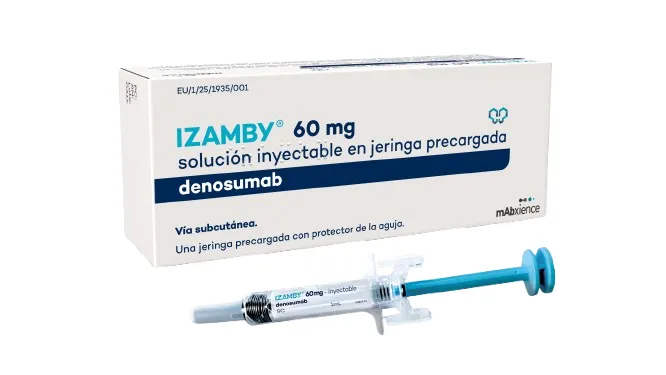
Table of Contents
Package leaflet: Information for the user
Introduction
Package leaflet: information for the user
Izamby 60 mg solution for injection in pre-filled syringe
denosumab
This medicinal product is subject to additional monitoring, which will allow for rapid identification of new safety information. You can help by reporting any adverse reactions you may experience. Section 4 at the end of this leaflet contains information on how to report adverse reactions.
Read all of this leaflet carefully before you start using this medicine, because it contains important information for you.
- Keep this leaflet, as you may need to read it again.
- If you have any questions, ask your doctor or pharmacist.
- This medicine has been prescribed for you only, and you should not give it to other people, even if they have the same symptoms as you, because it may harm them.
- If you experience any adverse reactions, consult your doctor or pharmacist, even if they are adverse reactions not listed in this leaflet. See section 4.
- Your doctor will provide you with a patient reminder card containing important safety information you should know before and during your treatment with Izamby.
Contents of this leaflet
- What Izamby is and what it is used for
- What you need to know before using Izamby
- How to use Izamby
- Possible side effects
- How to store Izamby
- Contents of the pack and other information
1. What Izamby is and what it is used for
What Izamby is and how it works
Izamby contains denosumab, a protein (monoclonal antibody) that interferes with the action of another protein in order to treat bone loss and osteoporosis. Treatment with denosumab strengthens bones and reduces the likelihood of fractures.
Bone is living tissue that is continuously renewed. Oestrogens contribute to maintaining bone health. After menopause, oestrogen levels decline, which may cause bones to become thinner and more fragile. Over time, this can lead to a condition called osteoporosis. Osteoporosis can also occur in men due to various causes, including age and/or low levels of the male hormone testosterone. It may also occur in patients receiving glucocorticoid treatment. Many patients with osteoporosis do not have symptoms, yet they remain at risk of bone fractures, particularly in the spine, hip, and wrists.
Surgical procedures or medications that suppress the production of oestrogen or testosterone, used to treat patients with prostate or breast cancer, can also cause bone loss. As a result, bones become weaker and more prone to breaking.
What Izamby is used for
Izamby is used to treat:
- postmenopausal osteoporosis in women and osteoporosis in men who are at increased risk of fracture (bone breakage), by reducing the risk of hip, vertebral, and non-vertebral fractures,
- bone loss caused by reduced hormone levels (testosterone) resulting from surgery or drug treatment in patients with prostate cancer,
- bone loss resulting from long-term glucocorticoid therapy in patients who are at high risk of fracture.
2. What you need to know before using Izamby
Do not use Izamby
- if you have low levels of calcium in the blood (hypocalcemia),
- if you are allergic to denosumab or any of the other ingredients of this medicine (listed in section 6).
Warnings and precautions
Talk to your doctor or pharmacist before starting to use Izamby.
While being treated with Izamby, you may develop a skin infection with symptoms such as a swollen and red area on the skin, most commonly on the lower leg, which feels warm and tender to the touch (cellulitis), and which may be accompanied by fever. Contact your doctor immediately if you experience any of these symptoms.
Additionally, you must take calcium and vitamin D supplements during treatment with Izamby. Your doctor will discuss this with you.
While receiving Izamby, you may develop low levels of calcium in the blood. Contact your doctor immediately if you notice any of the following symptoms: muscle spasms, contractions or cramps, and/or numbness or tingling in the fingers, toes or around the mouth, and/or seizures, confusion or loss of consciousness.
Rarely, cases of very low blood calcium levels have been reported, requiring hospitalization and, in some cases, leading to potentially life-threatening reactions. Therefore, before each dose is administered, and within two weeks after the initial dose in patients predisposed to hypocalcemia, your blood calcium levels will be checked (through a blood test).
Inform your doctor if you have or have had severe kidney problems, renal failure, if you have required dialysis, or if you are taking medications called glucocorticoids (such as prednisolone or dexamethasone), as these may increase the risk of low blood calcium levels if you do not take calcium supplements.
Problems in the mouth, teeth or jaw
In patients receiving denosumab for osteoporosis, a rare adverse effect called osteonecrosis of the jaw (ONJ) (damage to the jawbone) has been reported (may affect up to 1 in 1,000 people). The risk of ONJ increases in patients treated for a long time (may affect up to 1 in 200 people if treated for 10 years). ONJ may also occur after stopping treatment. It is important to try to prevent ONJ from developing, as it can be a painful condition that may be difficult to treat. To reduce the risk of developing ONJ, follow these precautions:
Before receiving treatment, inform your doctor or nurse (healthcare professional) if:
- you have any problems with your mouth or teeth such as poor dental health, gum disease, or planned dental extraction,
- you do not receive regular dental check-ups or have not had a dental check-up for a long time,
- you are a smoker (as this may increase the risk of dental problems),
- you have previously been treated with a bisphosphonate (used to prevent or treat bone disorders),
- you are taking medications called corticosteroids (such as prednisolone or dexamethasone),
- you have cancer.
Your doctor may ask you to have a dental examination before starting treatment with Izamby.
During treatment, you must maintain good oral hygiene and undergo routine dental check-ups. If you wear dentures, ensure they fit properly. If you are undergoing dental treatment or are scheduled for dental surgery (e.g., tooth extractions), inform your doctor about your dental treatment and inform your dentist that you are being treated with Izamby.
Contact your doctor and dentist immediately if you experience any problems in your mouth or teeth such as loose teeth, pain or swelling, or non-healing or oozing sores, as these could be symptoms of ONJ.
Unusual femur fractures
Some people have developed unusual fractures in the femur while being treated with denosumab. Consult your doctor if you experience new or unusual pain in the hip, groin or thigh.
Children and adolescents
Izamby must not be used in individuals under 18 years of age.
Other medicines and Izamby
Tell your doctor or pharmacist if you are taking, have recently taken, or might need to take any other medicines. It is especially important that you inform your doctor if you are being treated with another medicine containing denosumab.
You must not use Izamby together with another medicine containing denosumab.
Pregnancy and breastfeeding
Izamby has not been studied in pregnant women. If you are pregnant, think you may be pregnant, or plan to become pregnant, consult your doctor before using this medicine. Use of Izamby during pregnancy is not recommended. Women of childbearing potential must use effective contraception during treatment with Izamby and for at least 5 months after stopping treatment with Izamby.
If you become pregnant during treatment with Izamby or within 5 months after stopping treatment with Izamby, inform your doctor.
It is unknown whether Izamby is excreted in human breast milk. It is important to inform your doctor if you are breastfeeding or plan to breastfeed. Your doctor will help you decide whether to discontinue breastfeeding or to stop using Izamby, taking into account the benefits of breastfeeding for the child and the benefits of Izamby for the mother.
If you are breastfeeding during treatment with Izamby, please inform your doctor.
Talk to your doctor or pharmacist before using any medicine.
Driving and using machines
The influence of Izamby on the ability to drive and use machines is negligible or none.
Izamby contains sorbitol
This medicine contains 46 mg of sorbitol in each ml of solution.
Izamby contains sodium
This medicine contains less than 1 mmol of sodium (23 mg) per 60 mg dose; hence, it is essentially “sodium-free”.
Izamby contains polysorbate
This medicine contains 0.1 mg of polysorbate 20 (E 432) in each syringe, equivalent to 0.1 mg/ml.
Polysorbates may cause allergic reactions. Inform your doctor if you have any known allergies.
3. How to use Izamby
Follow exactly the administration instructions for this medicine as given by your doctor. If in doubt, consult your doctor again.
The recommended dose is one pre-filled syringe containing 60 mg, administered under the skin (subcutaneously) as a single injection every 6 months. The best sites for the injection are the upper thighs and the abdomen. If a caregiver (a person caring for you) is administering the injection, it may also be given into the outer side of the upper arm. Consult your doctor for the date of your next possible injection. Each pack of Izamby contains a reminder card that can be used to keep a record of the date of your next injection.
In addition, you must take calcium and vitamin D supplements during treatment with Izamby. Your doctor will discuss this with you.
Your doctor may decide whether it is better for you or a caregiver to administer the Izamby injection. Your doctor or healthcare professional will show you or your caregiver how to use Izamby. If you would like instructions on how to inject Izamby, please read the last section of this leaflet.
Do not shake.
Before administration, inspect the solution. Do not inject the solution if it contains particles, is cloudy, or has changed in colour.
If you forget to use Izamby
If you miss a dose of Izamby, the injection should be administered as soon as possible. After that, injections should be scheduled every 6 months starting from the date of the last injection.
If you stop using Izamby
To get the maximum benefit from your treatment and to reduce the risk of fractures, it is important that you use Izamby for the entire period prescribed by your doctor. Do not stop treatment without first talking to your doctor.
4. Possible adverse effects
Like all medicines, this medicine can cause adverse effects, although not everyone will experience them.
Patients treated with Izamby may rarely develop skin infections (mainly cellulitis). Contact your doctor immediately if any of the following symptoms occur during treatment with Izamby: a swollen, red area on the skin, usually on the lower leg, which is warm and tender to the touch and may be accompanied by fever.
Rarely, patients receiving Izamby may develop mouth and/or jaw pain, swelling or non-healing ulcers in the mouth or jaw, discharge, numbness or a feeling of heaviness in the jaw, or loose teeth. These could be symptoms of bone damage in the jaw (osteonecrosis). Contact your doctor and dentist immediately if you experience such symptoms while on treatment with Izamby or after stopping treatment.
Rarely, patients receiving Izamby may develop low levels of calcium in the blood (hypocalcemia); very low calcium levels may require hospitalization and could even be life-threatening. Symptoms include muscle spasms, contractions, or cramps, and/or numbness or tingling in the fingers, toes, or around the mouth and/or seizures, confusion, or loss of consciousness. If you experience any of these, contact your doctor immediately. Low calcium levels in the blood may also cause a change in heart rhythm known as QT prolongation, which can be detected by an electrocardiogram (ECG).
Rarely, unusual femoral fractures may occur in patients receiving Izamby. Consult your doctor if you experience new or unusual pain in the hip, groin, or thigh, as this may be an early sign of a possible femoral fracture.
Rarely, allergic reactions may occur in patients receiving Izamby. Symptoms include swelling of the face, lips, tongue, throat, or other body parts; skin rash, itching, or hives; wheezing or difficulty breathing. Contact your doctor if you experience such symptoms while on treatment with Izamby.
Very common adverse effects (may affect more than 1 in 10 people):
- bone, joint, and/or muscle pain, which may sometimes be severe,
- pain in the legs or arms (limb pain).
Common adverse effects (may affect up to 1 in 10 people):
- painful urination, frequent urination, blood in the urine, urinary incontinence,
- upper respiratory tract infection,
- pain, tingling, or numbness radiating down the lower leg (sciatica),
- constipation,
- abdominal discomfort,
- skin rash,
- skin condition with itching, redness, and/or dryness (eczema),
- hair loss (alopecia).
Uncommon adverse effects (may affect up to 1 in 100 people):
- fever, vomiting, and abdominal pain or discomfort (diverticulitis),
- ear infection,
- skin rash or mouth ulcers (drug-induced lichenoid eruptions).
Rare adverse effects (may affect up to 1 in 10,000 people):
- allergic reaction that may damage blood vessels, mainly in the skin (e.g., purple or reddish-brown spots, hives, or skin ulcers) (hypersensitivity vasculitis).
Frequency not known (cannot be estimated from available data):
- consult your doctor if you have ear pain, ear discharge, and/or an ear infection. These could be symptoms of damage to the ear bones.
Reporting of adverse effects
If you experience any adverse effect, talk to your doctor or pharmacist, even if it is a possible adverse effect not listed in this leaflet. You may also report them directly through the national reporting system included in Appendix V. By reporting adverse effects, you can help provide more information on the safety of this medicine.
5. Storage of Izamby
Keep this medicine out of the sight and reach of children.
Do not use this medicine after the expiry date stated on the label and on the carton after "CAD" or "EXP". The expiry date refers to the last day of the month indicated.
Store in a refrigerator (between 2 °C and 8 °C).
Do not freeze.
Keep the pre-filled syringe in the outer packaging to protect it from light.
Before injection, the pre-filled syringe may be removed from the refrigerator and allowed to reach room temperature (up to 25 °C) to make the injection more comfortable. Once the syringe has reached room temperature (up to 25 °C), it must be used within 30 days.
Medicines must not be disposed of via wastewater or household waste. Ask your pharmacist how to dispose of unused medicines and their packaging. This will help protect the environment.
6. Contents of the container and other information
Composition of Izamby
- The active substance is denosumab. Each 1 ml pre-filled syringe contains 60 mg of denosumab (60 mg/mL).
- The other components are glacial acetic acid, sodium hydroxide, sorbitol (E 420), polysorbate 20, and water for injections.
Appearance of the product and contents of the container
Izamby is an injectable solution, colourless to slightly yellow, available in a pre-filled syringe ready for use.
Each pack contains one pre-filled syringe with a needle shield protector.
Marketing Authorization Holder
Mabxience Research SL
C/ Manuel Pombo Angulo 28
28050 Madrid
Spain
Manufacturer responsible for manufacturing
GH GENHELIX S.A.
Parque Tecnológico de León
Edificio GENHELIX
C/Julia Morros, s/n
Armunia, 24009 León
Spain
You can request further information about this medicinal product by contacting the local representative of the Marketing Authorization Holder:
Date of the most recent revision of this leaflet: <{MM/YYYY}><{month YYYY}>.
Belgium/Belgium/Belgium Mabxience Research SL Tel/Tel: + 34 917 711 500 | Lithuania UAB EGIS Lithuania Tel: + 370 5 231 4658 |
| Luxembourg/Luxembourg Mabxience Research SL Tel/Tel: + 34 917 711 500 |
Czech Republic EGIS Praha, spol. s r.o Tel: + 420 227 129 111 | Hungary Egis Gyógyszergyár Zrt. Tel.: + 36 1 803 5555 |
Denmark Medical Valley Invest AB Tlf: + 46 40 122131 | Malta Mabxience Research SL Tel: + 34 917 711 500 |
Germany Mabxience Research SL Tel: + 34 917 711 500 | Netherlands Medical Valley Invest AB Tel: + 46 40 122131 |
Estonia Mabxience Research SL Tel: + 34 917 711 500 | Norway Medical Valley Invest AB Tlf: + 46 40 122131 |
Greece ELPEN Pharmaceutical Co. Inc Tel: + 30 210 6039326-9 | Austria Gebro Pharma GmbH Tel: + 43 (0)5453 5300-0 |
Spain Laboratorios Gebro Pharma S.A. Tel: + 34 93 205 86 86 | Poland Egis Polska sp. z o.o. Tel.: + 48 22 417 92 00 |
France Laboratoires Biogaran Tél: + 33 (0) 800 970 109 | Portugal Mabxience Research SL Tel: + 34 917 711 500 |
Croatia Mabxience Research SL Tel: + 34 917 711 500 | Romania Egis Rompharma SRL Tel: + 40 21 412 00 17 |
Ireland Mabxience Research SL Tel: + 34 917 711 500 | Slovenia Mabxience Research SL Tel: + 34 917 711 500 |
Iceland Mabxience Research SL Sími: + 34 917 711 500 | Slovakia EGIS SLOVAKIA spol. s r.o., Tel: + 421 2 3240 9422 |
Italy Abiogen Pharma S.p.A Tel: + 39 050 315 4101 | Finland Medical Valley Invest AB Puh/Tel: + 46 40 122131 |
Cyprus Mabxience Research SL Tel: + 34 917 711 500 | Sweden Medical Valley Invest AB Tel: + 46 40 122131 |
Latvia Egis Latvia SIA Tel: + 371 676 13859 |
Other sources of information
Detailed information on this medicine is available on the European Medicines Agency website: https://www.ema.europa.eu.
Instructions for use
Read these instructions before starting to use the Izamby pre-filled syringes with needle shield and each time you receive a new pack. There may be new information. You should also speak with your healthcare professional about your condition or your treatment.
Keep these instructions for use so you can read them again if necessary.
IMPORTANT INFORMATION
Important information you should know before injecting yourself with Izamby:
- It is important that you do not attempt to administer the injection yourself unless you have been trained by your doctor or healthcare professional on the correct way to inject Izamby.
- Izamby is for subcutaneous injection only (inject directly under the skin).
- Do not open the carton until you are ready to use the medicine.
- Do not remove the needle cap from the pre-filled syringe until you are ready for the injection.
- Do not use the pre-filled syringe if it has fallen on a hard surface. Use a new pre-filled syringe and contact your doctor or healthcare professional.
- Do not attempt to activate the pre-filled syringe before the injection.
- Do not attempt to remove the needle shield from the pre-filled syringe.
Contact your doctor or healthcare professional if you or your caregiver have any questions about the correct way to inject Izamby.
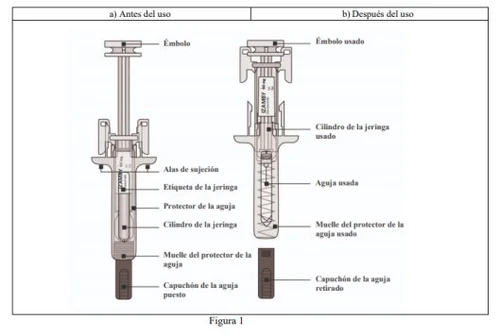
Figure 1 shows what the pre-filled syringe with needle shield looks like before (a) and after (b) use.
- Prepare for the Izamby injection
Gather the materials
-
Place the materials needed for your injection on a clean, well-lit surface:
-
Izamby carton containing the pre-filled syringe
-
Alcohol wipes
-
Cotton wool or gauze
-
Plaster
-
Sharps container
Allow the syringe to reach room temperature
-
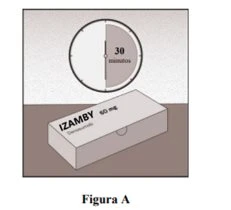
To make the injection more comfortable, leave the carton with the pre-filled syringe inside at room temperature for approximately 30 minutes before the injection (Figure A).
-
Do not try to warm the pre-filled syringe using a heat source such as hot water or microwave.
-
Do not leave the pre-filled syringe exposed to direct sunlight.
-
Do not shake the pre-filled syringe.
-
Keep the pre-filled syringe out of the sight and reach of children.
Wash your hands
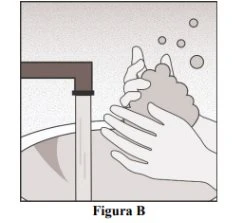
- Wash your hands thoroughly with water and soap (Figure B).
Remove the pre-filled syringe from the carton
- Open the carton.
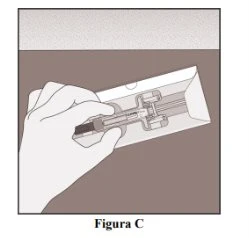
- Hold the pre-filled syringe by the barrel (Figure C).
- Lift the syringe out of the carton.
- Place the syringe on a clean, flat surface.
For safety reasons:
- Do not hold it by the plunger.
- Do not hold it by the needle cap.
Examine the medicine and the pre-filled syringe
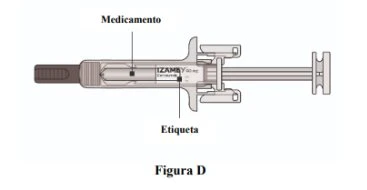
- Check that the product name “Izamby” is printed on the label (Figure D).
- Check the expiry date printed on the label (Figure D).
- Check that the medicine is a clear, colourless to slightly yellow solution (Figure D).
- Check that the pre-filled syringe is not damaged.
Do not use the pre-filled syringe if:
- The medicine is cloudy or contains particles.
- Any of the components are cracked or broken.
- The needle cap is missing or loose.
- The date is past the last day of the month shown as the expiry date on the label.
In any of these cases, contact your doctor or healthcare professional.
- Prepare yourself
Prepare the injection site
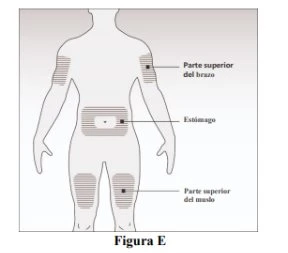
- Choose the injection site (Figure E):
Possible sites include:
-
The upper thigh.
-
The stomach area, except for a 5 cm area around the navel.
-
The outer side of the upper arm (only if another person administers the injection).
Do not inject into areas where the skin is tender, bruised, red, or hardened. Avoid injecting into areas with scars or stretch marks.
Clean the injection site
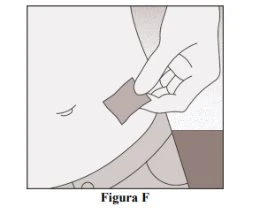
- Clean the injection site with an alcohol wipe (Figure F).
- Allow the skin to dry.
- Do not touch the injection site before injecting.
Remove the needle cap
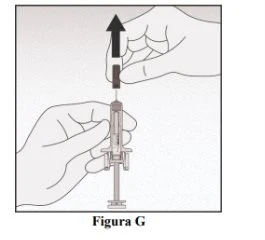
- Carefully pull the needle cap straight off and away from your body (Figure G).
- Discard the needle cap.
- Do not attempt to recap the needle.
- Inject yourself with Izamby
Insert the needle
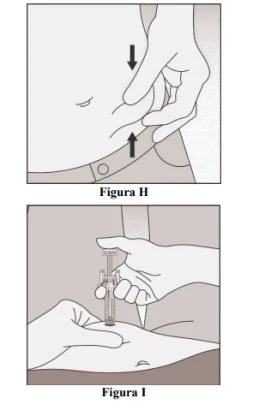
- Pinch the injection site to create a firm surface (Figure H).
- Do not touch the cleaned area of skin.
- Note: It is important to keep the skin pinched during injection.
- Insert the needle at a 45 to 90 degree angle into the pinched skin (Figure I).
Inject Izamby
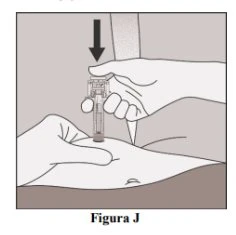
- Slowly push the plunger all the way down until all the liquid has been injected and the syringe is empty (Figure J).
Note: The plunger must be fully depressed to ensure the full dose is delivered and to activate the needle shield.
Lift your thumb
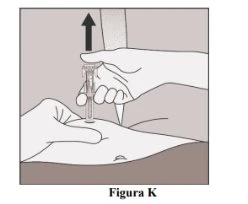
- Lift your thumb from the plunger so that the needle shield covers the needle (Figure K).
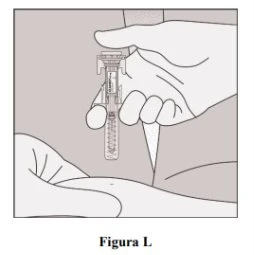
- Remove the needle from the skin (Figure L).
- Release the skin.
Contact your doctor or healthcare professional immediately if:
- the full dose was not injected, or
- the needle shield does not activate after the injection.
- Dispose of Izamby
Dispose of the syringe
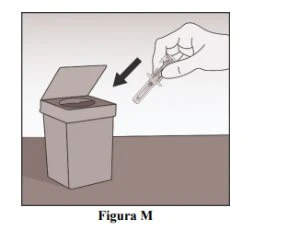
- Dispose of the used pre-filled syringe and other materials in a sharps container (Figure M).
- Note: Disposal of medicines must comply with local regulations. Ask your doctor or healthcare professional how to dispose of medicines you no longer need. This will help protect the environment.
- Do not recap the needle on used pre-filled syringes.
- Do not reuse the pre-filled syringe, even if not all the medicine was injected.
- Do not recycle pre-filled syringes or throw them in the household waste.
- Keep the syringe and sharps container out of the sight and reach of children.
Examine the injection site
- If you see blood, press the injection site with cotton wool or gauze.
- Do not rub the injection site. If needed, apply a plaster.
Record the date of your next injection
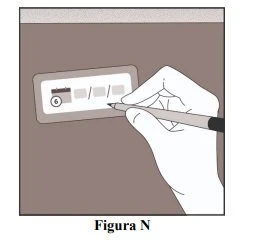
- Record the date of your next injection on the reminder card included in the pack (Figure N).