Ixiaro injectable suspension
Spain
Table of Contents
Package leaflet: Information for the user
Introduction
PACKAGE LEAFLET: INFORMATION FOR THE USER
IXIARO injectable suspension
Japanese encephalitis vaccine (inactivated, adsorbed)
Read all of this leaflet carefully before you or your child starts using this vaccine, because it contains important information for you.
- Keep this leaflet, as you and your child may need to read it again.
- If you have any questions, consult your doctor.
- This vaccine has been prescribed only for you and/or your child. Do not give it to other people.
- If you and/or your child experience any adverse reactions, consult your doctor, even if they are adverse reactions not listed in this leaflet. See section 4.
Contents of this leaflet:
- What IXIARO is and what it is used for
- What you need to know before you and/or your child use IXIARO
- How IXIARO is administered
- Possible side effects
- How to store IXIARO
- Contents of the pack and other information
1. What IXIARO is and what it is used for
IXIARO is a vaccine against the Japanese encephalitis virus.
The vaccine stimulates the body to produce its own protection (antibodies) against this disease.
IXIARO is indicated for the prevention of infection caused by the Japanese encephalitis virus (JEV). This virus is found mainly in Asia and is transmitted to humans through mosquitoes that have bitten an infected animal (for example, a pig). Many infected individuals experience mild symptoms or no symptoms at all. In individuals who develop a severe form of the disease, Japanese encephalitis (JE) usually begins with flu-like symptoms, including fever, chills, fatigue, headache, nausea, and vomiting. Confusion and agitation may also appear in the early stages of the disease.
IXIARO should only be administered to adults, adolescents, children, or infants older than 2 months of age who are travelling to countries where JE is endemic or who are at risk of exposure due to their occupation.
2. What you need to know before you and/or your child start using IXIARO
DO NOT use IXIARO:
- If you and/or your child are allergic (hypersensitive) to the active substance or to any of the other components of this medicine (listed in section 6).
- If you and/or your child have experienced an allergic reaction after receiving a previous dose of IXIARO. Symptoms of an allergic reaction may include itchy rash, difficulty breathing, and swelling of the face and tongue.
- If you and/or your child have an illness with high fever. In this case, your doctor will postpone vaccination.
Warnings and precautions
IXIARO must not be injected into a blood vessel.
Primary vaccination should be completed at least one week before potential exposure to Japanese encephalitis virus (JEV).
Tell your doctor:
-
- If you and/or your child have experienced any health problems after administration of a previous vaccine;
- If you and/or your child have any other known allergies;
- If you have a bleeding disorder (a condition causing you and/or your child to bleed more than normal) or have a reduced number of blood platelets, which increases the risk of bleeding or bruising (thrombocytopenia);
- If your child is less than 2 months old, as IXIARO has not been studied in infants under 2 months of age;
- If your immune system (you and/or your child) does not function properly (immunodeficiency) or if you and/or your child are taking medicines that affect the immune system (such as a medicine called cortisone or cancer treatments).
Your doctor will explain the potential risks and benefits of receiving IXIARO.
Please consider the following:
- IXIARO cannot cause the disease it protects against.
- IXIARO will not prevent infections caused by other viruses different from the Japanese encephalitis virus.
- Like any other vaccine, vaccination with IXIARO may not provide protection in all cases.
- You should continue to take necessary precautions to avoid mosquito bites (wearing appropriate clothing, using repellents, mosquito nets) even after vaccination with IXIARO.
Use of IXIARO with other medicines
Clinical trials evaluating the efficacy and safety of medicines in humans have shown that IXIARO can be administered simultaneously with the hepatitis A vaccine and the rabies vaccine.
Inform your doctor if you and/or your child are using, have recently used, or might take any other medicines, including those obtained without prescription, or if you have recently received any other vaccine.
Pregnancy, breastfeeding, and fertility
There are insufficient data on the use of IXIARO in pregnant or breastfeeding women.
As a precautionary measure, IXIARO should not be used during pregnancy or breastfeeding.
If you are pregnant or breastfeeding, think you might be pregnant, or plan to become pregnant, consult your doctor before using this vaccine.
Driving and using machines
IXIARO has no influence or its influence is negligible on the ability to drive and use machines.
IXIARO contains potassium and sodium
This medicine contains potassium, less than 1 mmol (39 mg) per 0.5 ml single dose, i.e., essentially "potassium-free", and less than 1 mmol of sodium (23 mg) per 0.5 ml single dose, i.e., essentially "sodium-free". This medicine may contain traces of sodium metabisulfite below the limit of detection.
3. How to use IXIARO
The recommended dose for adults, adolescents and children older than 3 years of age is 2 injections of 0.5 ml each:
- The first injection on day 0
- The second injection 28 days after the first (day 28)
Adults aged 18 to ≤ 65 years may also be vaccinated as follows:
- The first injection on day 0
- The second injection 7 days after the first injection (day 7)
Infants and children aged between 2 months and <3 years of age
The recommended dose for infants and children aged between 2 months and <3 years of age is 2 injections of 0.25 ml each:
- The first injection on day 0
- The second injection 28 days after the first (day 28)
For instructions on how to prepare the 0.25 ml dose, see the end of this leaflet.
Make sure that you and/or your child complete the full 2-dose vaccination schedule. The second injection should be administered at least one week before potential exposure to Japanese encephalitis virus. Otherwise, you and/or your child may not be fully protected against the disease.
For adults, adolescents, children and infants aged 1 year or older, a booster dose may be given during the second year (i.e., 12 to 24 months) after the first dose of the recommended primary immunization. In adults, a second booster dose may be given 10 years after the first booster dose. In elderly individuals (> 65 years of age), the first booster dose may be given earlier. Your doctor will decide on the need for and timing of booster doses.
Administration
Your doctor or nurse will inject IXIARO into the muscle of your arm (deltoid). IXIARO must not be injected into a blood vessel. If you and/or your child have a bleeding disorder, your doctor may decide to administer the vaccine under the skin (subcutaneously).
If you have any further questions about the use of this product, ask your doctor or pharmacist.
If you forget to receive IXIARO
If you and/or your child miss one of the scheduled injections, consult your doctor and arrange another appointment for the second injection. Without the second injection, you and/or your child will not be fully protected against the disease. Available information indicates that the second injection may be given up to 11 months after the first.
4. Possible adverse effects
Like all medicines, this product may produce adverse effects, although not everyone experiences them.
Most of the following adverse effects were observed during clinical trials, usually occurring within three days after vaccination. They are generally mild and resolve within a few days.
Very common (affects more than 1 in 10 people):
Headache, muscle pain, pain at the injection site, hypersensitivity at the injection site, fatigue
Common (affects between 1 and 10 in 100 people):
Nausea, flu-like illness, fever, other reactions at the injection site (e.g., redness, hardening, swelling, itching)
Uncommon (affects between 1 and 10 in 1,000 people):
Vomiting, rash, changes in lymph nodes, migraine (pulsating headache, often accompanied by nausea and vomiting and sensitivity to light), dizziness, vertigo (sensation of spinning), diarrhea, abdominal pain, excessive sweating, itching, chills, malaise, musculoskeletal stiffness, joint pain, weakness, abnormal liver function tests (increased liver enzymes)
Rare (affects between 1 and 10 in 10,000 people):
Palpitations, rapid heart rate, difficulty breathing, abnormal skin sensations (e.g., prickling), hives, skin redness, pain in arms or legs, thrombocytopenia, nerve inflammation, swelling of limbs and ankles, taste disturbance, eyelid swelling, fainting
Other adverse effects in children aged between 2 months and <3 years
In children aged between 2 months and <3 years, the following adverse effects have been observed more frequently compared to children aged 3 to <12 years, adolescents, and adults:
Very common: fever (28.9%), diarrhea (11.8%), flu-like illness (11.2%), irritability (11.0%)
Common: loss of appetite, vomiting, exanthema
Uncommon: cough
Reporting of adverse effects
If you and/or your child experience any type of adverse effect, consult your doctor, even if it is a possible adverse effect not listed in this leaflet. You may also report them directly through the national reporting system included in Appendix V. By reporting adverse effects, you can help provide more information on the safety of this medicine.
5. Storage of IXIARO
-
- Keep this medicine out of the sight and reach of children.
- Do not use this medicine after the expiry date stated on the packaging after “EXP”. The expiry date refers to the last day of the month indicated.
- Store in a refrigerator (between 2 °C and 8 °C).
- Do not freeze. If the vaccine has been frozen, it must not be used.
- Keep in the original packaging to protect from light.
- Medicines should not be disposed of via wastewater or household waste. Ask your pharmacist how to dispose of medicines that you or your child no longer need. This will help protect the environment.
6. ADDITIONAL INFORMATION
Composition of IXIARO
One dose (0.5 mL) of IXIARO contains:
6 AU3 of inactivated Japanese encephalitis virus strain SA14-14-2\textsuperscript{1,2}
equivalent to a potency ≤ 460 ng DE50
- produced in Vero cells
- adsorbed on aluminium hydroxide hydrate (approximately 0.25 milligrams Al\textsuperscript{3+})
- Antigen Units
Aluminium hydroxide is added to this vaccine as an adjuvant.
Other components are: sodium chloride, potassium dihydrogen phosphate, disodium hydrogen phosphate, water for injections.
Presentation of the product and contents of the pack
IXIARO is an injectable suspension (0.5 mL in a glass syringe with or without needle supplied separately, pack containing 1 syringe).
IXIARO is a sterile, white or slightly milky suspension that becomes homogeneous when shaken.
Marketing Authorisation Holder and Manufacturer
Marketing Authorisation Holder:
Valneva Austria GmbH
Campus Vienna Biocenter 3
A-1030 Vienna
Austria
E-mail: [email protected]
Manufacturer:
Valneva Scotland Ltd.
Oakbank Park Road,
Livingston EH53 0TG
United Kingdom
Valneva Austria GmbH
Campus Vienna Biocenter 3
A-1030 Vienna
Austria
For any information about this product, please contact the Marketing Authorisation Holder at the following address:
[email protected]
Date of the most recent revision of this leaflet.
Other sources of information
Detailed information on this medicine is available on the European Medicines Agency website: http://www.ema.europa.eu/. The package leaflet for this product is available on the European Medicines Agency website in all languages of the European Union/European Economic Area.
This information is intended for healthcare professionals only:
The pre-filled syringe is for single use only and must not be used for more than one person. The pre-filled syringe is ready for use. If a needle is not supplied, use a sterile needle.
Do not use if the blister seal is broken or if the packaging is damaged.
During the storage period, a slight white deposit may form with a colourless and transparent supernatant.
Before administration, shake the syringe well to obtain a homogeneous, white, opaque suspension. Do not administer if particles are present or if there are changes in colour after shaking, or if the syringe shows physical damage.
Any unused medicine and materials that have been in contact with it must be disposed of in accordance with local regulations.
Information on administration of a 0.5 mL dose of IXIARO to individuals over 3 years of age
To administer a full 0.5 mL dose, follow these steps:
- Shake the syringe until a homogeneous suspension is obtained.
- Remove the cap from the tip of the syringe by gently twisting it. Do not attempt to break or pull off the tip, as this may damage the syringe.
- Attach a needle to the pre-filled syringe.
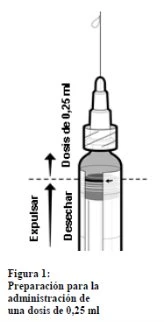
Information on preparation of a 0.25 mL dose of IXIARO for use in children under 3 years of age
To administer a 0.25 mL dose to children aged between 2 months and <3 years, follow these steps:
- Shake the syringe until a homogeneous suspension is obtained.
- Remove the cap from the tip of the syringe by gently twisting it. Do not attempt to break or pull off the tip, as this may damage the syringe.
- Attach a needle to the pre-filled syringe.
- Hold the syringe in an upright position.
- Push the plunger stopper up to the edge of the red line on the syringe barrel, indicated by a red arrow (see Figure 1)* to discard the excess volume.
- Attach a new sterile needle before injecting the remaining volume.
*If the plunger stopper is pushed beyond the red line, the 0.25 mL dose cannot be guaranteed and a new syringe must be used.