Isovorin 175 mg powder for injection and for infusion
Spain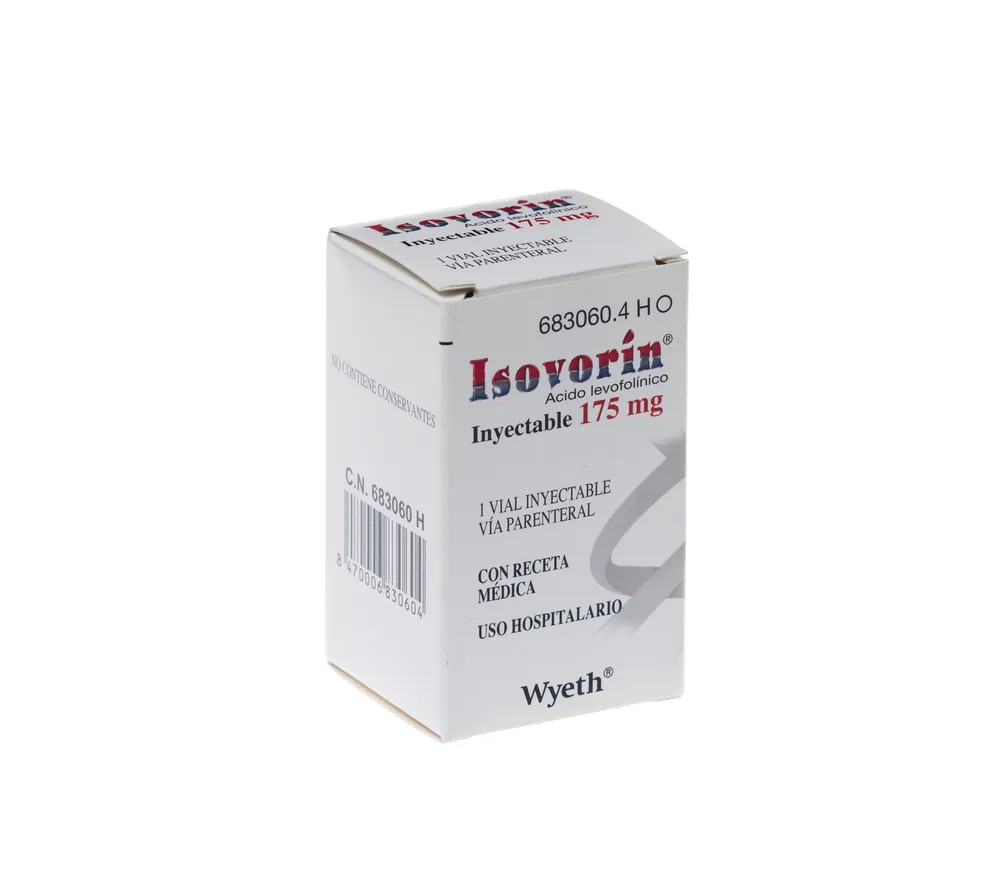
Table of Contents
Package leaflet: Information for the user
Introduction
Package leaflet: information for the patient
Isovorin 175 mg powder for injectable and perfusion solution
Leucovorin acid
Read the entire leaflet carefully before you start using this medicine, because it contains important information for you.
- Keep this leaflet, as you may need to read it again.
If you have any questions, consult your doctor, pharmacist or nurse.
-
This medicine has been prescribed for you only, and you should not give it to other people, even if they have the same symptoms as you, because it could harm them.
-
If you experience any adverse effects, consult your doctor, pharmacist or nurse, even if they are adverse effects not listed in this leaflet. See section 4.
Leaflet contents
- What Isovorin is and what it is used for
- What you need to know before using Isovorin
- How to use Isovorin
- Possible side effects
- Storage of Isovorin
- Contents of the pack and other information
1. What Isovorin is and what it is used for
Isovorin contains levofolinic acid, which is the active form of folic acid. Levofolinic acid acts as an antidote to folic acid antagonists and belongs to the group of medicinal agents known as detoxifying agents for tumor treatment.
This medicine is used in the following cases:
- To reduce side effects and treat overdose of certain anticancer medications such as methotrexate (and other folic acid antagonists).
- Used in combination with 5-fluorouracil, as it enhances the effect of this drug, in the treatment of cancer patients.
2. What you need to know before using Isovorin
Do not use Isovorin:
- if you are allergic to levofolinic acid or to any of the other ingredients of this medicine (listed in section 6).
- if you have anaemia (a disorder characterized by a reduction in the number of red blood cells and/or haemoglobin in the blood), whether pernicious anaemia or other megaloblastic anaemias secondary to vitamin B12 deficiency.
- if you are pregnant or breastfeeding, think you may be pregnant, or are planning to become pregnant.
Warnings and precautions
Talk to your doctor, pharmacist, or nurse before using Isovorin.
Your doctor will inform you about the benefits and risks of treatment with Isovorin, as well as the symptoms that may indicate possible drug toxicity.
If you are in any of the following situations, consult your doctor before using this medicine:
-
If you have pernicious anaemia or other megaloblastic anaemias due to vitamin B12 deficiency.
-
If you have blood disorders caused by anticancer medications.
-
If you are being treated with methotrexate or 5-fluorouracil. It is important that you strictly follow the dose of Isovorin prescribed by your doctor, as failure to do so may result in excessive toxicity or reduced efficacy of methotrexate.
-
If you have diarrhoea, as this may be a sign of gastrointestinal toxicity.
-
If you have previously received radiotherapy.
-
If you have accidentally taken an overdose of methotrexate.
-
If you have epilepsy and are being treated with phenobarbital, phenytoin, primidone, or succinimides, as there is a risk of increased seizure frequency (see section “Other medicines and Isovorin”).
Levofolinic acid must not be administered by intrathecal route (into the spinal cord).
Children and adolescents
There are no data on efficacy and safety in children and adolescents under 18 years of age.
Other medicines and Isovorin
Tell your doctor or pharmacist if you are taking, have recently taken, or might need to take any other medicines.
In particular, inform your doctor if you are taking the following medicines:
- Folic acid antagonist medicines such as cotrimoxazole, pyrimethamine, or chloramphenicol, as levofolinic acid may reduce their effectiveness.
- Antiepileptic medicines (such as phenobarbital, phenytoin, succinimides, or primidone), as high doses may partially reduce their effect and increase the frequency of seizures (see section “Warnings and precautions”).
- Medicines such as methotrexate or 5-fluorouracil. Calcium folinate should only be used with methotrexate or 5-fluorouracil under the direct supervision of a physician experienced in the use of cytotoxic chemotherapeutic agents.
Pregnancy, breastfeeding and fertility
If you are pregnant or breastfeeding, think you may be pregnant, or are planning to become pregnant, consult your doctor or pharmacist before using this medicine. Adequate and well-controlled clinical studies have not been conducted in pregnant or breastfeeding women.
It is unknown whether calcium levofolinate is excreted in breast milk. Your doctor will decide whether treatment with this medicine is necessary based on therapeutic indications.
Fertility studies have not been conducted with calcium folinate.
Driving and using machines
This medicine has no effect on the ability to drive or operate machinery.
This medicine contains sodium
This medicine contains less than 1 mmol (23 mg of sodium) per dose unit; i.e., essentially “sodium-free”.
3. How to use Isovorin
Your doctor will determine the dose and duration of treatment, as well as the most appropriate route of administration for you, based on your condition and response to treatment.
This medicine must not be administered by the intrathecal route (into the spinal cord).
This medicine should only be administered intravenously or intramuscularly. In the case of intravenous administration, no more than 160 mg of calcium folinate per minute should be injected due to the calcium content of the solution.
Leucovorin rescue in methotrexate therapy
If you have received a methotrexate dose higher than 500 mg/m², you must receive leucovorin subsequently. When methotrexate doses between 100 mg/m² - 500 mg/m² are administered, your doctor may consider rescue treatment.
Leucovorin rescue should begin 12–24 hours after the start of methotrexate infusion, with doses of 7.5 mg (approximately 5 mg/m²) of leucovorin every 6 hours for 72 hours.
Combined treatment with 5-fluorouracil
Since calcium folinate increases the activity and toxicity of 5-fluorouracil, treatment with this combination must be supervised by a physician experienced in the use of anticancer drugs.
Antidote for folic acid antagonists
This medicine may be used to reverse toxicity caused by trimetrexate, trimethoprim, or pyrimethamine. Your doctor will determine the treatment regimen.
If you use more Isovorin than you should
This medicine will be administered to you in a hospital setting, making it unlikely that you will receive more than the prescribed amount. No significant harm has been reported in patients who have received substantially higher doses of calcium folinate than recommended.
In case of overdose or accidental ingestion, consult your doctor or pharmacist immediately or call the Toxicology Information Service at telephone number: 91 562 04 20, indicating the medicine and the amount ingested.
If you forget to use Isovorin
Your doctor or nurse has instructions on when to administer your medicine. It is unlikely that the medicine will not be administered as prescribed. If you are aware that your dose has not been administered, contact your doctor or pharmacist immediately.
4. Possible adverse effects
Like all medicines, this medicine may cause adverse effects, although not everyone experiences them.
Uncommon adverse effects (may affect up to 1 in 100 people) include:
- Fever.
Rare adverse effects (may affect up to 1 in 1,000 people) include:
- Seizures and/or fainting.
- Depression.
- Agitation.
- Digestive problems.
- Difficulty sleeping (insomnia).
Very rare adverse effects (may affect up to 1 in 10,000 people) include:
- Severe allergic reaction: you may experience a sudden rash with itching (urticaria), swelling of the hands, feet, ankles, face, lips, mouth or throat (which may cause difficulty swallowing or breathing), and you may feel faint. This is a serious side effect. You may require urgent medical attention.
Adverse reactions when levoleucovorin is administered in combination with 5-fluorouracil are:
Very common adverse effects (may affect more than 1 in 10 patients) include:
- Nausea, vomiting, diarrhea.
- Inflammation of the mucous membranes of the intestine and mouth (in some cases fatal).
- Decrease in the number of blood cells (in some cases fatal).
Common adverse effects (may affect up to 1 in 10 patients) include:
- Redness and swelling of the palms of the hands or soles of the feet, which may cause the skin to peel (hand-foot syndrome).
Adverse effects with frequency not known (cannot be estimated from available data) include:
- Increased ammonium carbonate in blood.
Reporting of adverse effects:
If you experience any type of adverse effect, consult your doctor, pharmacist, or nurse, even if it is a possible adverse effect not listed in this leaflet. You may also report them directly via the Spanish Pharmacovigilance System for Human Medicines: www.notificaram.es. By reporting adverse effects, you can help provide more information on the safety of this medicine.
5. Storage of Isovorin
Keep this medicine out of sight and reach of children.
Do not store above 30°C and protect from light.
Do not use this medicine after the expiry date stated on the packaging after EXP. The expiry date is the last day of the month indicated.
6. Contents of the pack and other information
Composition of Isovorin
- The active substance is folinic acid. Each vial contains 175 mg of levofolinic acid in the form of calcium levofolinate.
- The other components (excipients) are mannitol, hydrochloric acid, and sodium hydroxide.
Appearance of Isovorin and contents of the pack
White to pale yellow lyophilized powder, packaged in a clear Type I glass vial with a bromobutyl rubber stopper and a green flip-off aluminum/plastic cap.
It is available in a single pack size containing 1 vial.
Marketing Authorization Holder:
Wyeth Farma, S.A.
Carretera A-1, Km. 23. Desvío Algete, Km. 1
28700 San Sebastián de los Reyes, Madrid
Spain
Manufacturer:
Wyeth Lederle S.r.l.
Via Franco Gorgone, Zona Industriale
95100 Catania
Italy
Local Representative:
Pfizer, S.L.
Avda. de Europa, 20-B
Parque Empresarial La Moraleja
28108 Alcobendas (Madrid)
Spain
Date of the most recent revision of this summary: October 2023
Detailed and up-to-date information on this medicinal product is available on the website of the Spanish Agency of Medicines and Health Products (AEMPS) http://www.aemps.gob.es/
IMPORTANT INFORMATION FOR HEALTHCARE PROFESSIONALS
Instructions for correct reconstitution of the medicinal product
Each vial must be reconstituted with 17.5 ml of sterile diluent to obtain a concentration of 10 mg of levofolinic acid per ml. This medicinal product does not contain preservatives.
Reconstitution may be performed using the following diluents:
- Bacteriostatic 9 mg/ml (0.9%) sodium chloride solution (containing benzyl alcohol)
- 9 mg/ml (0.9%) sodium chloride solution
- 50 mg/ml (5%) glucose solution
- Glucose-saline solution (50 mg/ml (5%) glucose in sodium chloride solution)
Reconstitution with water for injection alone is not recommended, as it does not yield an isotonic solution.
The use of bacteriostatic 9 mg/ml (0.9%) sodium chloride solution is not recommended for doses exceeding 10 mg/m² due to its benzyl alcohol content. If high doses are required, the medicinal product should be reconstituted with 9 mg/ml (0.9%) sodium chloride solution.
Reconstituted solutions may subsequently be diluted to concentrations ranging from:
- 0.5 mg/ml to 5 mg/ml in 9 mg/ml (0.9%) sodium chloride solution
- 50 mg/ml (5%) glucose solution
- Glucose-saline solution (50 mg/ml (5%) glucose in sodium chloride solution)
Instructions for correct storage of the reconstituted medicinal product
- Reconstituted solutions prepared with bacteriostatic 9 mg/ml (0.9%) sodium chloride solution (containing benzyl alcohol) are chemically and physically stable for up to one week at room temperature or for up to four weeks under refrigeration.
- Reconstituted solutions prepared with 9 mg/ml (0.9%) sodium chloride solution, 50 mg/ml (5%) glucose solution, or glucose-saline solution (5% glucose in sodium chloride solution) must be used within 24 hours when stored under refrigeration, due to sterility concerns (the vial contains no preservatives).
- Reconstituted and further diluted solutions in 0.9% sodium chloride solution, 5% glucose solution, or glucose-saline solution (5% glucose in sodium chloride solution), when stored in PVC bags, are chemically and physically stable for at least 14 days at room temperature or under refrigeration. However, for sterility reasons, use within 24 hours under refrigeration is recommended.
After reconstitution and prior to administration, the solution should be inspected visually. The solution for injection or infusion must be clear and slightly yellowish; if it is cloudy or particulate matter is observed, it must be discarded. Each vial is intended for single use only.
Disposal of unused medicinal product and of all materials that have been in contact with it must be carried out in accordance with local regulations.