Isoplasmal G solution for infusion
SpainTable of Contents
Package leaflet: Information for the user
Introduction
Package leaflet: information for the user
Isoplasmal G infusion solution
Read the entire leaflet carefully before you start using this medicine.
- Keep this leaflet, as you may need to read it again.
- If you have any questions, consult your doctor or pharmacist.
- This medicine has been prescribed for you; do not give it to other people, even if they have the same symptoms, as it may harm them.
- If you consider any of the side effects you experience to be severe, or if you notice any side effects not listed in this leaflet, inform your doctor or pharmacist.
Leaflet contents:
- What Isoplasmal G infusion solution (hereinafter Isoplasmal) is and what it is used for
- Before you use Isoplasmal
- How to use Isoplasmal
- Possible side effects
- Storage of Isoplasmal
- Additional information
1. What Isoplasmal is and what it is used for
Isoplasmal is a nutritional supplement administered directly into the vein, containing substances essential for bodily functions.
It is used to meet protein, glucose, electrolyte, and fluid requirements during periods of limited fasting.
2. Before using Isoplasmal
Do not use Isoplasmal
If you are allergic (hypersensitive) to any of the components of Isoplasmal
If you have:
- any disorder in your amino acid metabolism (breakdown)
- advanced liver disorders
- impaired kidney function (renal insufficiency) with abnormal levels of residual nitrogen
- excess potassium in the blood (hyperkalemia)
- excess fluid in the body (hyperhydration)
- impaired heart function (manifest cardiac insufficiency)
- acidosis
- diabetes mellitus
- excess glucose in the blood (hyperglycemia)
Isoplasmal must not be used in premature infants and newborns.
Take special care with Isoplasmal
Regular monitoring must be ensured for fluid and electrolyte levels, as well as acid-base balance.
An adequate supply of vitamins (particularly vitamin B1) must be guaranteed.
The sole use of Isoplasmal may be extended up to 7 days. In cases of longer-term nutritional disturbances, the duration of use may be increased.
Use of other medicines
Inform your doctor or pharmacist if you are using or have recently used any other medicines, including those obtained without a prescription.
Amino acid solutions such as Isoplasmal must not be used as carrier solutions for other medications. If mixed with other drugs, reactions may occur that could alter the solution.
Pregnancy and breastfeeding
During pregnancy, your doctor will decide, after assessing the potential benefits and risks of administering Isoplasmal, whether you may take this medicine.
Consult your doctor or pharmacist before using any medicine.
3. How to use Isoplasmal
This medicine will always be administered by healthcare personnel.
Your doctor will determine the amount you need each day. The maximum dose is 40 ml per kg of body weight per day.
This medicine must be administered intravenously by slow infusion.
If you are given more Isoplasmal than you should
It is unlikely that this will happen, as your doctor will determine your daily doses. However, if you were to receive more Isoplasmal than required, or if the solution were infused too rapidly, you might lose some amino acids through the urine and could experience nausea, chills, or vomiting. These symptoms will disappear as soon as the infusion is stopped or its rate is reduced.
If you have any further questions about the use of this medicine, ask your doctor or pharmacist.
4. Possible adverse effects
Like all medicines, Isoplasmal may cause adverse effects, although not everyone will experience them.
In exceptional cases, and when Isoplasmal is administered too rapidly, loss of amino acids in the urine may occur.
The adverse effects listed below are not due to the medicine itself, but may generally occur when any substance used for parenteral nutrition is administered, especially at the beginning.
The following adverse effects have been reported with the administration of Isoplasmal:
Uncommon (affects between 1 and 10 out of every 1,000 patients)
Gastrointestinal disorders:
nausea and vomiting.
General disorders and administration site conditions:
headache, chills, and fever.
Reporting of adverse effects
If you experience any type of adverse effect, consult your doctor or pharmacist, even if it is a possible adverse effect not listed in this leaflet. You may also report them directly via the Spanish Pharmacovigilance System for Human Medicines: www.notificaRAM.es. By reporting adverse effects, you can help provide more information on the safety of this medicine.
5. Storage of Isoplasmal
Keep out of the reach and sight of children.
Do not store above 25°C.
Keep the bags in the outer packaging to protect them from light.
Do not use Isoplasmal after the expiry date (after EXP) stated on the container. The expiry date refers to the last day of the month indicated.
Medicines should not be disposed of via wastewater or household waste. Ask your pharmacist how to dispose of medicines and containers you no longer need. This will help protect the environment.
6. Additional information
Composition of Isoplasmal
The active substances are amino acids, glucose and electrolytes.
The composition after mixing the two chambers is as follows:
From the upper chamber:
1000 ml Bag | 2000 ml Bag | |
Per 860 ml | Per 1720 ml | |
Isoleucine | 1.440 g | 2.880 g |
Leucine | 2.520 g | 5.040 g |
Lysine hydrochloride | 2.770 g | 5.540 g |
Methionine | 0.600 g | 1.200 g |
Phenylalanine | 1.260 g | 2.520 g |
Threonine | 1.440 g | 2.880 g |
Tryptophan | 0.600 g | 1.200 g |
Valine | 1.920 g | 3.840 g |
Arginine | 2.580 g | 5.160 g |
Histidine | 1.620 g | 3.240 g |
Alanine | 3.720 g | 7.440 g |
Glycine | 2.100 g | 4.200 g |
Asparagine monohydrate | 0.310 g | 0.620 g |
Aspartic acid | 0.270 g | 0.540 g |
Glutamic acid | 2.700 g | 5.400 g |
Ornithine hydrochloride | 0.690 g | 1.380 g |
Proline | 2.100 g | 4.200 g |
Serine | 0.960 g | 1.920 g |
Tyrosine | 0.430 g | 0.860 g |
Acetylcysteine | 0.820 g | 1.640 g |
Potassium acetate | 1.970 g | 3.940 g |
Sodium acetate trihydrate | 1.290 g | 2.580 g |
Sodium hydroxide | 0.240 g | 0.480 g |
From the lower chamber:
1000 ml bag | 2000 ml bag | |
Per 140 ml | Per 280 ml | |
Glucose monohydrate | 55.00 g | 110.00 g |
Sodium chloride | 0.470 g | 0.940 g |
Magnesium chloride hexahydrate | 0.310 g | 0.620 g |
Monosodium phosphate dihydrate | 0.780 g | 1.560 g |
Zinc acetate dihydrate | 0.0176 g | 0.0352 g |
Electrolytes | mmol/l |
Sodium | 28.5 |
Potassium | 20 |
Magnesium | 1.5 |
Zinc | 0.08 |
Chlorides | 28.8 |
Acetates | 29.6 |
Phosphate | 5 |
Total Amino Acids | 30.9 g/l |
Total Nitrogen | 4.7 g/l |
Protein Equivalent | 29.21 g/l |
Theoretical Osmolarity | 648.5 mOsm/l |
pH | 5.0–6.5 |
BCAA/Total AA Ratio | 0.36 |
Energy Value | ? 319 kcal/l |
The other components are: citric acid monohydrate and water for injections.
Appearance of the product and contents of the container
Isoplasmal is a clear, colourless or slightly straw-coloured infusion solution supplied in flexible plastic bags of 1000 ml and 2000 ml. The container is divided into two compartments, separated by an internal seal (closure), of 860 ml and 140 ml or 1720 ml and 280 ml, respectively.
The dual-chamber bag design allows mixing of amino acids and glucose. If necessary, lipids, vitamins, trace elements, and even additional electrolytes may be added, provided that precipitation of the solution does not occur.
Marketing Authorization Holder and Manufacturer
- Braun Medical, S.A.
Ctra. de Terrassa, 121
08191-Rubí (Barcelona)
Spain
This leaflet was approved in February 2025.
Detailed information on this medicinal product is available on the website of the Spanish Agency of Medicines and Health Products (Agencia Española de Medicamentos y Productos Sanitarios).
This information is intended for healthcare professionals only:
Single-use containers. Discard any unused residual contents after completion of infusion.
The solution should only be used if the container closure is undamaged and the solution is clear.
Use a sterile administration set for administration.
If, in complete parenteral nutrition, it is necessary to add other nutrients such as carbohydrates, lipids, vitamins, and trace elements to this medicinal product, such additions must be made under strict aseptic conditions. Mix thoroughly after addition of any additive. Pay special attention to compatibility.
Disposal of unused medicine and of all materials that have been in contact with it must be carried out in accordance with local regulations.
Instructions for the correct use of Isoplasmal
Preparation:
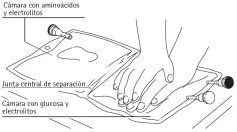
After removing the protective cover, proceed as follows: Unfold the bag and place it on a hard surface. Open the central seal by pressing with both hands on one of the chambers of the bag. The homogeneous mixture is then ready for use. Remove the white cap from the infusion connector. Clean the connector and insert the infusion equipment. Infuse according to protocol.
Addition of lipids:
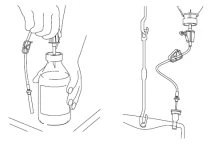
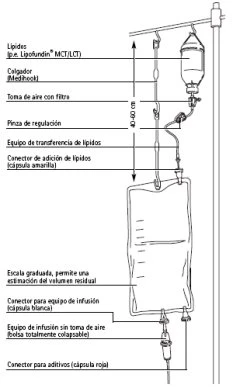
Close the flow regulator clamp and the air inlet of the lipid transfer set. Disinfect the connectors and insert the spike of the transfer set into the lipid bottle and the needle into the additive port located at the top of the bag. Ensure a distance of 40–60 cm (= 2–3 Medihook hangers) between the lipid bottle and the bag. Open the flow regulator clamp and the air inlet of the transfer set. The lipid emulsion will flow by gravity into the bag. Supervision is not required during lipid transfer.
Additives:
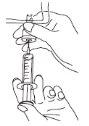
If necessary, additives may be directly introduced into the bag using a syringe through the port located at the bottom of the bag, under aseptic conditions. For compatibility information, consult your pharmacist or the manufacturer/distributor.
Infusion:
Connect the infusion set (without air inlet) to the infusion connector.
Mixing:
Unhang the bag and mix the contents by inverting the bag 2–3 times.
Administration rate: maximum 40 drops per minute (120 ml/h).