Irbesartan Viatris 150 mg tablets EFG
Spain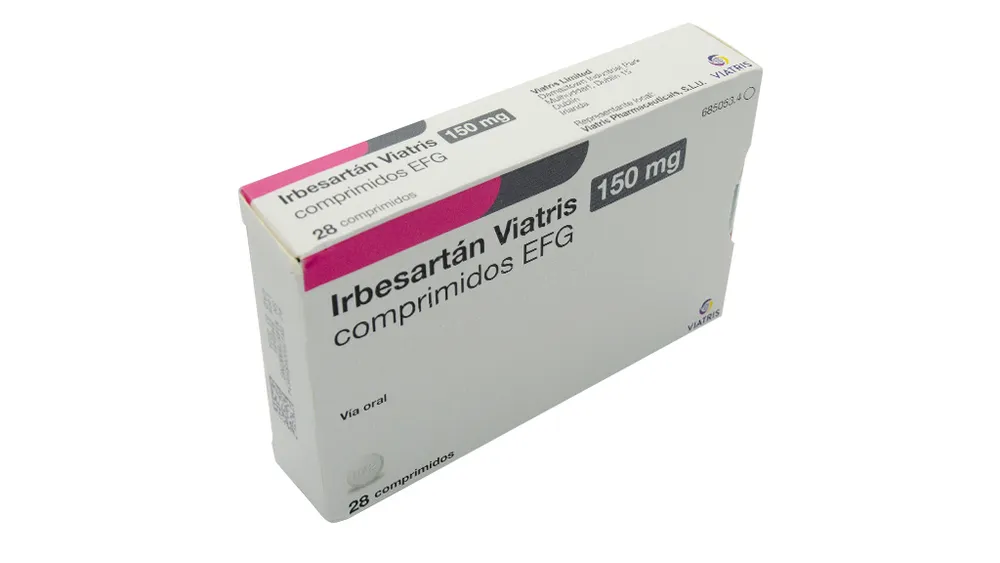
Table of Contents
- Package leaflet: Information for the user
- Introduction
- 1. What Irbesartán Viatris is and what it is used for
- 2. What you need to know before taking Irbesartán Viatris
- 3. How to take Irbesartan Viatris
- 4. Possible adverse effects
- 5. Storage of Irbesartan Viatris
- 6. Contents of the pack and other information
Package leaflet: Information for the user
Introduction
Package leaflet: Information for the patient
Irbesartan Viatris 150 mg tablets EFG
Read the entire leaflet carefully before you start taking this medicine, because it contains important information for you.
- Keep this leaflet. You may need to read it again.
- If you have any questions, ask your doctor or pharmacist.
- This medicine has been prescribed for you only and must not be given to other people, even if they have the same symptoms as you, because it may harm them.
- If you experience any adverse effects, consult your doctor or pharmacist, even if they are adverse effects not listed in this leaflet. See section 4.
Leaflet contents
- What Irbesartan Viatris is and what it is used for
- What you need to know before taking Irbesartan Viatris
- How to take Irbesartan Viatris
- Possible side effects
- How to store Irbesartan Viatris
- Contents of the pack and other information
1. What Irbesartán Viatris is and what it is used for
Irbesartán Viatris contains irbesartan, which belongs to a group of medicines known as angiotensin-II receptor antagonists. Angiotensin-II is a substance produced in the body that binds to receptors, causing blood vessels to constrict. This results in an increase in blood pressure. Irbesartan prevents angiotensin-II from binding to these receptors, thereby relaxing blood vessels and reducing blood pressure. Irbesartan slows the decline in renal function in patients with high blood pressure and type 2 diabetes.
Irbesartán Viatris is used in adult patients:
-
To treat high blood pressure (essential hypertension).
-
To protect the kidney in patients with high blood pressure, type 2 diabetes, and clinical evidence of impaired kidney function.
2. What you need to know before taking Irbesartán Viatris
Do not take Irbesartán Viatris:
- If you are allergic to irbesartan or to any of the other ingredients of this medicine (listed in section 6).
- If you are more than 3 months pregnant. (In any case, it is better to avoid taking this medicine also during early pregnancy – see Pregnancy section).
- If you have diabetes or kidney failure and are being treated with a blood pressure-lowering medicine containing aliskiren.
Warnings and precautions
Talk to your doctor or pharmacist before taking this medicine:
-
If you have had or develop during treatment, excessive vomiting (feeling sick) or diarrhoea.
-
If you have been taking diuretics or have been on a low-sodium diet.
-
If you have kidney problems, including narrowing of the kidney artery, or have had a kidney transplant.
-
If you have heart problems, including narrowing of heart valves, or enlargement or weakness of the heart muscle (heart failure).
-
If you have narrowing of the blood vessels of the heart, which may cause chest pain, for example, angina.
-
If you are taking irbesartan for diabetic kidney disease. In this case, your doctor may perform regular blood tests, especially to monitor potassium levels if kidney function is impaired.
-
If you experience low blood sugar levels (symptoms may include sweating, weakness, hunger, dizziness, trembling, headache, flushing or paleness, numbness, rapid and strong heartbeat), especially if you are being treated for diabetes.
-
If you have primary aldosteronism (a condition related to increased production of the hormone aldosterone, which causes sodium retention and leads to high blood pressure).
-
If you are of Afro-Caribbean origin, irbesartan may be less effective in reducing blood pressure.
-
If you are taking any of the following medicines used to treat high blood pressure (hypertension):
- An ACE inhibitor (e.g., enalapril, lisinopril, ramipril), particularly if you have kidney problems related to diabetes.
- Aliskiren.
Talk to your doctor if you experience abdominal pain, nausea, vomiting, or diarrhoea after taking irbesartan. Your doctor will decide whether to continue treatment. Do not stop taking irbesartan on your own.
Your doctor may monitor your kidney function, blood pressure, and blood electrolyte levels (e.g., potassium) at regular intervals.
See also the information under the heading “Do not take Irbesartán Viatris”.
If you are pregnant, suspect you may be pregnant, or plan to become pregnant, you must inform your doctor. Use of irbesartan is not recommended during early pregnancy (first 3 months), and it must not be used from the third month of pregnancy onwards, as it may cause serious harm to your baby (see section Pregnancy).
During treatment:
You should also inform your doctor:
- If you are going to undergo surgery or receive anaesthetics.
Children and adolescents
This medicine should not be used in children and adolescents, as safety and efficacy have not yet been established.
Other medicines and Irbesartán Viatris
Tell your doctor or pharmacist if you are taking, have recently taken, or might need to take any other medicines.
Your doctor may need to adjust your dose and/or take other precautions:
- If you are taking ACE inhibitors or aliskiren (see also information under the headings “Do not take Irbesartán Viatris” and “Warnings and precautions”).
You may need blood tests if you are taking:
- Potassium supplements.
- Salt substitutes containing potassium.
- Potassium-sparing (diuretic) medicines or medicines that may increase potassium levels in the blood, for example, heparin.
- Medicines containing lithium (used to treat mental health conditions).
- Repaglinide (a medicine used to lower blood sugar levels).
If you are taking a type of painkiller known as non-steroidal anti-inflammatory drugs or COX-2 inhibitors, such as celecoxib or acetylsalicylic acid, the effect of irbesartan may be reduced.
Pregnancy and breastfeeding
Pregnancy
If you are pregnant or breastfeeding, think you may be pregnant, or are planning to become pregnant, consult your doctor before using this medicine. Generally, your doctor will advise you to stop taking irbesartan before becoming pregnant or as soon as pregnancy is confirmed, and will recommend an alternative antihypertensive medicine. Irbesartan is not recommended during early pregnancy and must not be administered from the third month of pregnancy onwards, as it may cause serious harm to your baby when used from that time.
Breastfeeding
Inform your doctor if you are breastfeeding or are about to start breastfeeding. Use of irbesartan is not recommended for breastfeeding mothers, and your doctor may choose an alternative treatment if you wish to breastfeed, especially if your baby is a newborn or was born prematurely.
Driving and using machines
It is unlikely that irbesartan will affect your ability to drive or use machines. However, during treatment for hypertension, dizziness or fatigue may occasionally occur. If you experience these symptoms, discuss with your doctor before driving or using machines.
Irbesartán Viatris contains lactose and sodium
If your doctor has informed you that you have an intolerance to certain sugars (e.g., lactose), consult him before taking this medicine.
This medicine contains less than 23 mg of sodium (1 mmol) per tablet; this is essentially “sodium-free”.
3. How to take Irbesartan Viatris
Follow exactly the instructions given by your doctor or pharmacist for taking this medicine. If in doubt, consult your doctor or pharmacist again.
Method of administration
Irbesartan is administered orally. The tablets should be swallowed with a sufficient amount of liquid (for example, a glass of water). Irbesartan may be taken with or without food. You should try to take your daily dose at the same time each day. It is important that you continue taking irbesartan unless your doctor advises otherwise.
- Patients with high blood pressure
The recommended dose is 150 mg once daily. Subsequently, depending on the blood pressure response, this dose may be increased to 300 mg once daily.
- Patients with high blood pressure and type 2 diabetes with kidney impairment
In patients with high blood pressure and type 2 diabetes, the recommended maintenance dose for the treatment of associated kidney impairment is 300 mg once daily.
Your doctor may advise a lower dose, especially when starting treatment, if you are undergoing haemodialysis or are 75 years of age or older.
The maximum blood pressure-lowering effect should be achieved within 4–6 weeks after starting treatment.
Use in children and adolescents
Irbesartan must not be given to children under 18 years of age. If a child swallows several tablets, contact your doctor immediately.
If you take more Irbesartan Viatris than you should
If you accidentally take too many tablets, contact your doctor immediately. You may feel dizzy or notice that your heart is beating faster or slower than normal.
In case of overdose or accidental ingestion, contact your doctor or pharmacist, or call the Toxicology Information Service at 91 562 04 20, indicating the medicine and the amount ingested. Take the packaging and any remaining tablets with you.
If you forget to take Irbesartan Viatris
If you accidentally miss a dose, simply take your next scheduled dose at the usual time. Do not take a double dose to make up for missed doses.
If you have any further questions about the use of this medicine, consult your doctor or pharmacist.
4. Possible adverse effects
Like all medicines, this medicine can cause adverse effects, although not everyone will experience them.
Some of these adverse effects may be serious and may require immediate medical attention. If you experience any of the following adverse effects, stop taking this medicine immediately and contact your doctor or go straight to the nearest hospital emergency department:
Frequency not known (cannot be estimated from available data)
- Severe allergic reaction with symptoms such as red, itchy rash, feeling dizzy or faint, localized swelling of the face, lips and/or tongue, which could cause difficulty breathing.
- Yellowing of the skin and whites of the eyes, severe pain in the upper stomach, feeling sick or vomiting—this may be due to liver problems.
- Skin rash with purple spots and red raised areas caused by inflammation of small blood vessels (vasculitis).
- Increased frequency of urination, in large amounts, with pale-colored urine, or difficulty urinating, requiring effort, or less frequent urination, in which case the urine may be darker in color or contain blood. This may be due to kidney problems.
Other possible adverse effects
Very common (may affect more than 1 in 10 people)
- If you have high blood pressure and type 2 diabetes with kidney impairment, blood tests may show increased levels of potassium.
Common (may affect up to 1 in 10 people)
-
Dizziness.
-
Feeling sick or being sick (nausea or vomiting).
-
Feeling tired (fatigue).
-
Blood tests may show elevated levels of an enzyme that indicates how muscles and the heart are functioning (creatine kinase enzyme).
-
In patients with high blood pressure and type 2 diabetes with kidney impairment:
-
Dizziness upon standing up from a lying or sitting position.
-
Low blood pressure upon standing up from a lying or sitting position.
-
Muscle or joint pain.
-
Blood tests may show a decrease in levels of a protein found in red blood cells (hemoglobin).
Uncommon (may affect up to 1 in 100 people)
- Feeling that your heart is beating faster than normal (tachycardia).
- Skin redness.
- Cough.
- Diarrhea.
- Indigestion/heartburn.
- Sexual dysfunction (changes in sexual function).
- Chest pain.
Rare (may affect up to 1 in 1,000 people)
- Intestinal angioedema: swelling in the intestine causing symptoms such as abdominal pain, nausea, vomiting, and diarrhea.
Frequency not known (cannot be estimated from available data)
- Appearance of bruises or bleeding more easily than normal, which may be due to a reduced number of platelets (blood cells involved in clotting).
- Tiredness, headaches, shortness of breath during physical activity, dizziness, and paleness, which may be caused by a reduced number of red blood cells (anemia).
- Sensation of spinning (vertigo).
- Headache.
- Altered taste.
- Ringing in the ears (tinnitus).
- Muscle cramps.
- Muscle and joint pain.
- Blood tests show abnormal liver function.
- Blood tests show increased levels of potassium in the blood.
- Low blood sugar levels.
Reporting of adverse effects
If you experience any adverse effect, talk to your doctor or pharmacist, even if it is a possible adverse effect not listed in this leaflet. You may also report them directly via the Spanish Pharmacovigilance System for Human Medicines: https://www.notificaram.es. By reporting adverse effects, you can help provide more information on the safety of this medicine.
5. Storage of Irbesartan Viatris
Keep this medicine out of the sight and reach of children.
Do not use this medicine after the expiry date stated on the container, label, or blisters, after EXP or CAD. The expiry date refers to the last day of the month indicated.
The shelf life of the product when stored in plastic bottles is 90 days after opening.
This medicine does not require any special storage conditions.
Medicines must not be disposed of via wastewater or household waste. Dispose of containers and unused medicines at the SIGRE collection point at your pharmacy. If in doubt, ask your pharmacist how to dispose of containers and medicines you no longer need. This will help protect the environment.
6. Contents of the pack and other information
Composition of Irbesartán Viatris:
The active substance is irbesartan. Each tablet contains 150 mg of irbesartan. The other components are monohydrate lactose (see section 2 of the leaflet “Irbesartán Viatris contains lactose”), povidone, microcrystalline cellulose (E-460), sodium croscarmellose, magnesium stearate (E-572) and anhydrous colloidal silica.
Appearance of the product and contents of the pack
Round, white to almost white tablets with bevelled edges, marked with an "M" on one side and "IN2" on the other.
Available in blisters of 10, 14, 28, 30, 56, 57, 58, 60, 84, 90, 98 and 100 tablets.
Calendar blister packs of 14, 28, 56, 84 and 98 tablets.
Plastic bottles containing 30, 500 and 1000 tablets.
Only certain pack sizes may be marketed.
Marketing Authorisation Holder and Manufacturer
Marketing Authorisation Holder:
Viatris Limited
Damastown Industrial Park
Mulhuddart, Dublin 15
Dublin
Ireland
Manufacturer:
McDermott Laboratories Limited trading as Gerard Laboratories
35/36 Baldoyle Industrial Estate
Grange Road, Dublin 13
Ireland
or
Mylan Hungary Kft.
H-2900 Komárom
Mylan utca 1
Hungary
or
Generics [UK] Limited
Station Close, Potters Bar,
Hertfordshire,
EN6 1TL
United Kingdom
For further information regarding this medicinal product, please contact the local representative of the Marketing Authorisation Holder:
Viatris Pharmaceuticals, S.L.U.
C/ General Aranaz, 86
28027 - Madrid
Spain
This medicinal product is authorised in the Member States of the European Economic Area under the following names:
Germany Irbesartan Mylan 150 mg Tabletten
Belgium Irbesartan Mylan 150 mg tabletten
Slovakia Irbesartan Mylan 150 mg
Spain Irbesartán Viatris 150 mg comprimidos EFG
France IRBESARTAN VIATRIS 150 mg comprimé
Greece Irbesartan/Mylan δισκ?α 150 mg/TAB
Italy Irbesartan Mylan 150 mg compresse
Luxembourg Irbesartan Mylan 150 mg comprimés
Norway Irbesartan Mylan 150 mg tabletter
Netherlands Irbesartan Mylan 150 mg tabletten
Portugal Irbesartan Mylan 150 mg comprimidos
United Kingdom Irbesartan 150 mg tablets
Czech Republic Irbesartan Mylan 150 mg tablety
Romania Irbesartan Mylan 150 mg comprimate
Sweden Irbesartan Mylan 150 mg tabletter
Date of the most recent revision of this leaflet: January 2025
Detailed information on this medicinal product is available on the website of the Spanish Agency of Medicines and Health Products (AEMPS): https://www.aemps.gob.es/