Iopimax 5 mg/ml eye drops solution
Spain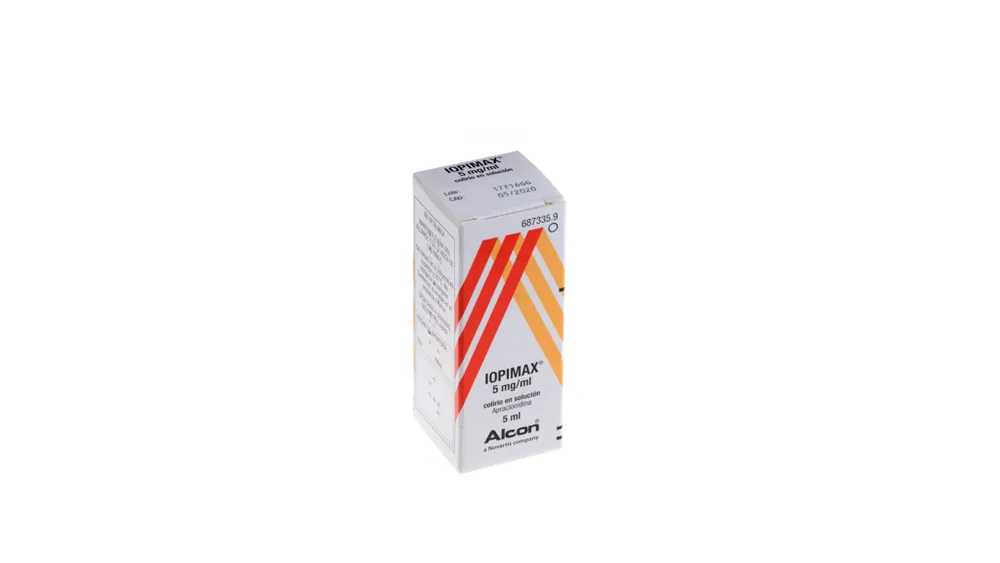
Table of Contents
Package leaflet: Information for the user
Introduction
Package leaflet: information for the user
IOPIMAX 5mg/ml eye drops solution
Apraclonidine hydrochloride
Read the entire leaflet carefully before you start using this medicine because it contains important information for you.
- Keep this leaflet, as you may need to read it again.
- If you have any questions, consult your doctor or pharmacist.
- This medicine has been prescribed for you only, and you must not give it to other people, even if they have the same symptoms as you, because it could harm them.
- If you experience any adverse effects, consult your doctor or pharmacist, even if they are adverse effects not listed in this leaflet. See section 4.
Leaflet contents
-
What IOPIMAX is and what it is used for
-
What you need to know before using IOPIMAX
-
How to use IOPIMAX
-
Possible side effects
-
How to store IOPIMAX
-
Contents of the pack and other information
1. What IOPIMAX is and what it is used for
IOPIMAX 5 mg/ml eye drops solution contains apraclonidine (as hydrochloride) as the active substance.
IOPIMAX belongs to a group of medicines called alpha-agonists.
It is used for the treatment of chronic glaucoma in individuals who are receiving other medications to treat this condition.
In these individuals, IOPIMAX helps reduce fluid pressure in the eye and delays the need for surgical intervention to relieve intraocular pressure.
2. What you need to know before starting to use IOPIMAX
Do not use IOPIMAX
- if you have a history of heart disease or unstable circulatory problems.
- if you are allergic to apraclonidine or to any of the other ingredients of this medicine (listed in section 6).
- if you are currently taking antidepressants belonging to the class of monoamine oxidase inhibitors or tricyclic antidepressants.
- if you are currently taking medications belonging to the class of sympathomimetics taken orally or by injection.
- in CHILDREN.
If you have any doubts, consult your doctor.
Warnings and precautions
Take special care:
- Use this medicine only in your eye(s).
- IOPIMAX may no longer control your eye pressure after using it for some time. Your doctor will examine your eyes frequently while you are using IOPIMAX to ensure the eye drops are still effective.
- Since IOPIMAX reduces eye pressure, eye pressure should be monitored regularly to ensure it remains under control.
If you have a history of or are being treated for any of the following conditions:
- Any heart disease (including angina, heart attack, or heart failure)
- High blood pressure or other circulatory problems (including embolism, Raynaud's disease, and fainting)
- Kidney or liver problems
- Depression
- Parkinson's disease
- Diabetes or low blood sugar levels. IOPIMAX may mask the signs and symptoms of sudden low blood sugar, such as rapid heartbeat or tremor.
- If you are scheduled for surgery
If you think any of the above conditions apply to you, you may still be able to use IOPIMAX, but consult your doctor first.
Use of IOPIMAX with food, drinks, and alcohol
Do not consume alcohol during treatment with IOPIMAX, as it may enhance its effects.
Other medicines and IOPIMAX
Inform your doctor or pharmacist if you are using, have recently used, or might need to use any other medicines.
Do not use IOPIMAX if you are taking antidepressants belonging to the class of monoamine oxidase inhibitors or tricyclic antidepressants. IOPIMAX should also not be used if you are taking medications belonging to the class of sympathomimetics taken orally or by injection.
IOPIMAX may increase the effects of other medicines used to treat depression, asthma, high blood pressure, heart medications containing digoxin or digitoxin, various types of mental illness, and Parkinson's disease. It may interact with certain pain relievers, sedatives, anesthetics, tricyclic antidepressants, cough and cold remedies, glaucoma medications such as timolol or brimonidine, and eye drops used to whiten the eyes.
Pregnancy, breastfeeding, and fertility
If you are pregnant or breastfeeding, think you might be pregnant, or are planning to become pregnant, consult your doctor or pharmacist before using this medicine.
Do not use this medicine during pregnancy or breastfeeding.
Driving and use of machines
This type of medicine may cause drowsiness and dizziness. If this occurs, do not drive or operate machinery.
IOPIMAX contains benzalkonium chloride
This medicine contains 0.1 mg of benzalkonium chloride per ml, equivalent to 0.01%.
IOPIMAX contains a preservative (benzalkonium chloride) that can be absorbed by soft contact lenses and may discolor them. You should remove your contact lenses before using this medicine and wait 15 minutes before reinserting them. Benzalkonium chloride may cause eye irritation, especially if you have dry eye or other corneal diseases (the transparent layer at the front of the eye). Consult your doctor if you experience a foreign body sensation, stinging, or pain in the eye after using this medicine.
3. How to use IOPIMAX
Recommended dose
The recommended dose is 1 drop in the eye(s) 3 times a day.
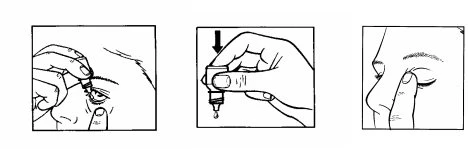
1 2 3
Remove the neck band around the cap when opening the bottle for the first time.
Always follow exactly the instructions for use of this medicine as given by your doctor or pharmacist. If in doubt, consult your doctor or pharmacist again.
How to use it
- Wash your hands before starting.
- Unscrew the cap.
- Hold the bottle upside down between your thumb and fingers.
- Tilt your head backwards.
- Pull down your lower eyelid with one finger until a pouch forms between the eyelid and your eye, into which one drop should be placed (Figure 1).
- Bring the tip of the bottle close to your eye. A mirror may be helpful.
- Do not touch the eye or eyelid, nearby areas, or other surfaces with the dropper tip. The drops could become contaminated.
- Gently squeeze the bottle so that one drop falls at a time (Figure 2).
- Do not squeeze the bottle forcefully; gentle pressure is sufficient.
- After using IOPIMAX, press with your finger on the inner corner of the eye, next to the nose. This helps prevent IOPIMAX from passing into the rest of the body (Figure 3).
- If applying drops to both eyes, repeat the above steps for the other eye. Close the bottle tightly after use.
- If a drop misses the eye, try again.
- In case of accidental ingestion of IOPIMAX, contact your doctor immediately.
If you forget to use IOPIMAX
Continue with the next scheduled dose. However, if it is almost time for the next dose, do not take the missed dose and continue with your regular dosing schedule.
Do not use a double dose to make up for a missed dose.
If you use more IOPIMAX than you should
You can remove it by rinsing the eyes with lukewarm water. Do not use further drops until your next scheduled dose. In case of accidental ingestion, overdose symptoms may include: low blood pressure, drowsiness, slowed heart rate, hypoventilation (reduced rate and depth of breathing causing increased carbon dioxide), and seizures.
If you are using other ophthalmic medicines, wait at least 5 minutes between administering this eye drop and other ophthalmic medicines. Ophthalmic ointments should be administered last.
If you have any further questions about the use of this medicine, ask your doctor or pharmacist.
4. Possible adverse effects
Like all medicines, this medicine can cause adverse effects, although not everyone experiences them.
IOPIMAX may cause allergic reactions. If you experience one or more of the following symptoms in your eye(s): redness, itching, watery eyes, abnormal sensation, or swelling of the eye or eyelid, consult your doctor immediately.
If your vision worsens after using IOPIMAX, stop using it and consult your doctor immediately.
You may experience some or all of the following reactions in your eye(s):
Very common (may affect more than 1 in 10 people): increased redness, itching, swelling.
Common (may affect up to 1 in 10 people): discomfort, increased tear production, eyelid swelling, sensation of sand in the eye, dry eye, crusting of the eyelids.
Uncommon (may affect up to 1 in 100 people): swelling under the eyelids, eye swelling, abnormal vision, pain, inflammation and irritation of the eye or eyelids, corneal surface damage (front part of your eye), light sensitivity, redness of the eyelid, eyelid enlargement or retraction, pupil enlargement, reduced vision, blurred vision, drooping eyelid, eye discharge or whitening.
You may also experience effects in other parts of your body, including:
Common (may affect up to 1 in 10 people): dry mouth, nasal inflammation, dermatitis, nasal dryness, weakness, headache, altered taste.
Uncommon (may affect up to 1 in 100 people): chest pain, swelling of hands, feet or limbs, irregular heartbeat, constipation, nausea, feeling of tiredness, throat inflammation, runny nose, muscle pain, abnormal coordination, drowsiness, dizziness, tingling sensation, feeling of nervousness, depression, difficulty sleeping, reduced expiratory airflow or breathing difficulty, sensation of unusual smell, facial swelling, irritability, dilation of blood vessels.
Reporting of adverse effects
If you experience any adverse effect, consult your doctor or pharmacist, even if it is a possible adverse effect not listed in this leaflet. You can also report them directly via the Spanish Pharmacovigilance System for Human Medicines: https://www.notificaRAM.es. By reporting adverse effects, you can help provide more information on the safety of this medicine.
5. Storage of IOPIMAX
-
Keep this medicine out of the sight and reach of children.
-
Do not store above 25°C. Do not refrigerate or freeze.
-
Keep the bottle tightly closed and store it in the outer packaging.
-
Do not use this medicine after the expiry date stated on the bottle and carton after “EXP”. The expiry date refers to the last day of the month indicated.
-
To prevent infection, the bottle must be discarded 4 weeks after first opening.
Medicines should not be disposed of via wastewater or household waste. Dispose of unused containers and medicines at the SIGRE Point at your pharmacy. If in doubt, ask your pharmacist how to dispose of medicines and containers you no longer need. This will help protect the environment.
6. Contents of the pack and other information
Composition of IOPIMAX
- The active substance is apraclonidine 5 mg/mL (as hydrochloride).
- The other components are sodium chloride, sodium acetate (trihydrate), benzalkonium chloride, hydrochloric acid and/or sodium hydroxide (to adjust pH), and purified water.
Appearance of the medicinal product and contents of the container
IOPIMAX is a clear, colourless or slightly yellowish solution supplied in a carton containing a 5 mL or 10 mL plastic bottle with a screw cap.
Marketing Authorization Holder
Essential Pharma Limited,
Vision Exchange Building
Triq it-Territorjals, Zone 1,
Central Business District,
Birkirkara, CBD 1070,
Malta
Manufacturer
Essential Pharma Limited,
Vision Exchange Building
Triq it-Territorjals, Zone 1,
Central Business District,
Birkirkara, CBD 1070,
Malta
Date of the most recent revision of this package leaflet: February 2023.
Detailed information on this medicine is available on the website of the Spanish Agency of Medicines and Health Products (AEMPS) http://aemps.gob.es/