Iodine 100 mg/ml cutaneous solution
Spain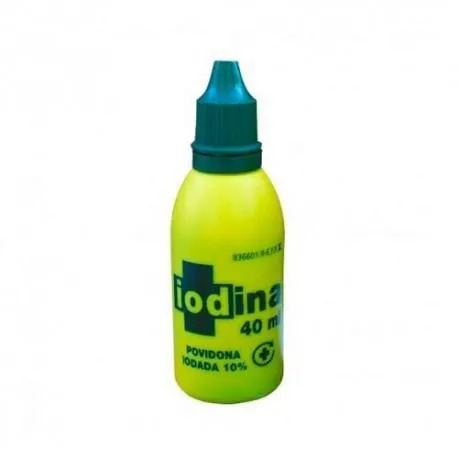
Table of Contents
- Package leaflet: Information for the user
- Introduction
- 1. What Iodina cutaneous solution is and what it is used for
- 2. What you need to know before using Iodina
- 3. How to use Iodina cutaneous solution
- 4. Possible adverse effects
- 5. Storage of Iodine Cutaneous Solution
- 6. Contents of the pack and other information
Package leaflet: Information for the user
Introduction
Package leaflet: information for the user
Iodine 100 mg/ml cutaneous solution
Povidone iodine
Read all of this leaflet carefully before you start using this medicine, because it contains
important information for you.
Follow exactly the instructions for use provided in this leaflet or as directed by your doctor, pharmacist, or nurse.
- Keep this leaflet, as you may need to read it again.
- If you need advice or more information, consult your pharmacist.
- If you experience any adverse effects, consult your doctor, pharmacist, or nurse, even if they are effects not listed in this leaflet. See section 4.
- You should consult a doctor if your condition worsens or does not improve.
Contents of the leaflet
- What Iodine cutaneous solution is and what it is used for.
- What you need to know before using Iodine cutaneous solution.
- How to use Iodine cutaneous solution.
- Possible adverse effects.
- How to store Iodine cutaneous solution.
- Contents of the pack and other information.
1. What Iodina cutaneous solution is and what it is used for
Povidone iodine, the active substance of this medicine, is an antiseptic (which destroys germs that cause infections) containing iodine.
Iodina is indicated in adults and children over 1 month of age as a general topical antiseptic for minor wounds, superficial cuts, mild burns, and abrasions.
2. What you need to know before using Iodina
Do not use Iodina cutaneous solution
- If you are allergic to povidone iodine or to any of the other components of this medicine (listed in section 6).
- If you have hyperthyroidism or other acute thyroid diseases.
- Before, during, and after administration of radioactive iodine.
- With products containing mercury due to the formation of a substance that may damage the skin.
- In children under one month of age.
Warnings and precautions
Consult your doctor, pharmacist, or nurse before starting to use Iodina cutaneous solution.
For external use only. Do not ingest. Avoid contact with eyes, ears, and other mucous membranes. Consult your doctor if symptoms persist or worsen.
Prolonged exposure to wet solution may cause irritation and, rarely, severe skin reactions. Chemical burns of the skin may occur due to accumulation. In such cases, discontinue use. Do not heat before application.
Patients with goiter, thyroid nodules, or other non-acute thyroid diseases are at risk of developing hyperthyroidism when exposed to high amounts of iodine. In these patients, povidone iodine solution should not be applied for prolonged periods or over large skin areas unless strictly indicated. Even after treatment ends, early symptoms of possible hyperthyroidism should be monitored, and thyroid function should be checked if necessary. Regular or prolonged use of this medicine should also be avoided in patients with burns affecting more than 20% of body surface area, large or open wounds, or renal failure. Thyroid function tests should be performed in cases of prolonged use or application to large skin areas or burns.
Do not use before or after radioactive iodine scintigraphy or treatment of thyroid carcinoma with radioactive iodine.
The use of povidone iodine may cause transient discoloration at the application site due to the inherent color of the medicine.
Children
Iodina is contraindicated in neonates (0 to 1 month). Newborns and young children are at higher risk of developing hypothyroidism. If used in children, thyroid function must be monitored. Use in children under 30 months of age, if absolutely necessary, should be limited to brief and limited application, followed by rinsing with sterile water. Consult your doctor before administration.
Other medicines and Iodina
Inform your doctor or pharmacist if you are taking, have recently taken, or might need to take any other medicines.
Do not use with mercurial compounds, silver-containing products, hydrogen peroxide, or taurolidine (antiseptics).
Continued use should be avoided in patients receiving concomitant lithium therapy (used in psychiatry).
This medicine should not be applied simultaneously with other products containing sodium thiosulfate, as both agents will be inactivated before exerting their effect.
When antiseptics are used together with or after octenidine, transient dark discoloration of the affected areas may occur.
Interaction with diagnostic tests: the use of povidone iodine may lead to errors in toluidine or guaiacol tests for detecting hemoglobin or glucose in feces or urine. It may also interfere with thyroid function tests and treatments involving radioactive iodine.
Inform your doctor if you are scheduled to undergo any diagnostic test.
Inform your doctor if:
- Symptoms do not improve or worsen.
- You have received treatments with radioactive iodine within the last 4 weeks.
- You have an allergic or irritant skin reaction such as redness, small blisters, itching, or rash, which may appear immediately.
Pregnancy, breastfeeding, and fertility
If you are pregnant or breastfeeding, think you may be pregnant, or are planning to become pregnant, consult your doctor or pharmacist before using this medicine.
Pregnancy and breastfeeding
Iodina should not be used during pregnancy or breastfeeding unless your doctor considers that the potential benefit justifies the potential risk to the fetus.
Its use could cause transient hypothyroidism in fetuses and newborns.
Driving and using machines
Iodina does not affect the ability to drive or operate machinery.
Iodina cutaneous solution contains sodium lauryl sulfate
This medicine contains 0.6 mg of sodium lauryl sulfate per milliliter of solution. Sodium lauryl sulfate may cause local skin reactions (such as itching or burning sensation) or increase skin reactions caused by other medicines when applied to the same area.
3. How to use Iodina cutaneous solution
Follow exactly the medicinal product administration instructions contained in this leaflet or those indicated by your doctor, pharmacist, or nurse. If in doubt, ask your doctor, pharmacist, or nurse.
The recommended dose is:
Use in adults and adolescents
Apply 2 to 3 times a day depending on the severity and extent of the lesion.
Use in children
Iodina is contraindicated in neonates (from 0 to 1 month). Use in children under 30 months, if absolutely necessary, should be limited to brief and limited application, followed by rinsing with sterile water. Consult your doctor before administration.
Caution must be exercised, as newborns and young children are at higher risk of developing hypothyroidism following administration of large amounts of iodine due to the natural permeability of their skin and their increased sensitivity to iodine.
Method of administration
For cutaneous use.
Apply a small amount directly to the affected area. Wash and dry the affected area before applying the product.
If you use more Iodina cutaneous solution than you should
If an excessive amount of the product is applied and skin irritation occurs, wash the affected area thoroughly with abundant water, discontinue treatment, and if irritation persists, consult a doctor.
Symptoms could include abdominal pain, anuria (suppression or reduction of urine), circulatory, respiratory, and metabolic problems. Excess iodine may cause goiter, hypothyroidism, and hyperthyroidism.
In case of accidental ingestion, go to a medical center or call the Toxicology Information Service at telephone number 91 562 04 20, indicating the medicinal product and the amount ingested.
In cases of accidental ingestion, if the patient is conscious, not vomiting, and able to tolerate oral intake, milk should be administered every 15 minutes to relieve gastric irritation. Additionally, to eliminate residual povidone-iodine, a starch solution should be administered, prepared by adding 15 mg of corn starch or 15 mg of flour to 500 ml of water. If the patient has esophageal damage, gastric lavage or emesis (induced vomiting) must not be performed.
If you have any further questions about the use of this medicinal product, ask your doctor, pharmacist, or nurse.
4. Possible adverse effects
Like all medicines, this medicine can cause adverse effects, although not everyone will experience them.
In the rare cases when skin irritation or allergy occurs, discontinue treatment and wash the affected area with water.
Rare adverse effects (may affect up to 1 in 1,000 people) include hypersensitivity and contact dermatitis, manifesting as red skin, small blisters, and itching. Burning and irritation at the application site may also occur.
Very rarely (may affect up to 1 in 10,000 people), anaphylactic reactions (severe allergic reaction), hyperthyroidism with tachycardia and agitation, and angioedema (swelling caused by allergy) have been observed.
Other adverse effects with unknown frequency (frequency cannot be estimated from available data) include hypothyroidism, electrolyte imbalance, metabolic acidosis, acute renal failure, hepatic function disorders, abnormal blood osmolarity, exfoliative dermatitis, dry skin, skin discoloration, and chemical burn on the skin.
If you consider any of the adverse effects you experience to be severe, or if you notice any adverse effect not mentioned in this leaflet, inform your doctor or pharmacist.
Reporting of adverse effects
If you experience any type of adverse effect, consult your doctor, pharmacist, or nurse, even if it is a possible adverse effect not listed in this leaflet. You may also report them directly through the Spanish System of Pharmacovigilance of Human Medicines (https://www.notificaram.es). By reporting adverse effects, you can help provide more information on the safety of this medicine.
5. Storage of Iodine Cutaneous Solution
Keep this medicine out of sight and reach of children.
Store at room temperature.
Do not use this medicine after the expiry date stated on the packaging after CAD or EXP. The expiry date refers to the last day of the month indicated.
Medicines must not be disposed of via wastewater or household waste. Dispose of unused containers and medicines at the SIGRE Point at your pharmacy. If you have any doubts, ask your pharmacist how to dispose of containers and medicines you no longer need. This will help protect the environment.
6. Contents of the pack and other information
Composition of Iodina cutaneous solution
The active substance is povidone iodine. Each ml of solution contains 100 mg of povidone iodine.
The other components (excipients) are: sodium lauryl sulfate, sodium hydrogen phosphate dodecahydrate, and purified water.
Appearance of the medicine and contents of the pack
Brown-coloured solution.
Presented in packs containing 1 high-density polyethylene bottle with 40 ml or 125 ml of solution.
Marketing Authorization Holder and Manufacturer
Laboratorio Reig Jofre, S.A.
Gran Capitan 10
08970 Sant Joan Despí (Barcelona), Spain
Date of the most recent revision of this leaflet: April 2025
Detailed and up-to-date information on this medicine is available on the website of the Spanish Agency for Medicines and Health Products (AEMPS) https://www.aemps.es/