Invanz 1 g powder for concentrate for solution for infusion
Spain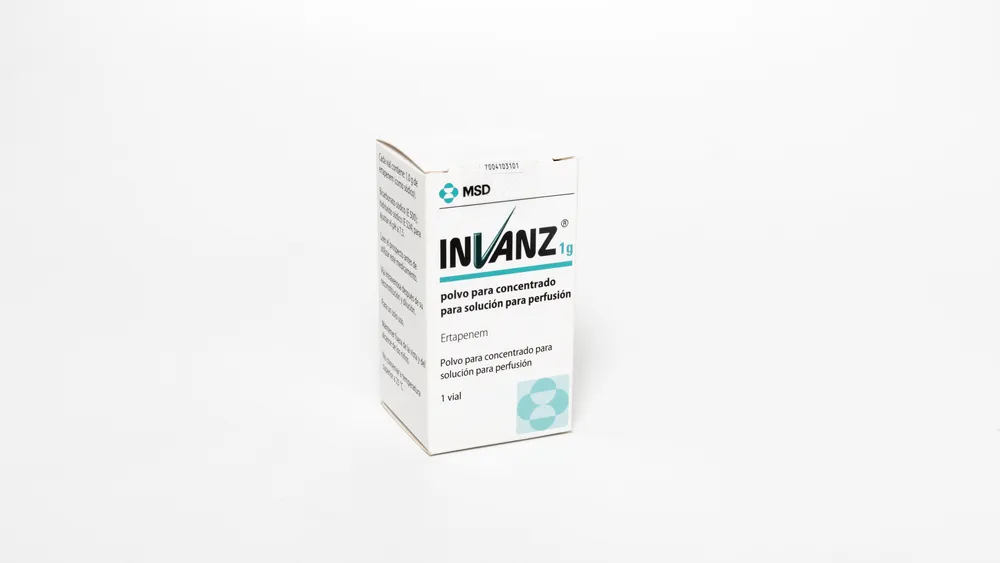
Table of Contents
Package leaflet: Information for the user
Introduction
Package leaflet: information for the user
INVANZ 1g powder for concentrate for solution for infusion
ertapenem
Read all of this leaflet carefully before you start using this medicine, because it contains important information for you.
- Keep this leaflet. You may need to read it again.
- If you have any questions, ask your doctor, pharmacist or nurse.
- This medicine has been prescribed for you only, and you should not give it to other people, even if they have the same symptoms as you, because it may harm them.
- If you experience any adverse reactions, consult your doctor, pharmacist or nurse, even if they are adverse reactions not listed in this leaflet. See section 4.
Contents of this leaflet
- What INVANZ is and what it is used for
- What you need to know before using INVANZ
- How to use INVANZ
- Possible side effects
- How to store INVANZ
- Contents of the pack and other information
1. What INVANZ is and what it is used for
INVANZ contains ertapenem, which is an antibiotic belonging to the beta-lactam group. It has the ability to destroy a wide variety of bacteria (microorganisms) that cause infections in different parts of the body.
INVANZ can be administered to individuals aged 3 months and older.
Treatment:
Your doctor has prescribed INVANZ because you or your child have one (or more) of the following types of infection:
- Abdominal infection
- Infection affecting the lungs (pneumonia)
- Gynecological infections
- Skin infections in the foot of diabetic patients
Prevention:
- Prevention of surgical wound infections in adults following colon or rectal surgery.
2. What you need to know before using INVANZ
Do not use INVANZ
- if you are allergic to the active substance (ertapenem) or to any of the other ingredients of this medicine (listed in section 6).
- if you are allergic to antibiotics such as penicillins, cephalosporins, or carbapenems (used to treat various infections).
Warnings and precautions
Talk to your doctor, pharmacist, or nurse before starting to use INVANZ.
If you experience an allergic reaction during treatment (such as swelling of the face, tongue, or throat, difficulty breathing or swallowing, or skin rash), inform your doctor immediately, as you may require urgent medical treatment.
Although antibiotics, including INVANZ, destroy certain bacteria, other bacteria and fungi may overgrow. This is known as bacterial overgrowth. Your doctor will monitor for bacterial overgrowth and treat you if necessary.
It is important to inform your doctor if you develop diarrhea before, during, or after treatment with INVANZ. This may be due to a condition known as colitis (inflammation of the intestine). Do not take any medication for diarrhea without first consulting your doctor.
Inform your doctor if you are taking medications called valproic acid or sodium valproate (see below Use of INVANZ with other medicines).
Inform your doctor of any other medical conditions you currently have or have had in the past, including:
- Kidney disease. It is especially important that your doctor knows if you have kidney disease and if you are receiving dialysis treatment.
- Allergies to any medicines, including antibiotics.
- Disorders of the central nervous system, such as localized tremors or seizures.
Children and adolescents (from 3 months to 17 years of age)
Experience with INVANZ in children under two years of age is limited. For this age group, your doctor will decide whether the potential benefit justifies treatment. There is no experience with INVANZ in children under 3 months of age.
Other medicines and INVANZ
Inform your doctor if you are taking, have recently taken, or might need to take any other medicines.
Tell your doctor, pharmacist, or nurse if you are taking medicines called valproic acid or sodium valproate (used to treat epilepsy, bipolar disorder, migraines, or schizophrenia). This is because INVANZ may affect how other medicines work. Your doctor will decide whether INVANZ should be used in combination with these medicines.
Pregnancy and breastfeeding
If you are pregnant or breastfeeding, think you might be pregnant, or plan to become pregnant, consult your doctor before using this medicine.
INVANZ has not been studied in pregnant women. INVANZ should not be used during pregnancy unless your doctor decides that the potential benefit justifies the potential risk to the fetus.
Women receiving INVANZ must not breastfeed, as it has been detected in breast milk and may therefore affect the infant.
Driving and using machines
Do not drive or operate tools or machinery until you know how this medicine affects you.
INVANZ has been associated with certain adverse effects such as dizziness and somnolence, which may affect a patient's ability to drive or operate machinery.
INVANZ contains sodium
This medicine contains approximately 137 mg of sodium (the main component of table/cooking salt) in each 1.0 g dose. This corresponds to 6.85% of the maximum daily recommended sodium intake for an adult.
3. How to use INVANZ
INVANZ will always be prepared and administered intravenously (into a vein) by a doctor or other healthcare professional.
The recommended dose of INVANZ for adults and adolescents aged 13 years and older is 1 gram (g) given once daily. The recommended dose for children from 3 months to 12 years of age is 15 mg/kg, administered twice daily (without exceeding 1 g/day). Your doctor will decide how many days of treatment you need.
To prevent wound infections after colon or rectal surgery, the recommended dose of INVANZ is 1 g given as a single intravenous dose 1 hour before surgery.
It is very important that you continue receiving INVANZ for the entire duration prescribed by your doctor.
If you receive more INVANZ than you should
If you are concerned that you may have received too much INVANZ, consult your doctor or another healthcare professional immediately.
If you forget to use INVANZ
If you are concerned that you may have missed a dose, consult your doctor or another healthcare professional immediately.
4. Possible adverse effects
Like all medicines, this medicine can cause adverse effects, although not everyone experiences them.
Adults aged 18 years and older:
Since the drug was marketed, serious allergic reactions (anaphylaxis) and hypersensitivity syndromes (allergic reactions such as: skin rash, fever, abnormal blood tests) have been reported. Early signs of a serious allergic reaction may include swelling of the face and/or throat. If these symptoms occur, inform your doctor immediately, as you may require urgent medical treatment.
Frequent adverse effects (may affect up to 1 in 10 people) are:
- Headache
- Diarrhea, nausea, vomiting
- Skin rash, itching
- Problems with the vein where the medicine is administered (including inflammation, formation of a lump, swelling at the injection site, or leakage of fluid into the surrounding tissue and skin at the injection site)
- Increased platelet count
- Changes in liver function tests
Uncommon adverse effects (may affect up to 1 in 100 people) are:
- Dizziness, drowsiness, insomnia, confusion, seizures
- Low blood pressure, slow heart rate
- Difficulty breathing, sore throat
- Constipation, oral yeast infection, antibiotic-associated diarrhea, acid reflux, dry mouth, indigestion, loss of appetite
- Skin redness
- Vaginal discharge and irritation
- Abdominal pain, fatigue, fungal infection, fever, edema/swelling, chest pain, altered taste
- Abnormalities in certain urine and blood tests
Rare adverse effects (may affect up to 1 in 1,000 people) are:
- Decrease in white blood cells, decrease in the number of platelets in the blood
- Low blood sugar levels
- Irritation, anxiety, depression, tremor
- Irregular heart rate, increased blood pressure, bleeding, rapid heart rate
- Nasal congestion, cough, nosebleeds, pneumonia, unusual breathing sounds and wheezing
- Inflammation of the gallbladder, difficulty swallowing, fecal incontinence, yellowing of the skin (jaundice), liver disorder
- Skin inflammation, fungal skin infection, skin peeling, wound infection after surgery
- Muscle cramps, shoulder pain
- Urinary tract infection, kidney failure
- Abortion, genital bleeding
- Allergic reaction, malaise, pelvic peritonitis, changes in the white part of the eye, fainting
- The skin may harden at the injection site
- Swelling of blood vessels in the skin
Adverse effects with frequency not known (cannot be estimated from available data) are:
- Hallucinations
- Decreased level of consciousness
- Altered mental state (including aggression, delirium, disorientation, changes in mental status)
- Abnormal movements
- Muscle weakness
- Unsteady gait
- Stained teeth
Changes in certain parameters measured in blood tests have also been reported.
If you develop fluid-filled or raised spots on your skin over a large area of your body, inform your doctor or nurse immediately.
Children and adolescents (from 3 months to 17 years of age):
Frequent adverse effects (may affect up to 1 in 10 people) are:
- Diarrhea
- Diaper dermatitis
- Pain at the infusion site
- Changes in white blood cell count
- Changes in liver function tests
Uncommon adverse effects (may affect up to 1 in 100 people) are:
- Headache
- Hot flushes, high blood pressure, small smooth red or purple spots under the skin
- Pale stools, black tarry stools
- Skin redness, skin rash
- Burning, itching, redness, and warmth at the infusion site, redness at the injection site
- Increased platelet count
- Changes in certain blood tests
Adverse effects with frequency not known (cannot be estimated from available data) are:
- Hallucinations
- Altered mental state (including aggression)
Reporting of adverse effects
If you experience any type of adverse effect, consult your doctor, pharmacist, or nurse, even if they are possible adverse effects not listed in this leaflet. You may also report them directly through the national reporting system included in Appendix V. By reporting adverse effects, you can help provide more information on the safety of this medicine.
5. Storage of INVANZ
Keep this medicine out of the sight and reach of children.
Do not use this medicine after the expiry date stated on the container.
The first two digits indicate the month; the following four digits indicate the year.
Do not store above 25 °C.
6. Contents of the pack and other information
Composition of INVANZ
- The active substance is ertapenem 1 g.
- The other components are: sodium bicarbonate (E-500) and sodium hydroxide (E-524).
Nature of the medicinal product and pack contents
INVANZ is a lyophilized powder for concentrate for solution for infusion, white to slightly yellowish in colour.
Solutions of INVANZ range from colourless to pale yellow. Variations in colour within this range do not affect efficacy.
INVANZ is available in packs of 1 vial or 10 vials.
Only certain pack sizes may be marketed.
Marketing Authorization Holder
Merck Sharp & Dohme B.V.
Waarderweg 39
2031 BN Haarlem
The Netherlands
Manufacturer responsible for batch release
FAREVA Mirabel
Route de Marsat, Riom
63963 Clermont-Ferrand Cedex 9
France
For further information on this medicinal product, please contact the local representative of the Marketing Authorization Holder:
Belgium/Belgium/Belgium MSD Belgium Tel/Tel: +32(0)27766211 | Lithuania UAB Merck Sharp & Dohme Tel. +370 5 2780 247 |
| Luxembourg/Luxembourg MSD Belgium Tel/Tel: +32(0)27766211 |
Czech Republic Merck Sharp & Dohme s.r.o. Tel.: +420 277 050 000 | Hungary MSD Pharma Hungary Kft. Tel.: +36 1 888 5300 |
Denmark MSD Danmark ApS Tlf.: +45 4482 4000 | Malta Merck Sharp & Dohme Cyprus Limited Tel: 8007 4433 (+356 99917558) |
Germany INFECTOPHARM Arzneimittel und Consilium GmbH Tel.: +49 (0)6252 / 95-7000 | Netherlands Merck Sharp & Dohme B.V. Tel: 0800 9999000 (+31 23 5153153) |
Estonia Merck Sharp & Dohme OÜ Tel: +372 614 4200 | Norway MSD (Norge) AS Tlf: +47 32 20 73 00 |
Greece MSD Α.Ε.Ε. Tel: +30 210 98 97 300 | Austria Merck Sharp & Dohme Ges.m.b.H. Tel: +43 (0) 1 26 044 |
Spain Merck Sharp & Dohme de España, S.A. Tel: +34 91 321 06 00 | Poland MSD Polska Sp. z o.o. Tel.: +48 22 549 51 00 |
France MSD France Tel: +33 (0)1 80 46 40 40 | Portugal Merck Sharp & Dohme, Lda Tel.: +351 21 4465700 |
Croatia Merck Sharp & Dohme d.o.o. Tel: +385 1 6611 333 | Romania Merck Sharp & Dohme Romania S.R.L. Tel.: +40 21 529 29 00 |
Ireland Merck Sharp & Dohme Ireland (Human Health) Limited Tel: +353 (0)1 2998700 | Slovenia Merck Sharp & Dohme, inovativna zdravila d.o.o. Tel: +386 1 520 4201 |
Iceland Vistor ehf. Sími: +354 535 7000 | Slovakia Merck Sharp & Dohme, s. r. o. Tel.: +421 2 58282010 |
Italy MSD Italia S.r.l. Tel: 800 23 99 89 (+39 06 361911) | Finland/Suomi MSD Finland Oy Puh/Tel: +358 (0)9 804 650 |
Cyprus Merck Sharp & Dohme Cyprus Limited Tel: 800 00 673 (+357 22866700) | Sweden Merck Sharp & Dohme (Sweden) AB Tel: +46 77 5700488 |
Latvia SIA Merck Sharp & Dohme Latvija Tel.: +371 67025300 |
Date of last review of this package leaflet: {MM/YYYY}.
Detailed information on this medicine is available on the European Medicines Agency website: https://www.ema.europa.eu.
This information is intended for healthcare professionals only:
Instructions for reconstituting and diluting INVANZ:
For single use only.
Preparation for intravenous administration:
INVANZ must be reconstituted and then diluted before administration.
Adults and adolescents (aged 13 to 17 years)
Reconstitution:
Reconstitute the contents of the 1 g INVANZ vial with 10 ml of water for injection or 9 mg/ml (0.9%) sodium chloride solution to obtain a reconstituted solution of approximately 100 mg/ml. Shake well to dissolve.
Dilution
For a 50 ml infusion bag: For a 1 g dose, immediately transfer the contents of the reconstituted vial to a 50 ml bag of 9 mg/ml (0.9%) sodium chloride solution; or
For a 50 ml diluent vial: For a 1 g dose, remove 10 ml from a 50 ml vial of 9 mg/ml (0.9%) sodium chloride solution and discard. Transfer the contents of the reconstituted 1 g INVANZ vial to the 50 ml vial of 9 mg/ml (0.9%) sodium chloride solution.
Infusion
Administer by infusion over 30 minutes.
Children (aged 3 months to 12 years)
Reconstitution
Reconstitute the contents of the 1 g INVANZ vial with 10 ml of water for injection or 9 mg/ml (0.9%) sodium chloride solution to obtain a reconstituted solution of approximately 100 mg/ml. Shake well to dissolve.
Dilution
For an infusion bag: transfer a volume equivalent to 15 mg/kg body weight (not exceeding 1 g/day) to an infusion bag containing 9 mg/ml (0.9%) sodium chloride solution, to achieve a final concentration of 20 mg/ml or less; or
For a diluent vial: transfer a volume equivalent to 15 mg/kg body weight (not exceeding 1 g/day) to a vial containing 9 mg/ml (0.9%) sodium chloride solution, to achieve a final concentration of 20 mg/ml or less.
Infusion
Administer by infusion over 30 minutes.
The reconstituted solution must be diluted in 9 mg/ml (0.9%) sodium chloride solution immediately after preparation. Diluted solutions must be used immediately. If not used immediately, the in-use storage times are the responsibility of the user. Diluted solutions (approximately 20 mg/ml of ertapenem) are physically and chemically stable for 6 hours at room temperature (25°C) or for 24 hours at 2–8°C (refrigerated). Once removed from refrigeration, diluted solutions must be used within 4 hours. Do not freeze reconstituted solutions.
Whenever possible, reconstituted solutions should be inspected visually for particulate matter or discoloration prior to administration. INVANZ solutions range from colorless to pale yellow. Variation in color within this range does not affect efficacy.
Any unused medicinal product and waste materials that have come into contact with it should be disposed of in accordance with local requirements.