Inovelon 100 mg film-coated tablets
Spain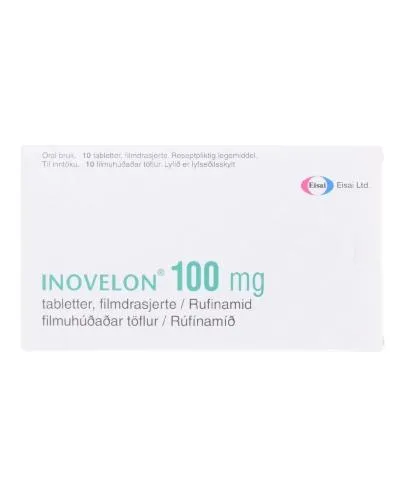
Table of Contents
Package leaflet: Information for the user
Introduction
Package leaflet: information for the user
Inovelon 100 mg film-coated tablets
Inovelon 200 mg film-coated tablets
Inovelon 400 mg film-coated tablets
Rufinamide
Read the entire leaflet carefully before you start taking this medicine because it contains important information for you.
- Keep this leaflet. You may need to read it again.
- If you have any questions, ask your doctor or pharmacist.
- This medicine has been prescribed for you only. Do not give it to other people, even if they have the same symptoms as you, because it may harm them.
- If you experience any adverse effects, consult your doctor or pharmacist, even if they are effects not listed in this leaflet. See section 4.
Contents of the leaflet:
- What Inovelon is and what it is used for
- What you need to know before taking Inovelon
- How to take Inovelon
- Possible side effects
- How to store Inovelon
- Contents of the pack and other information
1. What Inovelon is and what it is used for
Inovelon contains a medicine called rufinamide. It belongs to a group of medicines called antiepileptics, which are used to treat epilepsy (a condition that causes epileptic seizures or fits).
Inovelon is used in combination with other medicines to treat seizures associated with Lennox-Gastaut syndrome in adults, adolescents, and children over 1 year of age. Lennox-Gastaut syndrome is the name given to a group of severe epilepsies in which repeated seizures of various types may occur.
Your doctor has prescribed Inovelon to reduce the number of seizures or fits.
2. What you need to know before taking Inovelon
Do not take Inovelon:
- if you are allergic to rufinamide, triazole derivatives, or any of the other components of Inovelon (listed in section 6).
Warnings and precautions
Consult your doctor or pharmacist:
-
if you have congenital short QT syndrome or a family history of this syndrome (an electrical disorder of the heart), as the use of rufinamide may worsen it.
-
if you have liver problems. Information on the use of rufinamide in this group is limited; therefore, it may be necessary to increase the dose of the medicine more slowly. If your liver disease is severe, your doctor may decide that Inovelon is not suitable for you.
-
if you develop a skin rash or fever. These could be signs of an allergic reaction. Seek medical advice immediately, as very rarely this may become serious.
-
if you experience an increase in the number, severity, or duration of seizures, you must contact your doctor immediately if this occurs.
-
if you experience difficulty walking, abnormal movements, dizziness, or drowsiness, inform your doctor if any of these occur. If you take this medicine and have self-harming or suicidal thoughts at any time, contact your doctor or go to hospital immediately (see section 4).
Please consult with your doctor, even if you experienced these effects at any time in the past.
Children
Inovelon must not be used in children under 1 year of age, as there is insufficient information on its use in this age group.
Taking Inovelon with other medicines
Inform your doctor or pharmacist if you are taking or have recently taken any other medicines, including those obtained without a prescription. If you are taking the following medicines: phenobarbital, fosphenytoin, phenytoin, or primidone, you may require careful monitoring for two weeks when starting or stopping treatment with rufinamide, or after any significant dose change. The dose of these other medicines may need to be adjusted, as they may be less effective when taken with rufinamide.
Antiepileptic medicines and Inovelon
If your doctor prescribes or recommends additional treatment for epilepsy (e.g., valproate), you must inform them that you are taking Inovelon, as your dose may need to be adjusted.
Taking valproate together with rufinamide in children and adults will result in high levels of rufinamide in the blood. Inform your doctor if you are taking valproate, as your doctor may need to adjust your dose of Inovelon.
Inform your doctor if you are using oral/hormonal contraceptives (i.e., "the pill"). Inovelon may reduce the effectiveness of the pill in preventing pregnancy. Therefore, it is recommended that you use another reliable and effective contraceptive method (such as a barrier method, e.g., condoms) while taking Inovelon.
Inform your doctor if you are using blood thinners such as warfarin. Your doctor may need to adjust your dose.
Inform your doctor if you are using digoxin (a medicine used to treat heart conditions). Your doctor may need to adjust your dose.
Taking Inovelon with food and drinks
See section 3 “How to take Inovelon” for recommendations on taking Inovelon with food and drinks.
Pregnancy, breastfeeding, and fertility
If you are pregnant, think you might be pregnant, or are planning to become pregnant, consult your doctor or pharmacist before using this medicine. You should only take Inovelon during pregnancy if instructed by your doctor.
Breastfeeding is not recommended while taking Inovelon, as it is unknown whether rufinamide passes into breast milk.
If you are a woman of childbearing age, you must use contraceptive methods while taking Inovelon.
Consult your doctor or pharmacist before using any medicine together with Inovelon.
Driving and using machines
Inovelon may cause dizziness, drowsiness, and affect your vision, especially at the beginning of treatment or after a dose increase. If this happens to you, do not drive or operate machinery.
Inovelon contains lactose
If your doctor has informed you of an intolerance to certain sugars, contact your doctor before taking this medicine.
Inovelon contains sodium
This medicine contains less than 1 mmol of sodium (23 mg) per daily dose; hence, it is essentially “sodium-free”.
3. How to use Inovelon
Follow exactly the instructions given by your doctor for taking this medicine. If in doubt, consult your doctor or pharmacist again.
Finding the best dose of Inovelon for you may take some time. Your doctor will calculate the appropriate dose based on your age, weight, and whether you are taking Inovelon together with another medicine called valproate.
Children between one and four years of age
The recommended starting dose is 10 mg per kilogram of body weight per day. This is taken as two equal doses, half in the morning and half at night. Your doctor will calculate your dose and may increase it in increments of 10 mg per kilogram of body weight every three days.
The maximum daily dose depends on whether or not you are also taking valproate. The maximum daily dose without valproate is 45 mg per kilogram of body weight per day. The maximum daily dose with valproate is 30 mg per kilogram of body weight per day.
Children aged 4 years and older who weigh less than 30 kg
The recommended starting dose is 200 mg per day. This is taken as two equal doses, half in the morning and half at night. Your doctor will calculate your dose and may increase it by 200 mg (5 ml) every three days.
The maximum daily dose depends on whether or not you are taking valproate. The maximum daily dose without valproate is 1,000 mg per day. The maximum daily dose with valproate is 600 mg per day.
Adults, adolescents and children weighing 30 kg or more
The recommended starting dose is 400 mg per day. This is taken as two equal doses, half in the morning and half at night. Your doctor will calculate your dose and may increase it by 400 mg on alternate days.
The maximum daily dose depends on whether or not you are taking valproate. The maximum daily dose without valproate must not exceed 3,200 mg, depending on your body weight. The maximum daily dose with valproate must not exceed 2,200 mg, depending on your body weight.
Some patients may respond to lower doses, and your doctor may adjust your dose according to your response to treatment.
If you experience adverse effects, your doctor may increase your dose more slowly.
Inovelon tablets should be taken twice daily with water, in the morning and at night. Inovelon should be taken with food. If you have difficulty swallowing, you may crush the tablet, then mix the powder in approximately half a glass of water (100 ml), and drink it immediately. You may also divide the tablets into two equal halves and swallow them with water.
Do not reduce the dose or stop taking this medicine unless instructed by your doctor.
If you take more Inovelon than you should
If you have taken more Inovelon than you should, inform your doctor or pharmacist immediately, or contact the nearest hospital emergency department, taking the medicine with you.
If you forget to take Inovelon
If you forget to take a dose, continue taking the medicine as usual. Do not take a double dose to make up for the forgotten dose. If you forget to take more than one dose, consult your doctor.
If you stop taking Inovelon
If your doctor advises you to stop treatment, follow their instructions regarding gradually reducing the dose of Inovelon to reduce the risk of increased seizures.
If you have any further questions about how to use this medicine, ask your doctor or pharmacist.
4. Possible adverse effects
Like all medicines, Inovelon can cause adverse effects, although not everyone will experience them.
The following adverse effects may be very serious:
Skin rash and/or fever. These may be signs of an allergic reaction. If this occurs, inform your doctor or go to hospital immediately.
Change in the type of seizures you experience/seizures that are more frequent and last longer (called status epilepticus). Inform your doctor immediately.
A small number of people taking antiepileptic medicines such as Inovelon have had thoughts of self-harm or suicide. If you ever have such thoughts, contact your doctor immediately (see section 2).
You may experience the following adverse effects with this medicine. Inform your doctor if you experience any of the following:
Very common adverse effects (affecting more than 1 in 10 patients) of Inovelon are:
Dizziness, headache, nausea, vomiting, somnolence, fatigue.
Frequent adverse effects (affecting more than 1 in 100 patients) of Inovelon are:
Nervous system disorders including: difficulty walking, abnormal movements, seizures/convulsive seizures, unusual eye movements, blurred vision, tremors.
Stomach-related problems including: stomach pain, constipation, indigestion, soft stools (diarrhea), loss of appetite or changes in appetite, weight loss.
Infections: ear infection, flu, nasal congestion, lung infection.
In addition, patients have experienced: anxiety, insomnia, epistaxis (nosebleeds), acne, skin rash, back pain, infrequent menstruation, bruising, head injuries (as a result of accidental injury during an epileptic seizure).
Uncommon adverse effects (affecting between 1 in 100 and 1 in 1,000 patients) of Inovelon are:
Allergic reactions and increased liver function markers (elevated liver enzymes).
Reporting of adverse effects
If you experience any adverse effect, consult your doctor, even if it is a possible adverse effect not listed in this leaflet. You can also report them directly via the Spanish Pharmacovigilance System for Human Medicines at www.notificaRAM.es. By reporting adverse effects, you can help provide more information on the safety of this medicine.
5. Storage of Inovelon
Keep this medicine out of the sight and reach of children.
Do not use this medicine after the expiry date stated on the blister pack and the carton. The expiry date refers to the last day of the month indicated.
Do not store above 30°C.
Do not use this medicine if you notice any change in the appearance of the medicine.
Medicines should not be disposed of via wastewater or household waste. Ask your pharmacist how to properly dispose of unused medicines and their packaging. This will help protect the environment.
6. Contents of the pack and other information
Composition of Inovelon
- The active substance is rufinamide.
Each 100 mg film-coated tablet contains 100 mg of rufinamide.
Each 200 mg film-coated tablet contains 200 mg of rufinamide.
Each 400 mg film-coated tablet contains 400 mg of rufinamide.
- The other components are lactose monohydrate, microcrystalline cellulose (E460), maize starch, sodium croscarmellose (E468), hypromellose (E464), magnesium stearate, sodium lauryl sulphate and colloidal anhydrous silica. The coating consists of hypromellose (E464), macrogol (8000), titanium dioxide (E171), talc and red iron oxide (E172).
Appearance of Inovelon and contents of the pack
- Inovelon 100 mg tablets are pink, film-coated, oval-shaped, slightly convex tablets, scored on both sides, with ‘?261’ engraved on one side and nothing on the other.
Available in packs of 10, 30, 50, 60 and 100 film-coated tablets.
- Inovelon 200 mg tablets are pink, film-coated, oval-shaped, slightly convex tablets, scored on both sides, with ‘?262’ engraved on one side and nothing on the other.
Available in packs of 10, 30, 50, 60 and 100 film-coated tablets.
- Inovelon 400 mg tablets are pink, film-coated, oval-shaped, slightly convex tablets, scored on both sides, with ‘?263’ engraved on one side and nothing on the other.
Available in packs of 10, 30, 50, 60, 100 and 200 film-coated tablets.
Marketing Authorisation Holder and Manufacturer
Marketing Authorisation Holder:
Eisai GmbH
Edmund-Rumpler-Straße 3
60549 Frankfurt am Main
Germany
e-mail: [email protected]
Manufacturer:
Eisai GmbH
Edmund-Rumpler-Straße 3
60549 Frankfurt am Main
Germany
Further information on this medicinal product is available from the local representative of the Marketing Authorisation Holder:
|
Belgium/Belgium/Belgium Eisai SA/NV Tél/Tel: +32 (0)800 158 58 |
Lithuania Eisai GmbH Tel: +49 (0)69 66 58 50 |
|
Bulgaria Eisai GmbH Tel: +49 (0)69 66 58 50 |
Luxembourg/Luxembourg Eisai SA/NV Tél/Tel: +32 (0)800 158 58 (Belgium/Belgium) |
|
Czech Republic Eisai GesmbH organisational unit Tel: +420 242 485 839 |
Hungary Eisai GmbH Tel.: +49 (0)69 66 58 50 |
|
Denmark Eisai AB Tlf: +46 (0)8 501 01 600 (Sweden) |
Malta Associated Drug Co. Ltd Tel: +356 2277 8000 |
|
Germany Eisai GmbH Tel: +49 (0)69 66 58 50 |
Netherlands Eisai B.V. Tél/Tel: +31 (0)900 575 3340 |
|
Estonia Eisai GmbH Tel: +49 (0)69 66 58 50 (Germany) |
Norway Eisai AB Tlf: +46 (0)8 501 01 600 (Sweden) |
|
Greece Arriani Pharmaceutical S.A. Tel: +30 210 668 3000 |
Austria Eisai GesmbH Tel: +43 (0)1 535 1980-0 |
|
Spain Eisai Farmacéutica, S.A. Tel: +34 91 455 94 55 |
Poland Eisai GmbH Tel: +49 (0)69 66 58 50 (Germany) |
|
France Eisai SAS Tél: +33 1 47 67 00 05 |
Portugal Eisai Farmacêutica, Unipessoal Lda Tel: +351 214 875 540 |
|
Croatia Eisai GmbH Tel: +49 (0)69 66 58 50 |
Romania Eisai GmbH Tel: +49 (0)69 66 58 50 (Germany) |
|
Ireland Eisai GmbH Tel: +49 (0)69 66 58 50 |
Slovenia Eisai GmbH Tel: +49 (0)69 66 58 50 (Germany) |
|
Iceland Eisai AB Sími: +46 (0)8 501 01 600 (Sweden) |
Slovakia Eisai GesmbH organisational unit Tel.: +420 242 485 839 (Czech Republic) |
|
Italy Eisai S.r.l. Tel: +39 02 5181401 |
Finland Eisai AB Puh/Tel: +46 (0)8 501 01 600 (Sweden) |
|
Cyprus Arriani Pharmaceuticals S.A. Tel: +30 210 668 3000 (Greece) |
Sweden Eisai AB Tel: +46 (0)8 501 01 600 |
|
Latvia Eisai GmbH Tel: +49 (0)69 66 58 50 (Germany) |
United Kingdom (Northern Ireland) Eisai GmbH Tel: +49 (0)69 66 58 50 (Germany) |
Date of the most recent review of this leaflet:
Detailed information on this medicine is available on the European Medicines Agency website: http://www.ema.europa.eu