Innohep 4,500 UI anti-Xa/0.45 ml solution for injection in pre-filled syringes
Spain
Table of Contents
Package leaflet: Information for the user
Introduction
Package leaflet: information for the user
innohep 4,500 anti-Xa IU/0.45 ml solution for injection in pre-filled syringes
(10,000 anti-Xa IU)
tinzaparin sodium
Read the entire package leaflet carefully before you start using this medicine, because it contains important information for you.
|
Package leaflet contents
- What innohep is and what it is used for
- What you need to know before using innohep
- How to use innohep
- Possible side effects
- Storage of innohep
- Package contents and additional information.
1. What is innohep and what is it used for
innohep is a medicine that makes the blood less likely to clot by reducing its natural ability to form clots.
innohep is used to
-
prevent the formation of blood clots in adults before and after surgery.
-
prevent the formation of blood clots in adults who are at increased risk of clotting, for example, due to an acute illness with limited mobility.
-
prevent the formation of blood clots in the hemodialysis equipment used in patients undergoing hemodialysis or hemofiltration. In hemodialysis, waste products and fluids are removed from the blood by a machine and a dialysis filter that acts as an artificial kidney.
2. What you need to know before using innohep
Do not use innohep:
- if you are allergic to tinzaparin sodium or to any of the other ingredients of this medicine (listed in section 6).
- if you have or have had heparin-induced thrombocytopenia.
- if you have a serious bleeding condition (e.g., in the brain, spinal cord, eyes, or stomach).
- if you have a severe heart infection (infective endocarditis).
Warnings and precautions
Talk to your doctor or nurse before using innohep:
- if you are scheduled to receive spinal or epidural anaesthesia or a lumbar puncture.
- if you know you have a tendency to bleed.
- if you are being treated with other medicines administered by intramuscular injection.
- if you have low platelet levels in your blood.
- if you have high levels of potassium in your blood (hyperkalaemia).
- if you have a prosthetic heart valve.
- if you have kidney problems.
Children and adolescents
innohep is not indicated for use in children and adolescents.
Using innohep with other medicines
Tell your doctor or pharmacist if you are taking, have recently taken, or might need to take any other medicines. Some medicines may interact with the effect of innohep.
Inform your doctor if you are taking any of the following medicines, as they may increase your risk of bleeding:
- Medicines for inflammation and pain, especially non-steroidal anti-inflammatory drugs (NSAIDs), such as acetylsalicylic acid.
- Medicines used to dissolve blood clots (thrombolytic agents).
- Medicines that block the action of vitamin K (vitamin K antagonists).
- Activated protein C.
- Direct factor Xa and IIa inhibitors.
Pregnancy and breastfeeding
If you are pregnant or breastfeeding, think you may be pregnant, or plan to become pregnant, consult your doctor or pharmacist before using this medicine.
innohep in pre-filled syringes can be used during all trimesters of pregnancy.
If epidural anaesthesia is required, inform your doctor that you are using innohep.
Inform your doctor or nurse if you have a prosthetic heart valve.
Driving and using machines
innohep does not affect the ability to drive or operate machinery.
innohep contains sodium
This medicine contains less than 23 mg of sodium (1 mmol) per ml; i.e., it is essentially "sodium-free".
3. How to use innohep
Follow exactly the instructions given by your doctor or nurse for administering this medicine. If in doubt, consult your doctor or nurse again.
Your doctor may request routine blood tests to assess the effect of innohep.
To prevent the formation of blood clots in your veins
innohep must be injected under the skin (subcutaneous injection). The dose and duration of treatment will depend on the type of surgery or illness you have. Your doctor will tell you the appropriate dose for you and how long your treatment should last.
To prevent the formation of blood clots during hemodialysis or hemofiltration
innohep will be introduced into the hemodialysis machine circuits or administered into a vein. The dose will depend on the duration of dialysis.
Instructions for injecting innohep:
- Wash your hands thoroughly before injecting this medicine. Clean the skin around the injection site with an alcohol swab and allow it to dry without rubbing.
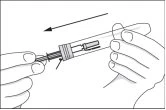
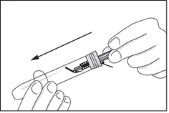
- Open the syringe container by fully lifting back the colored cap and remove the syringe.
Inspect the contents of the syringe before use. If you notice cloudiness or a precipitate in the medicine, do not use it and take another syringe. The medicine may have a yellowish tint during storage, but it can still be used as long as the solution is clear and the expiry date has not been exceeded. Each syringe is for single use only.
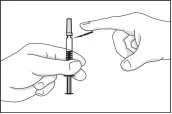
- Pull down the safety device away from the needle protective cap.
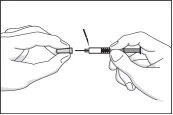
- Remove the cap protecting the needle without twisting it. Do not pull back the plunger or remove the air bubble inside the syringe. If the air bubble is not properly positioned next to the plunger, gently tap the syringe until the air bubble moves to the correct position next to the plunger.
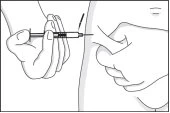
- Gently grasp a fold of skin without pressing, between the thumb and index finger of one hand, and with the other hand insert the needle vertically into the skin fold, i.e., at a right angle to the skin.
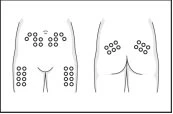
-
Inject the required dose slowly into the fatty tissue, for example, into the abdominal area, the front of the thighs, the lower back, or the back of the arms. Wait a few seconds to allow the solution to disperse before withdrawing the needle and releasing the skin fold.
-
Clean the area with gauze if bleeding occurs. For your next injection, choose a different injection site (for example, alternate between the left and right side of the abdomen).
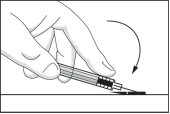
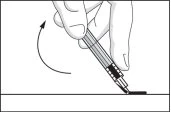
- Fold the safety device back to its original position so that it lies parallel to the needle. Then, with the safety device lying flat on a hard surface, press down until the needle is locked inside the device.
- The used syringe, with the needle pointing downward, can be placed back into its original container or into a sharps disposal container. In this way, the syringe is rendered safe, and the container with the syringe or the sharps container can be returned to a hospital or pharmacist for proper disposal.
If you use more innohep than you should
If you are treated with more innohep than you need, bleeding may occur. Contact your doctor or nurse immediately if you feel unwell or think you have administered too high a dose of innohep.
In case of overdose or accidental ingestion, you may also contact the Toxicology Information Service. Telephone 91 562 04 20.
If you forget to use innohep
Do not administer a double dose to make up for a missed dose. If you have missed more than one dose, consult your doctor as soon as possible.
If you stop using innohep
If you interrupt treatment with innohep, the blood-thinning effect will cease. Do not stop treatment with innohep without consulting your doctor or nurse.
If you have any further questions about the use of this medicine, ask your doctor or nurse.
4. Possible adverse effects
Like all medicines, innohep can cause adverse effects, although not everyone experiences them.
Serious adverse effects:
Serious adverse effects requiring immediate medical attention are rarely observed during treatment with innohep. If you experience any of the following symptoms, contact your doctor immediately or go to the nearest hospital for urgent treatment.
- Severe allergic reaction. Symptoms include sudden onset of a severe rash, swelling of the throat, face, lips or mouth, and difficulty breathing.
- Severe bleeding. Symptoms include red or brown urine, tar-like stools, unusual bruises (very painful, extensive or dark), and any bleeding that does not stop.
The following adverse effects have been observed with administration of innohep:
Frequent: may affect up to 1 in 10 people
- Bleeding. This may lead to complications such as anaemia (low number of red blood cells in the blood) or bruising
- Reactions at the injection site (including bruising, bleeding, pain, itching, redness, swelling and hardening at the injection site)
Uncommon: may affect up to 1 in 100 people
- Thrombocytopenia (decrease in the number of platelets in the blood)
- Hypersensitivity (allergic reaction)
- Bruising and skin discolouration
- Increased liver enzyme levels
- Dermatitis (inflammation of the skin)
- Skin rash and itching
Rare: may affect up to 1 in 1,000 people
- Heparin-induced thrombocytopenia (decrease in the number of platelets in the blood due to heparin treatment)
- Thrombocytosis (increase in the number of platelets in the blood)
- Angioedema (swelling of the face, lips and tongue)
- Anaphylactic reaction (see above “Severe allergic reaction”)
- Hyperkalemia (increased levels of potassium in the blood)
- Toxic skin rash
- Skin necrosis (death of skin tissue)
- Hives
- Osteoporosis, observed with long-term treatment
- Priapism (prolonged, often painful erection without prior sexual stimulation)
Paediatric population
Limited information from a clinical trial and post-marketing data indicates that the adverse reaction profile in children and adolescents is comparable to that observed in adults.
Reporting of adverse effects
If you experience any type of adverse effect, talk to your doctor, pharmacist or nurse, even if it is a possible adverse effect not listed in this leaflet. You can also report them directly via the Spanish Pharmacovigilance System for Human Medicines: https://www.notificaram.es. By reporting adverse effects, you can help provide more information on the safety of this medicine.
5. Storage of innohep
- Keep this medicine out of the sight and reach of children.
- Do not use this medicine after the expiry date stated on the packaging after EXP. The expiry date is the last day of the month indicated.
- No special storage conditions are required.
- Do not use this medicine if you notice cloudiness or a precipitate in the syringe.
- The solution may develop a yellowish tint during storage, but this does not affect the quality of the product and it remains safe for use.
- Medicines should not be disposed of via wastewater or household waste. Return empty containers and unused medicines to the SIGRE collection point at your pharmacy. If in doubt, ask your pharmacist how to dispose of unused medicines and their containers. This will help protect the environment.
6. Contents of the pack and other information
Composition of innohep
- The active substance is tinzaparin sodium. Each ml of injectable solution contains 10,000 anti-Xa IU of tinzaparin sodium.
- The other components are sodium acetate, sodium hydroxide and water for injections.
Appearance of the product and contents of the pack
Injectable solution.
Clear glass syringes containing a colourless or pale yellow solution, free from cloudiness and any deposit-forming material when the syringe is left at rest.
Pack sizes:
- 0.45 ml (4,500 anti-Xa IU), packs containing 2, 10 and 50 syringes.
Only some pack sizes may be marketed.
Marketing Authorisation Holder
LEO Pharma A/S
Industriparken 55
DK-2750 Ballerup
Denmark
Manufacturer
Laboratoires LEO S.A.
39 Route de Chartres
FR-28500 Vernouillet Cedex
France
Date of the most recent revision of this summary: December 2019
Detailed and up-to-date information on this medicine is available on the website of the Spanish Agency of Medicines and Health Products (AEMPS) http://www.aemps.gob.es/.