Infanrix Hexa powder and suspension for suspension for injection
Spain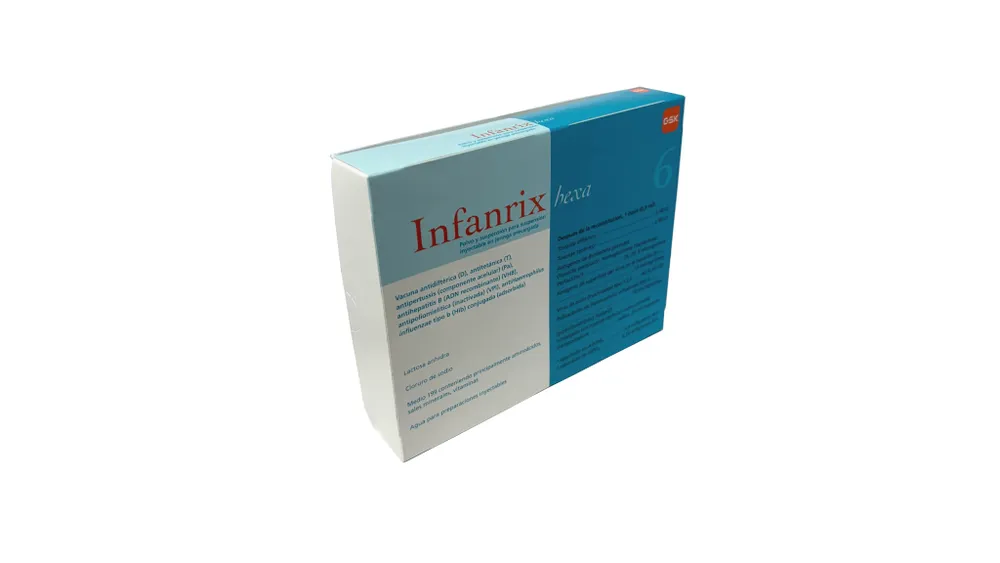
Table of Contents
Package leaflet: Information for the user
Introduction
Package leaflet: information for the user
Infanrix hexa, Powder and solvent for injectable suspension in pre-filled syringe
Diphtheria (D), tetanus (T), acellular pertussis (Pa), hepatitis B (recombinant DNA) (HBV), inactivated poliomyelitis (IPV), Haemophilus influenzae type b (Hib) conjugate (adsorbed) vaccine.
Read all of this leaflet carefully before your child is vaccinated because it contains important information for you.
- Keep this leaflet, as you may need to read it again.
- If you have any questions, ask your doctor or pharmacist.
- This vaccine has been prescribed only for your child and must not be given to other people.
- If your child experiences any adverse reactions, consult your doctor or pharmacist, even if they are not listed in this leaflet. See section 4.
Contents of this leaflet
- What Infanrix hexa is and what it is used for
- What you need to know before your child receives Infanrix hexa
- How Infanrix hexa is given
- Possible side effects
- How to store Infanrix hexa
- Contents of the pack and other information
1. What Infanrix hexa is and what it is used for
Infanrix hexa is a vaccine used to protect your child against six diseases:
-
Diphtheria: a serious bacterial disease that mainly affects the respiratory tract and sometimes the skin, causing severe breathing problems and, in some cases, suffocation. The bacteria also release a toxin that can cause nerve damage, heart problems, and even death.
-
Tetanus: tetanus bacteria, commonly found in soil, dust, horse manure, and wooden splinters, enter the body through cuts, scratches, or wounds in the skin and release a toxin. This can cause muscle stiffness, painful muscle spasms, seizures, and even death.
-
Pertussis (whooping cough): a highly contagious bacterial infection affecting the respiratory tract, causing prolonged coughing often accompanied by a characteristic sound known as a "whoop." It may also lead to ear infections, chest infections (bronchitis), lung infections (pneumonia), seizures, brain damage, or even death.
-
Hepatitis B: caused by the hepatitis B virus, which attacks the liver. The virus may cause lifelong infection and can lead to cirrhosis and liver cancer.
-
Polio: a viral infection that can sometimes damage nerves and cause permanent harm, leading to inability to move muscles (paralysis), including those needed for breathing and walking. It may cause permanent disability or even death.
-
Haemophilus influenzae type b (Hib): a bacterial infection. It can cause meningitis (inflammation of the brain), which may result in mental retardation, cerebral palsy, deafness, epilepsy, or partial blindness. It may also cause throat swelling, leading to death by suffocation. Additionally, it can infect the blood, heart, lungs, bones, joints, and tissues of the eyes and mouth.
How Infanrix hexa works
- Infanrix hexa helps the body develop its own protection (antibodies). This will protect your child against these diseases.
- As with all vaccines, Infanrix hexa may not fully protect every vaccinated child.
- The vaccine cannot cause the diseases it is intended to protect against.
2. What you need to know before your child receives Infanrix hexa
Infanrix hexa must not be given
-
if your child is allergic to:
-
Infanrix hexa or to any of the other components of this vaccine (listed in section 6).
-
Formaldehyde.
-
Neomycin or polymyxin (antibiotics).
Signs of an allergic reaction may include skin itching, rash, breathing difficulties, or swelling of the face or tongue.
-
if your child has had an allergic reaction to any vaccine against diphtheria, tetanus, pertussis, hepatitis B, polio, or Haemophilus influenzae type b.
-
if your child has experienced nervous system problems within 7 days after receiving a previous pertussis-containing vaccine.
-
if your child has a severe infection with fever (above 38 °C). A mild infection, such as a cold, should not prevent vaccination, but you should inform your doctor first.
Infanrix hexa must not be administered if any of the above situations apply to your child. If you are unsure, speak with your doctor or pharmacist before your child receives Infanrix hexa.
Warnings and precautions
Talk to your doctor or pharmacist before your child receives Infanrix hexa:
-
if your child has had any problems after a previous dose of Infanrix hexa or another pertussis-containing vaccine, especially:
-
fever (above 40 °C) within 48 hours after vaccination
-
collapse or shock-like state within 48 hours after vaccination
-
persistent, inconsolable crying lasting 3 hours or more, occurring within 48 hours after vaccination
-
seizures (with or without fever) within 3 days after vaccination
- if your child has undiagnosed or progressive neurological disease or uncontrolled epilepsy. The vaccine may be given once the condition is under control
- if your child has a bleeding disorder or bruises easily
-
if your child tends to have seizures when running a fever, or if there is a family history of such episodes.
-
if your child becomes unresponsive or has seizures (fits) after vaccination, contact your doctor immediately. See also section 4 Possible side effects.
-
if your baby was born very prematurely (at or before 28 weeks of gestation), breathing pauses longer than normal may occur during the first 2–3 days after vaccination. These babies may require respiratory monitoring for 48–72 hours after receiving the first two or three doses of Infanrix hexa.
If any of the above situations apply to your child (or if you are unsure), speak with your doctor or pharmacist before your child is given Infanrix hexa.
Use of Infanrix hexa with other medicines
Your doctor may recommend giving your child a medicine to reduce fever (such as paracetamol) before or immediately after administration of Infanrix hexa. This may help reduce some of the adverse effects (febrile reactions) associated with Infanrix hexa.
Inform your doctor or pharmacist if your child is taking, has recently taken, or might need to take any other medicines, or if your child has recently received any other vaccine.
Infanrix hexa contains neomycin, polymyxin, para-aminobenzoic acid, phenylalanine, sodium, and potassium
This vaccine contains neomycin and polymyxin (antibiotics). Inform your doctor if your child has had an allergic reaction to these components.
Infanrix hexa contains para-aminobenzoic acid. This may cause allergic reactions (possibly delayed), and very rarely bronchospasm.
This vaccine contains 0.0298 micrograms of phenylalanine per dose. Phenylalanine may be harmful in individuals with phenylketonuria (PKU), a rare genetic disorder in which phenylalanine accumulates because the body cannot process it properly.
This vaccine contains less than 1 mmol of sodium (23 mg) per dose; therefore, it is essentially “sodium-free”.
This vaccine contains potassium, less than 1 mmol (39 mg) per dose; therefore, it is essentially “potassium-free”.
3. How Infanrix hexa is given
How much is given
- Your child will receive a total of two or three injections, with an interval of at least 2 or 1 month(s) between each injection.
- The doctor or nurse will tell you when your child should return for the next injections.
- The doctor will inform you whether additional injections (booster doses) are needed.
How the vaccine is given
- Infanrix hexa is injected into a muscle.
- The vaccine must never be injected into a blood vessel or into the skin.
If your child misses a dose
- If your child misses a scheduled injection, it is important to arrange another appointment.
- Make sure your child completes the full course of vaccination. Otherwise, your child may not be fully protected against the diseases.
4. Possible side effects
Like all medicines, this vaccine may cause side effects, although not everybody gets them.
The following side effects may occur with this vaccine:
Allergic reactions
If your child has an allergic reaction, seek medical advice immediately. Signs may include:
- rashes which may be itchy or blistering
- swelling of the eyes and face
- difficulty breathing or swallowing
- sudden drop in blood pressure and loss of consciousness.
These signs usually begin shortly after receiving the injection. Speak to a doctor immediately if this occurs after leaving the clinic.
Contact your doctor immediately if your child has any of the following serious side effects:
- collapse
- episodes of loss of consciousness
- seizures (with or without fever).
These side effects have occurred very rarely with Infanrix hexa as well as with other pertussis vaccines. They usually occur within 2 or 3 days after vaccination.
Other side effects include:
Very common (may occur in more than 1 in 10 doses of the vaccine): drowsiness, loss of appetite, fever of 38 °C or higher, swelling, pain, redness at the injection site, abnormal crying, irritability or restlessness.
Common (may occur in up to 1 in 10 doses of the vaccine): diarrhoea, vomiting, high fever above 39.5 °C, swelling greater than 5 cm or hardening at the injection site, feeling of nervousness.
Uncommon (may occur in up to 1 in 100 doses of the vaccine): upper respiratory tract infection, fatigue, cough, extensive swelling in the limb where the injection was given.
Rare (may occur in up to 1 in 1,000 doses of the vaccine): bronchitis, rash, swelling of the glands in the neck, armpit or groin (lymphadenopathy), bleeding or bruising more easily than normal (thrombocytopenia), in premature infants (born at 28 weeks of gestation or earlier), periods between breaths may be longer than normal during the 2–3 days following vaccination, temporary stop in breathing (apnoea), swelling of the face, lips, mouth, tongue or throat which may cause difficulty in swallowing or breathing (angioedema), swelling throughout the limb where the injection was given, blisters.
Very rare (may occur in up to 1 in 10,000 doses of the vaccine): itching (dermatitis).
Experience with hepatitis B vaccine
In extremely rare cases, the following side effects have been reported with hepatitis B vaccine: paralysis, numbness or weakness of arms and legs (neuropathy), inflammation of certain nerves, possibly with tingling or loss of normal sensation or movement (Guillain-Barré syndrome), inflammation or infection of the brain (encephalopathy, encephalitis), infection around the brain (meningitis).
A causal relationship with the vaccine has not been established.
Bleeding or bruising more easily than normal (thrombocytopenia) has been reported with hepatitis B vaccines.
Reporting of side effects
If your child experiences any type of side effect, consult your doctor or pharmacist, even if it is a possible side effect not listed in this leaflet. You may also report them directly through the national reporting system included in Appendix V. By reporting side effects, you can help provide more information on the safety of this medicine.
5. Storage of Infanrix hexa
- Keep this vaccine out of the sight and reach of children.
- Do not use this vaccine after the expiry date stated on the container. The expiry date refers to the last day of the month indicated.
- Store in a refrigerator (between 2 °C and 8 °C).
- Keep in the original packaging to protect from light.
- Do not freeze. Freezing will destroy the vaccine.
- Medicines should not be disposed of via wastewater or household waste. Ask your pharmacist how to dispose of any unused containers and medicines. This will help protect the environment.
6. Contents of the pack and other information
Composition of Infanrix hexa
The active substances are:
Diphtheria toxoid1 not less than 30 International Units
Tetanus toxoid1 not less than 40 International Units
Bordetella pertussis antigens
Pertussis toxoid1 25 micrograms
Filamentous haemagglutinin1 25 micrograms
Pertactin1 8 micrograms
Hepatitis B virus surface antigen2,3 10 micrograms
Poliovirus (inactivated)
type 1 (Mahoney strain)4 40 D-antigen Units
type 2 (MEF-1 strain)4 8 D-antigen Units
type 3 (Saukett strain)4 32 D-antigen Units
Haemophilus influenzae type b polysaccharide 10 micrograms
(polyribosylribitol phosphate)3
conjugated to tetanus toxoid as carrier protein approx. 25 micrograms
1adsorbed on hydrated aluminium hydroxide (Al(OH)3) 0.5 milligrams Al3+
2produced in yeast cells (Saccharomyces cerevisiae) by recombinant DNA technology
3adsorbed on aluminium phosphate (AlPO4) 0.32 milligrams Al3+
4propagated on VERO cells
The other components are:
Hib lyophilised powder: anhydrous lactose
DTPa-HBV-IPV suspension: sodium chloride (NaCl), Medium 199 (containing amino acids (including phenylalanine), mineral salts (including sodium and potassium), vitamins (including para-aminobenzoic acid) and other substances), and water for injections.
Appearance of the product and contents of the pack
- The diphtheria, tetanus, acellular pertussis, hepatitis B, inactivated poliovirus component (DTPa-HBV-IPV) is a white, slightly milky liquid and is supplied in a pre-filled syringe (0.5 ml).
- The Hib component is a white lyophilised powder and is supplied in a glass vial.
- Both components are mixed immediately before your child receives the injection. The appearance of the mixture is a white, slightly milky liquid.
- Infanrix hexa is available in a 1-dose vial + pre-filled syringe pack, pack sizes of 1 and 10 with and without separate needles, and a multiple pack of 5 packs, each containing 10 vials (1 dose) and 10 pre-filled syringes (1 dose), without separate needles. Only certain pack sizes may be marketed.
Marketing Authorisation Holder and Manufacturer
GlaxoSmithKline Biologicals s.a.
Rue de l´Institut 89
B-1330 Rixensart
Belgium
Further information on this medicinal product is available by contacting the local representative of the Marketing Authorisation Holder:
Belgium/Belgium/Belgium GlaxoSmithKline Pharmaceuticals SA/NV Tel/Tel: + 32 10 85 52 00 | Lithuania GlaxoSmithKline Biologicals SA Tel: +370 80000334 |
| Luxembourg/Luxembourg GlaxoSmithKline Pharmaceuticals SA/NV Tel/Tel: + 32 10 85 52 00 |
Czech Republic GlaxoSmithKline s.r.o. Tel: + 420 22 2 00 11 11 | Hungary GlaxoSmithKline Biologicals SA Tel.: +36 80088309 |
Denmark GlaxoSmithKline Pharma A/S Tlf.: + 45 36 35 91 00 | Malta GlaxoSmithKline Biologicals SA Tel: +356 80065004 |
Germany GlaxoSmithKline GmbH & Co. KG Tel: + 49 (0)89 360448701 | Netherlands GlaxoSmithKline BV Tel: + 31 (0)33 2081100 |
Estonia GlaxoSmithKline Biologicals SA Tel: +372 8002640 | Norway GlaxoSmithKline AS Tlf: + 47 22 70 20 00 |
Greece GlaxoSmithKline Μονοπρόσωπη A.E.B.E. Tel: + 30 210 68 82 100 | Austria GlaxoSmithKline Pharma GmbH. Tel: + 43 (0)1 97075 0 |
Spain GlaxoSmithKline, S.A. Tel: + 34 900 202 700 | Poland GSK Services Sp. z o.o. Tel.: + 48 (22) 576 9000 |
France GlaxoSmithKline Laboratory Tel: + 33 (0) 1 39 17 84 44 Croatia GlaxoSmithKline Biologicals SA Tel: +385 800787089 | Portugal Smith Kline & French Portuguesa, Produtos Farmacêuticos, Lda. Tel: + 351 21 412 95 00 Romania GlaxoSmithKline Biologicals SA Tel: +40 800672524 |
Ireland GlaxoSmithKline (Ireland) Ltd Tel: + 353 (0)1 495 5000 | Slovenia GlaxoSmithKline Biologicals SA Tel: +386 80688869 |
Iceland Vistor hf. Tel: +354 535 7000 | Slovakia GlaxoSmithKline Biologicals SA. Tel: +421 800500589 |
Italy GlaxoSmithKline S.p.A. Tel:+ 39 (0)45 7741 111 | Finland GlaxoSmithKline Oy Tel: + 358 (0)10 30 30 30 |
Cyprus GlaxoSmithKline Biologicals SA Tel: +357 80070017 | Sweden GlaxoSmithKline AB Tel: + 46 (0)8 638 93 00 |
Latvia GlaxoSmithKline Biologicals SA Tel: +371 80205045 | United Kingdom (Northern Ireland) GlaxoSmithKline Biologicals SA Tel: +44(0)800 221441 |
Date of the most recent review of this leaflet:
Other sources of information
Detailed information on this medicinal product is available on the European Medicines Agency website: https://www.ema.europa.eu/
This leaflet is available on the European Medicines Agency website in all languages of the European Union/European Economic Area.
This information is intended for healthcare professionals only:
After storage, a clear liquid and a white deposit may be observed in the pre-filled syringe containing the DTPa-HBV-IPV suspension. This is a normal observation.
The pre-filled syringe must be shaken well to obtain a homogeneous, white, turbid suspension.
The vaccine is reconstituted by adding the entire contents of the pre-filled syringe to the vial containing the lyophilized powder. The mixture must be shaken well until the lyophilized powder is completely dissolved before administration.
The reconstituted vaccine appears as a suspension slightly more turbid than the liquid component alone. This is a normal observation.
The vaccine suspension should be visually inspected before and after reconstitution for the presence of foreign particles and/or any change in physical appearance. If either of these conditions is observed, the vaccine must not be administered.
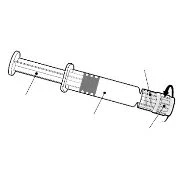
Instructions for the pre-filled syringe
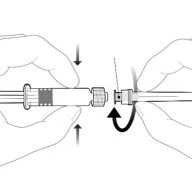
| Hold the syringe by the barrel, not by the plunger. Unscrew the syringe cap by turning it counterclockwise. |
| To insert the needle, connect the base to the luer-lock adapter and turn it a quarter turn clockwise until you feel it lock. Reconstitute the vaccine as indicated above. Do not remove the syringe plunger from the barrel. If this happens, do not administer the vaccine. |




Waste disposal
Disposal of unused medication and all materials that have come into contact with it must be carried out in accordance with local regulations.