Inacid 25 mg hard capsules
Spain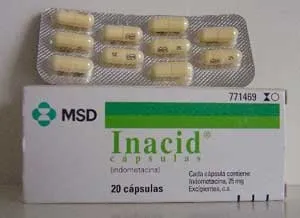
Table of Contents
Package leaflet: Information for the user
Introduction
Package leaflet: information for the patient
Inacid 25 mg hard capsules
Indometacin
Read all of this leaflet carefully before you start taking this medicine, because it contains important information for you.
- Keep this leaflet, as you may need to read it again. If you have any questions, consult your doctor or pharmacist.
- This medicine has been prescribed for you only, and you should not give it to other people, even if they have the same symptoms as you, because it may harm them.
- If you experience any adverse effects, consult your doctor or pharmacist, even if these are adverse effects not listed in this leaflet. See section 4.
Contents of this leaflet
- What Inacid is and what it is used for
- What you need to know before taking Inacid
- How to take Inacid
- Possible side effects
- How to store Inacid
- Contents of the pack and other information
1. What Inacid is and what it is used for
Inacid contains indometacin as the active substance, which belongs to a class of medicines known as non-steroidal anti-inflammatory and antirheumatic drugs.
Inacid is indicated for symptomatic treatment in patients suffering from:
- Rheumatoid arthritis, ankylosing spondylitis (inflammation affecting the joints of the spinal column), and osteoarthritis.
- Acute gout attack.
- Acute musculoskeletal disorders.
- Conditions involving inflammation, pain, and post-traumatic swelling.
2. What you need to know before starting to take Inacid
Do not take Inacid:
- if you are allergic to indometacin or to any of the other components of this medicine (listed in section 6),
- if acetylsalicylic acid or other non-steroidal anti-inflammatory drugs (NSAIDs) have caused you asthma, rhinitis, urticaria, or another allergic reaction,
- if you have a history of gastrointestinal bleeding or perforation related to previous treatment with NSAIDs,
- if you have active or recurrent peptic ulcer/gastrointestinal bleeding,
- if you suffer from severe heart disease,
- if you are in the third trimester of pregnancy or are breastfeeding,
- if you are receiving treatment for perioperative pain in the case of coronary artery bypass graft (CABG) surgery, a procedure to treat a blocked heart artery,
- if you are under 14 years of age.
Warnings and precautions
Consult your doctor or pharmacist before starting to take this medicine.
You should avoid taking Inacid together with other NSAIDs, including other anti-inflammatory medicines such as selective cyclooxygenase-2 (COX-2) inhibitors.
Inform your doctor if you currently suffer or have previously suffered from any of the following conditions:
- Gastrointestinal bleeding, ulcers, or perforations in the stomach or intestine.
- Hypertension, heart problems, or have had a stroke.
- Severe skin disorders.
- Severe liver disease or abnormal liver function tests.
- Renal failure.
- Bleeding disorders or other coagulation problems.
- Psychiatric disorders, epilepsy, or Parkinson's disease.
- Infections.
- Blood disorders, such as decreased white blood cells, red blood cells, or platelets.
- Lactose allergy or allergy to any other component of Inacid 25 mg capsules.
Inform your doctor
- If you are taking medications that affect blood coagulation, such as corticosteroids, oral anticoagulants, or antiplatelet agents like acetylsalicylic acid. You should also mention the use of other medicines that could increase the risk of such bleeding, such as corticosteroids and selective serotonin reuptake inhibitor (SSRI) antidepressants.
- If you have Crohn's disease or ulcerative colitis, as medicines like indometacin may worsen these conditions. If abdominal pain, diarrhea, or vomiting occur, stop taking Inacid and inform your doctor immediately.
Gastrointestinal risks:
The most common adverse effects associated with medicines like Inacid are gastrointestinal: peptic ulcers, gastrointestinal bleeding, and perforations (in some cases fatal), especially in elderly patients. Less frequently, gastritis has been observed. These may occur at any time during treatment, with or without warning symptoms.
The risk of gastrointestinal bleeding is higher when high doses are used, if you have a history of peptic ulcer, or if you are elderly. In such cases, your doctor may consider prescribing a stomach-protective medicine.
If you experience abdominal pain, vomiting blood or material resembling coffee grounds, or black stools, these may be symptoms of gastrointestinal bleeding. Stop taking Inacid immediately and seek medical help without delay.
Cardiovascular risks:
Medicines like Inacid may be associated with a moderate increase in the risk of heart attack (myocardial infarction) or stroke. This risk is more likely when high doses are used or treatment is prolonged. Your doctor may monitor your blood pressure, as Inacid may cause it to rise.
It is important to take the lowest effective dose of Inacid that relieves/controls your symptoms for the shortest duration necessary.
If you have heart problems, have had a heart attack, have a history of stroke, or think you may be at risk of these conditions (for example, if you have high blood pressure, diabetes, high cholesterol, or are a smoker), discuss this treatment with your doctor.
Risk of serious skin reactions:
Medicines like Inacid may rarely be associated with serious skin reactions such as Stevens-Johnson syndrome and toxic epidermal necrolysis.
The highest risk of such reactions occurs at the beginning of treatment (usually within the first month of treatment). If you develop skin rashes, possibly with blistering or mucosal ulcers (e.g., in the mouth), or other symptoms of an allergic reaction, stop taking Inacid and consult your doctor immediately.
Risk of hepatic reactions:
Medicines like Inacid may be associated with liver disorders causing yellowing of the skin and eyes (jaundice), sometimes accompanied by high fever, swelling, or tenderness in the upper abdomen.
Vision:
If you experience blurred vision while taking Inacid, stop taking Inacid and inform your doctor.
Other precautions:
Inform your doctor if you experience headache, possibly accompanied by dizziness and drowsiness after taking Inacid.
In some cases, Inacid may worsen psychiatric disorders, epilepsy, or Parkinson's disease. Therefore, if you suffer from any of these conditions and notice a worsening, discuss this treatment with your doctor.
Like other non-steroidal anti-inflammatory drugs, Inacid may mask the symptoms of an infection.
Your doctor may recommend periodic blood tests during treatment with Inacid to monitor your blood cells, liver and kidney function, or blood levels of other medications.
Children and adolescents
Do not administer to children under 14 years of age.
Use of Inacid with other medicines
Inform your doctor or pharmacist if you are taking, have recently taken, or might need to take any other medicines.
Certain medicines may interact with Inacid. In such cases, it may be necessary to adjust the dose or discontinue treatment with one of the other medicines.
This is especially important if you are taking:
- Anticoagulants, platelet aggregation inhibitors (to prevent blood clotting).
- Corticosteroids (e.g., cortisone, prednisone) (used to treat various types of inflammation or autoimmune diseases).
- Selective serotonin reuptake inhibitors (used to treat depression).
- Acetylsalicylic acid (aspirin) or other NSAIDs, including selective COX-2 inhibitors, and diflunisal (used to treat fever, pain, or inflammation).
- Probenecid (used to treat gout).
- Methotrexate (used to treat certain types of cancer, psoriasis, or rheumatic diseases).
- Cyclosporine (used to suppress the immune system).
- Lithium (used to treat certain types of depression).
- Diuretics, angiotensin II receptor antagonists, angiotensin-converting enzyme (ACE) inhibitors, plasma renin antagonists (medicines for high blood pressure).
- Digoxin (for treatment of heart conditions).
- Phenylpropanolamine (appetite suppressant).
Pregnancy, breastfeeding, and fertility
If you are pregnant or breastfeeding, think you may be pregnant, or plan to become pregnant, consult your doctor before using this medicine.
Do not take Inacid during the last three months of pregnancy, as it may harm the fetus or cause problems during delivery. It may cause kidney and heart problems in your fetus. It may affect your tendency and your baby's tendency to bleed and may delay or prolong labor more than expected. You should not take Inacid during the first six months of pregnancy unless clearly necessary and as directed by your doctor. If treatment is needed during this period or while trying to conceive, you should take the lowest possible dose for the shortest possible time. If taken for more than a few days starting from week 20 of pregnancy, Inacid may cause kidney problems in your fetus, which may lead to low levels of amniotic fluid surrounding the baby (oligohydramnios) or narrowing of a blood vessel (ductus arteriosus) in the baby's heart. If treatment for longer than a few days is needed, your doctor may recommend additional monitoring.
Because the use of medicines like Inacid has been associated with an increased risk of congenital malformations/spontaneous abortions, their use is not recommended during the first and second trimesters of pregnancy unless strictly necessary. In such cases, the dose and duration of treatment should be limited to the minimum possible.
Breastfeeding
Indometacin is excreted in breast milk; therefore, you should not take this medicine if you are breastfeeding.
Fertility
Inacid may reduce your ability to conceive. Inform your doctor if you are planning to have a baby or if you have difficulty becoming pregnant.
Driving and use of machines
Inacid may cause drowsiness, dizziness, and blurred vision. In such cases, do not drive or operate any tools or machinery that require alertness.
Inacid contains lactose
This medicine contains lactose. If you have an intolerance to certain sugars, consult your doctor before taking this medicine.
3. How to take Inacid
Follow exactly the instructions for using this medicine as given by your doctor. If in doubt, consult your doctor or pharmacist again.
Your doctor will determine the dose you should take and the duration of treatment. It is important that you use the lowest dose that controls your pain, and you should not take Inacid for longer than necessary to control your symptoms.
The recommended dose is:
Adults
The usual dose is 50 mg to 200 mg of indometacin per day, given in divided doses.
Rheumatoid arthritis, ankylosing spondylitis, and osteoarthritis: 25 mg of indometacin (1 capsule) every 8–12 hours. If necessary, your doctor may gradually increase the dose in increments of 25 mg or 50 mg up to a maximum of 200 mg of indometacin per day.
Acute gout attack: 50 mg of indometacin (2 capsules) every 8 hours, up to a maximum of 200 mg per day, until symptoms disappear. This should only be used during the period of acute pain.
Musculoskeletal disorders, muscle pain, and inflammation: 25 mg of indometacin (1 capsule) every 6 or 8 hours, until symptoms resolve (1–2 weeks).
Maximum daily dose
Do not take more than 200 mg of indometacin per day.
Elderly patients
Your doctor may prescribe you a lower daily dose and reduce the duration of treatment.
Use in children and adolescents
Inacid must not be used in children under 14 years of age.
Patients with kidney problems
If you have any kidney disease, consult your doctor before taking this medicine.
Method of administration:
Oral use.
The capsules must be swallowed whole with or after food, and with sufficient water or other liquid to reduce the risk of stomach discomfort.
If you take more Inacid than you should
In case of overdose or accidental ingestion, contact your doctor or pharmacist immediately or call the Toxicology Information Service, Telephone: 91 562 04 20, stating the medicine and the amount ingested.
If you forget to take Inacid
Do not take a double dose to make up for the missed dose.
If you have any further questions about the use of this medicine, ask your doctor or pharmacist.
If you stop treatment with Inacid
If you have any questions about the use of this medicine, ask your doctor or pharmacist.
4. Possible adverse effects
Like all medicines, this medicine can cause adverse effects, although not everyone will experience them.
If you experience any of these adverse effects, stop taking this medicine and consult your doctor immediately.
- Severe allergic reaction, such as swelling of the face, lips, or throat, wheezing or difficulty breathing, sudden drop in blood pressure, skin rash.
- Severe abdominal pain (stomach pain) or other abdominal symptoms.
- Blood in the stool.
- Black-colored stools.
- Vomiting blood or dark material resembling coffee grounds.
- Jaundice (yellowing of the skin and whites of the eyes).
- Blisters or peeling of the skin.
- Irregular red spots on the skin of the hands and arms.
The following adverse effects have been reported:
Very common (may affect more than 1 in 10 people):
Headache, dizziness, lightheadedness, vertigo.
Common (may affect up to 1 in 10 people):
Depression, fatigue or tiredness, nausea, loss of appetite, vomiting, indigestion, stomach pain, constipation, diarrhea.
Uncommon (may affect up to 1 in 100 people):
Tinnitus, hearing disorders, increase in liver enzyme test results, abdominal pain, bleeding or perforation of the large intestine, inflammation of the mouth, stomach irritation, flatulence, swelling due to fluid retention, hair loss.
Rare (may affect up to 1 in 1,000 people):
Itching of the skin, urticaria, inflammation of blood vessels, skin rash, sudden difficulty breathing, asthma, pulmonary edema, psychological disorders, delirium, mental confusion, anxiety, fainting, drowsiness, tingling or numbness in the limbs, speech problems, insomnia, worsening of epilepsy or Parkinson's disease, involuntary muscle movements, muscle weakness, seizures, coma, blurred vision, double vision, eye pain, hearing loss, increased heart rate, irregular heartbeat, heart failure, chest pain, high blood pressure, low blood pressure, hepatitis, liver disorders, gastrointestinal ulcers in the esophagus, stomach, or small or large intestine, blood in urine, vaginal bleeding, breast enlargement (also in men), breast tenderness, redness, sweating, nosebleeds, elevated levels of potassium or glucose in the blood, glucose in urine, elevated blood urea levels.
Very rare (may affect up to 1 in 10,000 people):
Decrease in white blood cells, deficiency of a type of white blood cells, deficiency of red blood cells, decrease in platelets, skin hemorrhages, coagulation disorders, corneal deposits in the eye, retinal disturbances, abnormal amounts of protein in urine, kidney disorders, renal failure.
Frequency not known (cannot be estimated from available data):
Inflammation of the pancreas.
Reporting of adverse effects
If you experience any adverse effects, consult your doctor or pharmacist, even if they are possible adverse effects not listed in this leaflet. You may also report them directly via the Spanish Pharmacovigilance System for Human Medicines: https://www.notificaram.es.
By reporting adverse effects, you can help provide more information on the safety of this medicine.
5. Storage of Inacid
Keep this medicine out of the sight and reach of children.
Do not use this medicine after the expiry date stated on the packaging after EXP. The expiry date refers to the last day of the month indicated.
Medicines must not be disposed of via wastewater or household waste. Dispose of empty containers and unused medicines at the SIGRE collection point at your pharmacy. If you are unsure, ask your pharmacist how to properly dispose of unused containers and medicines. This will help protect the environment.
No special storage conditions are required.
6. Package contents and additional information
Composition of Inacid 25 mg
- The active substance is indometacin. Each capsule contains 25 mg of indometacin.
- The other components (excipients) are: monohydrate lactose, lecithin, magnesium stearate, anhydrous colloidal silica, gelatin, titanium dioxide (E171), and yellow iron oxide (E172).
Appearance of the product and contents of the package
The capsules are light ivory-colored hard gelatin capsules.
Inacid 25 mg capsules are packaged in PVC/aluminum blisters, presented in cardboard containers containing 20 or 50 hard capsules.
Marketing Authorization Holder and Manufacturer
Marketing Authorization Holder
H.A.C. PHARMA
Péricentre II-
43, Avenue de la Côte de Nacre
14000 CAEN
France
Manufacturer
allphamed Pharbil Arzneimittel GmbH
Hildebrandstrasse 10-12
37081 Göttingen, Germany
For further information about this medicinal product, please contact the local representative of the Marketing Authorization Holder:
Euromed Pharma Spain, S.L.
C/Eduard Maristany, 430-432
08918 Badalona
Barcelona - Spain
Tel: +34 932 684 208
Fax: +34 933 150 469
Date of latest revision of this leaflet: December 2022
Detailed and up-to-date information on this medicinal product is available on the website of the Spanish Agency of Medicines and Medical Devices (AEMPS) http://www.aemps.gob.es