Implanon NXT 68 mg implant
Spain
Table of Contents
- Package Leaflet: Information for the User
- Introduction
- 1. What Implanon NXT is and what it is used for
- 2. What you need to know before using Implanon NXT
- 3. How to use Implanon NXT
- 4. Possible adverse effects
- 5. Storage of Implanon NXT
- 6. Package contents and other information
- 7.1 When to insert Implanon NXT
- **7.2 How to insert Implanon NXT**
- 7.3 How to remove Implanon NXT
- 7.4 How to replace Implanon NXT
Package Leaflet: Information for the User
Introduction
Package Leaflet: Information for the User
Implanon NXT 68 mg implant
etonogestrel
Read the entire leaflet carefully before starting to use this medicine, because it contains important information for you.
- Keep this leaflet, as you may need to read it again.
- If you have any questions, consult your doctor, pharmacist, or nurse.
- If you experience any adverse effects, consult your doctor, pharmacist, or nurse, even if they are adverse effects not listed in this leaflet. See section 4.
Your doctor will provide you with the Patient Information Card containing important information you should know. Keep the card in a safe place and show it to your healthcare professional during any visit related to the use of the implant.
Leaflet Contents
-
What Implanon NXT is and what it is used for
-
What you need to know before using Implanon NXT
-
How to use Implanon NXT
-
Possible side effects
-
How to store Implanon NXT
-
Contents of the pack and other information
-
Information for Healthcare Professionals
1. What Implanon NXT is and what it is used for
Implanon NXT is a preloaded contraceptive implant in a disposable applicator. Its efficacy and safety have been established in women aged between 18 and 40 years. The implant is a small, soft, flexible plastic rod measuring 4 cm in length and 2 mm in diameter, containing 68 milligrams of the active substance etonogestrel. The applicator enables a healthcare professional to insert the implant just under the skin of the upper arm. Etonogestrel is a synthetic female hormone similar to progesterone. A small amount of etonogestrel is continuously released into the bloodstream. The implant is made of ethylene-vinyl acetate copolymer, a plastic that does not dissolve in the body. It also contains a small amount of barium sulfate, which makes it visible on X-rays.
Implanon NXT is used to prevent pregnancy
How Implanon NXT works
The implant is inserted just under the skin. The active substance, etonogestrel, works in two ways:
-
Prevents the release of an egg from the ovaries.
-
Causes changes in the cervix that make it difficult for sperm to enter the uterus.
As a result, Implanon NXT protects you from pregnancy for a period of three years; however, if you are overweight, your doctor may recommend replacing the implant before the end of three years. Implanon NXT is one of several available contraceptive methods. Another common method of birth control is the combined oral contraceptive pill. Unlike combined pills, Implanon NXT can be used by women who cannot or do not wish to use estrogens. When using Implanon NXT, there is no need to remember to take a daily pill.
This is one of the reasons why Implanon NXT is highly reliable (more than 99% effective). In rare cases, if the implant has not been inserted correctly or has not been inserted at all, you may not be protected against pregnancy. While using Implanon NXT, your menstrual bleeding may change or stop, become irregular, occur infrequently or frequently, be prolonged, or, in rare cases, be heavy. Your bleeding pattern during the first three months usually indicates your future bleeding pattern. Menstrual pain may improve.
You may discontinue Implanon NXT at any time (see also “If you wish to stop using Implanon NXT”).
2. What you need to know before using Implanon NXT
Hormonal contraceptives, including Implanon NXT, do not protect against HIV infection (AIDS) or any other sexually transmitted diseases.
Do not use Implanon NXT
Do not use Implanon NXT if you have any of the conditions listed below. If you have any of these conditions, inform your doctor before Implanon NXT is inserted. Your doctor may advise you to use a non-hormonal contraceptive method.
- if you are allergic to etonogestrel or to any of the other ingredients of this medicine (listed in section 6).
- if you have or have had thrombosis. Thrombosis is the formation of a blood clot in a blood vessel (for example in the legs [deep vein thrombosis] or in the lungs [pulmonary embolism]).
- if you have or have had jaundice (yellowing of the skin), severe liver disease (when the liver does not function properly), or a liver tumour.
- if you have had breast cancer or cancer of the genital organs, or if there is suspicion that you may have such cancer.
- if you have unexplained vaginal bleeding.
If any of these conditions occur for the first time while you are using Implanon NXT, you must consult your doctor immediately.
Warnings and precautions
Talk to your doctor, pharmacist, or nurse before starting to use Implanon NXT.
If you are about to have Implanon NXT inserted and you have any of the following conditions, you may require special medical monitoring. Your doctor will explain what you need to do. Inform your doctor if you have any of these conditions before Implanon NXT is inserted. Also inform your doctor if you are diagnosed with any of these conditions during treatment with Implanon NXT, or if you already have one and it worsens while using Implanon NXT.
- if you have had breast cancer;
- if you have or have had liver disease;
- if you have ever had thrombosis;
- if you have diabetes;
- if you are overweight;
- if you have epilepsy;
- if you have tuberculosis;
- if you have high blood pressure (hypertension);
- if you have or have previously had chloasma (yellowish-brown skin patches, particularly on the face); in this case, avoid intense exposure to sunlight or ultraviolet radiation.
Potentially serious conditions
Cancer
The following information comes from studies in women taking combined oral contraceptives containing two different female hormones daily ("the Pill"). It is not known whether these data apply to women using a different hormonal contraceptive, such as progestogen-only implants.
A slightly increased frequency of breast cancer has been observed in women using combined oral contraceptives, although it is unknown whether this is due to the treatment. For example, more tumours may be detected in women using combined pills because they attend medical check-ups more frequently. This increased frequency gradually decreases after stopping the combined pill. It is important to examine your breasts regularly and inform your doctor if you notice a lump in your breast. Also inform your doctor if any close relative has or has had breast cancer.
Rarely, benign liver tumours and, even more rarely, malignant liver tumours have been reported in women using "the Pill". If you have severe abdominal pain, contact your doctor immediately.
Thrombosis
A blood clot in a vein (called venous thrombosis) can block the vein. This may occur in the veins of the legs, lungs (pulmonary embolism), or other organs. A blood clot in an artery (called arterial thrombosis) can block the artery. For example, a blood clot in an artery may cause a heart attack, or in the brain may cause a stroke.
The use of any combined hormonal contraceptive increases the risk of developing these clots compared to women who do not use combined hormonal contraceptives.
This risk is not as high as the risk of developing a blood clot during pregnancy.
It is believed that the risk in users of progestogen-only contraceptives, such as Implanon NXT, is lower than in users of pills that also contain oestrogens. Cases of blood clot formation such as pulmonary embolism, deep vein thrombosis, heart attack, and stroke have been reported in women using etonogestrel implants. However, available data do not indicate an increased risk of these events in women using the implant.
If you notice possible signs of thrombosis, you must consult your doctor immediately (see also "When you should consult your doctor").
Other conditions
Changes in menstrual bleeding pattern
As with other progestogen-only contraceptives, your menstrual bleeding pattern may change during use of Implanon NXT. You may experience changes in the frequency of bleeding (absence, decreased bleeding, more frequent or continuous bleeding), intensity (decreased or increased), or duration. One in five women will have no bleeding, while one in five women will experience frequent and/or prolonged bleeding. Occasionally, cases of heavy bleeding have been reported. In clinical trials, changes in bleeding were the most common reason for discontinuing treatment (approximately 11%). Your bleeding pattern during the first three months generally indicates your future bleeding pattern.
A change in bleeding pattern does not mean that Implanon NXT is unsuitable for you or that it does not protect you from pregnancy. Generally, no action is required. You should consult your doctor if menstrual bleeding is heavy or prolonged.
Problems related to insertion and removal of the implant
The implant may move from its original insertion site in the arm for various reasons, such as incorrect insertion or external causes (e.g., manipulation of the implant or contact sports). Rarely, implants have been found in blood vessels of the arm or in the pulmonary artery (a blood vessel in the lung). When the implant has moved from its original insertion site, locating the implant may be more difficult, and removal may require a larger incision or a surgical extraction procedure in hospital. If the implant cannot be found in the arm, your healthcare provider may perform an X-ray or use other imaging techniques to locate it in the chest. If the implant is found in the chest, surgery may be necessary. If the implant cannot be located and there is no evidence it has been expelled, contraceptive protection and the risk of progestogen-related adverse effects may last longer than intended.
If at any time you cannot feel the implant, you must contact your doctor as soon as possible.
Psychiatric disorders
Some women using hormonal contraceptives such as Implanon NXT have reported depression or a depressed mood. Depression can be severe and may sometimes lead to suicidal thoughts. If you experience mood changes or depressive symptoms, contact your doctor for further medical advice as soon as possible.
Ovarian cysts
With the use of all low-dose hormonal contraceptives, small fluid-filled sacs in the ovaries, called ovarian cysts, may develop and usually disappear on their own. Occasionally, they may cause mild abdominal pain and only rarely lead to more serious problems.
Broken or bent implant
The function of the implant should not be affected if the implant breaks or bends while inserted in your arm. The implant may break or bend due to external forces. A broken implant may move from its insertion site. If you have any doubts, consult your healthcare professional.
Use of Implanon NXT with other medicines
Always inform your doctor about any medicines or herbal remedies you are taking. Also inform any doctor or dentist who prescribes another medicine (or pharmacist) that you are using Implanon NXT. They can advise you whether you need to take additional contraceptive measures (for example, use of condoms) and, if so, for how long, or whether you need to adjust the use of the other medicine.
Some medicines:
- may affect the levels of Implanon NXT in the blood;
- may make it less effective in preventing pregnancy;
- may cause unexpected bleeding.
These include medicines used to treat:
- epilepsy (e.g., primidone, phenytoin, barbiturates, carbamazepine, oxcarbazepine, topiramate, felbamate);
- tuberculosis (e.g., rifampicin);
- HIV/AIDS infections (nelfinavir, nevirapine, efavirenz);
- hepatitis C virus infection (e.g., boceprevir, telaprevir);
- other infections (griseofulvin);
- high blood pressure in the blood vessels of the lungs (bosentan);
- depression (e.g., St. John’s wort (Hypericum perforatum)).
Implanon NXT may influence the effect of other medicines, for example:
- medicines containing ciclosporin;
- the antiepileptic lamotrigine (this could lead to an increase in seizure frequency).
Consult your doctor or pharmacist before taking any medicine.
Implanon NXT with food and drink
There is no evidence that food and drink affect the use of Implanon NXT.
Pregnancy and breastfeeding
Do not use Implanon NXT if you are pregnant or suspect you may be pregnant. If you are unsure whether you are pregnant, you should take a pregnancy test before Implanon NXT is inserted.
Implanon NXT can be used during the breastfeeding period. Although a small amount of the active ingredient in Implanon NXT passes into breast milk, it does not affect the production or quality of breast milk, or the growth and development of infants.
If you are breastfeeding, consult your doctor before using this medicine.
Children and adolescents
The safety and efficacy of Implanon NXT in adolescents under 18 years of age has not been established.
Driving and using machines
There are no data indicating that the use of Implanon NXT affects the ability to drive or use machines.
When you should consult your doctor
Regular check-ups Before Implanon NXT is inserted, your healthcare provider will ask you some questions about your medical history and that of your immediate family. They will also measure your blood pressure and, depending on your personal circumstances, may request additional tests. While using Implanon NXT, your doctor may schedule a follow-up (routine) examination some time after implant insertion. In general, the frequency and nature of follow-up checks will depend on your individual situation. Your healthcare provider should palpate the implant at every check-up visit. Contact your doctor as soon as possible in the following cases:
|
3. How to use Implanon NXT
Inform your healthcare professional if you are pregnant or think you may be pregnant before Implanon NXT is inserted (e.g. if you have had unprotected sexual intercourse in your current menstrual cycle).
How it is used
Implanon NXT must be inserted and removed only by a healthcare professional who is familiar with the procedures described in section 7 of this leaflet.
Your healthcare professional will decide, in consultation with you, the most appropriate time for insertion. This depends on your individual circumstances (for example, the contraceptive method you are currently using). Unless you are switching directly from another hormonal contraceptive method, insertion should take place on days 1–5 of your spontaneous menstrual bleeding, in order to exclude pregnancy. If the implant is inserted after day 5 of menstruation, you must use an additional contraceptive method (such as a condom) for the first 7 days after insertion.
Local anaesthesia will be administered before inserting or removing Implanon NXT. Implanon NXT is inserted just under the skin on the inner side of the upper non-dominant arm (the arm you do not write with). The procedures for insertion and removal of Implanon NXT are shown in section 6 of the leaflet.
The implant should be palpable after insertion
After insertion is completed, your healthcare professional will ask you to check by palpation that the implant has indeed been inserted into your arm (feeling the implant under the skin). A correctly inserted implant should be clearly palpable both by the healthcare professional and by you, and you should be able to feel its ends between your index and thumb fingers. Note that palpation does not provide complete confirmation of the presence of the implant. If you cannot feel the implant immediately after insertion, or at any time thereafter, it may not have been inserted, it may have been inserted too deeply, or it may have moved from its original insertion site.
Therefore, it is important that you occasionally gently palpate the implant to ensure you know where it is located. If you cannot feel the implant at any time, contact your doctor as soon as possible.
If you have any doubt whatsoever, you should use a barrier contraceptive method (e.g. a condom) until both you and your healthcare professional are completely certain that the implant is in place. Your healthcare professional may need to perform an X-ray, ultrasound, MRI scan, or request blood tests to confirm that the implant is present. If the implant cannot be found in the arm after a thorough search, your healthcare professional may perform an X-ray or use other imaging methods to locate it in the chest area. Once the healthcare professional has located an implant that could not be palpated, it should be removed.
Implanon NXT must be removed or replaced no later than three years after insertion.
Patient Information Card
To help you remember when and where Implanon NXT was inserted, as well as the date by which it must be removed, your healthcare professional will give you a Patient Information Card containing this information. The Patient Information Card also includes instructions to gently palpate the implant from time to time to ensure you know its location. If you cannot feel the implant at any time, contact your doctor as soon as possible. Keep the card in a safe place. Show the Patient Information Card to your healthcare professional during any visit related to the use of the implant.
If you wish to have a new Implanon NXT inserted at the end of the current one's use, the new implant should be inserted immediately after removal of the previous one. The new implant may be inserted in the same arm, often at the same site as the previous implant, provided the site is appropriate. Please consult your healthcare professional.
If you wish to stop using Implanon NXT
You may ask your healthcare professional to remove the implant at any time.
If the implant cannot be located by palpation, your healthcare professional may perform an X-ray, ultrasound, or use magnetic resonance imaging (MRI) to locate it. Depending on the exact position of the implant, removal may be more complicated and could require surgery.
If you do not wish to become pregnant after removal of Implanon NXT, discuss other reliable methods of birth control with your healthcare professional.
If you stop using Implanon NXT because you wish to become pregnant, it is generally recommended to wait for one menstrual period before trying to conceive. This will help you calculate the expected date of delivery.
4. Possible adverse effects
Like all medicines, this medicine can cause adverse effects, although not everybody gets them.
During the use of Implanon NXT, menstrual bleeding may become irregular. This bleeding may consist only of slight spotting, which will not require the use of sanitary pads. It may also consist of heavier bleeding, similar to a light menstruation, which will require the use of sanitary pads. It may also occur that you do not bleed at all. Irregular bleeding is not a sign that the contraceptive protection of Implanon NXT has decreased. Usually, no action will be necessary. However, consult your doctor if the bleeding is heavy and prolonged.
Serious adverse effects are explained in section 2 "Cancer" and "Thrombosis". Please read this section carefully for detailed information and consult your doctor immediately if necessary.
The following adverse effects have been reported:
Very Common (may affect more than 1 in 10 people) | Common (may affect up to 1 in 10 people) | Uncommon (may affect up to 1 in 100 people) |
Acne; headache; increase in body weight; breast pain and tenderness; irregular bleeding; vaginal infection. | Loss of hair; dizziness; depressed mood; emotional instability; nervousness; decreased libido; increased appetite; stomach pain; nausea; flatulence; menstrual pain; decrease in body weight; influenza-like syndrome; pain; fatigue; hot flushes; implant site pain; implant site reaction; ovarian cyst. | Itching; genital itching; rash; increased hair growth; migraine; anxiety; difficulty sleeping; sleepiness; diarrhea; vomiting; constipation; urinary tract infection; vaginal discomfort (e.g. discharge); breast enlargement; breast discharge; back pain; fever; fluid retention; difficulty or pain when urinating; allergic reaction; sore throat and pain; rinitis; joint pain; muscle pain; bone pain. |
In addition to these adverse effects, an increase in blood pressure has been observed occasionally. Increased pressure in the head (benign intracranial hypertension) has been reported, with symptoms such as persistent headache, accompanied by a feeling of illness (nausea), feeling unwell (vomiting), and changes in vision, including blurred vision.
Oily skin (seborrhoea) has also been observed as an adverse effect. Seek immediate medical attention if you experience symptoms of a severe allergic reaction, such as (i) swelling of the face, tongue, or throat; (ii) difficulty swallowing; or (iii) hives and difficulty breathing.
During insertion or removal of Implanon NXT, bruising (severe in some cases), pain, swelling, or itching may occur, and in rare cases infection. A scar may form or an abscess may develop at the implantation site. Due to the placement of the implant, you may experience loss of consciousness. Swelling or a sensation of numbness (or lack of sensitivity) may occur. The implant may be expelled or displaced if not inserted properly. In rare cases, implants located in a blood vessel have been reported, including in a blood vessel in the lung, which may be associated with difficulty breathing and/or coughing with or without bleeding. Surgery may be required to remove the implant.
Cases of blood clots in a vein (called venous thrombosis) or in an artery (called arterial thrombosis) have been reported in women using etonogestrel implants. A blood clot in a vein can block the vein and may occur in the veins of the legs (deep vein thrombosis), lungs (pulmonary embolism), or other organs. A blood clot in an artery can block the artery and may cause a heart attack, or in the brain may cause a stroke.
If you experience any type of adverse effect, consult your doctor, pharmacist, or nurse, even if they are possible adverse effects not listed in this leaflet.
Reporting of adverse effects:
If you experience any type of adverse effect, consult your doctor or pharmacist, even if they are possible adverse effects not listed in this leaflet. You may also report them directly via the Spanish Pharmacovigilance System for Human Medicinal Products: https://www.notificaram.es. By reporting adverse effects, you can help provide more information on the safety of this medicine.
5. Storage of Implanon NXT
Keep this medicine out of sight and reach of children.
Do not use this medicine after the expiry date stated on the packaging (blister and carton).
Store in the original blister.
Medicines must not be disposed of via wastewater or household waste. Dispose of unused medicines and their packaging at the SIGRE collection point at your pharmacy. If in doubt, ask your pharmacist how to dispose of medicines and packaging you no longer need. This helps protect the environment.
No special storage conditions are required.
6. Package contents and other information
Composition of Implanon NXT
Each applicator contains one implant with:
- The active substance is: etonogestrel (68 mg).
- The other components are: vinyl acetate-ethylene copolymer, barium sulfate, and magnesium stearate.
Appearance of the product and contents of the pack
Implanon NXT is a long-acting contraceptive for subcutaneous insertion. It consists of a radiopaque implant containing only a progestogen, preloaded into a new, ready-to-use, easy-to-use, disposable applicator.
The implant is whitish in colour, measures 4 centimetres in length and 2 millimetres in diameter, and contains etonogestrel and barium sulfate. The applicator is designed to facilitate implant insertion just beneath the skin on the inner upper aspect of your non-dominant arm (the arm you do not use for writing). The implant must be inserted and removed by a healthcare professional familiar with both procedures. For easy removal, the implant must be inserted just under the skin. A local anaesthetic must be administered before inserting or removing the implant. The risk of complications is small if the instructions provided here are followed.
Pack sizes: Box with 1 blister, box with 5 blisters.
Only certain pack sizes may be marketed.
Marketing Authorisation Holder and Manufacturer
Marketing Authorisation Holder:
Organon Salud, S.L.
Paseo de la Castellana, 77
28046 Madrid
Spain
Tel.: 915911279
Manufacturer:
N.V. Organon
Kloosterstraat 6,
5349 AB Oss,
The Netherlands
This medicinal product is authorised in the Member States of the European Economic Area and in the United Kingdom (Northern Ireland) under the following names:
Germany, Austria, Belgium, Slovakia, Spain, Ireland, Luxembourg, Malta, The Netherlands, Poland, Portugal: Implanon NXT
Denmark, Estonia, Finland, France, Iceland, Italy, Norway, United Kingdom (Northern Ireland), Romania, Sweden: Nexplanon
Date of the most recent review of this leaflet: September 2025.
Detailed and up-to-date information on this medicine is available on the website of the Spanish Agency of Medicines and Health Products (AEMPS) (http://www.aemps.gob.es/)
The purpose of these pictograms is solely to illustrate the procedures for insertion and removal of the implantfor the woman who will use the implant.
Note: The exact procedures for insertion and removal of Implanon NXT by a qualified healthcare professional are described in the Summary of Product Characteristics and in section 7 on the reverse side of this leaflet.
- How Implanon NXT is inserted
- Insertion of Implanon NXT must be performed only by a qualified healthcare professional familiar with the technique.
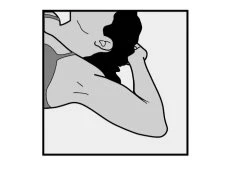
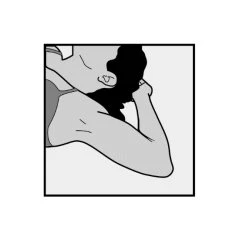
- To facilitate implant insertion, lie on your back with your elbow bent and your hand placed behind your head (or as close as possible).
-
The implant will be inserted into the inner side of the non-dominant arm (the arm not used for writing).
-
The insertion site will be marked on the skin, and the area will be disinfected and anaesthetised.
-
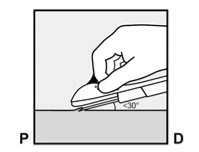
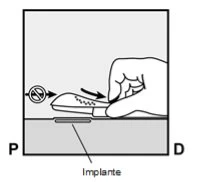
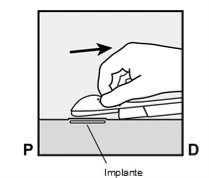
The skin is stretched and the needle is inserted directly beneath the skin. Once the tip is under the skin, it is fully inserted in a movement parallel to the skin surface.
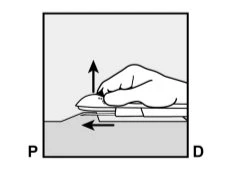
P, proximal (towards the shoulder);
D, distal (towards the elbow)
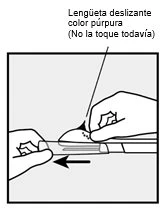
- The purple sliding tab is unlocked to retract the needle. The implant will remain in the upper arm once the needle is withdrawn.
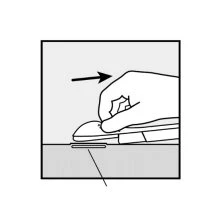
- The presence of the implant must be verified by palpating the area immediately after insertion. In a correctly inserted implant, both the healthcare professional and you should be able to feel its ends between the index and thumb. Note that palpation does not guarantee 100% certainty of the implant's presence.
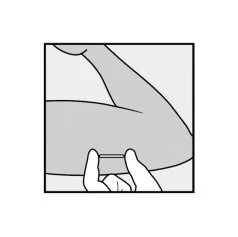
- If the implant cannot be palpated or its presence is uncertain, other methods must be used to confirm its presence.
- Once the healthcare professional has located an implant that could not be palpated, it must be removed.
- Until the presence of the implant is confirmed, you may not be protected against pregnancy and therefore a barrier contraceptive method (e.g., condom) must be used.
- A small adhesive dressing will be applied over the insertion site, and a compression dressing will be applied to minimise bruising (haematoma). You may remove the compression dressing after 24 hours and the small inner adhesive dressing over the insertion site within 3–5 days.
- After implant insertion, the healthcare professional will give you a Patient Information Card indicating the insertion site, the date of insertion, and the latest date by which the implant must be removed or replaced. Keep this card in a safe place, as the information it contains may be useful for future removal.
- How Implanon NXT is removed
- Removal of the implant must be performed only by a qualified healthcare professional familiar with the technique.
- The implant may be removed at your request or no later than three years after insertion.
- The location of the implant insertion site is indicated on the Patient Information Card.
- The healthcare professional will locate the implant. If the implant cannot be located, the healthcare professional may need to perform an X-ray, CT scan, ultrasound, or MRI.
- To facilitate removal, lie on your back with your elbow bent and your hand placed behind your head (or as close as possible).
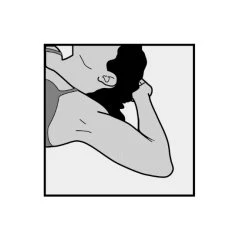

- The upper part of your arm will be disinfected and anaesthetised.
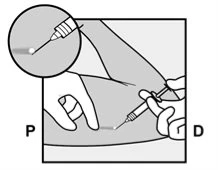
- A small incision will be made along the arm, just below the end of the implant.
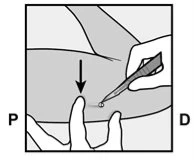
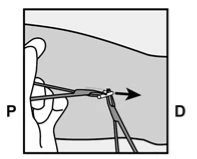
- The implant is gently pushed towards the incision site and removed with forceps.
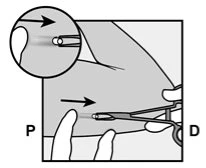
- Occasionally, the implant may be surrounded by a firmer layer of tissue. In such cases, a small cut in the tissue may be necessary before removing the implant.
- If you wish your healthcare professional to replace Implanon NXT with a new implant, the new implant may be inserted through the same incision, provided the site is correctly located.
- The incision is closed with sterile adhesive skin closures.
- A compression dressing will be applied to minimise bruising (haematoma). You may remove the compression dressing after 24 hours and the sterile adhesive skin closures over the insertion site within 3–5 days.
The following information is intended exclusively for thehealthcare professional.
7. Information for the healthcare professional
7.1 When to insert Implanon NXT
IMPORTANT: Pregnancy must be ruled out before inserting the implant.
The timing of insertion depends on the woman's recent history of contraceptive use as follows:
If the woman has not been using hormonal contraception in the past month
The implant should be inserted between Day 1 (the first day of menstruation) and Day 5 of the woman's menstrual cycle, even if bleeding is still occurring.
If insertion is performed according to these instructions, no additional contraceptive method is necessary. If there is any deviation from the recommended timing for implant insertion, the woman should be advised to use a barrier contraceptive method for 7 days after implant insertion. If sexual intercourse has already occurred, pregnancy must be ruled out.
Switching from another hormonal contraceptive method to Implanon NXT
Switching from a combined hormonal contraceptive (combined oral contraceptive, vaginal ring, or transdermal patch)
The implant should preferably be inserted the day after taking the last active tablet (the last tablet containing active ingredients) of the previous combined oral contraceptive, or the day after removal of the vaginal ring or transdermal patch. At the latest, the implant should be inserted the day after the end of the hormone-free interval (or placebo tablet period) of any of the previously mentioned contraceptive treatments. Not all contraceptive methods (transdermal patch, vaginal ring) are marketed in all countries.
If insertion is performed according to these instructions, no additional contraceptive method is necessary. If there is any deviation from the recommended timing for implant insertion, the woman should be advised to use a barrier contraceptive method for 7 days after implant insertion. If sexual intercourse has already occurred, pregnancy must be ruled out.
Switching from a progestogen-only contraceptive method (e.g., progestogen-only pill, injectable, other implant, or progestogen-releasing intrauterine system [IUS])
Because there are several types of progestogen-only contraceptive methods, implant insertion should be performed as follows:
- Injectable contraceptives: Insert the implant on the day the next injection is due.
- Progestogen-only pill: A woman using the progestogen-only pill may switch to Implanon NXT on any day of the month. The implant must be inserted within 24 hours after taking the last pill.
- Implant/Progestogen-releasing intrauterine system (IUS): Insert the implant on the same day as removal of the previous implant or IUS.
If insertion is performed according to these instructions, no additional contraceptive method is necessary. If there is any deviation from the recommended timing for implant insertion, the woman should be advised to use a barrier contraceptive method for 7 days after implant insertion. If sexual intercourse has already occurred, pregnancy must be ruled out.
After a planned abortion or spontaneous miscarriage
The implant may be inserted immediately after a planned abortion or spontaneous miscarriage.
- First trimester: If inserted within 5 days, no additional contraceptive method is necessary.
- Second trimester: If inserted within 21 days, no additional contraceptive method is necessary.
If insertion occurs outside the recommended timing, the woman should be advised to use a barrier contraceptive method for 7 days after implant insertion. If sexual intercourse has already occurred, pregnancy must be ruled out before insertion.
After childbirth
The implant may be inserted immediately after childbirth, both in breastfeeding and non-breastfeeding women, based on an individual benefit/risks assessment.
- If inserted within 21 days after childbirth, no additional contraceptive method is necessary.
- If inserted more than 21 days after childbirth, the woman should be advised to use a barrier contraceptive method for 7 days after implant insertion. If sexual intercourse has already occurred, pregnancy must be ruled out before insertion.
7.2 How to insert Implanon NXT
The basis for successful use and subsequent removal of Implanon NXT lies in the correct and careful subcutaneous insertion of the implant into the non-dominant upper arm, following the instructions outlined below. Both the healthcare professional and the woman must be able to palpate and feel the implant under the woman's skin after placement.
The implant must be inserted subcutaneously just beneath the skin on the inner aspect of the upper non-dominant arm.
- An implant inserted deeper than the dermal layer (deep insertion) may not be palpable and could complicate its localization and/or removal (see section 4.2 How to remove Implanon NXT and section 4.4 of the Summary of Product Characteristics).
- If the implant is inserted too deeply, neurological or vascular damage may occur. Cases of deep or incorrect insertions have been associated with paresthesia (due to neurological injury) and implant migration (due to intramuscular or fascial insertion), and in rare cases, intravascular insertion.
Insertion of Implanon NXT must be performed under aseptic conditions and only by a qualified healthcare professional familiar with the technique. The implant must be inserted only using the preloaded applicator.
Insertion procedure
To help ensure the implant is inserted just beneath the skin, the healthcare professional should position themselves in such a way as to clearly observe the needle's advancement by viewing the applicator from the side, rather than from above the arm. A lateral view allows clear visualization of the insertion site and the needle's movement just under the skin.
For illustrative purposes, the following figures show the inner aspect of the left arm.
|
Figure 1 |
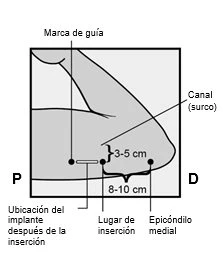
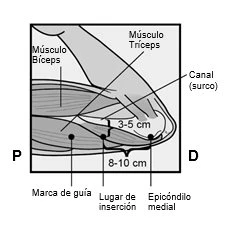
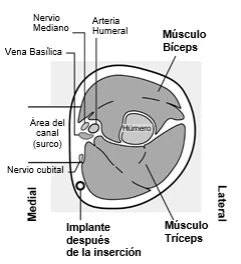
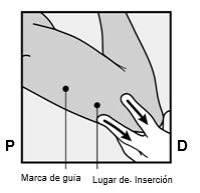
Identify the insertion site located on the inner aspect of the upper non-dominant arm. The insertion site lies over the triceps muscle, approximately 8–10 cm above the medial epicondyle of the humerus and 3–5 cm posterior (beneath) the groove (sulcus) between the biceps and triceps muscles (Figures 2a, 2b and 2c). This location has been selected to avoid the major blood vessels and nerves located within and around the groove. If insertion at this site is not feasible (e.g., in women with thin arms), the implant should be inserted posterior to the groove and as far away from it as possible. | |
Figure 2a Figure 2b P - proximal (toward the shoulder); D - distal (toward the elbow)
Figure 2c Cross-section of the upper left arm, viewed from the elbow Medial (inner side of the arm) Lateral (outer side of the arm) | |
| |
|
Figure 3 |
To ensure correct subcutaneous placement, position yourself so that you can observe the advancement of the needle laterally, not from above the arm. A lateral view allows clear visualization of the insertion site and the needle moving just beneath the skin (see Figure 6). |
Figure 4
Figure 5a |
|
Figure 5b |
If the needle tip emerges through the skin before full insertion is completed, withdraw the needle slightly and reposition it subcutaneously to complete the insertion procedure. |
Figure 6 |
Do not move ( ) the applicator while moving the purple slider tab (Figure 8b). The implant is now in its final subcutaneous position, and the needle is locked within the applicator body. The applicator can now be removed (Figure 8c). |
Figure 7
Figure 8a |
Figure 8b |
Figure 8c |
If the applicator is not held steady during this step or if the purple slider tab is not fully retracted until it stops, the implant may not be correctly inserted and may protrude from the insertion site. If the implant protrudes from the insertion site, remove it and repeat the procedure at the same insertion site using a new applicator. If the implant protrudes, do not push it back into the incision. | |
| |
|
Figure 9 |
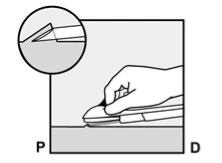
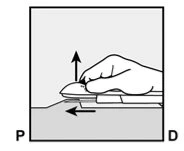
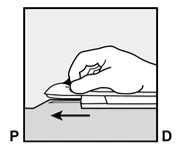
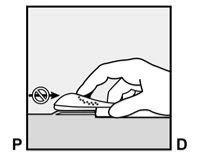
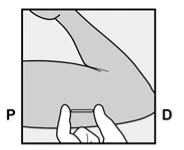
|
|
|
If the implant is not palpable after insertion
If the implant cannot be palpated when its presence is in doubt, the implant may not have been inserted or may have been inserted too deeply:
|
7.3 How to remove Implanon NXT
Removal of the implant must be performed only under aseptic conditions by a qualified healthcare professional familiar with the removal technique. If you are not familiar with the removal technique, for further information, contact the Marketing Authorization Holder, Organon Salud, S.L.
Before starting the removal procedure, the healthcare professional must assess the location of the implant. Confirm by palpation the exact location of the implant in the arm.
If the implant is not palpable, consult the Patient Information Card or the patient's medical record to verify in which arm the implant was inserted. If the implant cannot be palpated, it may have been inserted deeper than usual or may have migrated. Note that the implant may be located near blood vessels and nerves. Removal of non-palpable implants should only be performed by a healthcare professional experienced in removing deeply inserted implants and familiar with implant location and arm anatomy. For further information, contact the Marketing Authorization Holder, Organon Salud, S.L.
See section "Locating and removing a non-palpable implant" below if the implant is not palpable.
Removal procedure for a palpable implant
For illustrative purposes, the following figures show the inner surface of the left arm.
|
Figure 10 |
|
Figure 11 P, proximal (toward the shoulder); D, distal (toward the elbow) |
|
Figure 12 |
|
Figure 13 |
If necessary, gently remove any tissue adherent to the tip of the implant by dissection. If the implant tip remains unexposed after dissection, make an incision into the tissue sheath and then extract the implant using forceps (Figures 15 and 16). |
Figure 14 |
Figure 15 |
Figure 16 |
|
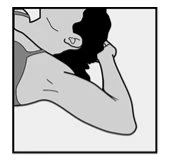
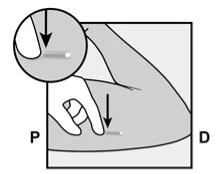
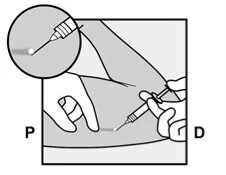
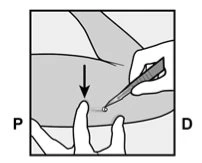
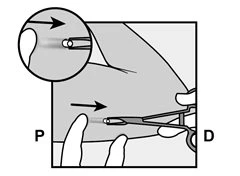
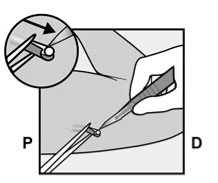
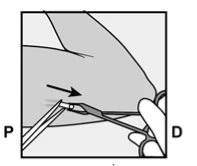
- If you are unable to grasp the implant, stop the procedure and refer the woman to a healthcare professional experienced in complex implant removals, or contact the Marketing Authorization Holder, Organon Salud, S.L.
Figure 17 |
Figure 18 |
Figure 19 |
| ||
| ||
Localization and removal of a non-palpable implant Occasionally, implant displacement has been reported, usually involving minor movement from the original position (see also section 4.4 of the Summary of Product Characteristics). This may result in the implant not being palpable at the insertion site. An implant inserted deeply or displaced may not be palpable, and imaging techniques such as those described below may be required to locate it. A non-palpable implant must always be located before removal. Due to the radiopaque nature of the implant, suitable localization methods include two-dimensional X-ray imaging and computed tomography (CT) scanning. High-frequency linear ultrasound (10 MHz or higher) or magnetic resonance imaging (MRI) may also be used. Once the implant has been localized in the arm, removal should be performed by a healthcare professional experienced in removing deeply inserted implants and familiar with arm anatomy. Consider performing implant removal under ultrasound guidance. If the implant cannot be located in the arm after exhaustive attempts, imaging of the chest may be considered, as extremely rare cases of implant migration to the pulmonary blood vessels have been reported. If the implant is found in the chest, surgical or endovascular procedures may be required for removal; consultation with healthcare professionals familiar with thoracic anatomy is recommended. If imaging methods fail to locate the implant at any time, its presence may be confirmed by measuring etonogestrel blood levels. Contact the Marketing Authorization Holder for further information. If the implant has migrated within the arm, removal may require a minor surgical procedure with a larger incision or a surgical procedure performed in an operating room. Removal of a deeply inserted implant should be performed cautiously to help avoid damage to deeper neurological or vascular structures in the arm. Non-palpable and deeply inserted implants must be removed by healthcare professionals familiar with arm anatomy and with the removal of deeply inserted implants. Exploratory surgery without prior knowledge of the exact location of the implant is strongly discouraged. Contact the Marketing Authorization Holder for further information. |
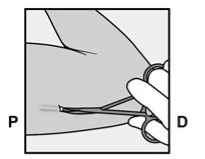
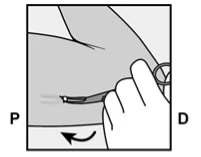
7.4 How to replace Implanon NXT
After removal of the implant, it may be immediately replaced with a new one; the insertion procedure is similar to that described in section 7.2.
The new implant may be inserted in the same arm and using the same incision through which the previous implant was removed, provided that the site is in the correct location, i.e., 8–10 cm from the medial epicondyle of the humerus and 3–5 cm posterior (below) the channel (groove) (see section 4.2 of the Summary of Product Characteristics, How to insert Implanon NXT). If the new implant is inserted through the same incision, anaesthetize the insertion site by injecting an anaesthetic (e.g., 2 ml of lidocaine (1%)) just under the skin, starting at the incision made for removal and along the "insertion channel", following the steps indicated in the insertion instructions.