Imigran 6 mg solution for injection
Spain
Table of Contents
Package leaflet: Information for the user
Introduction
Package leaflet: information for the user
Imigran 6 mg injection solution
Sumatriptan (as sumatriptan succinate)
Read the entire leaflet carefully before you start taking this medicine, as it contains important information for you.
- Keep this leaflet, as you may need to read it again.
- If you have any questions, ask your doctor or pharmacist.
- This medicine has been prescribed for you only, and you should not give it to other people, even if they have the same symptoms as you, because it may harm them.
- If you experience any adverse effects, consult your doctor or pharmacist, even if they are adverse effects not listed in this leaflet. See section 4.
Leaflet contents
- What Imigran is and what it is used for
- What you need to know before using Imigran
- How to use Imigran
- Possible side effects
- How to store Imigran
- Contents of the pack and other information
1. What Imigran is and what it is used for
Imigran contains the active substance sumatriptan, which belongs to a group of medicines known as triptans (also known as 5-HT1 receptor agonists).
Imigran is used to relieve the headache pain and other symptoms of a migraine attack or a cluster headache attack.
The dilation of blood vessels in the brain is thought to be the cause of the headache pain in migraine. This medicine constricts the blood vessels in the brain and relieves migraine symptoms.
2. What you need to know before using Imigran
Do not use Imigran
- if you are allergic to sumatriptan or any of the other ingredients of this medicine (listed in section 6)
- if you have heart problems such as narrowing of the arteries (coronary artery disease) or chest pain (angina), or if you have had a heart attack
- if you have circulation problems in your legs causing pain, such as cramps when walking (peripheral vascular disease)
- if you have had a stroke or a mini-stroke (also called transient ischaemic attack or TIA)
- if you have high blood pressure. You may use Imigran if your blood pressure is slightly elevated and is being treated
- if you have liver disease, consult your doctor. If liver disease is severe, Imigran is not suitable for you
- with migraine medicines, including those containing ergotamine, or similar medicines such as methysergide or any triptan/5-HT1 receptor agonist (medicines also used to treat migraine)
- with antidepressants called MAOIs (monoamine oxidase inhibitors), or if you have taken these medicines within the last two weeks.
If any of these apply to you
?Tell your doctor, and do not use Imigran.
Warnings and precautions
Talk to your doctor or pharmacist before starting to use Imigran.
Before taking Imigran, your doctor needs to know if you have any additional risk factors for heart disease:
-
if you are a man over 40 years old
-
if you are a woman who has gone through the menopause
-
if you smoke or are overweight
-
if you have diabetes or high cholesterol
-
if you have a family history of heart disease.
Very rarely, people have developed serious heart problems after using Imigran, even though they did not have signs of heart disease previously. If any of the above apply to you, this may mean you have a higher risk of developing heart disease, so
?Tell your doctor to have your heart function checked before being prescribed Imigran.
If you have a history of seizures
Or if you have other conditions that may make seizures more likely – for example, a head injury or alcoholism.
?Tell your doctor so you can be monitored more closely.
If you have high blood pressure
Imigran may not be suitable for you:
?Tell your doctor or pharmacist before using Imigran.
If you have kidney or liver disease
?Tell your doctor or pharmacist before using Imigran.
If you are allergic to antibiotics called sulfonamides
If so, you may also be allergic to Imigran. If you know you are allergic to antibiotics but are not sure whether they were sulfonamides:
?Tell your doctor or pharmacist before using Imigran.
If you are taking antidepressants called SSRIs (Selective Serotonin Reuptake Inhibitors) or SNRIs (Serotonin and Noradrenaline Reuptake Inhibitors)
?Tell your doctor or pharmacist before using Imigran. See also below, Other medicines and Imigran.
If you use Imigran frequently
Using Imigran too often may worsen your headaches.
?Tell your doctor if this happens to you. Your doctor may advise you to stop using this medicine.
If you feel pain or tightness in your chest after using Imigran
These effects may intensify but usually pass quickly. If they do not pass quickly or become more severe:
?Get medical help immediately. See section 4 of this leaflet, which contains more information about these possible side effects.
Other medicines and Imigran
Tell your doctor or pharmacist if you are taking, have recently taken, or might need to take any other medicine. This includes any herbal products or medicines purchased without a prescription.
Some medicines should not be taken with Imigran, and others may cause side effects if taken with Imigran. Tell your doctor if you are taking other medicines, such as:
- ergotamine, also used to treat migraine, or similar medicines such as methysergide (see section 2 Do not use Imigran). Do not use Imigran at the same time as these medicines. Stop taking these medicines at least 24 hours before using Imigran. Do not take any other medicine containing ergotamine or ergotamine-like compounds until at least 6 hours after using Imigran
- other triptans/5-HT1 receptor agonists (such as naratriptan, rizatriptan, zolmitriptan), also used to treat migraine (see section 2 Do not use Imigran). Do not use Imigran at the same time as these medicines. Stop taking these medicines at least 24 hours before using Imigran. Do not take another triptan/5-HT1 receptor agonist at least 24 hours after using Imigran
- SSRIs (Selective Serotonin Reuptake Inhibitors) or SNRIs (Serotonin and Noradrenaline Reuptake Inhibitors) used to treat depression. Using Imigran with these medicines may cause serotonin syndrome (a group of symptoms that may include restlessness, confusion, sweating, hallucinations, increased reflexes, muscle spasms, chills, increased heart rate, and agitation). Tell your doctor immediately if you experience any of these symptoms
- MAOIs (monoamine oxidase inhibitors) used to treat depression. Do not use Imigran if you have taken these medicines within the last 2 weeks
- St John’s wort (Hypericum perforatum). You are more likely to experience adverse effects if you take herbal remedies containing St John’s wort while using Imigran.
Fertility, pregnancy and breast-feeding
If you are pregnant or breast-feeding, think you may be pregnant or are planning to become pregnant, consult your doctor before using this medicine. There is limited information on the safety of Imigran in pregnant women, although so far there is no evidence that it increases the risk of birth defects. Your doctor will assess with you whether or not you should use Imigran during pregnancy.
You must not breast-feed your baby for 12 hours after taking Imigran. If you express breast milk during this time, discard the milk and do not give it to your baby.
Some women have reported breast and/or nipple pain after using sumatriptan. The pain is usually temporary and disappears within 3 to 12 hours.
Driving and using machines
This medicine, like migraine, may cause drowsiness. If you experience these effects, avoid driving or using machines as it could be dangerous.
Imigran contains sodium chloride
This medicine contains less than 23 mg of sodium (1 mmol) per 0.5 ml; this is essentially “sodium-free”.
It may cause severe allergic reactions because the container contains latex rubber.
3. How to use Imigran
Follow exactly the instructions for administering this medicine as given by your doctor. If in doubt, consult your doctor or pharmacist again.
Only use Imigran after your migraine headache has started. Do not use Imigran to prevent a migraine attack.
Remember to take your medicine.
Your doctor will tell you how long to use Imigran. Do not stop treatment earlier.
Imigran should be used as soon as migraine or acute headache symptoms appear; however, it may be used at any time during an attack.
Administration is not recommended in children, adolescents under 18 years of age, or elderly patients.
The recommended dose in adults for migraine or acute headache symptoms is a single subcutaneous injection (6 mg) just under the skin. Your doctor will show you where to administer the injection, usually in the thigh or buttock. Do not inject directly into a vein. Some people begin to notice improvement within 15 minutes of administering Imigran.
If no improvement is obtained after administration of one dose, a second dose of sumatriptan should not be used for the same migraine or acute headache attack. However, you may take your usual headache medication, provided it does not contain ergotamine or dihydroergotamine.
If symptoms improve after the first dose but then return, a second dose of Imigran may be used, provided at least one hour has passed since the first dose.
Do not use more than 2 injections within 24 hours, and allow at least one hour between doses.
Needles and syringes can be dangerous and must be safely and hygienically discarded.

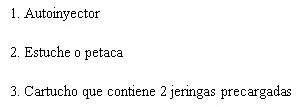 The device consists of three parts: auto-injector, case or holder, and a cartridge containing two syringes, as shown in the following figure:
The auto-injector can only be used when loaded with a syringe.
Contents of the case or holder
-
When opening the case or holder lid, you will see the auto-injector and the cartridge with the syringes.
-
Check that the cartridge is correctly positioned, i.e., when the blue buttons are visible through the holes in the case or holder.
To use the auto-injector
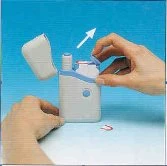
- Open the case or holder.
Remove the seal from one of the two syringes contained in the cartridge.
- Open the cap of the corresponding syringe.
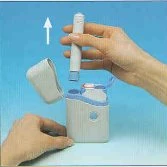
- Remove the auto-injector from the case or holder.
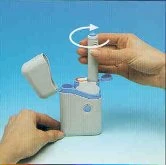
- Firmly insert the auto-injector into the cartridge and rotate the auto-injector clockwise until it will not turn further.
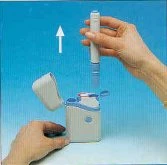
- Firmly pull the loaded auto-injector outward. This may require some effort.
There is a safety button that prevents accidental injection until you are ready.

- Press the loaded auto-injector firmly against the skin—preferably on the outer side of the thigh or upper outer side of the arm (deltoid muscle)—so that the grey part slides down to the blue part. To inject, press and hold the blue button on the auto-injector down for at least five seconds (or count to ten).

- Carefully remove the auto-injector.
Be careful, as the needle will be visible.
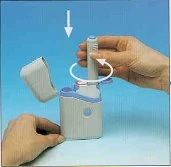
- Immediately return the used syringe by placing it back into the cartridge, pushing the auto-injector down into it as far as it will go. Then, rotate the auto-injector counterclockwise until it comes out of the cartridge.
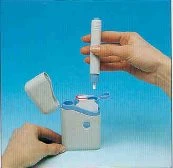
- Remove the auto-injector from the cartridge; then, close the cap over the used syringe.
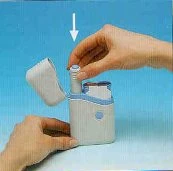
- Return the auto-injector to its place in the holder by pushing it down. You will hear a click when the auto-injector is properly seated.
If you use more Imigran than you should:
In case of overdose or accidental ingestion, consult your doctor or pharmacist immediately or call the Toxicology Information Service at telephone: 91 562 04 20, stating the medicine and the amount ingested.
If you have any further questions about the use of this medicine, ask your doctor or pharmacist.
4. Possible adverse effects
Like all medicines, Imigran can cause adverse effects, although not everyone experiences them. Some of these symptoms may be caused by migraine itself.
Allergic reactions: seek medical help immediately
The following adverse effects have occurred in a very small number of people, and their exact frequency is unknown.
- Signs of allergy include rash, hives (itching and rash); wheezing (wheezing in the chest); swollen eyelids, face or lips; complete collapse.
If you notice any of these symptoms shortly after using Imigran:
? Do not use it again. Contact your doctor immediately.
Very common adverse effects
(affect more than 1 in 10 people)
- Pain at the injection site.
- Itching, burning, redness, swelling, bruising, and bleeding at the injection site.
Common adverse effects
(affect up to 1 in 10 people)
- Pain, heaviness, pressure, tightness, or pain in the chest, throat, or other parts of the body, or unusual sensations, including numbness, tingling, and hot or cold feelings. These effects may be intense but usually resolve quickly.
If these effects persist or worsen (especially chest pain):
? Seek urgent medical attention. In a small number of people, these symptoms may be caused by heart attacks.
Other common adverse effects include:
- Nausea or vomiting, although this may be due to migraine itself.
- Tiredness or drowsiness.
- Dizziness, weakness, or hot flushes.
- Temporary increase in blood pressure.
- Difficulty breathing.
- Muscle pain.
Rare adverse effects
(affect up to 1 in 1,000 people)
- Breast pain.
Very rare adverse effects
(affect up to 1 in 10,000 people)
- Changes in liver function. Inform your doctor or nurse that you are taking Imigran if you are having a blood test to check liver function.
Some patients may experience any of the following adverse effects, but the frequency is unknown
- Seizures/attacks, tremors, muscle spasms, neck stiffness.
- Visual disturbances such as flickering, reduced vision, double vision, vision loss, and in some cases, even permanent defects (although these may be due to the migraine attack itself).
- Heart problems, in which the heart may beat faster, slower, or with changes in rhythm, chest pain (angina), or heart attack.
- Pale skin, bluish discoloration and/or pain in fingers, toes, ears, nose, or jaw in response to cold or stress (Raynaud's phenomenon).
- Pain in the lower left side of the abdomen and bloody diarrhoea (ischaemic colitis).
- Diarrhoea.
- If you have recently had an injury or have inflammation (such as rheumatism or colon inflammation), you may experience pain or worsening of pain at the site of injury or inflammation.
- Joint pain.
- Anxiety.
- Difficulty swallowing.
- Excessive sweating.
If you have had a blood test to check your liver function and have taken Imigran, inform your doctor, as it may affect the results.
Reporting of adverse effects:
If you experience any adverse effect, talk to your doctor or pharmacist, even if it is a possible adverse effect not listed in this leaflet. You can also report them directly via the Spanish Pharmacovigilance System for Human Medicinal Products: www.notificaRAM.es. By reporting adverse effects, you can help provide more information on the safety of this medicine.
5. Storage of Imigran
Keep this medicine out of the sight and reach of children.
Do not store above 30°C. Keep in the original packaging to protect from light.
Do not use this medicine after the expiry date stated on the packaging after EXP. The expiry date is the last day of the month indicated.
Medicines must not be disposed of via wastewater or household waste. Dispose of unused medicines and their containers at the SIGRE collection point at your pharmacy. If you are unsure, ask your pharmacist how to dispose of medicines and containers you no longer need. This will help protect the environment.
6. Contents of the pack and other information
Composition of Imigran:
-The active substance is sumatriptan. Each pre-filled syringe contains 6 milligrams of sumatriptan (as sumatriptan succinate).
-The other components are sodium chloride and water for injections.
Appearance of the product and contents of the pack
Imigran is presented as a pre-filled syringe containing a solution with 6 mg of sumatriptan. Each pack contains a case or carrier with 2 pre-filled syringes and an auto-injection device.
The needle shield of the pre-filled syringe contains natural dry rubber latex, which may cause severe allergic reactions in individuals sensitive to latex.
Marketing Authorization Holder and Manufacturer
Marketing Authorization Holder:
GlaxoSmithKline S.A.
P.T.M. C/ Severo Ochoa, 2
28760 Tres Cantos (Madrid)
Tel: +34 900 202 700
Manufacturer:
GlaxoSmithKline Manufacturing S.p.A.
Strada Provinciale Asolana, 9
43056 San Polo di Torrile
Parma
Italy
Date of the most recent review of this leaflet: August 2025
Detailed and up-to-date information on this medicinal product is available on the website of the Spanish Agency for Medicines and Health Products (AEMPS) http://www.aemps.gob.es/