Imigran 20 mg solution for nasal spray
Spain
Table of Contents
Package leaflet: Information for the user
Introduction
Package leaflet: information for the user
Imigran 20 mg nasal spray solution
Sumatriptan
Read the entire leaflet carefully before you start using this medicine, because it contains important information for you.
- Keep this leaflet, as you may need to read it again.
- If you have any questions, consult your doctor or pharmacist.
- This medicine has been prescribed for you only, and you should not give it to other people, even if they have the same symptoms as you, because it could harm them.
- If you experience any adverse effects, consult your doctor or pharmacist, even if they are adverse effects not listed in this leaflet. See section 4.
Leaflet contents
- What Imigran is and what it is used for
- What you need to know before using Imigran
- How to use Imigran
- Possible adverse effects
- How to store Imigran
- Contents of the pack and other information
1. What Imigran is and what it is used for
Each Imigran 20 mg nasal spray contains a single dose of sumatriptan, which belongs to a group of medicines known as triptans (also known as 5-HT1 receptor agonists).
Imigran 20 mg is used to treat migraine headache.
The symptoms of migraine may be caused by a temporary dilation of blood vessels in the head. Imigran 20 mg is believed to reduce this dilation of blood vessels. This, in turn, helps relieve headache pain and other symptoms of a migraine attack, such as nausea or vomiting and sensitivity to light and sound.
2. What you need to know before using Imigran
Do not use Imigran 20 mg
- if you are allergic to sumatriptan or any of the other ingredients of this medicine (listed in section 6)
- if you have heart problems such as narrowing of the arteries (ischaemic heart disease) or chest pain (angina), or have had a heart attack
- if you have circulation problems in your legs causing pain, such as cramps when walking (peripheral vascular disease)
- if you have had a stroke or a mini-stroke (also called transient ischaemic attack or TIA)
- if you have high blood pressure. You may use Imigran 20 mg if your blood pressure is slightly elevated and is being treated
- if you have severe liver disease
- with other migraine medicines, including those containing ergotamine, or similar medicines such as methysergide, or any triptans/5-HT1 receptor agonists (medicines also used to treat migraine)
- with antidepressants known as MAOIs (monoamine oxidase inhibitors), or if you have taken these medicines within the last 2 weeks.
If any of these apply to you:
?Tell your doctor and do not use Imigran 20 mg.
Take special care with Imigran 20 mg
Talk to your doctor or pharmacist before starting to use Imigran 20 mg.
If you have any additional risk factors
- if you smoke heavily or are using nicotine replacement therapy, and especially
- if you are a man over 40 years of age, or
- if you are a woman who has entered menopause.
Very rarely, people have developed serious heart problems after using Imigran 20 mg, even though they showed no prior signs of heart disease. If any of the above apply to you, this may mean you have an increased risk of developing heart disease, so:
?Tell your doctor to check your heart function before being prescribed Imigran 20 mg.
If you have a history of seizures
Or if you have other conditions that may increase the likelihood of seizures – for example, head injury or alcoholism.
?Tell your doctor so you can be monitored more closely.
If you have liver or kidney disease
?Tell your doctor so you can be monitored more closely.
If you are allergic to antibiotics known as sulfonamides
If so, you may also be allergic to Imigran 20 mg. If you know you are allergic to antibiotics but are unsure whether they are sulfonamides:
?Tell your doctor or pharmacist before using Imigran 20 mg.
If you are taking antidepressants known as SSRIs (Selective Serotonin Reuptake Inhibitors) or SNRIs (Serotonin and Noradrenaline Reuptake Inhibitors)
?Tell your doctor or pharmacist before using Imigran 20 mg. See also, Other medicines and Imigran 20 mg.
If you use Imigran 20 mg frequently
Using Imigran 20 mg too often may worsen your headaches.
?Tell your doctor if this happens to you. Your doctor may advise you to stop using Imigran 20 mg.
If you experience chest pain or tightness after using Imigran 20 mg
These effects may intensify but usually pass quickly. If they do not pass quickly or become more severe:
?Get medical help immediately. See section 4 of this leaflet for more information about these possible side effects.
Other medicines and Imigran 20 mg
Tell your doctor or pharmacist if you are taking, have recently taken, or might need to take any other medicine. This includes any herbal remedies or medicines purchased without a prescription.
Some medicines should not be taken with Imigran 20 mg, and others may cause adverse effects when taken with Imigran 20 mg. Tell your doctor if you are taking other medicines, such as:
- Ergotamine, also used to treat migraine, or similar medicines such as methysergide (see section 2 Do not use Imigran 20 mg). Do not use Imigran 20 mg at the same time as these medicines. Stop taking these medicines at least 24 hours before using Imigran 20 mg. Do not take any other medicine containing ergotamine or ergotamine-like compounds until at least 6 hours after using Imigran 20 mg.
- Other triptans/5-HT1 receptor agonists (such as naratriptan, rizatriptan, zolmitriptan), also used to treat migraine (see section 2 Do not use Imigran 20 mg). Do not use Imigran 20 mg at the same time as these medicines. Stop taking these medicines at least 24 hours before using Imigran 20 mg. Do not take another triptan/5-HT1 receptor agonist within at least 24 hours after using Imigran 20 mg.
- SSRIs (Selective Serotonin Reuptake Inhibitors) or SNRIs (Serotonin and Noradrenaline Reuptake Inhibitors) used to treat depression. Using Imigran 20 mg with these medicines may cause serotonin syndrome (a group of symptoms that may include restlessness, confusion, sweating, hallucinations, increased reflexes, muscle spasms, shivering, increased heart rate, and agitation). Inform your doctor immediately if you experience these symptoms.
- MAOIs (monoamine oxidase inhibitors) used to treat depression. Do not use Imigran 20 mg if you have taken these medicines within the last 2 weeks.
- St. John’s Wort (Hypericum perforatum). You are more likely to experience adverse effects if you take herbal remedies containing St. John’s Wort while using Imigran 20 mg.
Pregnancy and breastfeeding
Tell your doctor or pharmacist before using any medicine.
- If you are pregnant or breastfeeding, think you may be pregnant, or plan to become pregnant, consult your doctor before using this medicine. There is limited information on the safety of Imigran 20 mg in pregnant women, although so far there is no evidence that it increases the risk of birth defects. Your doctor will assess with you whether or not you should use Imigran 20 mg during pregnancy.
- You must not breastfeed your baby for 12 hours after taking Imigran 20 mg. If you express breast milk during this time, discard the milk and do not give it to your baby.
Some women have reported breast and/or nipple pain after using sumatriptan. This pain is usually temporary and resolves within 3 to 12 hours.
Driving and using machines
Migraine symptoms or the medicine may cause drowsiness. If this occurs, do not drive or operate machinery.
3. How to use Imigran
Use Imigran 20 mg only after your migraine headache has started.
Do not use Imigran 20 mg to prevent a migraine attack.
Always follow exactly the instructions given by your doctor for using this medicine. If you are unsure, consult your doctor or pharmacist again.
There is a step-by-step guide for using the spray at the end of this leaflet (see section 6).
Dosage
Adults aged 18 years and over
- The usual dose for adults between 18 and 65 years of age is one spray of Imigran 20 mg into one nostril.
For some people, one spray of Imigran 10 mg into one nostril is sufficient.
Do not use more than two sprays within 24 hours.
Adolescents aged 12 to 17 years
- The usual dose for adolescents aged 12 to 17 years is one spray of Imigran 10 mg into one nostril.
Children under 12 years
- Imigran 20 mg is not recommended in children under 12 years of age.
Elderly (over 65 years of age)
- Imigran 20 mg is not recommended in people over 65 years of age.
When to use Imigran 20 mg
- It is best to use Imigran 20 mg as soon as you feel the migraine starting, although you may use it at any time during the attack.
If symptoms return
- You may use a second spray of Imigran 20 mg after 2 hours, but do not use more than two sprays within 24 hours.
If the first spray has no effect
- Do not use a second spray, or any other Imigran preparation, for the same attack.
If Imigran 20 mg does not provide relief:
?Consult your doctor or pharmacist for advice.
If you use more Imigran 20 mg than you should
- Do not use more than two sprays of Imigran 20 mg within 24 hours.
Using too much Imigran 20 mg may make you ill. If you have used more than two sprays within 24 hours:
?Contact your doctor for advice.
In case of overdose, contact your doctor or pharmacist immediately, or call the Toxicology Information Service at: 91 562 04 20, stating the medicine and the amount taken.
If you have any further questions about the use of this medicine, ask your doctor or pharmacist.
4. Possible adverse effects
Like all medicines, this medicine may cause adverse effects, although not everyone experiences them.
Some of these symptoms may be caused by migraine itself.
Adverse effects reported in adults have also been observed in adolescents. These include very rare cases of heart attacks.
Allergic reactions: seek medical help immediately
The following adverse effects have occurred in a very small number of people, and their exact frequency is unknown.
- Signs of allergy include rash, hives (itching and rash); wheezing (whistling in the chest); swollen eyelids, face or lips; complete collapse.
If you notice any of these symptoms shortly after using Imigran 20 mg:
? Do not use it again. Contact your doctor immediately.
Very common adverse effects
(affect more than 1 in 10 people)
- Unpleasant taste.
Common adverse effects
(affect up to 1 in 10 people)
- Pain, heaviness, pressure, tightness or pain in the chest, throat or other parts of the body, or unusual sensations, including numbness, tingling, and sensations of heat or cold. These effects may be intense, but usually disappear quickly.
If these effects persist or worsen (especially chest pain):
? Seek urgent medical attention. In a small number of people, these symptoms may be caused by heart attacks.
Other common adverse effects include:
- Irritation or burning sensation in the nose or throat, nosebleeds.
- Nausea or vomiting, although this may be due to migraine itself.
- Tiredness or drowsiness.
- Dizziness, feeling weak or hot flushes.
- Temporary increase in blood pressure.
- Difficulty breathing.
- Muscle pain.
Rare adverse effects
(affect up to 1 in 1,000 people)
- Breast pain.
Very rare adverse effects
(affect up to 1 in 10,000 people)
- Changes in liver function. Inform your doctor or nurse that you are taking Imigran 20 mg if you are to have a blood test to check liver function.
Some patients may experience any of the following adverse effects, but the frequency with which they occur is unknown
- Seizures/attacks, tremors, muscle spasms, neck stiffness.
- Visual disturbances such as flickering, reduced vision, double vision, vision loss, and in some cases even permanent defects (although these may be due to the migraine attack itself).
- Heart problems, in which the heart may beat faster, slower, or with changes in rhythm, chest pain (angina), or heart attack.
- Pale skin, bluish skin, and/or pain in the fingers, toes, ears, nose or jaw in response to cold or stress (Raynaud's phenomenon).
- Feeling of weakness (may lower blood pressure).
- Pain in the lower left side of the abdomen and bloody diarrhoea (ischaemic colitis).
- Diarrhoea.
- If you have recently had an injury or have inflammation (such as rheumatism or inflammation of the colon), you may experience pain or worsening of pain at the site of injury or inflammation.
- Joint pain.
- Anxiety.
- Difficulty swallowing.
- Excessive sweating.
Reporting of adverse effects:
If you experience any type of adverse effect, consult your doctor or pharmacist, even if it is a possible adverse effect not listed in this leaflet. You may also report them directly via the Spanish Pharmacovigilance System for Human Medicines: www.notificaRAM.es. By reporting adverse effects, you can help provide more information on the safety of this medicine.
5. Storage of Imigran
Keep this medicine out of the sight and reach of children.
Keep this medicine in its original sealed outer packaging (blister pack) to protect it from light.
Do not store above 30°C and do not freeze.
Do not use this medicine after the expiry date stated on the packaging after EXP. The expiry date refers to the last day of the month indicated.
Medicines must not be disposed of via wastewater or household waste. Dispose of unused medicines and their packaging at a SIGRE collection point at your pharmacy. If you are unsure, ask your pharmacist how to properly dispose of unused medicines and their packaging. This will help protect the environment.
6. Contents of the pack and other information
Composition of Imigran 20 mg
The active substance is sumatriptan (20 mg).
The other components are potassium dihydrogen phosphate, anhydrous disodium phosphate, sulfuric acid, sodium hydroxide and purified water.
Appearance of the product and contents of the pack
This medicine comes in a pre-filled spray device and contains sumatriptan in 0.1 ml of yellow-coloured solution.
Imigran 20 mg is packaged in a box containing single-dose nasal sprays individually sealed in blisters. Available pack sizes contain 1, 2, or 6 pre-filled nasal spray devices, although not all pack sizes may be available in your country. Each spray contains one dose of Imigran 20 mg.
Only certain pack sizes may be marketed.
Marketing Authorization Holder and Manufacturer
Marketing Authorization Holder:
GlaxoSmithKline, S.A.
P.T.M. C/ Severo Ochoa, 2
28760 Tres Cantos (Madrid)
Tel: +34 900 202 700
[email protected]
Manufacturer:
GlaxoSmithKline Manufacturing S.p.A.
Strada Provinciale Asolana, 90
43056 San Polo di Torrile
Parma
Italy
This medicine is authorized in the European Economic Area (EEA) Member States and the United Kingdom (Northern Ireland) under the following names:
- Imigran nasal spray: Austria, Denmark, Finland, Germany, Italy, the Netherlands, Spain, Sweden and the United Kingdom (Northern Ireland).
- Imitrex nasal spray: Belgium and Luxembourg.
Date of the most recent review of this leaflet: August 2025.
Follow step by step the guide for Imigran 20 mg
Do not open the blister until the moment you are going to use the spray. Each spray is sealed in a blister to keep it safe and clean. If you carry a spray without its blister, or in an opened blister, it may not work properly when you need it.
Each spray contains only one dose of Imigran 20 mg.
Do not press the plunger too early or you will lose the dose.
Imigran 20 mg consists of three parts:




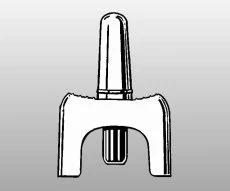
How to use the nasal spray
- Remove the nasal spray from the blister pack (blister) only immediately before use.
- Adopt a comfortable position, preferably sitting down.
- If you feel your nose is blocked or you have a cold**, blow your nose.**
- Hold the nasal spray gently with your fingers and thumb as shown in Figure A.
Do not press the blue plunger yet.

- Block one nostril by firmly pressing a finger against one side of your nose. It does not matter which nostril you choose.
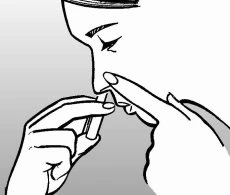
- Insert the nasal spray applicator into the other nostril, as far as comfortable – about 1 cm or half an inch (Figure B).
Breathe out gently through your mouth.
Keep your head upright and your mouth closed.
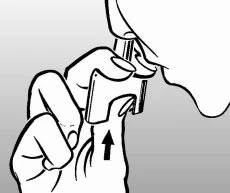
- Begin to inhale gently through your nose.
While inhaling:
Firmly press the blue plunger with your thumb.
The plunger may feel slightly stiff and you may hear a click. Continue to inhale while pressing (Figure C).
- Remove the nasal spray and take your finger off the side of your nose.
Keep your head upright for 10–20 seconds, breathing in gently through your nose and breathing out through your mouth. This helps the medicine stay in your nose.
You may notice your nose feels moist inside and detect a slight characteristic taste after using the nasal spray – this is normal and will pass quickly.
- Your nasal spray is now empty. Dispose of it safely and hygienically.
Detailed and up-to-date information on this medicine is available on the website of the Spanish Agency for Medicines and Health Products (AEMPS): http://www.aemps.gob.es/