Iluvien 190 micrograms intravitreal implant in applicator
Spain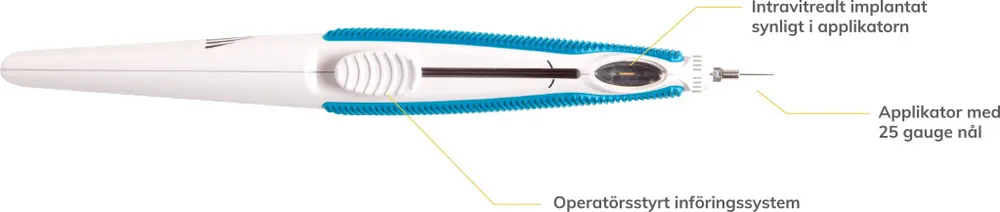
Table of Contents
Package leaflet: Information for the user
Introduction
Package leaflet: information for the user
ILUVIEN 190 micrograms intravitreal implant in applicator
Fluocinolone acetonide
Read all of this leaflet carefully before you are given this medicine because it contains important information for you.
- Keep this leaflet. You may need to read it again.
- If you have any questions, ask your doctor.
- If you experience any side effects, talk to your doctor, even if it is not listed in this leaflet. See section 4.
Contents of the leaflet
- What ILUVIEN is and what it is used for
- What you need to know before you are given ILUVIEN
- How ILUVIEN is administered
- Possible side effects
- How to store ILUVIEN
- Contents of the pack and other information
1. What Iluvien is and what it is used for
Iluvien is a small tube inserted into the eye that releases very small amounts of the active substance, fluocinolone acetonide, for up to 3 years. Fluocinolone acetonide belongs to a group of medicines called corticosteroids.
Iluvien is used to treat vision loss associated with diabetic macular edema when other available treatments have failed. Diabetic macular edema is a condition affecting some people with diabetes, causing damage to the light-sensitive layer at the back of the eye responsible for central vision, known as the macula. The active substance (the drug fluocinolone acetonide) helps reduce inflammation and swelling developing in the macula. As a result, Iluvien may improve damaged vision or prevent it from worsening.
Iluvien is used to prevent recurrences of inflammation in the back of the eye. This inflammation may cause floaters, which are black spots or lines scattered across the field of vision, or may lead to vision loss by damaging the part of the eye responsible for clear vision, called the "macula." Vision loss may not improve unless the inflammation is treated. Iluvien helps reduce inflammation and swelling in the back of the eye. It may improve damaged vision or prevent it from getting worse. It may stop future episodes of inflammation.
2. What you need to know before Iluvien is administered to you
Do not receive Iluvien:
- If you are allergic to fluocinolone acetonide or to any of the other ingredients of this medicine (listed in section 6).
- If you have any type of infection in the eye or in the area surrounding the eye.
- If you have glaucoma (high pressure inside the eye).
Warnings and precautions
- Before receiving an injection of Iluvien, inform your doctor if:
- You are taking anticoagulants.
- You have previously had a herpes simplex infection (an eye ulcer with prolonged duration).
- Iluvien is administered as an injection into the eye. Occasionally, the injection may cause an infection inside the eye, eye pain or redness, or a retinal detachment or tear. It is important to identify and treat these conditions as soon as possible. Contact your doctor immediately if you experience increasing eye pain or discomfort, worsening eye redness, flashing lights, a sudden increase in floaters, partially blocked vision, blurred vision or loss of vision, increased sensitivity to light, or other visual disturbances after the injection.
- In some patients, intraocular pressure may increase, with a possible development of glaucoma. This may not be noticeable to you; therefore, your doctor should monitor it during your clinic visits.
- In most patients who have not yet undergone cataract surgery, clouding of the eye's natural lens (a cataract) may occur after treatment with Iluvien. If this happens, your vision will decrease and you may likely require surgery to remove the cataract. Your doctor will help you decide the most appropriate time for this surgery, but you should be aware that until you are ready for surgery, your vision may be as poor or worse than it was before receiving the Iluvien injection.
- The injection of Iluvien into both eyes simultaneously has not been studied and is therefore not recommended. Your doctor should not administer Iluvien into both eyes at the same time.
- There is a possibility that the Iluvien implant may move from the back to the front of the eye. The risk of this is higher if you have previously undergone cataract surgery. Signs that the implant may have moved to the front of the eye could include distorted vision or other visual disturbances, inflammation of the eye surface (corneal inflammation), or you may notice a change in the appearance of the front of your eye. Inform your doctor immediately if you notice anything unusual that makes you suspect the implant has moved.
- In patients with inflammation of the back of the eye, intraocular pressure may decrease, but this usually lasts only a few days after the injection. This may not be noticeable to you; therefore, your doctor should monitor it between 2 and 8 days after the injection and during subsequent clinic visits.
Children and adolescents (under 18 years of age)
Iluvien has not been studied in children and adolescents. Therefore, its use in this population is not recommended.
Interaction of Iluvien with other medicines
Inform your doctor if you are using, have recently used, or might need to use any other medicines, including those obtained without a prescription.
Pregnancy, breastfeeding, and fertility
- Experience with the use of Iluvien in pregnant or breastfeeding women is limited; therefore, potential risks are unknown.
- Data on fertility are not available. However, since Iluvien is administered directly into the eye, effects on male or female fertility are unlikely.
- If you are pregnant or breastfeeding, think you may be pregnant, or plan to become pregnant, consult your doctor before treatment with Iluvien.
Driving and use of machines
After treatment with Iluvien, you may temporarily experience some degree of blurred vision. If this occurs, do not drive or operate machinery until this symptom resolves.
3. How ILUVIEN is administered
The Iluvien injection will be administered by your ophthalmologist.
Iluvien is given as a single injection into the eye. Afterwards, your doctor will regularly monitor your vision.
Before the injection, your doctor will use antibiotic eye drops and carefully clean your eye to prevent infections. Your doctor will also apply a local anesthetic to prevent any pain that the injection might cause.
Your doctor may ask you to use antibiotic eye drops before and after the injection to prevent any possible eye infection. Follow these instructions carefully.
If the effect of the implant wears off and your doctor recommends it, another implant may be injected into the eye. This only applies if you are receiving Iluvien for the treatment of diabetic macular edema.
If you have any further questions about the use of this medicine, ask your doctor.
4. Possible adverse effects
Like all medicines, Iluvien may cause adverse effects, although not everyone experiences them.
Some adverse effects may occur with the administration of Iluvien, mainly affecting the eye. Occasionally, the injection may cause an infection inside the eye, eye pain or redness, or retinal detachment or tear. It is important to identify and treat these conditions as soon as possible. Inform your doctor immediately if you experience increasing eye pain or discomfort, worsening eye redness, flashing lights, a sudden increase in floaters, partially blocked vision, decreased vision, or increased sensitivity to light after the injection. Other adverse effects may include an increase or decrease in intraocular pressure or a veil or clouding in the eye's natural lens. An increase in intraocular pressure that damages the optic nerve (glaucoma) may be more likely if your intraocular pressure was above average before treatment. Your doctor will discuss the risks of this with you before treatment. Section 2 of this leaflet (Warnings and precautions) describes the symptoms you may experience and what you should do if you experience them.
The following adverse effects may be observed with Iluvien:
Very common (may affect more than 1 in 10 people)
Increased intraocular pressure, clouding or veil in the natural lens of the eye (cataract), or eye surgery to correct cataract.
Common (may affect up to 1 in 10 people)
Increased intraocular pressure damaging the optic nerve (glaucoma), detachment of the light-sensitive layer at the back of the eye (retinal detachment), bleeding in the white part of the eye or inside the eye, small particles or spots in vision (floaters), sensation of seeing through steam or fog, decreased eye pressure causing sudden pain and blurred vision, loss of normal visual field, eye pain or irritation, reduced vision, or eye surgery or procedure to relieve increased intraocular pressure or to remove the gel-like material filling the back of the eye, increased proteins and cells in the front of the eye due to inflammation, sensation of a foreign body in the eye, dry eye.
Uncommon (may affect up to 1 in 100 people)
Blockage of blood vessels at the back of the eye, growth of new blood vessels inside the eye, ulcer in the white part of the eye, changes in the gel-like material filling the back of the eye, a veil in the sac holding the eye's lens, eye redness, itching or infection in the eye, thinning of the eye's outer white layer, eye trauma due to the injection procedure, unintended movement of the implant through the white part of the eye and/or other injection-related complications, movement of the Iluvien implant from the back to the front of the eye, inflammation of the eye surface (corneal inflammation), involuntary eyelid twitching, eye pain and discomfort with sudden episodes of intense pain associated with blurred vision, deposits on the outer layer of the eye, painful eye caused by a scratch on the eye surface, eye swelling.
The most frequently reported non-visual adverse effect, considered possibly caused by the drug or the injection procedure, is headache.
Reporting of adverse effects
If you experience any adverse effect, consult your doctor, pharmacist, or nurse, even if it is a possible adverse effect not listed in this leaflet. You may also report them directly via the Spanish Pharmacovigilance System for Human Medicines: https://www.notificaram.es. By reporting adverse effects, you can help provide more information on the safety of this medicine.
5. Storage of ILUVIEN
- Keep this medicine out of the sight and reach of children.
- Do not use this medicine after the expiry date which is stated on the carton and the inner packaging after EXP.
- Store below 30°C.
- Do not refrigerate or freeze.
- Do not open the pouch containing the applicator until immediately before administration.
- Medicines should not be disposed of via wastewater or household waste. Ask your pharmacist how to dispose of medicines and packaging that you no longer need. This will help protect the environment.
Dispose of the applicator safely in a biohazard sharps container.
6. Contents of the pack and other information
Composition of Iluvien
- The active substance is fluocinolone acetonide.
- Each intravitreal implant contains 190 micrograms of fluocinolone acetonide.
- The other component is polyvinyl alcohol.
- The implant is a small polyimide tube, sealed at one end with silicone adhesive and at the other end with polyvinyl alcohol.
Appearance of the product and contents of the pack
Iluvien consists of a small light brown tube (approximately 3.5 mm x 0.37 mm), which is preloaded into an applicator system. The preloaded applicator is placed in a polycarbonate container and sealed with a removable cap. Each sealed container is supplied in a box that includes the package leaflet.
Marketing Authorization Holder and Manufacturer
Marketing Authorization Holder:
Alimera Sciences Europe Limited
77 Sir John Rogerson’s Quay
Dublin 2
Ireland
Manufacturer:
Millmount Healthcare Limited
Block-7, City North Business Campus
Stamullen
Co. Meath
K32 YD60
Ireland
Further information about this medicinal product can be requested from the local representative of the Marketing Authorization Holder:
BRILL PHARMA, S.L.
C/ Munner, 8,
08022 Barcelona (Spain)
93 417 09 11
This medicinal product is authorized in the following European Economic Area member states under the trade name “Iluvien”:
Germany, Austria, Belgium, Denmark, Spain, Finland, France, Ireland, Italy, Luxembourg, Norway, Netherlands, Poland, Portugal, Sweden, United Kingdom, and the Czech Republic.
Date of the most recent review of this leaflet: 07/2023
Detailed and up-to-date information on this medicinal product is available on the website of the Spanish Agency of Medicines and Health Products (AEMPS) http://www.aemps.gob.es/
This information is intended for healthcare professionals only:
THERAPEUTIC INDICATIONS
Iluvien is indicated for the treatment of:
- Visual impairment associated with chronic diabetic macular edema when response to available therapies is considered insufficient.
- Prevention of recurrence of non-infectious recurrent uveitis affecting the posterior segment of the eye.
CONTRAINDICATIONS
The intravitreal implant with Iluvien is contraindicated in the presence of pre-existing glaucoma or active or suspected ocular or periocular infection, including most viral diseases of the cornea and conjunctiva, such as epithelial keratitis due to herpes simplex (dendritic keratitis), vaccinia, varicella, mycobacterial infections, and fungal infections.
Iluvien is contraindicated in patients with:
- Hypersensitivity to the active substance or to any of the excipients
- Infectious uveitis
DOSAGE AND ADMINISTRATION
FOR INTRAOCULAR USE ONLY.
Treatment with Iluvien is for intravitreal use only and must be administered by an ophthalmologist experienced in the administration of intravitreal injections.
The intravitreal injection procedure must be performed under controlled aseptic conditions, including the use of sterile gloves, a sterile drape, and a sterile eyelid speculum (or equivalent). Prior to injection, appropriate anesthesia and a broad-spectrum microbicide should be administered.
The procedure for Iluvien injection is as follows:
- An antibiotic in drop form may be administered prior to the procedure, at the discretion of the treating ophthalmologist.
- Immediately before injection, administer one drop of topical anesthetic at the injection site (inferotemporal quadrant is recommended), followed either by a cotton-tipped applicator soaked in anesthetic or by subconjunctival administration of an appropriate anesthetic.
- Administer 2–3 drops of an appropriate topical antiseptic into the inferior fornix. The eyelids may be swabbed with a cotton-tipped applicator soaked in the appropriate antiseptic. Insert a sterile eyelid speculum. Ask the patient to look upward and place a cotton-tipped applicator soaked in the appropriate antiseptic at the injection site. Allow the topical antiseptic to dry for 30–60 seconds before injecting Iluvien.
- The exterior of the container holding the applicator should not be considered sterile. A non-sterile assistant should remove the container from the box and inspect the container and cap for damage. If damaged, do not use the unit. If acceptable, the assistant should remove the cap without touching the inner surface.
- Visually inspect through the viewing window of the preloaded applicator to confirm the presence of a pharmaceutical implant inside.
- Remove the applicator from the container using sterile gloves, touching only the applicator and sterile surfaces.
The needle protective cap must not be removed until Iluvien is ready for injection.
Prior to injection, the tip of the applicator must be kept above the horizontal plane to ensure proper positioning of the implant within the applicator.
- To minimize the amount of air administered with the implant, the administration procedure involves two steps. Before inserting the needle into the eye, press the button down and slide it forward to the first stop (at the curved black marks along the button track). At the first stop, release the button, which should then move back to the UP position. If the button does not return to the UP position, do not proceed with this unit.
- The ideal location for the implant is inferior to the optic disc and posterior to the equator of the eye. Measure 4 mm inferotemporally from the limbus using a caliper.
- Carefully remove the needle protective cap and inspect the tip to ensure it is not bent.
- Gently displace the conjunctiva so that, upon needle withdrawal, the conjunctival and scleral entry sites do not align. Precautions should be taken to avoid contact between the needle and the eyelid margin or eyelashes. Insert the needle into the eye. To release the implant, with the button in the UP position, advance the button by sliding it forward to the end of its travel, then withdraw the needle. Note: Ensure the button reaches the end of its travel before withdrawing the needle.
- Remove the eyelid speculum and perform indirect ophthalmoscopy to verify implant location, adequate perfusion of the central retinal artery, and absence of other complications.
Scleral depression may improve visualization of the implant. The examination should include assessment of optic nerve head perfusion immediately after injection. At the ophthalmologist’s discretion, immediate measurement of intraocular pressure (IOP) may be performed.
After the procedure, patients should be monitored for potential complications such as endophthalmitis, increased intraocular pressure, retinal detachment, vitreous hemorrhage or detachment, and ocular hypotony (observed up to 8 days after treatment). Biomicroscopy with tonometry should be performed within 2 to 7 days following implant injection.
Subsequently, patients should be monitored at least quarterly to detect potential complications, due to the prolonged duration of fluocinolone acetonide release, approximately 36 months.