Ideos 500 mg/2,000 IU chewable tablets
Spain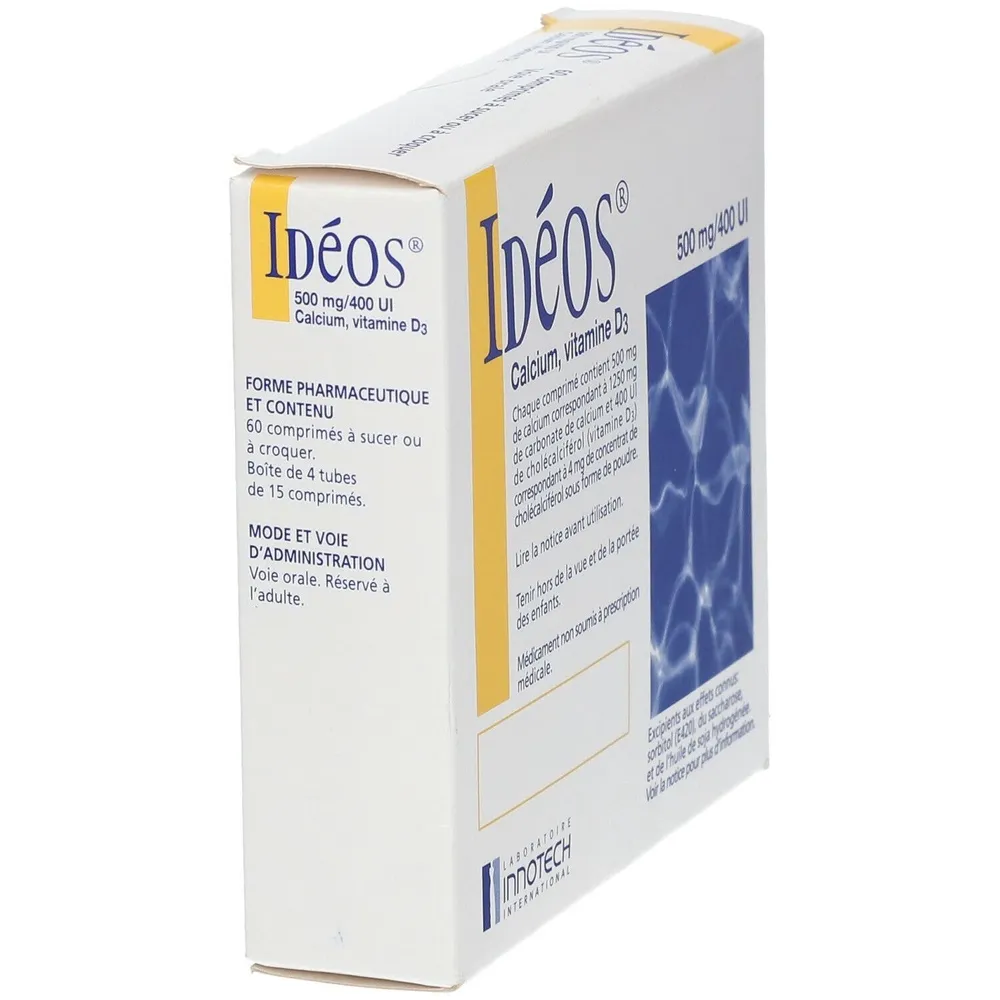
Table of Contents
- Package leaflet: Information for the user
- Introduction
- 1. What Ideos is and what it is used for
- 2. What you need to know before taking Ideos
- 3. How to take Ideos
- 4. Possible adverse effects
- 5. Storage of Ideos
- 6. Contents of the pack and other information
- **Marketing Authorization Holder and Manufacturing Responsible Party:**
Package leaflet: Information for the user
Introduction
Package leaflet: information for the user
Ideos 500 mg/2,000 IU chewable tablets
calcium/colecalciferol (vitamin D3)
Read all of this leaflet carefully before you start taking this medicine because it contains important information for you.
- Keep this leaflet. You may need to read it again.
- If you have any further questions, ask your doctor or pharmacist.
- This medicine has been prescribed for you only and must not be given to other people, even if they have the same symptoms as you, because it may harm them.
- If you experience any adverse effects, consult your doctor or pharmacist, even if they are effects not listed in this leaflet. See section 4.
Contents of the leaflet
- What Ideos is and what it is used for
- What you need to know before taking Ideos
- How to take Ideos
- Possible side effects
- How to store Ideos
- Contents of the pack and other information
1. What Ideos is and what it is used for
Ideos is a calcium and vitamin D3 supplement.
It is used
- to treat calcium and vitamin D deficiency in adults.
2. What you need to know before taking Ideos
Do not take Ideos
- if you are allergic to calcium, colecalciferol (vitamin D3), or any of the other ingredients of this medicine (listed in section 6).
- if you have high levels of calcium in your blood (hypercalcemia).
- if you have high levels of calcium in your urine (hypercalciuria).
- if you have overactive parathyroid glands (hyperparathyroidism).
- if you have bone marrow cancer (myeloma).
- if you have cancer that has spread to your bones (bone metastases).
- if you have restricted limb movement (prolonged immobilization) accompanied by hypercalcemia and/or hypercalciuria.
- if you have kidney stones (nephrolithiasis).
- if you have calcium deposits in the kidneys (nephrocalcinosis).
- if you have excessive intake of vitamin D (hypervitaminosis D).
- if you have severe kidney problems.
Warnings and precautions
Talk to your doctor or pharmacist before taking this medicine:
- if you are on long-term treatment, especially if you are also taking diuretics (used to treat high blood pressure or edema) or cardiac glycosides (used to treat heart disorders).
- if you have any kidney disease.
- if you have sarcoidosis (an immune system disorder that may increase vitamin D levels in the body).
- if you have osteoporosis and are simultaneously unable to move.
- if you are taking other products containing vitamin D. Additional doses of calcium and vitamin D should be taken under close medical supervision.
Children and adolescents
This medicine is not intended for use in children and adolescents.
Other medicines and Ideos
Inform your doctor or pharmacist if you are taking, have recently taken, or might need to take any other medicines.
-
Other medicines that may interact with or be affected by this medicine include:
-
thiazide diuretics (used to treat high blood pressure or edema)
-
cardiac glycosides (used to treat heart disorders)
-
HIV inhibitors (e.g., raltegravir, dolutegravir, elvitegravir).
-
If you are also taking tetracyclines (a type of antibiotic), you should take them at least two hours before or four to six hours after taking this medicine. Calcium carbonate may interfere with the absorption of tetracycline preparations if taken at the same time.
-
Medicines containing bisphosphonates (used to treat osteoporosis) should be taken at least three hours before taking this medicine.
-
Orlistat (used to treat obesity), cholestyramine (a product used to reduce high cholesterol levels), or laxatives such as liquid paraffin may alter absorption and thereby reduce the effect of fat-soluble vitamins, e.g., vitamin D3.
-
Phenytoin (a medicine used to treat epilepsy) or barbiturates (hypnotics) may reduce the effect of vitamin D.
-
Glucocorticoids (e.g., cortisone) may reduce the effect of vitamin D and lower blood calcium levels.
-
Calcium may reduce the effect of levothyroxine (used to treat thyroid deficiency). Therefore, levothyroxine should be taken at least four hours before or four hours after this medicine.
-
The effect of quinolone antibiotics may be reduced if taken at the same time as calcium. Take quinolone antibiotics two hours before or six hours after taking this medicine.
-
Calcium salts may reduce the absorption of iron, zinc, and strontium ranelate. Therefore, iron, zinc, or strontium ranelate preparations should be taken at least two hours before or after this medicine.
-
Additional supplementation with calcium and vitamin D should only be administered under medical supervision and will require frequent monitoring of calcium levels in blood and urine.
If you are taking any of the medicines listed above, your doctor will provide further instructions.
Taking Ideos with food, drinks, and alcohol
You may take this medicine at any time, with or without food.
Pregnancy, breastfeeding, and fertility
If you are pregnant or breastfeeding, think you may be pregnant, or are planning to become pregnant, consult your doctor or pharmacist before using this medicine.
Use of this medicine during pregnancy is not recommended in patients who do not have calcium and vitamin D deficiency. When vitamin D deficiency is present, the recommended dose depends on national guidelines; however, the maximum daily dose should not exceed 2,500 mg of calcium and 4,000 IU of vitamin D per day.
Prolonged overdose of calcium and vitamin D during pregnancy should be avoided, as this may lead to high calcium levels in the blood and may have a negative effect on the fetus.
This medicine may be used during breastfeeding. Since calcium and vitamin D pass into breast milk, consult your doctor first if your child is receiving other products containing vitamin D. This should be taken into account when administering additional vitamin D to the child.
Alternatively, treatment may be switched to other medicines containing calcium and vitamin D3 with a lower concentration of vitamin D3.
Driving and using machines
This medicine has no influence on your ability to drive or operate machinery.
This medicine contains
- 0.5 mg of aspartame (E951), a source of phenylalanine. It may be harmful if you have phenylketonuria (PKU), a rare genetic disorder in which phenylalanine accumulates because the body cannot properly eliminate it.
- 38.5 mg of sorbitol (E420), 185 mg of isomalt (E953), and 3.85 mg of sucrose. If your doctor has diagnosed you with an intolerance to certain sugars, consult your doctor before taking this medicine. It may harm the teeth.
- This medicine contains less than 1 mmol of sodium (23 mg) per chewable tablet; i.e., essentially “sodium-free”.
- This medicine contains traces of benzyl alcohol. Benzyl alcohol may cause allergic reactions.
3. How to take Ideos
Follow exactly the instructions for using this medicine as given by your doctor or pharmacist. If in doubt, consult your doctor or pharmacist again.
The recommended dose is 1 chewable tablet per day, providing 500 mg of calcium and 2,000 IU (International Units) of vitamin D3. Your doctor will determine the dosage individually for you.
The tablet must be chewed before swallowing. It can be taken at any time of day, with or without food.
You should pay attention to maintaining an adequate daily intake of calcium through your diet (e.g. dairy products, vegetables, mineral water).
Use in children and adolescents
This medicine is not intended for use in children and adolescents.
If you take more Ideos than you should
An overdose of this medicine may cause symptoms such as discomfort (nausea), vomiting, excessive thirst, excessive drowsiness, increased urine production, depletion of body fluids, or constipation. If you suspect an overdose, contact your doctor or pharmacist immediately.
In case of overdose or accidental ingestion, consult your doctor or pharmacist immediately or call the Toxicology Information Service at telephone number: 91 562 04 20, indicating the medicine and the amount ingested.
If you forget to take Ideos
If you forget to take this medicine, take it as soon as you remember. However, do not take a double dose to make up for the missed tablets.
If you stop taking Ideos
If you wish to discontinue or prematurely stop treatment, consult your doctor.
If you have any further questions about the use of this medicine, ask your doctor or pharmacist.
4. Possible adverse effects
Like all medicines, this medicine can cause adverse effects, although not everybody will experience them.
Stop taking Ideos and contact a doctor immediately if you experience the following allergic reaction (frequency unknown because it cannot be estimated from the available data):
- swelling of the face, lips, tongue or throat with sudden difficulty breathing and severe skin rash.
Other reported adverse effects are:
Uncommon: may affect up to 1 in 100 people
- elevated levels of calcium in blood (hypercalcemia) or urine (hypercalciuria).
Rare: may affect up to 1 in 1,000 people
- malaise (nausea), diarrhea, abdominal pain, constipation, flatulence, bloating (abdominal distension).
- rash, itching, hives.
Reporting of adverse effects
If you experience any adverse effect, consult your doctor or pharmacist, even if it is a possible adverse effect not listed in this leaflet. You can also report them directly through the Spanish Pharmacovigilance System for Human Medicines: https://www.notificaram.es. By reporting adverse effects, you can help provide more information on the safety of this medicine.
5. Storage of Ideos
Keep this medicine out of the sight and reach of children.
Do not use this medicine after the expiry date stated on the carton and on the laminated aluminum strips after “EXP”. The expiry date refers to the last day of the month indicated.
This medicine does not require any special storage temperature. Keep the container tightly closed to protect it from moisture.
Medicines must not be disposed of via wastewater or household waste. Dispose of unused medicines and empty containers at the SIGRE collection point at your pharmacy. Ask your pharmacist how to properly dispose of containers and medicines you no longer need. This will help protect the environment.
6. Contents of the pack and other information
Composition of Ideos
- The active substances are calcium and colecalciferol. Each chewable tablet contains 500 mg of calcium (as calcium carbonate) and 50 micrograms of colecalciferol (vitamin D3, equivalent to 2,000 IU) as concentrated colecalciferol (in powder form).
- The other components (excipients) are: isomalt (E953), xylitol, sorbitol (E420), citric acid, monobasic sodium citrate, sodium carmellose, magnesium stearate, Orange flavour “CPB”, Orange flavour “CVT”, colloidal anhydrous silica, aspartame, potassium acesulfame, sodium ascorbate, all-rac-alpha-tocopherol, modified maize starch, sucrose, medium-chain triglycerides, colloidal hydrated silica, mannitol, benzyl alcohol and propylene glycol.
Appearance of the product and contents of the pack
The chewable tablets are round, white, 18 mm in diameter.
Available in polypropylene tubes with a polyethylene cap containing a desiccant, or in laminated aluminium foil blisters. Break the strip to open.
Pack sizes:
Tubes: 30, 60 (2x30) and 90 (3x30) chewable tablets.
Blisters: 30 (5x6), 60 (10x6), 90 (15x6) chewable tablets.
Only certain pack sizes may be marketed.
Marketing Authorization Holder and Manufacturing Responsible Party:
Marketing Authorization Holder
Theramex Ireland Limited
3rd Floor, Kilmore House,
Park Lane, Spencer Dock,
Dublin 1
D01 YE64
Ireland
Manufacturing Responsible Party
HERMES PHARMA GmbH
Hans-Urmiller-Ring 52
82515 Wolfratshausen
Germany
Further information on this medicinal product is available upon request from the local representative of the Marketing Authorization Holder:
Theramex Healthcare Spain, S.L.
Calle Martínez Villergas 52, Edificio C, planta 2ª izquierda
28027 Madrid
Spain
This medicinal product is authorized in the European Economic Area member states under the following names:
Belgium: Calcium/Vitamine D3 Theramex 500 mg/2000 UI comprimés à croquer
Calcium/Vitamine D3 Theramex 500 mg/2000 IE Kautabletten
Calcium/Vitamine D3 Theramex 500 mg/2000 IE Kauwtabletten
Spain: Ideos 500 mg/2,000 IU chewable tablets
Portugal: Cacit 500 mg / 2000 UI chewable tablets
Sweden: Calcium/Cholecalciferol Theramex
Date of most recent review of this leaflet: 23 February 2024
Detailed information on this medicinal product is available on the website of the Spanish Agency for Medicines and Health Products (AEMPS): http://www.aemps.gob.es/