Idefirix 11 mg powder for concentrate for solution for infusion
Spain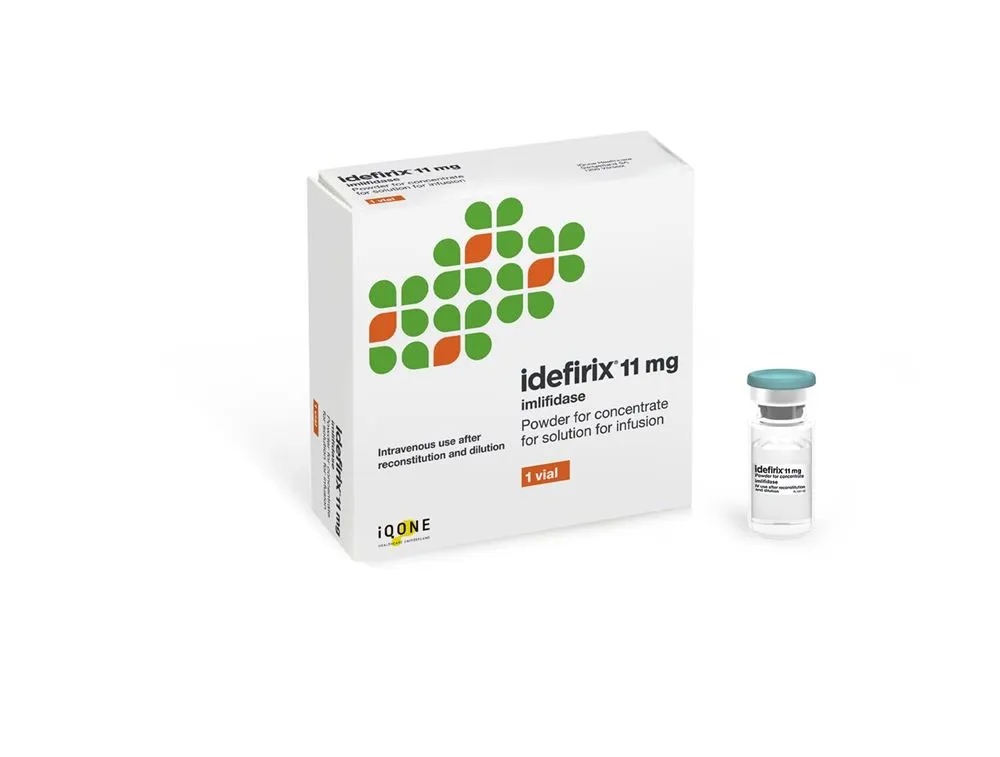
Table of Contents
Package leaflet: Information for the user
Introduction
Package leaflet: information for the user
Idefirix 11 mg powder for concentrate for solution for infusion
imlifidase
This medicinal product is subject to additional monitoring, which will allow for rapid detection of new safety information. You can help by reporting any side effects you may experience. Information on how to report side effects is provided at the end of section 4.
Read all of this leaflet carefully before you start using this medicine, because it contains important information for you.
- Keep this leaflet, as you may need to read it again.
- If you have any questions, consult your doctor.
- If you experience any side effects, consult your doctor, even if they are side effects not listed in this leaflet. See section 4.
Contents of the leaflet
- What Idefirix is and what it is used for
- What you need to know before using Idefirix
- How to use Idefirix
- Possible side effects
- How to store Idefirix
- Contents of the pack and other information
1. What Idefirix is and what it is used for
Idefirix contains the active substance imlifidase, which belongs to a group of medicines called immunosuppressants. It is administered before kidney transplantation to prevent the immune system (the body's defenses) from rejecting the donated kidney.
Idefirix breaks down a type of antibody in the body, immunoglobulin G (IgG), which plays a role in destroying "foreign" or harmful substances.
Imlifidase is a protein derived from a bacterium called Streptococcus pyogenes.
2. What you need to know before using Idefirix
Do not use Idefirix
- If you are allergic to imlifidase or any of the other components of this medicine (listed in section 6).
- If you have a severe infection.
- If you have a blood disorder called thrombotic thrombocytopenic purpura (TTP), which causes blood clots to form in small blood vessels throughout the body.
Warnings and precautions
Infusion reactions
Idefirix contains a protein and may cause allergic reactions in some people. You will be given medications to reduce the risk of an allergic reaction. If you experience any symptoms of an allergic reaction, such as acute rash, difficulty breathing, flushing, or redness, during the infusion (drip), the infusion may need to be slowed down or stopped. Once these symptoms have disappeared or improved, the infusion may be continued.
Infections
IgG is important for protecting you against infections, and since Idefirix breaks down IgG, you will receive antibiotics to reduce the risk of infections.
Antibody-mediated rejection (AMR)
Your body will produce new IgG antibodies that may attack the transplanted kidney. Your doctor will monitor you closely, and you will receive medications to reduce the risk of rejection.
Children and adolescents
Do not administer this medicine to children and adolescents under 18 years of age, as the use of this medicine has not been studied in this age group.
Other medicines and Idefirix
Tell your doctor if you are taking, have recently taken, or might need to take any other medicines. Idefirix may affect the way some medicines work, and their doses may need to be adjusted.
Idefirix breaks down IgG, so medicines based on IgG may not work if administered at the same time as Idefirix. This includes the following medicines:
- basiliximab (used to prevent kidney transplant rejection);
- rituximab (used to treat cancers such as non-Hodgkin's lymphoma and chronic lymphocytic leukemia, and inflammatory diseases such as rheumatoid arthritis);
- alemtuzumab (used to treat a form of multiple sclerosis);
- adalimumab (used to treat inflammatory diseases such as rheumatoid arthritis, ankylosing spondylitis, psoriasis, Crohn's disease, and ulcerative colitis);
- denosumab (used to treat osteoporosis);
- belatacept (used to prevent kidney transplant rejection);
- etanercept (used to treat inflammatory diseases such as rheumatoid arthritis, psoriatic arthritis, ankylosing spondylitis, and psoriasis);
- rabbit antithymocyte globulin (rATG) (used to prevent kidney transplant rejection);
- intravenous immunoglobulin (IVIG) (used to increase abnormally low immunoglobulin levels in the blood or to treat inflammatory diseases such as Guillain-Barré syndrome, Kawasaki disease, and chronic inflammatory demyelinating polyneuropathy).
Pregnancy and breastfeeding
Use of Idefirix during pregnancy is not recommended. Consult your doctor if you think you may be pregnant.
It is unknown whether Idefirix is excreted in breast milk. You must not breastfeed if you are receiving treatment with Idefirix.
Idefirix contains sodium and polysorbate 80
This medicine contains less than 23 mg of sodium (1 mmol) per dose; this is essentially "sodium-free".
This medicine contains 0.5 mg of polysorbate 80 per ml. Polysorbates may cause allergic reactions. Inform your doctor if you have any known allergies.
3. How to use Idefirix
Idefirix will be prescribed by a physician experienced in kidney transplantation and is intended for use in a hospital setting. The medicine will be administered by intravenous infusion over approximately 15 minutes.
A healthcare professional will calculate the appropriate dose for you based on your body weight. Idefirix is usually given as a single dose, but your doctor may decide to administer a second dose before transplantation.
Information for healthcare professionals on dose calculation, preparation, and infusion of Idefirix is provided at the end of this leaflet.
If you use more Idefirix than you should
You will be closely monitored during and after the infusion. Healthcare professionals will check for adverse reactions.
4. Possible adverse effects
Like all medicines, this medicine can cause adverse effects, although not everyone experiences them.
Tell your doctor immediately if you experience any of the following adverse effects:
- Signs of infection, such as fever, chills, cough, weakness, or general malaise (very common: may affect more than 1 in 10 people).
- Signs of infusion reaction, such as acute rash, difficulty breathing, hot flushes, redness of the skin (common: may affect up to 1 in 10 people).
- Muscle pain or fatigue (symptoms of myalgia) (common: may affect up to 1 in 10 people).
Other adverse effects are:
Common (may affect up to 1 in 10 people):
- Infections: lung infection (pneumonia), blood infections (septicemia), abdominal infection, upper respiratory tract infection, adenovirus infection, parvovirus infection, urinary tract infection, influenza, wound infection, postoperative wound infection, catheter site infection.
- Transplant rejection (IgG antibodies will attempt to reject the donor kidney, and you may feel general malaise).
- Low or high blood pressure (symptoms of low blood pressure may include dizziness; symptoms of high blood pressure may include headache).
- Low red blood cell count (anemia).
- Dizziness upon changing position, for example, when standing up.
- Headache.
- Rupture of a blood vessel in the eye.
- Decreased vision.
- Increased heart rate.
- Pain at the infusion site.
- Increased liver enzymes (observed in blood tests).
Reporting of adverse effects
If you experience any adverse effect, consult your doctor, even if it is a possible adverse effect not listed in this leaflet. You may also report them directly through the national reporting system included in Appendix V. By reporting adverse effects, you can help provide more information on the safety of this medicine.
5. Storage of Idefirix
Keep this medicine out of the sight and reach of children. Idefirix is stored in the hospital pharmacy.
Do not use this medicine after the expiry date which is stated on the label of the vial and on the carton after EXP. The expiry date refers to the last day of the month indicated.
Store in a refrigerator (between 2 °C and 8 °C). Do not freeze. Keep in the original packaging to protect from light.
Chemical and physical in-use stability after reconstitution and dilution has been demonstrated for 24 hours at 2–8 °C, including up to 4 hours at 25 °C within this 24-hour period.
Do not use this medicine if particles or discoloration are observed after reconstitution.
Medicines should not be disposed of via wastewater. Ask your pharmacist how to dispose of medicines and packaging that you no longer need. This helps protect the environment.
6. Contents of the pack and other information
Composition of Idefirix
- The active substance is imlifidase. Each vial contains 11 mg of imlifidase. After reconstitution, each ml of concentrate contains 10 mg of imlifidase.
- The other components are mannitol, polysorbate 80, tromethamine, edetate disodium dihydrate, and hydrochloric acid (to adjust pH). See section 2, "Idefirix contains sodium and polysorbate 80".
Presentation of the product and contents of the pack
-
Idefirix is supplied in a glass vial containing a lyophilized powder for concentrate for solution for infusion (powder for concentrate). The powder is presented as a white, disc-shaped cake.
-
The pack contains 1 or 2 vials. Only certain pack sizes may be marketed.
Marketing Authorization Holder
Hansa Biopharma AB
P.O. Box 785
220 07 Lund
Sweden
Manufacturer
Biotechnologines farmacijos centras Biotechpharma UAB
Mokslininku g. 4
LT-08412 Vilnius
Lithuania
Propharma Group The Netherlands B.V.
Schipholweg 59
2316 ZL, Leiden
The Netherlands
Date of the most recent review of this leaflet:
This medicine has been authorised under a "conditional approval". This type of approval means that further information on this medicine is expected.
The European Medicines Agency will review new information on this medicine at least once a year, and this leaflet will be updated as necessary.
Other sources of information
Detailed information on this medicine is available on the European Medicines Agency website: https://www.ema.europa.eu
This information is intended for healthcare professionals only:
Reconstitution of the powder
Add 1.2 ml of sterile water for injection to the Idefirix vial, taking care to direct the stream of water toward the glass wall and not directly onto the powder.
Gently swirl the vial in a circular motion for at least 30 seconds to completely dissolve the powder. Do not shake, to minimize the risk of foam formation. The vial will now contain imlifidase 10 mg/ml, and up to 1.1 ml of solution may be withdrawn.
The reconstituted solution should be clear to slightly opalescent and colourless or slightly yellow. Do not use if particulate matter or discoloration is observed. It is recommended to transfer the reconstituted solution from the vial to the infusion bag immediately.
Preparation of the infusion solution
Slowly add the appropriate amount of reconstituted imlifidase solution to an infusion bag containing 50 ml of sodium chloride 9 mg/ml (0.9%) solution for infusion. Invert the infusion bag several times to ensure adequate mixing. The infusion bag must be protected from light at all times.
Before use, visually inspect the infusion solution for particulate matter or discoloration. Discard the solution if particulates or discoloration are observed.
Administration
The fully diluted infusion must be administered over 15 minutes using an infusion set with a low protein-binding, non-pyrogenic, sterile in-line filter (pore size 0.2 μm). At the end of the infusion, flush the intravenous line with sodium chloride 9 mg/ml (0.9%) solution for infusion to ensure the patient receives the complete dose. Do not store unused infusion solution for later use.