Idarubicin Sandoz 1 mg/ml concentrate for solution for infusion
Spain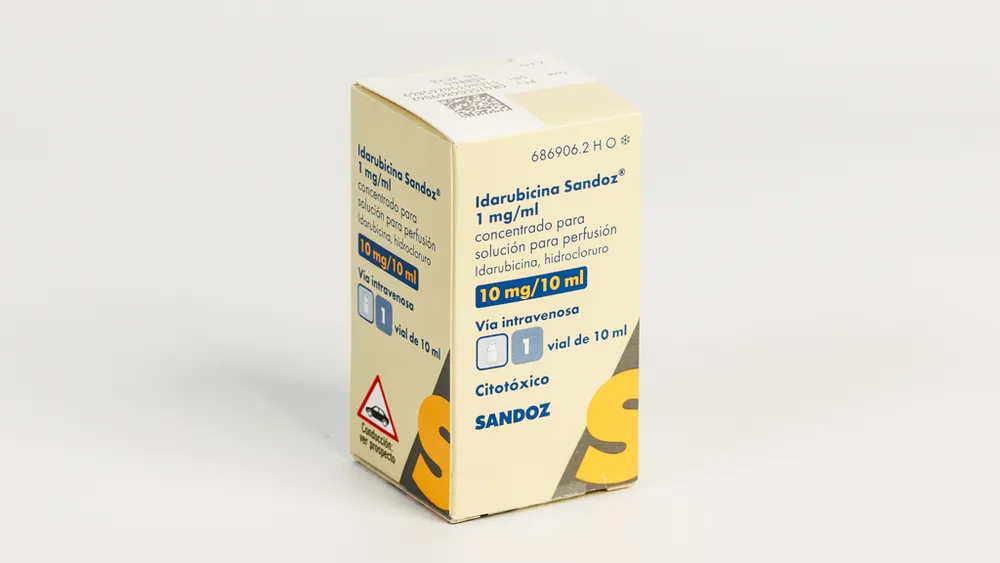
Table of Contents
- Package leaflet: Information for the user
- Introduction
- 1. What Idarubicina Sandoz is and what it is used for
- 2. What you need to know before using Idarubicina Sandoz
- 3. How to use Idarubicina Sandoz
- 4. Possible adverse effects
- 5. Storage of Idarubicina Sandoz
- 6. Contents of the container and other information
Package leaflet: Information for the user
Introduction
Package leaflet: information for the user
Idarubicin Sandoz 1 mg/ml concentrate for solution for infusion
Idarubicin, hydrochloride
Read all of this leaflet carefully before you start using this medicine because it contains important information for you.
- Keep this leaflet. You may need to read it again.
- If you have any questions, ask your doctor, pharmacist or nurse.
- If you get any side effects, talk to your doctor, pharmacist or nurse. This includes any side effects not listed in this leaflet. See section 4.
Contents of this leaflet
- What Idarubicin Sandoz is and what it is used for
- What you need to know before using Idarubicin Sandoz
- How to use Idarubicin Sandoz
- Possible side effects
- How to store Idarubicin Sandoz
- Contents of the pack and other information
1. What Idarubicina Sandoz is and what it is used for
Idarubicina Sandoz contains an active substance called idarubicin, which belongs to a group of medicines known as anthracyclines. Idarubicin interferes with the way cells in the body grow and multiply, and is used in the treatment of certain cancers (chemotherapy).
Idarubicin is used in the treatment of different types of leukemia (cancer of the white blood cells).
Idarubicin, in combination with cytarabine, is used for the induction of remission as first-line therapy in children with previously untreated acute myeloid leukemia (AML).
2. What you need to know before using Idarubicina Sandoz
Do not use Idarubicina Sandoz if:
- you have had an allergic reaction (hypersensitivity) to idarubicin or to any of the other components of this medicine (listed in section 6), or to other anthracyclines or anthracenediones,
- your liver or kidneys are not functioning properly,
- you have uncontrolled infections,
- you have serious heart muscle problems (cardiomyopathy),
- you have acute inflammatory heart disease,
- you suffer from severe heart disease,
- you have severe abnormal arrhythmias,
- you have recently had a heart attack,
- your bone marrow is not producing enough blood cells (however, in this case your doctor will decide whether to start treatment if the benefit to you outweighs the risk),
- you have previously received treatment with maximum doses of idarubicin and/or other similar anticancer medicines such as daunorubicin or doxorubicin,
- you have a tendency to bleed,
- you suffer from mouth inflammation,
- you are breastfeeding (see “Pregnancy, breastfeeding and fertility”),
- you have recently been vaccinated against yellow fever.
Warnings and precautions
Talk to your doctor, pharmacist, or nurse before using idarubicin if:
-
you suffer from bone marrow suppression caused by prior treatment. Idarubicin can affect your bone marrow and reduce the production of blood cells. Your doctor may wish to delay your next treatment cycle until your blood counts have recovered. Regular blood tests will be needed to monitor this.
-
you have had heart problems in the past or are currently being treated for them; please ensure your doctor is aware of this. Idarubicin can cause heart damage. Your heart function will be monitored through various tests before and during treatment (ECG, MUGA scan [a special imaging technique showing the heart's chambers], or ECHO [echocardiography]). Heart damage from idarubicin is particularly associated with high doses and may not become apparent for several weeks, so regular monitoring is required during this period.
-
you have kidney or liver problems. Your kidney and liver function may be affected by idarubicin. To monitor these changes, blood tests should be performed before and periodically during treatment. It is important not to miss these blood tests.
Regular blood tests, and assessments of liver, kidney, and heart function should be carried out before starting and during treatment with idarubicin. Infants and children appear to be more sensitive to anthracycline-induced cardiotoxicity; therefore, periodic and long-term monitoring is necessary in these patients.
Your doctor will perform regular checks such as:
- blood tests to ensure sufficient blood cells are present for normal blood function,
- blood tests to monitor uric acid levels,
- blood tests to check whether the kidneys and liver are functioning properly,
- heart tests, as idarubicin can affect the heart.
Based on the results of these tests, your doctor will decide whether idarubicin is unsuitable for your treatment or whether a reduced dose is needed.
High doses of idarubicin may worsen adverse effects such as mouth sores or may reduce the number of blood cells and platelets (the latter help blood to clot). If this occurs, you may require antibiotics or blood transfusions. Mouth ulcers can be managed and healed to reduce discomfort.
You must not receive vaccination with live vaccines (e.g., yellow fever), as serious, potentially life-threatening infections may occur. Please consult your doctor if you intend to be vaccinated.
If you have an infection, it should be controlled before starting treatment.
Idarubicin may harm the unborn fetus. Both women and men must use adequate contraception during treatment with idarubicin (see “Pregnancy, breastfeeding and fertility”).
Your urine may appear red for 1 or 2 days after treatment with idarubicin. Please consult your doctor if you have any concerns or questions about the color of your urine.
Please also consult your doctor if you are receiving radiotherapy at the same time or have received it 2 or 3 weeks before starting treatment.
Other medicines and Idarubicina Sandoz
Inform your doctor or pharmacist if you are currently using, have recently used, or might need to use any other medicines, including those obtained without a prescription.
In particular, inform your doctor or pharmacist if you are currently using or have recently used any of the following medicines:
- anticancer medicines that affect bone marrow function,
- medicines that affect kidney and/or liver function,
- medicines that may damage the heart (e.g., cyclophosphamide),
- medicines for pre-existing heart conditions (calcium channel blockers),
- any vaccines received in the past few months,
- immunosuppressants (such as cyclosporine or tacrolimus),
- medicines to prevent blood clotting (e.g., fenprocoumon or acenocoumarol).
Pregnancy, breastfeeding and fertility
You must not be treated with idarubicin unless clearly instructed by your doctor. Inform your doctor if you are pregnant or breastfeeding, think you may be pregnant, or plan to become pregnant. Your doctor will need to consider the potential risks to you or your baby.
Avoid becoming pregnant while you or your partner are being treated with idarubicin. If you are sexually active, you must use effective contraception to prevent pregnancy. Idarubicin may harm the unborn fetus, so it is important to inform your doctor if you think you may be pregnant.
Contraception in women of childbearing potential
You must always use an effective method of contraception while receiving idarubicin and for at least 6.5 months after the last dose. Discuss suitable contraceptive methods with your doctor.
Contraception in men
Men must always use effective contraception while receiving idarubicin and for at least 3.5 months after the last dose.
If you wish to have children after completing treatment, please consult your doctor for advice on available fertility preservation techniques.
Treatment with idarubicin may cause irreversible infertility in men. Talk to your doctor about sperm preservation options if you plan to father children in the future.
You must not breastfeed during treatment with idarubicin, as some of the medicine may pass into breast milk and could potentially harm your baby.
Consult your doctor or pharmacist before starting any medicine.
Driving and using machines
No studies have been conducted on the effects of idarubicin on the ability to drive or operate machinery.
Please consult your doctor before driving or operating machinery.
3. How to use Idarubicina Sandoz
Idarubicin will be administered to you by intravenous infusion (intravenous drip):
- Your doctor will prescribe the required amount (dose). The dose is determined based on your general health condition, weight, and height.
- Depending on your weight and height, your doctor will calculate your body surface area. This is necessary because the dose is usually calculated as "milligrams per square meter" (mg/m²), administered for 3 consecutive days.
- However, your doctor must adjust the dose according to your general condition and any other treatments you are receiving.
AML
- If the child is receiving idarubicin hydrochloride in addition to another antileukemic medication (cytarabine), the recommended dose is in the range of 10–12 mg/m², administered slowly into a vein once daily for 3 consecutive days. This is repeated every 3 weeks.
4. Possible adverse effects
Like all medicines, Idarubicin Sandoz may cause adverse effects, although not everyone experiences them.
Consult your doctor or nurse immediately:
- if you feel a stinging or burning sensation at the site where the medicine enters the vein during administration of idarubicin. This may mean that the remainder of the dose should be administered into another vein,
- if you have chills (flu-like symptoms) or skin rashes, as you may be allergic to one of your medicines,
- if you develop a sore throat or fever after treatment, or any bleeding or bruising, which may be due to the medicine reducing the number of blood cells.
Adverse effects that may occur with the following frequencies:
Very common adverse effects (may affect more than 1 in 10 patients)
- infections,
- decrease in the number of the following blood cells:
- reduction in red blood cells (anaemia), which may make you feel tired and weak,
- reduction in white blood cells (leucopenia or neutropenia), increasing the risk of infections, fever, or chills (flu-like symptoms).
Severe infections may occur after treatment with idarubicin alone or in combination, and may be life-threatening,
-
reduction in platelets (thrombocytopenia), which may cause you to bruise more easily or bleed more than usual if injured,
-
reduced numbers of all types of blood cells (pancytopenia),
-
loss of appetite (anorexia),
- feeling of dizziness (nausea), discomfort (vomiting), or diarrhoea,
-
mouth pain or ulcers (stomatitis), which may not appear until 3–10 days after treatment,
-
inflammation of the mucous membranes (mucositis),
-
abdominal pain,
-
burning sensation,
-
you may lose all or part of your hair, which usually grows back after treatment ends,
-
stinging or burning sensation at the injection site (local toxicity),
-
reddish discoloration of the urine, which may appear for several days after treatment. This is quite normal and should not be a cause for concern,
-
fever and chills,
-
headache.
Common adverse effects (may affect up to 1 in 10 patients)
- the heart does not have enough strength to pump blood adequately (congestive heart failure),
- damage to the heart muscle (cardiomyopathy), characterized by shortness of breath, lung swelling, shifting body swelling, heart and liver enlargement, reduced urine output, fluid retention in the abdomen, fluid accumulation near the lungs, abnormal heartbeat (gallop rhythm),
- heart tissue damage and irregularities (heartbeat too slow or too fast, rhythm changes, ineffective heart function),
- local inflammation of the veins where the infusion is administered (phlebitis),
- inflammation of the veins due to a blood clot (thrombophlebitis) or bleeding from various sites (haemorrhage),
- bleeding in the stomach or intestine,
- itching,
- skin previously damaged by radiotherapy may become highly sensitive,
- increased liver enzymes and bilirubin (blood values),
- skin rash,
- stomach pain.
Uncommon adverse effects (may affect up to 1 in 100 patients)
- blood poisoning (sepsis, septicaemia),
- blood cancer after completion of treatment (secondary leukaemia),
- complications that may occur after cancer treatment ends, caused by breakdown products from dying cancer cells (tumour lysis syndrome),
- high levels of uric acid in the blood (which may cause gout),
- loss of water (dehydration),
- changes in the electrocardiogram (ECG),
- heart attack (myocardial infarction),
- shock,
- inflammation of the oesophagus and intestine (may be severe and lead to perforation),
- change in the colour of nails and skin,
- itching,
- severe tissue damage (cellulitis and necrosis).
Rare adverse effects (may affect up to 1 in 1,000 patients)
- bleeding in the brain,
Very rare adverse effects (may affect up to 1 in 10,000 patients)
- severe allergic reactions (anaphylaxis), symptoms including fainting, skin rash or hives, itching, swelling of the lips and face, difficulty breathing, loss of consciousness,
- inflammation of the sac surrounding the heart (pericarditis),
- inflammation of the heart muscle (myocarditis),
- defects in the heart's electrical conduction system,
- blockage of blood vessels due to a blood clot in the circulatory system (thromboembolic events), including possible blockage of the pulmonary veins (pulmonary embolism),
- skin redness (flushing),
- stomach ulcers,
- numbness, swelling, and painful redness of the palms of the hands and soles of the feet.
Adverse effects of unknown frequency – frequency cannot be estimated from available data.
- local reaction at the site of administration.
Reporting of adverse effects
If you experience any adverse effect, talk to your doctor or pharmacist, even if it is a possible adverse effect not listed in this leaflet. You can also report them directly via the Spanish Pharmacovigilance System for Human Medicines: https://www.notificaram.es.
By reporting adverse effects, you can help provide more information on the safety of this medicine.
5. Storage of Idarubicina Sandoz
Keep this medicine out of the sight and reach of children.
Do not use this medicine after the expiry date stated on the container after EXP/CAD. The expiry date refers to the last day of the month indicated.
Store in a refrigerator (between 2 °C and 8 °C).
Keep the vial in its original outer packaging to protect it from light.
The diluted solution is chemically stable when stored for up to 14 days at 2 °C–8 °C and at room temperature (20 °C–25 °C); however, in accordance with good pharmaceutical practices, it is recommended that the solution should not be stored for longer than 24 hours at 2 °C–8 °C.
This medicine contains no preservatives. Therefore, if aseptic preparation cannot be guaranteed, the medicine should be prepared immediately before use, and any unused portion should be discarded.
Disposal of unused medicine and of all materials that have come into contact with it must be carried out in accordance with local regulations for cytotoxic agents.
6. Contents of the container and other information
Composition of Idarubicin Sandoz
- The active substance is idarubicin hydrochloride. Each ml of concentrate for solution for infusion contains 1 mg of idarubicin hydrochloride.
Each 5 ml vial contains 5 mg of idarubicin hydrochloride.
Each 10 ml vial contains 10 mg of idarubicin hydrochloride.
Each 20 ml vial contains 20 mg of idarubicin hydrochloride.
- The other components are glycerol, diluted hydrochloric acid (for pH adjustment), sodium hydroxide (for pH adjustment), water for injections.
Presentation of the product and contents of the container
This medicine is presented as a concentrate for solution for infusion.
Red to orange transparent solution, free from particles.
Colorless type I glass vial with a halobutyl rubber stopper coated with fluoropolymer, with or without a plastic protective cover (Onco-safe or Sleeving). The vials are sealed with an aluminium cap. “Onco-Safe” and Sleeving do not come into contact with the medicine and provide additional protection during transport, enhancing safety for medical and pharmaceutical personnel.
Pack sizes: 1x5mg/5ml, 5x5mg/5ml, 10x5mg/5ml, 1x10mg/10ml, 5x10mg/10ml, 10x10mg/10ml, 1x20mg/20ml, 5x20mg/20ml, 10x20mg/20ml.
Only certain pack sizes may be marketed.
Marketing Authorization Holder and Manufacturer
Marketing Authorization Holder
Sandoz Farmacéutica, S.A.
Centro Empresarial Parque Norte
Edificio Roble
C/ Serrano Galvache, 56
28033 Madrid
Spain
Manufacturer
Ebewe Pharma Ges.m.b.H. Nfg. KG
Mondseestraße 11
4866 Unterach
Austria
or
Fareva Unterach GmbH
Mondseestraße 11
4866 Unterach
Austria
Date of latest revision of this leaflet: 02/2024.
Detailed information on this medicine is available on the website of the Spanish Agency of Medicines and Health Products (AEMPS): http://www.aemps.gob.es/
This information is intended for healthcare professionals only:
Special precautions for disposal and handling
Due to the toxic nature of the compound, the following protective measures should be observed:
- Personnel handling this medicine must be trained in safe handling techniques for such preparations.
- Pregnant women must not handle this medicine.
- Personnel handling idarubicin must wear protective clothing (e.g., protective goggles, gowns, disposable gloves, and masks).
- All handling must be performed in a safety cabinet or isolated environment.
- The work surface should be protected with disposable, absorbent, laminated paper.
- All materials used for reconstitution, administration, or cleaning, including gloves, must be placed in high-risk waste material bags and destroyed by high-temperature incineration.
- Any spillage or leakage should be treated with diluted sodium hypochlorite solution (1% available chlorine), preferably by soaking, followed by rinsing with water. Discoloration indicates loss of cytostatic potential.
- All cleaning materials must be disposed of as described above.
- In case of accidental contact with skin or eyes, immediately wash thoroughly with abundant water or soap and water, or with a sodium bicarbonate solution.
- Discard any unused solution.
- Idarubicin Sandoz is for single use only.
- Only clear, transparent solutions should be used.
- Prior to administration, the solution should be brought to room temperature.
- Idarubicin should not be prepared more than 24 hours before administration.
- Take into account the risk of bacterial contamination due to handling.
i. Intravenous administration
Idarubicin Sandoz must be administered only by intravenous route.
The infusion can be prepared by diluting Idarubicin Sandoz with 0.9% sodium chloride or 5% glucose.
Alternatively, the required undiluted volume of product may be administered slowly through an intravenous infusion system over 5 to 10 minutes, or via free intravenous infusion with 0.9% sodium chloride or 5% glucose.
Direct injection is not recommended due to the risk of extravasation, which may occur even with adequate blood return upon needle aspiration.
ii. Disposal
Disposal of unused medicine and all materials used for reconstitution, dilution, and administration must be carried out in accordance with hospital regulations for cytotoxic agents and current legislation on hazardous waste disposal.
Incompatibilities
This medicine must not be mixed with other medicinal products except with 0.9% sodium chloride or 5% glucose.
Dosage and method of administration
For intravenous use only.
Must not be used by intrathecal route.
Dosage is normally calculated based on body surface area.
Dosage
Acute Myeloid Leukemia (AML)
Adults
- 12 mg/m² daily by intravenous infusion for 3 days in combination with cytarabine,
or
- 8 mg/m² daily by intravenous infusion for 5 days, with or without combination.
Paediatric population
In children with AML, the recommended dose of idarubicin hydrochloride in combination with cytarabine is 10–12 mg/m² body surface area daily for 3 days via slow intravenous injection.
NOTE: These are general guidelines. Refer to individual protocols for exact dosing.
The maximum total dose must not exceed 120 mg/m² of body surface area.
Acute Lymphoblastic Leukemia (ALL)
Adults
The recommended dose in adults is 12 mg/m² daily by intravenous infusion for 3 days within appropriate combination regimens.
Paediatric population
10 mg/m² daily by intravenous infusion for 3 days, within appropriate combination regimens.
However, these dosage regimens should take into account the patient's hematological status and the doses of other cytotoxic agents when used in combination.
Administration of a second dose should be delayed in patients who develop severe mucositis until recovery from this toxicity, and a 25% dose reduction is recommended.
The maximum total dose must not exceed 120 mg/m² of body surface area.
Patients with hepatic and/or renal impairment
Dose adjustment may be required in patients with renal or hepatic impairment.
Shelf life
2 years.
Chemical and physical stability in use has been demonstrated for 14 days at 2°C–8°C and at 25°C.
From a microbiological standpoint, the medicine should be used immediately.
If not used immediately, the storage time and conditions prior to use are the responsibility of the user and should normally not exceed 24 hours at 2°C–8°C, unless dilution takes place under controlled, validated aseptic conditions.
Special storage precautions
Store in a refrigerator (between 2°C–8°C).
Keep in the original packaging to protect from light.