Iclusig 45 mg film-coated tablets
Spain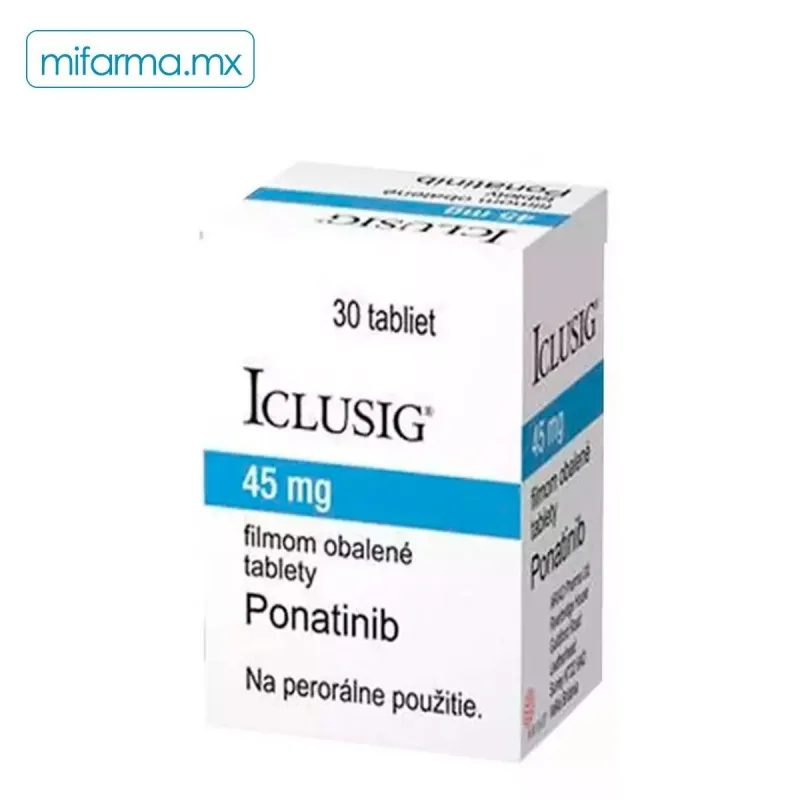
Table of Contents
Package leaflet: Information for the user
Introduction
Package leaflet: information for the patient
Iclusig 15 mg film-coated tablets
Iclusig 30 mg film-coated tablets
Iclusig 45 mg film-coated tablets
ponatinib
Read the entire leaflet carefully before you start taking this medicine, because it contains important information for you.
- Keep this leaflet as you may need to read it again.
- If you have any questions, ask your doctor or pharmacist.
- This medicine has been prescribed for you only, and you should not give it to other people, even if they have the same symptoms as you, because it may harm them.
- If you experience any adverse effects, talk to your doctor or pharmacist, even if they are adverse effects not listed in this leaflet. See section 4.
Leaflet contents
- What Iclusig is and what it is used for
- What you need to know before taking Iclusig
- How to take Iclusig
- Possible side effects
- How to store Iclusig
- Contents of the pack and other information
1. What Iclusig is and what it is used for
Iclusig is used to treat adults with the following types of leukemia who no longer benefit from treatment with other medicines or who have a specific genetic mutation known as T315I:
-
Chronic myeloid leukemia (CML): a blood cancer associated with the presence of too many abnormal white blood cells in the blood and bone marrow (where blood cells are formed).
-
Philadelphia chromosome-positive acute lymphoblastic leukemia (Ph+ ALL): a type of leukemia associated with the presence of too many immature white blood cells in the blood and blood-forming bone marrow. In this type of leukemia, part of the DNA (genetic material) has been rearranged, forming an abnormal chromosome called the Philadelphia chromosome.
Iclusig belongs to a group of medicines called tyrosine kinase inhibitors. In patients with CML and Ph+ ALL, changes in DNA activate a signal that instructs the body to produce abnormal white blood cells. Iclusig blocks this signal and thereby stops the production of these cells.
2. What you need to know before taking Iclusig
Do not take Iclusig
- if you are allergic to ponatinib or to any of the other ingredients of this medicine (listed in section 6).
Warnings and precautions
Talk to your doctor or pharmacist before taking Iclusig if:
- you have liver or pancreatic disease or kidney dysfunction. Your doctor may need to take extra precautions
- you have a history of alcoholism
- you have previously had a heart attack or stroke
- you have had blood clots in blood vessels
- you have had renal artery stenosis (narrowing of the blood vessels in one or both kidneys)
- you have heart problems, such as heart failure, irregular heartbeat, or QT interval prolongation
- you have high blood pressure
- you have or have had an aneurysm (a bulge and weakening of a blood vessel wall) or a tear in the wall of a blood vessel
- you have a history of bleeding disorders
- you have had or may currently have a hepatitis B virus infection. This is because Iclusig could cause hepatitis B to become active again, which can be fatal in some cases. Your doctor must carefully check for signs of this infection before starting treatment.
Your doctor will perform:
- assessments of heart function and the condition of your arteries and veins
- a complete blood count
These will be repeated every two weeks during the first three months after starting treatment. Afterwards, they will be performed once a month or as directed by your doctor.
- Tests to measure a blood protein called lipase
A blood protein known as lipase will be measured every two weeks during the first two months and then periodically thereafter. If lipase levels increase, treatment may need to be interrupted or the dose reduced.
- Liver function tests
Liver function tests will be performed periodically as directed by your doctor.
A brain disorder called reversible posterior leukoencephalopathy syndrome (RPLS) has been reported in patients treated with ponatinib. Symptoms may include sudden onset of severe headache, confusion, seizures, and vision changes. You must contact your doctor immediately if you experience any of these symptoms during treatment with ponatinib, as they could be serious.
Children and adolescents
Do not give this medicine to children under 18 years of age, as there is no data available in the pediatric population.
Other medicines and Iclusig
Tell your doctor or pharmacist if you are taking, have recently taken, or might need to take any other medicines.
The following medicines may interact with Iclusig or be affected by it:
- ketoconazole, itraconazole, voriconazole: medicines used to treat fungal infections
- indinavir, nelfinavir, ritonavir, saquinavir: medicines used to treat HIV infection
- clarithromycin, telithromycin, troleandomycin: medicines used to treat bacterial infections
- nefazodone: a medicine used to treat depression
- St. John's wort: a herbal medicine used to treat depression
- carbamazepine: a medicine used to treat epilepsy, manic and depressive states, and certain painful conditions
- phenobarbital, phenytoin: medicines used to treat epilepsy
- rifabutin, rifampicin: medicines used to treat tuberculosis or other infections
- digoxin: a medicine used to treat heart failure
- dabigatran: a medicine used to prevent blood clots
- colchicine: a medicine used to treat gout attacks
- pravastatin, rosuvastatin: medicines used to lower high cholesterol levels
- methotrexate: a medicine used to treat severe joint inflammation (rheumatoid arthritis), cancer, and psoriasis, a skin disease
- sulfasalazine: a medicine used to treat severe rheumatic and intestinal joint inflammation
Taking Iclusig with food and drink
Avoid grapefruit products, such as grapefruit juice.
Pregnancy and breastfeeding
If you are pregnant or breastfeeding, think you may be pregnant, or plan to become pregnant, consult your doctor or pharmacist before using this medicine.
- Contraception in men and women
Women of childbearing potential who are treated with Iclusig must not become pregnant. It is recommended that men treated with Iclusig do not father a child during treatment. Effective contraception must be used during treatment.
Use Iclusig during pregnancy only if your doctor tells you it is absolutely necessary, as there is a risk to the fetus.
- Breastfeeding
Breastfeeding must be discontinued during treatment with Iclusig. It is unknown whether Iclusig passes into breast milk.
Driving and using machines
You should exercise caution when driving or operating machinery because patients taking Iclusig may experience visual disturbances, dizziness, somnolence, and fatigue.
Iclusig contains lactose
If your doctor has informed you that you have an intolerance to certain sugars, consult with him before taking this medicine.
3. How to take Iclusig
Follow exactly the instructions for using this medicine as given by your doctor or pharmacist. If you are unsure, consult your doctor or pharmacist again.
Treatment with Iclusig must be prescribed by a physician experienced in the treatment of leukemia.
Iclusig is available as:
- a 45 mg film-coated tablet for the recommended dose
- a 15 mg film-coated tablet and a 30 mg film-coated tablet to allow dose adjustments
The recommended initial dose is one 45 mg film-coated tablet once daily.
Your doctor may reduce your dose or instruct you to temporarily interrupt Iclusig if:
-
an adequate response to treatment is achieved
-
the number of certain white blood cells called neutrophils decreases
-
the number of platelets decreases
-
a serious adverse reaction not affecting the blood occurs:
-
inflammation of the pancreas
-
increased concentrations of the serum proteins lipase and amylase
-
you develop heart or blood vessel problems
-
you have a liver disease
Iclusig may be restarted at the same or a lower dose once the event has resolved or is under control.
Your doctor may assess your response to treatment at regular intervals.
Method of administration
Swallow the tablets whole with a glass of water. The tablets may be taken with or without food. Do not crush or dissolve the tablets.
Do not swallow the container with the desiccant contained in the bottle.
Duration of treatment
Take Iclusig daily for the prescribed period. This is a long-term treatment.
If you take more Iclusig than you should
Contact your doctor immediately.
If you forget to take Iclusig
Do not take a double dose to make up for missed doses. Take the next dose at the usual time.
If you stop taking Iclusig
Do not stop taking Iclusig without the approval of your doctor.
If you have any further questions about the use of this medicine, ask your doctor or pharmacist.
4. Possible adverse effects
Like all medicines, this medicine can cause adverse effects, although not everyone gets them.
Patients aged 65 years or older are more likely to be affected by adverse effects.
Seek immediate medical attention if you experience any of the following serious adverse effects.
If abnormal results occur in blood tests, you must contact a doctor immediately.
Serious adverse effects (may affect up to 1 in 10 people):
-
- lung infection (may cause difficulty breathing)
-
inflammation of the pancreas. Inform your doctor immediately if you develop pancreatitis. Symptoms include severe pain in the stomach and back area.
-
fever, often with other signs of infection due to a decrease in white blood cell count
-
heart attack (symptoms include: sensation of increased heart rate, chest pain, difficulty breathing)
-
changes in blood concentrations:
-
decrease in red blood cell count (symptoms include: weakness, dizziness, and fatigue)
-
decrease in blood platelet count (symptoms include: increased tendency to bleed or bruise)
-
decrease in a type of white blood cell called neutrophils (symptoms include: increased tendency to develop infections)
-
increase in blood concentration of a serum protein called lipase
-
irregular heart rhythm, pulse abnormalities
-
heart failure (symptoms include: weakness, fatigue, and swelling of the legs)
-
pressure causing discomfort, fullness, tightness, or pain in the center of the chest (angina pectoris), and non-cardiac chest pain
-
high blood pressure
-
narrowing of cerebral arteries, stroke caused by reduced blood flow in part of the brain
-
problems with blood vessels of the heart
-
blood infection
-
swelling or red areas on the skin that feel warm and tender (cellulitis)
-
dehydration
-
difficulty breathing
-
fluid in the chest (may cause breathing difficulties)
-
diarrhea
-
formation of a blood clot in a deep vein, sudden venous blockage, or blood clot in a blood vessel of the lung (symptoms include: flushing, hot flush, facial redness, and difficulty breathing)
-
stroke (symptoms include: difficulty speaking or moving, drowsiness, headaches, and abnormal sensations)
-
problems with blood circulation (symptoms include: pain in arms or legs, and cold hands and feet)
-
blood clot in major arteries carrying blood to the head or neck (carotid artery)
-
constipation
-
reduction of sodium in the blood
-
increased tendency to bleed or bruise
Other possible adverse effects that may occur with the following frequencies are:
Very common adverse effects (may affect more than 1 in 10 people):
-
upper respiratory tract infection (may cause difficulty breathing)
-
decreased appetite
-
insomnia
-
headache, dizziness
-
cough
-
diarrhea, vomiting, nausea, constipation, abdominal pain
-
increased blood concentrations of several liver enzymes called:
-
alanine aminotransferase
-
aspartate aminotransferase
-
skin rash, dry skin, pruritus
-
pain in bones, joints, muscles, back, arms, or legs; muscle spasms
-
fatigue, fluid accumulation in arms and/or legs, fever, pain
-
elevated blood triglyceride levels
-
increased cholesterol detected in blood tests
Common adverse effects (may affect up to 1 in 10 people):
-
inflammation of hair follicles, swelling, red areas on the skin or under the skin that feel warm and tender
-
reduced activity of the thyroid gland
-
fluid retention
-
low levels of calcium, phosphate, or potassium in the blood
-
increased levels of sugar or uric acid in the blood
-
weight loss
-
transient ischaemic attack
-
nerve disorder in arms or legs (often causes numbness and pain in hands and feet)
-
nerve disorder in the face (often causes numbness or weakness on one or both sides of the face)
-
drowsiness, migraines
-
muscle weakness, musculoskeletal stiffness
-
increased or decreased sense of touch or sensitivity, abnormal sensations such as prickling, tingling, or itching
-
blurred vision, dry eyes, eye infection, visual disturbance, eye pain
-
swelling of eyelid tissue or around the eyes due to excess fluid
-
palpitations
-
pain in one or both legs when walking or exercising, which disappears after resting for a few minutes
-
hot flushes, flushing
-
nosebleeds, difficulty producing voice sounds, pulmonary hypertension
-
increased blood concentrations of liver and pancreatic enzymes:
-
amylase
-
alkaline phosphatase
-
gamma-glutamyl transferase
-
increased blood levels of C-reactive protein, which rises when there is inflammation in the body
-
heartburn caused by reflux of gastric juices, peptic ulcer
-
mouth inflammation, sore throat or mouth, dry mouth, gum bleeding
-
discomfort, indigestion, or abdominal bloating
-
stomach bleeding (symptoms include: stomach pain, vomiting blood)
-
increased blood concentration of bilirubin, the yellow breakdown product of blood pigment (symptoms include: dark urine)
-
bone or neck pain
-
pain caused by inflammation of the membrane surrounding tendons, usually in feet or hands
-
skin peeling, abnormal thickening of the skin, redness, bruising, skin pain, changes in skin color, flat discolored spots, small raised bumps on the skin, warts, acne-like skin disorders, symmetrically raised red areas on the skin that may appear all over the body, hair loss
-
facial swelling due to fluid accumulation
-
night sweats, increased sweating
-
erectile dysfunction (inability to achieve or maintain an erection)
-
chills, pseudoinfluenza illness
-
herpes zoster
-
overactive thyroid gland that accelerates the body's metabolism. This can cause various symptoms such as weight loss, hand tremors, and irregular or rapid heartbeats
-
weight gain
-
anxiety
-
heart problems, pain in the left side of the chest, dysfunction of the left heart chamber, changes in heart rhythm, rapid heartbeats, increase in a blood protein called brain natriuretic peptide, which may rise when the heart does not pump properly
-
narrowing of blood vessels, poor blood circulation, sudden increase in blood pressure
-
blockage of blood vessels in the eye
-
painful red lumps, skin pain, skin redness (inflammation of fatty tissue under the skin)
-
metabolic disorders caused by breakdown products of cancer cells during their destruction
Uncommon adverse effects (may affect up to 1 in 100 people):
- renal artery stenosis (narrowing of blood vessels in one or both kidneys)
- circulatory problems in the spleen
- liver damage, jaundice (symptoms include: yellowing of the skin and eyes)
- headache, confusion, seizures, and vision loss, which may be symptoms related to a brain disorder known as posterior reversible encephalopathy syndrome (PRES).
Frequency not known (cannot be estimated from available data):
-
- recurrence (reactivation) of hepatitis B virus infection if you have previously had hepatitis B (a liver infection)
- severe skin rashes with blistering or peeling that spread over the body, along with a feeling of tiredness. Inform your doctor immediately if you experience these symptoms.
- enlargement and weakening of the wall of a blood vessel or tearing of the blood vessel wall (arterial aneurysms and dissections).
Reporting of adverse effects
If you experience any adverse effect, talk to your doctor or pharmacist, even if it is a possible adverse effect not listed in this leaflet. You can also report them directly through the national reporting system included in Appendix V. By reporting adverse effects, you can help provide more information on the safety of this medicine.
5. Storage of Iclusig
Keep this medicine out of the sight and reach of children.
Do not use this medicine after the expiry date stated on the outer packaging and on the label of the vial after EXP. The expiry date refers to the last day of the month indicated.
Store in the original container to protect it from light.
The vial contains a plastic container with a molecular sieve desiccant. Keep the container inside the vial. Do not swallow the container with the desiccant.
Medicines must not be disposed of via wastewater or household waste. Ask your pharmacist how to dispose of medicines and packaging that you no longer need. This will help protect the environment.
6. Contents of the pack and other information
Composition of Iclusig
- The active substance is ponatinib.
Each 15 mg film-coated tablet contains 15 mg of ponatinib (as ponatinib hydrochloride).
Each 30 mg film-coated tablet contains 30 mg of ponatinib (as ponatinib hydrochloride).
Each 45 mg film-coated tablet contains 45 mg of ponatinib (as ponatinib hydrochloride).
- The other components are lactose monohydrate, microcrystalline cellulose, sodium starch glycolate, silicon dioxide (anhydrous colloidal), magnesium stearate, talc, macrogol 4000, polyvinyl alcohol and titanium dioxide (E171). See section 2 “Iclusig contains lactose”.
Appearance of Iclusig and contents of the pack
Iclusig film-coated tablets are white, round and biconvex on both upper and lower sides.
Iclusig 15 mg film-coated tablets are approximately 6 mm in diameter and have "A5" marked on one side.
Iclusig 30 mg film-coated tablets are approximately 8 mm in diameter and have "C7" marked on one side.
Iclusig 45 mg film-coated tablets are approximately 9 mm in diameter and have "AP4" marked on one side.
Iclusig is available in plastic bottles, each containing a molecular sieve desiccant. The bottles are packaged in a cardboard box.
Iclusig 15 mg bottles contain 30, 60 or 180 film-coated tablets.
Iclusig 30 mg bottles contain 30 film-coated tablets.
Iclusig 45 mg bottles contain 30 or 90 film-coated tablets.
Only certain pack sizes may be marketed.
Marketing Authorization Holder
Incyte Biosciences Distribution B.V.
Paasheuvelweg 25
1105 BP Amsterdam
The Netherlands
Manufacturer
Incyte Biosciences Distribution B.V.
Paasheuvelweg 25
1105 BP Amsterdam
The Netherlands
Tjoapack Netherlands B.V.
Nieuwe Donk 9
Etten-Leur, 4879 AC
The Netherlands
Date of the most recent revision of this leaflet: {MM/YYYY}.
Detailed information on this medicine is available on the European Medicines Agency website: http://www.ema.europa.eu.
There are also links to other websites on rare diseases and orphan medicinal products.
This leaflet is available on the European Medicines Agency website in all languages of the European Union/European Economic Area.