Ibuprofen Teva 400 mg soft capsules
Spain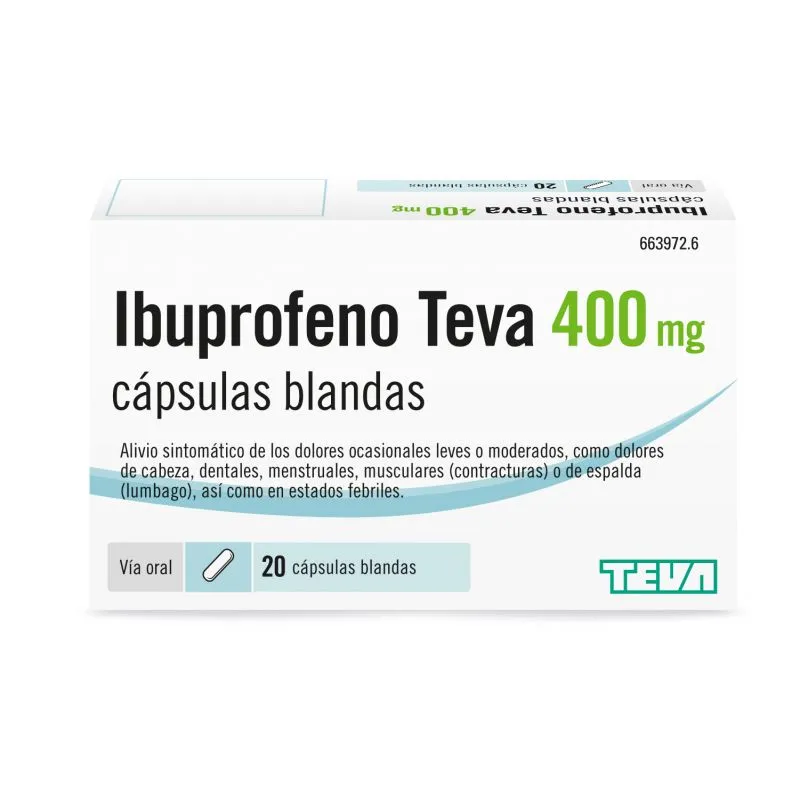
Table of Contents
Patient Information Leaflet
Introduction
Patient Information Leaflet
Ibuprofen Teva 400 mg Soft Capsules
Read the entire leaflet carefully before you start taking this medicine, as it contains important information for you.
Follow exactly the instructions for use of this medicine provided in this leaflet or those given by your doctor or pharmacist.
- Keep this leaflet, as you may need to read it again.
- If you need advice or more information, consult your pharmacist.
- If you experience any adverse effects, consult your doctor or pharmacist, even if they are effects not listed in this leaflet. See section 4.
- You should consult a doctor if pain worsens or does not improve after 5 days, or if fever does not improve after 3 days.
Leaflet Contents
- What Ibuprofen Teva is and what it is used for
- What you need to know before taking Ibuprofen Teva
- How to take Ibuprofen Teva
- Possible side effects
- How to store Ibuprofen Teva
- Contents of the pack and other information
1. What Ibuprofeno Teva is and what it is used for
Ibuprofen, the active ingredient in this medicine, works by reducing pain and fever.
It is used for the symptomatic relief of mild to moderate occasional pain, such as headaches, dental pain, menstrual pain, muscle pain (muscle strains), or back pain (lumbago), as well as for feverish conditions.
2. What you need to know before taking Ibuprofen Teva
Do not take Ibuprofen Teva if:
- you are allergic to ibuprofen or to any of the other ingredients of this medicine (listed in section 6)
- you have had a stomach or duodenal ulcer, gastrointestinal bleeding, or a perforation of the digestive tract
- you have experienced allergic reactions such as asthma after taking anti-inflammatory medicines, acetylsalicylic acid, or other painkillers
- you suffer from or have suffered from asthma, rhinitis, or urticaria
- you have severe liver, kidney, or heart disease (heart failure)
- you have bleeding disorders or blood coagulation problems
- you vomit blood, have black stools, or bloody diarrhoea
- you are in the third trimester of pregnancy.
Warnings and precautions
Consult your doctor or pharmacist before starting to take Ibuprofen Teva.
- Do not take more than 3 soft capsules (1200 mg of ibuprofen) per day, to avoid possible circulatory or heart problems.
- If you have previously suffered from stomach or intestinal diseases (e.g. ulcer), you should not take this medicine without medical supervision. Stomach or intestinal pain should not be treated with this medicine.
- If you experience stomach burning or pain while taking the medicine, stop treatment and consult your doctor. If you suffer from another illness or have any type of allergy, consult your doctor or pharmacist before taking this medicine.
- If you have Crohn's disease or ulcerative colitis, as medicines containing ibuprofen may worsen these conditions.
- If your doctor has prescribed an antiplatelet agent (to prevent blood clot formation) containing acetylsalicylic acid, and you are also taking Ibuprofen Teva, you must separate the administration of both medicines. Follow one of the following regimens:
- Take the dose of acetylsalicylic acid and wait at least half an hour before taking the dose of ibuprofen.
- Take the dose of ibuprofen at least 8 hours before taking acetylsalicylic acid.
- If you have hypertension or reduced kidney, heart, or liver function, if you have blood coagulation disorders or are undergoing anticoagulant treatment, consult your doctor before taking this medicine.
- Do not exceed the recommended dose described in section 3, "How to take Ibuprofen Teva".
- If you have chickenpox (a childhood infectious disease), you should not take ibuprofen.
- In case of dehydration due to severe diarrhoea or vomiting, especially in children, drink plenty of fluids and seek immediate medical attention.
- If you have acute intermittent porphyria (a rare disorder involving excessive excretion of porphyrin in urine and faeces).
- If you have an infection; see the heading “Infections” below.
- Allergic reactions to this medicine, such as breathing difficulties, swelling of the face and neck area (angioedema), or chest pain, have been reported with ibuprofen. Stop using ibuprofen immediately and contact your doctor or emergency medical services immediately if you notice any of these signs.
Anti-inflammatory/pain-relieving medicines such as ibuprofen may be associated with a small increased risk of heart attack or stroke, especially when used at high doses. Do not exceed the recommended dose or duration of treatment.
Discuss your treatment with your doctor or pharmacist before taking ibuprofen if:
- you have heart problems, including heart failure, angina (chest pain), or have had a heart attack, bypass surgery, peripheral arterial disease (circulation problems in the legs or feet due to narrowed or blocked arteries), or any type of stroke (including a "mini-stroke" or transient ischaemic attack "TIA").
- you have high blood pressure, diabetes, high cholesterol, a family history of heart disease or stroke, or if you are a smoker.
Skin reactions
Serious skin reactions have been reported with ibuprofen, such as exfoliative dermatitis, erythema multiforme, Stevens-Johnson syndrome, toxic epidermal necrolysis, drug reaction with eosinophilia and systemic symptoms (DRESS syndrome), and acute generalised exanthematous pustulosis (AGEP). Stop treatment with ibuprofen and seek immediate medical attention if you notice any symptoms related to these serious skin reactions described in section 4.
Infections
Ibuprofen may mask signs of infection such as fever and pain. Therefore, this medicine may delay appropriate treatment of the infection, increasing the risk of complications. This has been observed in bacterial pneumonia and bacterial skin infections associated with chickenpox. If you take this medicine while having an infection and infection symptoms persist or worsen, consult a doctor without delay.
Interference with diagnostic tests:
If you are due to undergo any diagnostic tests (including blood or urine tests), inform your doctor that you are taking this medicine, as it may alter the results of such tests.
Other medicines and Ibuprofen Teva
Inform your doctor or pharmacist if you are taking, have recently taken, or might need to take any other medicines.
In particular, if you are using any of the following medicines, it may be necessary to adjust the dose or discontinue treatment:
- Baclofen (used to treat involuntary and persistent muscle contractions)
- Cyclosporine and tacrolimus (used to prevent organ transplant rejection)
- Digoxin (used for heart conditions)
- Phenytoin (used in the treatment of epilepsy)
- Furosemide and other thiazide diuretics (used to increase urine elimination)
- Insulin and oral hypoglycaemics (used to lower blood glucose)
- Lithium (used to treat depression)
- Methotrexate (used in the treatment of cancer and rheumatoid arthritis)
- Mifepristone (used for medical abortion)
- Pentoxifylline (used for circulatory disorders)
- Probenecid (used in patients with gout or together with penicillin for infections)
- Quinolones (used for infections)
- Ion-exchange resins such as cholestyramine (used to reduce blood cholesterol levels)
- Sulphonamides (used for infections)
- Sulfinpyrazone (used for the treatment of gout)
- Tacrine (used in the treatment of Alzheimer's disease)
- Thrombolytics (medicines that dissolve or break down blood clots)
- Zidovudine (used in the treatment of patients infected with human immunodeficiency virus, HIV)
Do not use this medicine together with other painkillers and anti-inflammatory medicines (non-steroidal anti-inflammatory drugs and corticosteroids) without consulting your doctor.
Ibuprofen may affect or be affected by other medicines. For example:
- Anticoagulant medicines (e.g. to treat or prevent blood clotting problems, such as acetylsalicylic acid, warfarin, ticlopidine)
- Medicines that lower high blood pressure (ACE inhibitors such as captopril, beta-blockers such as atenolol-containing medicines, and angiotensin II antagonists such as losartan)
Other medicines may also affect or be affected by treatment with ibuprofen. Therefore, always consult your doctor or pharmacist before using this medicine with other medicines.
Taking Ibuprofen Teva with food and drink
Take this medicine with food or milk.
Do not take ibuprofen with alcohol, to avoid stomach damage.
Using ibuprofen in patients who regularly consume alcohol (three or more alcoholic drinks – beer, wine, spirits – per day) may cause stomach bleeding.
Use in children
Do not give this medicine to children under 18 years of age without consulting a doctor.
Use in people aged 65 years and over
Elderly people are generally more susceptible to side effects, so the dose may sometimes need to be reduced. Consult your doctor.
Pregnancy, breastfeeding and fertility
If you are pregnant or breastfeeding, think you may be pregnant, or are planning to become pregnant, consult your doctor or pharmacist before using this medicine.
Do not take ibuprofen during the last three months of pregnancy, as it may harm the foetus or cause problems during childbirth. It may cause kidney and heart problems in your foetus. It may affect your tendency and your baby's tendency to bleed and may delay or prolong labour beyond expectations. You should not take ibuprofen during the first six months of pregnancy unless clearly necessary and as directed by your doctor. If treatment is needed during this period or while trying to conceive, you should take the lowest possible dose for the shortest possible time. From week 20 of pregnancy, ibuprofen may cause kidney problems in your foetus if taken for more than a few days, which may lead to low levels of amniotic fluid surrounding the baby (oligohydramnios). If treatment for longer than a few days is needed, your doctor may recommend additional monitoring.
IMPORTANT FOR WOMEN:
If you are pregnant or think you might be pregnant, consult your doctor before taking this medicine. Taking medicines during pregnancy can be dangerous for the embryo or foetus and should be monitored by your doctor.
Ibuprofen belongs to a group of medicines that may reduce female fertility (the ability to become pregnant). This effect is reversible when the medicine is discontinued.
Breast-feeding
Consult your doctor or pharmacist before using any medicine.
Women who are breast-feeding should consult their doctor or pharmacist before taking this medicine.
Driving and use of machines
Although effects in this regard are not expected, caution should be exercised if drowsiness or dizziness occurs.
Ibuprofen Teva contains sorbitol
Sorbitol is a source of fructose. If your doctor has advised you (or your child) that you have an intolerance to certain sugars, or have been diagnosed with hereditary fructose intolerance (HFI), a rare genetic disorder in which patients cannot break down fructose, consult your doctor (or your child’s doctor) before taking this medicine.
3. How to take Ibuprofen Teva
Follow exactly the instructions for use of this medicine given by your doctor or pharmacist. If in doubt, consult your doctor or pharmacist again.
The recommended dose is:
- Adults: one soft capsule (400 mg of ibuprofen) every 6 or 8 hours, if necessary.
Do not take more than 3 soft capsules (1200 mg of ibuprofen) within 24 hours.
-
Patients over 65 years of age: dosage must be determined by the doctor, as a reduction of the usual dose may be necessary.
-
Patients with renal impairment or severe hepatic insufficiency: must not take this medicine (see section 2, Do not take).
-
Children and adolescents: consult your doctor before using this medicine in adolescents (over 12 years of age).
Due to the ibuprofen dose, this medicine must not be used in children or adolescents weighing less than 40 kg.
The lowest effective dose for the shortest duration necessary to relieve symptoms should be used. If you have an infection, consult a doctor immediately if symptoms (such as fever and pain) persist or worsen (see section 2).
This medicine is administered orally.
Swallow the soft capsules whole with plenty of liquid.
Take the medicine with food or milk, especially if gastrointestinal discomfort occurs.
This medicine should only be taken when pain or fever occurs. As these symptoms subside, treatment should be discontinued.
If symptoms worsen, if fever persists for more than 3 days, or pain for more than 5 days, consult your doctor.
If you take more Ibuprofen Teva than you should
If you have taken more ibuprofen than you should, or if a child has accidentally ingested the medicine, consult your doctor or pharmacist or call the Toxicology Information Service at telephone number 91 562 04 20, indicating the medicine and the amount ingested, or go immediately to the nearest hospital to obtain information about the risk and advice on the measures to be taken.
Symptoms of overdose may include nausea, stomach pain, vomiting (which may contain blood-stained sputum), headache, tinnitus, confusion, and involuntary eye movements. At high doses, symptoms such as drowsiness, chest pain, palpitations, loss of consciousness, seizures (mainly in children), weakness, dizziness, blood in the urine, low blood potassium levels, chills, and breathing difficulties have been reported.
4. Possible adverse effects
Like all medicines, this medicine may cause adverse effects, although not everyone will experience them.
Frequent (may affect up to 1 in 10 people): tiredness, headache, stomach and intestinal disorders (heartburn, diarrhoea, nausea, vomiting), skin disorders (rashes, itching), and tinnitus (ringing in the ears).
Uncommon (may affect up to 1 in 100 people): allergic reactions, asthma, rhinitis and urticaria, gastrointestinal bleeding and ulcers, sleep disturbances and mild restlessness, blurred vision, decreased visual acuity or changes in colour perception, and auditory disturbances.
Rare (may affect up to 1 in 1,000 people): oedema (swelling due to fluid retention), blood disorders (leucopenia), perforation of the stomach and intestine, liver disorders (including jaundice), kidney disorders such as acute interstitial nephritis with haematuria (blood in urine), proteinuria (excretion of protein in urine), and occasionally nephrotic syndrome; depression, visual disturbances (blurred vision), neck stiffness, bronchospasm (sudden sensation of suffocation), dyspnoea (difficulty breathing), and angioedema (a circulatory reaction affecting the deeper layers of the skin, causing inflammation and swelling).
Very rare (may affect up to 1 in 10,000 people): aseptic meningitis (inflammation of the meninges not caused by bacteria), blood disorders (aplastic anaemia and haemolytic anaemia) and coagulation disorders, hypertension and heart failure, severe skin reactions (erythematous rash), and eye and mucous membrane disorders such as Stevens-Johnson syndrome (severe erythema multiforme) and toxic epidermal necrolysis (skin and mucous membrane lesions leading to skin detachment), and erythema multiforme.
Frequency not known:
Skin becomes sensitive to light.
Drug-induced fixed eruption.
Chest pain, which may be a sign of a potentially serious allergic reaction called Kounis syndrome.
Stop treatment with ibuprofen and seek immediate medical attention if you notice any of the following symptoms:
- Flat, non-elevated red spots, target-like or circular rashes on the trunk, often with blisters in the centre, skin peeling, mouth, throat, nose, genital or eye ulcers. These severe skin rashes may be preceded by fever and flu-like symptoms [exfoliative dermatitis, erythema multiforme, Stevens-Johnson syndrome, toxic epidermal necrolysis].
- Widespread skin rash, high body temperature, and swollen lymph nodes (DRESS syndrome).
Generalised, red, scaly rash with bumps under the skin and blisters, accompanied by fever. Symptoms usually appear at the beginning of treatment (acute generalised exanthematous pustulosis).
Reporting of adverse effects
If you experience any type of adverse effect, consult your doctor or pharmacist, even if it is a possible adverse effect not listed in this leaflet. You may also report them directly via the Spanish Pharmacovigilance System for Human Medicines: https://www.notificaram.es.
By reporting adverse effects, you can help provide more information on the safety of this medicine.
5. Storage of Ibuprofen Teva
Keep this medicine out of the sight and reach of children.
No special storage conditions are required.
Do not use this medicine after the expiry date stated on the packaging. The expiry date refers to the last day of the month indicated.
Medicines must not be disposed of via wastewater or household waste. Dispose of unused medicines and their containers at the SIGRE collection point at your pharmacy. If in doubt, ask your pharmacist how to dispose of medicines and containers you no longer need.
This way you will help protect the environment.
6. Contents of the container and other information
Composition of Ibuprofen Teva
Each soft capsule contains 400 mg of ibuprofen as the active substance.
The other components are: Macrogol 600, potassium hydroxide, anhydrous colloidal silica, purified water, gelatin and sorbitol (E-420).
Appearance of Ibuprofen Teva and contents of the container
Transparent, oval-shaped soft gelatin capsules with a smooth and regular surface.
Available in packs containing 10 or 20 soft capsules in aluminum/PVC + PVDC blisters.
Marketing Authorization Holder
Teva Pharma, S.L.U.
C/ Anabel Segura, 11. Edificio Albatros B, 1st floor.
28108 Alcobendas, Madrid
Spain
Manufacturer
Laboratorios Liconsa S.A.
Pol. Ind. Miralcampo, Avenida Miralcampo nº7
19200, Azuqueca de Henares (Guadalajara), Spain
Date of latest revision of this leaflet: June 2025
Detailed information on this medicinal product is available on the website of the Spanish Agency for Medicines and Health Products (AEMPS) http://www.aemps.gob.es /